Category Archives: Rudolf Steiner

The History Man – a polemical story

The anthropopper was taken aback, not to say disappointed, that the good Herr Doktor Professor Peter Staudenmaier thinks that I cannot tell the difference between his polemical and his scholarly writings:

“And a whole lot of Steiner fans, alas, have no idea how to make basic sense of different kinds of texts. Like a lot of other anthroposophists, Smith is simply confused about how academics work, indeed about what sort of article he thought he was reading in the first place. This sort of confusion is widespread among Steiner’s followers. That is a big part of how they manage to mistake an essay like “Anthroposophy and Ecofascism” for an academic treatise.”

Although some might be tempted to say that in Staudi’s case there is no essential difference between the two – because if he’s writing, he’s lying – that would be unfair and I reject such an outrageous slur on a respected academic.

Wikipedia tells us that: “Polemics are usually addressed to important issues in religion, philosophy, politics, or science… typically motivated by strong emotions, such as hatred…”

Well, Staudi certainly brings hatred to his polemics – he clearly hates Steiner, anthroposophy, Waldorf schools and biodynamics. Would it be unreasonable to assume that he brings the same feelings to his academic writings, although taking a certain amount of care to appear more even-handed?

But the anthropopper is always keen to learn, and so has given himself a little exercise in polemics by writing the opening of a story that draws upon the techniques of the master. It is called:


The History Man

Staudenmaier was feeling trapped. Here he was, in his 50s and desperate to leave his mundane teaching job in an undistinguished university (ranked only 157th in the Forbes listings). What was worse, he was stuck in an ugly rustbelt town with a declining population right in the middle of what one of his students had called “bumfuck nowhere”. Everything about the place, the job and the students was beginning to get to him. Only the other day, a student had published the following about Marquette on a “Rate My Uni” website:

“You can get the same education at a state school for a much lower price… The campus area leaves a lot to be desired. The air literally stinks much of the time. Milwaukee’s weather is windy, damp, overcast, and cold. Drinking and basketball are the two primary sources of entertainment. There are a lot of nouveau rich (sic) kids who think they are the shit. There are many other students who went to Marquette b/c they thought they were too good for State U, but possess average intellects and often below average social skills. In retrospect, I wish I had gone elsewhere.”

Another student had written: “Marquette is a brand-name, that is all. Our facilities aren’t particularly nice with exception to some of the specific programs like law, dental or engineering or the like. Our gym is old, the cafeteria food is limited, and especially in comparison to the nearby state school, student resources are pitiful. Anyone not affiliated with Marquette will be treated as such. Basketball players are known to get preferential treatment (especially when it comes to work load, and financial disbursement). Marquette University shows little to no mercy when it comes to school payments resulting in many students (even good students) removing themselves based on the inability to pay semesters upfront.”

Even worse, another student had written: “This area is so filthy and disgusting, with Negroes always panhandling and demanding money from you, if they dont (sic) rob you at gunpoint which I was, other students were beaten and robbed or raped, and we have police reports and news articles to show. FU Jesuits!!! The area is full of crime and is unsafe, which the university wants to cover up. Go look it up yourself.”

And one particular student comment had come dangerously close to himself: “From top to bottom, I simply think Marquette University is a bit of a joke, from faculty, to public safety, to office of residence life, and to students. In terms of academics here at Marquette, I’m not very impressed. It’s sad when I’ve taken a total of 16 classes and have only had two teachers that I can say were solid teachers. I even took a history course this summer at a local community college and am willing to admit that he was better than any PHD professor that Marquette has to offer.”

And now the local newspaper had picked up on a recent scandal:

‘ “Be the difference” is the motto of Marquette University, the generally not-very-newsworthy Jesuit university in Milwaukee.  Marquette is in the news now for reasons that it cannot be very happy about.”

“First a teaching assistant at the Catholic institution, Cheryl Abbate, a doctoral student in philosophy, was caught on tape earlier this year giving a very un-Catholic answer to a student who wanted to write about his objections to same-sex marriage in a course titled, “Theory of Ethics.”  The student complained to an associate dean and to the chairman of the Philosophy Department, neither of whom saw a cause for concern. The student then played the recording to a Marquette professor of political science, John McAdams, who after listening to the recording, blogged on November 9 about the incident, making some pointed criticisms of Abbate’s refusal to countenance the expression of opinions counter to her own.  The story began to attract significant public attention, including an article on Inside Higher Ed, November 20, which reprised the story and gave links to accounts supporting McAdams’s views and others attacking him.”

This was all too embarrassing and Staudenmaier knew he had to get out before the last of his options closed down around him. He was pretty sure his supervisor had noted the following typical comment from a student on the “Rate My Professor” website:

“In Staudenmaier’s class all you do is READ. READ READ READ. The books he chooses are SOOO dry and completely uninteresting that it is almost impossible to pick them up. He was very animated but VERY REPETITIVE. Personally, if you want an easy history requirement class, don’t take him.”

How could he get out from this hellhole and find a job in one of the Big Ten universities before it was too late? Staudenmaier‘s private assessment of himself was that by rights he should be widely known for his groundbreaking research and radical views, and like the celebrated economist Paul Krugman, be invited to contribute polemical op-ed pieces to the New York Times. But he was also clear that this was never going to happen while he was stuck here in this run-down mid-west town known only for beer and motorcycles. He had to find a way to establish some sort of high profile academic reputation (and hence a potential escape route) by choosing a niche area for research where his supervisors were unlikely to know the territory and thus wouldn’t pull him up for any liberties he might take with sources and selective quotations. And then it came to him in a flash – anthroposophy and Rudolf Steiner! Yes, that was it… (to be continued)


The anthropopper should add that all the italicised quotations in this story are genuine, although his use of them and the context in which they are placed may bear only a tangential relationship to the truth – which by a strange coincidence is how he experiences Staudi’s own polemical writings.

Greetings to all, as Staudi might say.

21 Comments

Filed under Anthroposophy, Rudolf Steiner, Waldorf critics

The New Screwtape: Letter to an Apprentice Demon

Millions of readers have enjoyed The Screwtape Letters, written by C. S. Lewis and first published in 1942. In these letters, Lewis provides a devil’s eye view of how to undermine human beings and their faith in the spiritual world by promoting doubt and disinterest. The book consists of a series of letters from Screwtape, a senior demon in the Lowerarchy of Hell to his nephew, Wormwood, a junior and rather incompetent demonic apprentice, to whom he acts as mentor. In Screwtape’s advice, individual self-interest and greed are seen as the greatest good, and neither demon is capable of comprehending God’s love for human beings or acknowledging human virtue.

C S Lewis gave little away in the preface about how he managed to get hold of these letters:

“I have no intention of explaining how the correspondence which I now offer to the public fell into my hands. … The sort of script which is used in this book can be very easily obtained by anyone who has once learned the knack; but ill-disposed or excitable people who might make a bad use of it shall not learn it from me.”

Happily, and just in time for Halloween, the anthropopper has “learned the knack” and has discovered that Screwtape is still active in mentoring junior tempters. In particular, a cache of undated letters from Screwtape to an apprentice demon referred to only as “Staudi” has recently come into my hands. Further research will be needed to establish the identity of this servant of the Dark Lord. I reproduce one of these letters below.

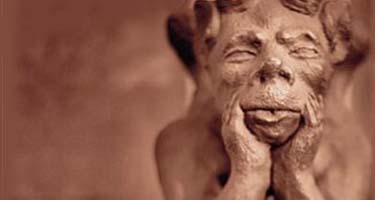
A mysterious carving, believed to represent "Uncle" Screwtape.

A mysterious carving, believed to represent “Uncle” Screwtape.


“My dear Staudi,

Congratulations on your appointment to an assistant professorship at the university! Not one of our more distinguished seats of learning, to be sure – but it does have the inestimable advantage of being a Jesuit university. The Jesuits are indeed among the strongest allies of Our Father Below and you will find that the intellectual atmosphere and ethos there are remarkably conducive to your work. They share with us an opposition to the dreadful renewed Mystery impulses that Our Enemy RS and his anthroposophical acolytes are seeking to foster in the human spirit.

RS has caused us a great deal of trouble over the years by revealing all sorts of hitherto secret knowledge that can only hinder our task. If ever human beings really came to understand what they are and what their future evolution will be, as described by the Enemy, then it will be all over with Our Father’s cause. It is therefore very important for us that the exoteric Church continues to demand belief and to impose creeds. On the other hand, it suits us just as well if the atheists and materialists hold the intellectual high ground and engender scorn for the spiritual in the minds of their followers. Either position is convenient for our purposes; and both are much better options than allowing our Enemy to point the way in freedom to a true esoteric knowledge of Christ and the future of humanity. Ideally, what we want in human beings is Doubt in the Spirit, Hatred of the Spirit and Fear of the Spirit.

"Our Father Below"

“Our Father Below”


So your task as an historian is to confer the mantle of academic credibility upon our efforts to consign RS and all his works to oblivion. You are to do this by so diminishing him in the eyes of the world that only a very few delusional people will want to pay any attention to what he has said and written.

Your weapons should of course include what we at the Training College call the Three Rs: Racism, Ridicule and Right-Wingery. Let us look at each of these in turn, and examine how you may deploy them for optimal effect.

The accusation of Racism made against any human being is one of the most effective ways today to kill off any real discussion of their views. In the 21st century it has the same effect on most people as did the sound of the leper’s bell in mediaeval times – they run as fast as possible in the opposite direction. You are to use the word purely as an incantation; if you like, purely for its selling power. By calling RS a racist (and you could add in “anti-semite” for good measure), you will set up in people’s minds the idea that not only should they have nothing to do with any of his endeavours but that it is perfectly respectable to abuse and condemn anything associated with him and his works. They will do this without shame and indeed, with a positive glow of self-approval for being so “right-on”. Now, you and I may know that this is all nonsense and that Our Enemy RS had the most nauseating universal love for all human vermin; but as all our apprentices learn, a lie can be half way around the world before the truth has got its boots on.

In your academic writings, you could try scattering around phrases such as “RS’s racially stratified pseudo-religion” and his “blatantly racist doctrine which anticipated important elements of the Nazi worldview by several decades” in the certain knowledge that these entirely false accusations will scare off thousands of potential followers. Manage to do this really well and you will achieve a situation in which most people, if they have heard of RS at all, will know only one thing about him – and that is that he was some kind of racist. However, a word of advice: try to do this with some subtlety and do not over-egg the pudding. Anything the anthroposophists say in defence of RS can of course be dismissed as special pleading, or better yet, you might say that anthroposophists “lack the sort of critical social consciousness that can counteract their flagrantly recessive core beliefs.”

Ridicule is also a very useful tool; and because of the excellent efforts put in over many years by our cultural zeitgeist operatives, it is now intellectually infra dig for most human beings in the West to express any interest, let alone belief, in matters relating to the spirit. Our Enemy’s pernicious views on so-called “spiritual science” have already put him beyond the intellectual pale, so your work has been half-completed for you already. The kind of people you should be seeking to influence here are the opinion formers and the chattering classes – rich, smart, superficially intellectual and brightly sceptical about everything in the world. They have an ingrained habit of belittling anything that has a whiff of the spiritual about it and they will enjoy pouring scorn on RS and his followers. What we are looking for is a similar outcome to what has already been achieved in ridiculing homeopathy. Your goal should be to give some journalists the idea that not only is anthroposophy ludicrous but that there is also a scandal just below the surface awaiting their investigative attention; for example, you could imply that Waldorf schools are run by a racist cult seeking secretly to indoctrinate our children with their weird beliefs. You can make much hay with this!

You can also make good use of those few sad renegades and turncoats, who were once upon a time active within the RS camp but who, for whatever reason, Hell be praised, have now decided to cast their lot with Our Father Below. These people tend to be active in social media and internet forums and so should you be; your aim should be to become like some kind of intellectual guru and arbiter of thought for them. They will come running to you with little snippets of tittle-tattle, seeking your approval and endorsement; you should encourage this.

The third powerful weapon in your armoury is Right-Wingery, and accusations thereof. You may begin this in quite a subtle, insinuating sort of way, eg: “RS was by his own account ‘enthusiastically active’ in pan-German nationalist movements in Vienna at the end of the nineteenth century.” You could continue with: “During his Vienna period RS fell under the sway of Nietzsche, the outstanding anti-democratic thinker of the era, whose elitism made a powerful impression.” This will help to build a picture of Our Enemy as a right-wing reactionary and elitist. You might then wish to add something like: “RS had high praise for ‘German militarism’ and continued to rail against France, French culture and the French language in rhetoric which matched that of Mein Kampf.” You see what I’ve done there? The implication is that RS’s views led straight on to those of Hitler. The fact that none of this is even slightly justifiable in factual terms is neither here nor there. Of course, this is not academic scholarship we are concerned with, but agit-prop.

So everything is clearly going well and you have made a good start. By the way, have you noted that your new university’s most distinguished alumnus is – Senator Joseph McCarthy! Yes, McCarthy, one of Our Father’s more significant political operatives in the 1950s, he of the anti-communist witch hunts in the USA and the notorious “Are you now or have you ever been…” hounding of some of the most distinguished people of his time. McCarthy is a useful example for you to follow and you should study his methods with care.

Senator Joseph McCarthy, "one of our more significant political operatives."

Senator Joseph McCarthy, “one of our more significant political operatives.”


Ultimately, of course, even that brilliant servant of Our Father Below over-reached himself – his tactics and inability to substantiate his claims led him to be censured by the United States Senate and he died in disgrace at the age of only 48. Try not to share a similar fate; you should be careful not to be caught out making demagogic, reckless and unsubstantiated accusations – instead, let some of our useful idiots on the internet forums do the heavy lifting for you.

My dear Staudi, your career is before you. Hell expects and demands that it should be one of unbroken success. If it is not, you know what awaits you.

Your affectionate friend,

Screwtape”

57 Comments

Filed under Anthroposophy, Rudolf Steiner, Waldorf critics

First Harvest of the Light Root at Emerson College

Those of you who have read my blog post, “Rudolf Steiner and the Chinese Yam”, will already be familiar with the story of this extraordinary root and its ability to incorporate within its physical substance large quantities of the light ether, of which most of our foods are nearly or completely lacking (you can read more about the ethers in the post linked to above). This is the vegetable that Rudolf Steiner said should eventually come to replace the potato as a mass staple food crop.

In April 2015, Ralf Roessner, the German author of the book The Light Root mentioned in that post, came to give a talk to a large and enthusiastic audience at Emerson College in Forest Row, East Sussex (UK). Not only did Ralf talk about the light root but he also brought some samples of the root for planting in the newly refurbished biodynamic garden at the college. There is an account and a short video about this event on the Emerson College website here.

It has to be said that growing the light root is not quite as straightforward as planting potatoes. Nik Marten and his colleagues in the BD garden at Emerson took out a deep trench surrounded with wooden boards which they filled with river sand, chosen for its fine, rounded crystals (ie not sharp sand, which can damage the roots). They then added a layer of good loamy soil and compost. The rootlets brought by Ralf were then gently pressed into the surface and biodynamic preparations applied to the soil. A wooden construction about 8’ high was then put up just to one side of the trench to hold a series of vertical strings, up which the leafy stems of the light root plants could entwine themselves. As the top growth climbs the strings, the root surges downwards into the depths of the river sand. Paradoxically, it needs the darkness and depth in order to develop and preserve the light ether qualities.

The light root stems growing up the strings of the wooden framework.

The light root stems growing up the strings of the wooden framework.

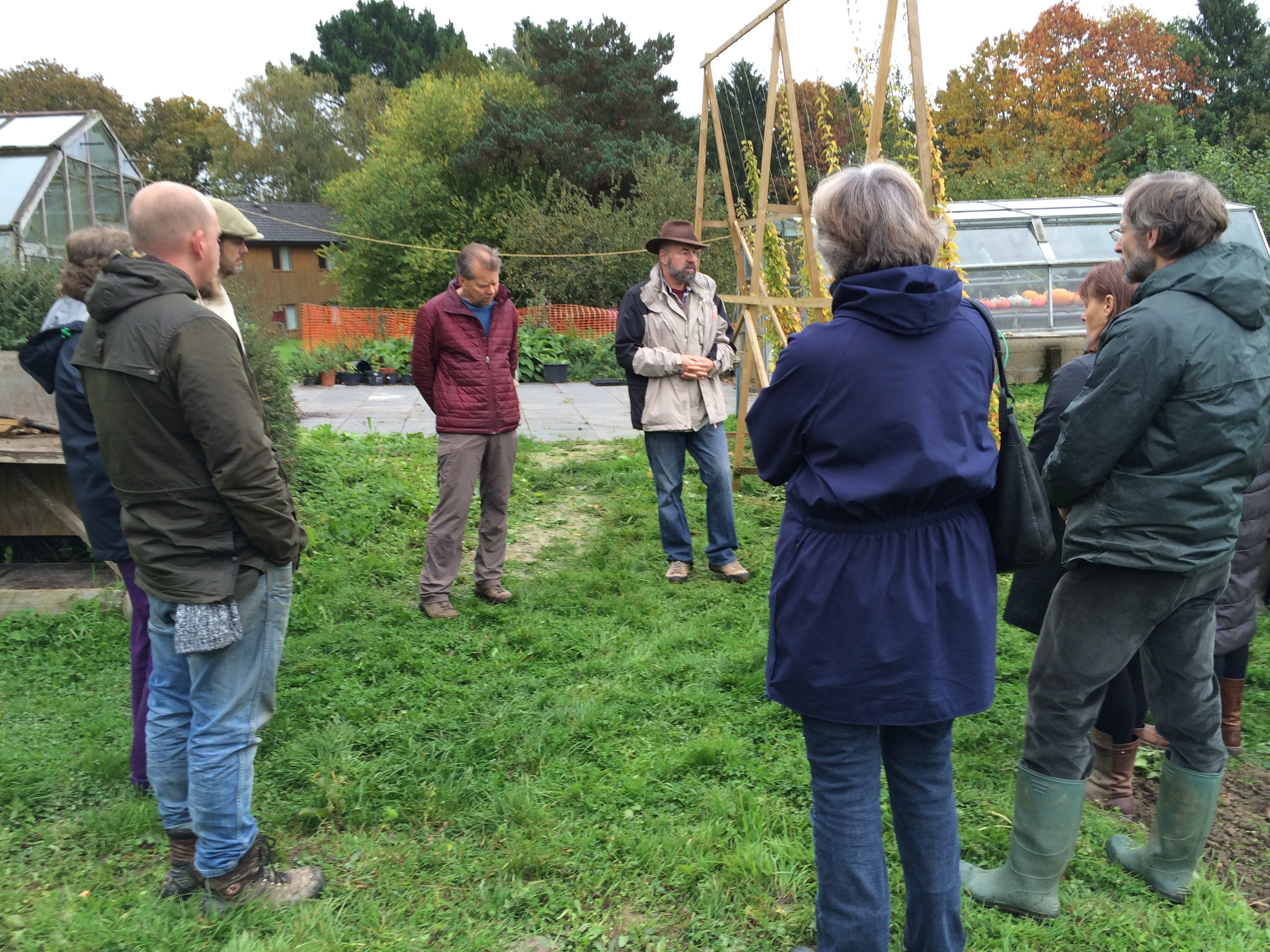
Six months later and Ralf returned to Emerson College to show us how to harvest and store the resulting crop. It was a damp and cold autumn day, with occasional showers – a typical October day in England! A group of about 15 people gathered in the BD garden and Ralf described some of the features that make the light root such an interesting plant. The roots with the light ether qualities grow only on male plants and if female plants grow with them, they will rapidly hybridise and produce all sorts of other yams, which may be perfectly good vegetables but do not hold the light ether. Ralf described how he had gone around the world seeking out samples of the yam, but only in the original growing area in China had he been able to source the right kind of plant.

The group gathers around Ralf Roessner (in hat) to hear more about the light root.

The group gathers around Ralf Roessner (in hat) to hear more about the light root.

Ralf then began to cut the leafy stems about six inches from the ground and as he began, several little mice began to scurry up and down the trench where they had obviously been living underground. This was a worrying sign – Ralf said that he had just come back from the Czech Republic, where the light root crop at a Camphill centre had been entirely eaten by mice. Despite this, the rest of the stems were cut and group members then began to lever up the wooden boards surrounding the trench so as to make it easier to harvest the roots.

Ralf Roessner begins to cut the top growth stems away from the roots prior to harvesting.

Ralf Roessner begins to cut the top growth stems away from the roots prior to harvesting.

Ralf and group members then began to remove carefully the soil from around each of the tufts left after the cutting-down of the top growth. After a while, we got down to the layer of river sand. Careful work with trowels and hands to remove the sand and keep it separate from the soil then began – the sand can be used year-after-year but should not be mixed with the soil. Gradually we could see the form of the roots emerging as the sand was cleared but this was delicate work – the roots can easily be broken if roughly harvested. Strangely, the roots begin to harden up, rather than soften further, in the days after the harvest.

Group members carefully scraping soil and sand away to reveal the light roots.

Group members carefully scraping soil and sand away to reveal the light roots.

It was a thrill to see the first root emerge and to see that it was of good size – Ralf said that it was of very good quality. Thus encouraged, work proceeded to bring up the rest of the roots. Some of the roots had indeed been eaten by mice but only a very few – and those that had not been eaten were all of a good size and quality. Even to the eyes of a non-clairvoyant like myself, there is a radiance about the roots that is quite noticeable. The roots were laid in trays and, at Ralf’s suggestion, some of the cut leaves and stems were laid on top of the trays, which helps the roots to adjust to their new situation and to remain in good condition.

Ralf Roessner holding the first light root to be harvested at Emerson College.

Ralf Roessner holding the first light root to be harvested at Emerson College.

The roots should be stored either in a clamp (ie straw is laid on the ground, the roots are put onto the straw, another layer of straw is added on top, and then the whole structure is covered with earth), although Ralf said that this method was vulnerable to attacks by mice; or in an earth cellar; or kept in the dark between 5-15 degrees Centigrade in river sand that is drier than that used in the trench. The roots should then last in good condition through until the next summer.

The light root requires special treatment after harvesting, too. It should not be washed, as water washes away the light ether very quickly. The roots come very clean out of the sand and a rub with a cloth is sufficient to bring them to sparkling condition. Nor should the roots be processed or cooked in machines using alternating current electricity, as this also destroys the light ether. It is best to have the light root raw in salads; or cooked in soups and sauces, where the liquid in which they are cooked is consumed by the eaters; or sliced with a knife and fried in a pan. Not all treatments are deleterious to the light ether, though – Ralf has observed that light root pounded in a mortar and pestle absorbs more and more of the light ether and this process can continue for hours. In an experiment he set up, the increase of light ether went on for up to 36 hours!

Radiant roots - some of Emerson College's first harvest of the light root.

Radiant roots – some of Emerson College’s first harvest of the light root.

At lunch that day, Ralf came round with some slices of raw light root for us to try with our meals. There is a mucilaginous quality to the cut root, which is crisp like a water chestnut and it has quite a bland taste, which of course is an advantage for a crop that may one day become a staple food like the potato. I have also sampled some sautéed light root and it was delicious – I would be quite happy to eat it instead of chips!

In a question and answer session after lunch, I asked Ralf whether, given the fairly demanding cultivation requirements and the need for great care in processing the roots after harvest, if he had any indications of when it might be possible for the light root to begin to assume the role of a staple food crop. He said that his sense of it was that it would be about three hundred years into the future and that his role, and the role of a few others in various countries, was to keep alive the knowledge of the plant and how to cultivate it until the world was ready to take it up. He also said that in future times the light root would be cultivated in a different way – in water – and that he was already experimenting with ways of doing this.

This was a fascinating and inspiring day, which provided (literally) much food for thought. Thanks are due to Nik Marten and his colleagues in Emerson’s biodynamic garden, to Michael Williams and Heidi Herrman for their excellent translating skills and of course to Ralf Roessner for bringing his knowledge, light root samples and huge enthusiasm to Emerson College.

7 Comments

Filed under Anthroposophy, Biodynamics, Chinese yam, Emerson College, Light Root, Ralf Roessner, Rudolf Steiner

Rudolf Steiner and Angels – The Potential Fall of Humans and their Angels

Part 3 of 3

Ahriman and Lucifer, the fallen angels
Interestingly, Steiner does not make a straight distinction between Good on the one hand and Evil on the other. Instead he has two poles of Evil, which he calls Lucifer and Ahriman.

Steiner saw Lucifer and Ahriman as not only forces or tendencies which affect humankind and draw us towards evil but also as actual beings. Unlike the Christ, these forces can take up their abode in our astral bodies, the seat of our desires and emotions and thus exercise a strong influence on us from within.
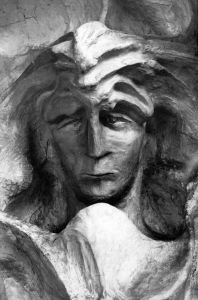
The head of Lucifer - a carving by Rudolf Steiner

The head of Lucifer – a carving by Rudolf Steiner

Lucifer encourages the tendency in human beings towards expansiveness, inflation, egotism, sensuality, passion, and ungrounded spirituality; Lucifer is the being who tells us that we are like the gods, knowing both good and evil, whereas Ahriman tells us that there is no God and that material reality is the only reality. Ahriman represents tendencies towards contraction, reduction, splitting, materialism, over-intellectualisation, lying, and a denial of spiritual realities; this leads to the idea that we are physical beings only. Both of these beings also play a helpful role and are in fact indispensable for human life, as the first awakens us to our freedom, while the second helps provide us with the capacity for speech and thinking. The two forces work in harmony at the present time, even though they appeal to different instincts in us. The way to deal with these two poles of Evil is to seek the balance in the middle, which is represented by Christ. However, because Ahriman can work through the seat of our desires but Christ can only work through our I or individuality, this means that the struggle is not an equal one. Our individuality has to so develop itself that it can in time learn to recognise and resist the many temptations offered by Lucifer and Ahriman. Steiner and the English sculptor Edith Maryon produced a monumental wooden carving called “Representative of Man”, which you can see in the Goetheanum at Dornach. It depicts the Christ providing the active place of balance between the opposing forces of Lucifer above and Ahriman below.
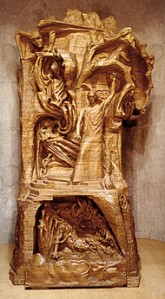
The monumental wooden statue, "Representative of Man", carved by Rudolf Steiner and Edith Maryon.

The monumental wooden statue, “Representative of Man”, carved by Rudolf Steiner and Edith Maryon.

Lucifer appeals above all to our pride and ambition, making us think that we have no limitations. Yet he is also the being who set us out on our evolutionary path to freedom. But Lucifer does not want us to be truly conscious, nor to acquire an egohood independent of himself.

In our present age, Ahriman is a greater threat to us than Lucifer. He is infinitely clever and is helping us to develop our technological civilisation. He wishes us to advance at breakneck speed, long before our individuality and moral nature are ready for such advances. He wishes to foreshorten our development so that we can never reach our true goal but only a false goal of enjoyment and endless material possessions. The scientist, the technologist and the inventor are Ahriman’s natural prey but all of us can fall victim to his temptations. Wherever there is egoism and love of power, entry is made easy for him.

While we may know of Ahriman from Persian mythology, Rudolf Steiner spoke of him as an actual, living spiritual entity. He is a being who fell behind during the Ancient Sun planetary stage. This being, he said, works to embed people firmly into physicality, encouraging dull, materialistic attitudes and a philistine, dry intellect. Steiner, in rare prophetic mode, talked about an actual incarnation of Ahriman on the earth and the potential consequences. Just as Christ incarnated in a physical body, so would Ahriman incarnate in the Western world – before ‘a part’ of the third millennium had passed. Steiner places this incarnation in the context of a ‘cosmic triad’ – Lucifer, Christ and Ahriman. Lucifer had his incarnation as the Yellow Emperor who reigned in China in the third millennium BC. Ahriman will incarnate as a counterpoint to the physical incarnation of Lucifer in the East, with the incarnation of Jesus Christ in Palestine two thousand years ago as the balancing point between the two.
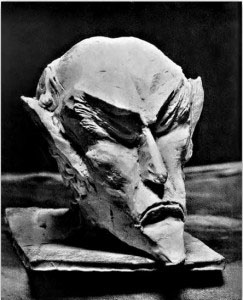
The Head of Ahriman, carved in wood by Rudolf Steiner.

The Head of Ahriman, carved in wood by Rudolf Steiner.

It seems possible to me that today we are living in the time of Ahriman’s incarnation. Ahriman is the Lord of Death and his will is to materialise human thinking into dead thinking to such an extent that the soul becomes fettered to the physical body and to an ever materialised earth, effectively cutting human beings off from their spiritual home – as an Ahrimanic form of immortality. This is nothing less than a spiritual death.

His incarnation on the physical plane will intensify his influence and many of us will fall into his clutches unknowingly, because his effects work in the unconscious aspect of the human being. It will work in the human thinking through the etheric body, where the human being is not conscious.

Though it is the wish of the “good” angels that we should reach our goal, it is not pre-destined that Ahriman will be defeated, because the goal can only be reached in freedom, by us choosing to get there out of our own free will. It’s therefore clear that the possibility cannot be ruled out that humankind will succumb finally to Ahriman and other opposing forces who are gaining in strength all the time, as we see around us every day in the news and in our daily lives.

There is one even more malign aspect of Evil spoken about by Steiner and that is Sorath, the Sun Demon, who is served by both Lucifer and Ahriman. I will say nothing more about Sorath here.
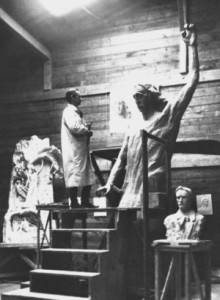
Rudolf Steiner in his studio, working on the statue "Representative of Man".

Rudolf Steiner in his studio, working on the statue “Representative of Man”.

Michael
Rudolf Steiner often spoke about the great battle that occurred in the spiritual world between the spirits who are followers of Michael the Guardian of the Cosmic Intelligence, and certain ahrimanic powers. According to him the latest battle commenced around 1840 and was lost by the ahrimanic powers in the autumn of 1879. I referred in Part 1 to the Archangel Michael but strictly speaking since 1879 he should be considered as one of the archai.

We know that in 1879 these ahrimanic powers, or spirits of darkness were cast down into the physical world and a picture of this can be found in the Revelation of St John – the Angel holding the key to the bottomless pit in which he is said to imprison the dragon. Perhaps the tragic history of the 20th century is not so much the result of human folly but rather of these powers being shut out of the spiritual world and thus rampaging through the physical world, influencing the likes of Mao, Stalin, Hitler and Pol Pot and their many other human agents. On present form, the 21st century is shaping up to be even worse than the previous one.

The foremost of the archai is known to us as Michael. It was his task to go on to become the guardian or administrator, one might say, of the Cosmic Intelligence. He is known in anthroposophy as the son of the Divine Sophia who is the foremost being of the hierarchy of the Spirits of Wisdom, the Kyriotetes, and whose task it is to gather up, regulate and harmonise the Cosmic
Intelligence.

What is this Cosmic Intelligence? There are many ways of describing the Cosmic Intelligence. One such way is that it is a gathering up of all the ‘conversations’ had by the hierarchies amongst themselves; their interrelationships regarding their knowledge and understanding pertaining to the being of Christ, the second logos who descended to earth and died at Golgotha. One could also call it the essence of the Holy Spirit because the Holy Spirit is the mediating substance.

Rudolf Steiner tells us that at around the time of the Mystery of Golgotha, Michael began sacrificing his ‘rulership’ of the Cosmic Intelligence to human beings. And it is the third hierarchy, which is the closest to humanity insofar as it shares various soul and bodily sheaths with human beings, that has the task of helping us to take up the Cosmic Intelligence in the way intended by Michael.

But we humans have the unique privilege of freewill, so we have a choice. To quote Steiner: “Two things are possible for humankind and through this possibility our freedom is guaranteed: to turn to Christ consciously … or to wish to feel our severance from spirit existence and thus fall in the direction taken by the ahrimanic powers. Humanity has been in this situation since the beginning of the fifteenth century.”

Since 1879 Michael has taken over the spiritual guidance of human affairs. He does what he has to do in such a way that he does not thereby wield an influence over human beings; but humans may follow him in freedom, in order with the Christ-power to find the way out of that sphere of Ahriman which they were obliged to enter.

The classical image of Michael depicts him in battle with a dragon and shows him standing on the dragon and spearing it in the mouth. One way of interpreting this might be to say that what Michael is doing is showing us how to penetrate the dragon of materialism with spiritual vision and insight, so that the spirit coiled up in matter can be released.
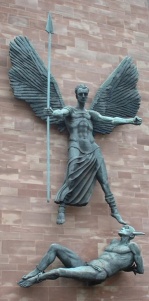
Sir Jacob Epstein's bronze statue for Coventry Cathedral of Michael.

Sir Jacob Epstein’s bronze statue for Coventry Cathedral of Michael.

But Michael also sees how the danger of humanity succumbing to the ahrimanic powers grows greater and greater. He knows that as regards himself he will always have Ahriman under his feet; but will that always be the case with human beings?

Michael sees the greatest event in the Earth’s history taking place. He sees Christ’s descent to the Earth, so as to be here with us when the Cosmic Intelligence is handed over to human beings. Through Christ’s great sacrifice, He is now living in the same sphere in which Ahriman also lives. Humans are now able to choose between Christ and Ahriman. Should humans wish to, we will be able to find the Christ-way in the evolution of humanity. But Michael cannot force humans to do anything – it is because the Cosmic intelligence has come entirely into the sphere of the human individuality that compulsion from the spiritual world has ceased.

And herein lies our great danger. Ahrimanic spirits seek to smother human beings’ awareness of their own spirituality. They want to teach people that they are really only a perfectly developed animal. Ahriman, says Steiner, is in truth the great teacher of materialistic Darwinism. He also teaches all the technological and practical activity in Earth evolution where nothing is considered valid unless it can be perceived by the senses. His desire for us is that we should have widespread technology, plenty of material goods, entertainment media, all sorts of toys and gadgets, the aim being to kill and obscure any awareness we may have that we are an image of the godhead. This is the aim ahrimanic spirits are seeking to achieve by sophisticated scientific means in our age.

What if Ahriman succeeds? You may recall from Part 2 that Steiner said that the angels had particular work to do in inserting three impulses into our astral bodies. You remember these three impulses:

1. That no human being should be able to enjoy the peace of happiness himself if others around him were unhappy
2. That human beings should be able to perceive the divine principle operating in every other human being
3. That human beings should be able to gain irrefutable insight into the reality of the spiritual world.

The angels do this by working within our astral bodies when we are asleep at night. Steiner was speaking in 1918, but he said that if human beings are not willing to turn to life in the spirit before the beginning of the third millennium, ie in our present time, then the angels would need to work in a different way; that is by withdrawing all their work from the astral body and taking it into the etheric body. But then, Steiner says, the human being would have no part in it, as it would have to be done when humans are asleep, as of course when we are asleep we leave behind our physical and etheric bodies in the bed and take our astral body and individuality into the spiritual world.

And he says that, if this happens, the inevitable effect on human evolution would be threefold:
First, something would be engendered in human bodies which human beings could not discover in freedom.
Second, danger would threaten from certain instinctive perceptions connected with the mystery of birth and conception and with sexual life as a whole.
Third, humanity will get to know specific powers which enable them to unleash some degree of mental control over machines, a development that will take the whole of technology along disastrous channels, a state of affairs, however, that will serve human egotism extremely well and please many people.

Now, I don’t know about you, but that sounds to me like things that are already happening. Let’s take the second point, about the effect on our sexuality. It’s unusual for Steiner to say very much about sex but here he is clear. He says that the effect on human evolution would be that certain instincts belonging to the sexual life and to sexual nature would not come to conscious awareness in a useful way but instead would become harmful. These instincts would not be mere aberrations but would enter into the social life, configuring it. Something would enter into people’s blood as a consequence of sexual life that would above all make people go against brotherliness on Earth rather than develop brotherliness and this would be a matter of instinct.

And Steiner hints at something even worse – he says that danger will come from certain angels who themselves would undergo a change, which he says “is something I cannot speak about, for it belongs to the higher secrets of initiation which may not yet be disclosed.”

But nearly one hundred years later, I think we can say something about this, and to me what may be happening now is very frightening.

Let us go back to the War in Heaven, which started in about 1840 and was completed in 1879 with the victory of Michael over the ahrimanic beings, who were cleared out of heaven and thrust into the abyss. Now what does that mean, to be cast out of heaven and into the abyss? Where have they gone?

There is a link between our blood and the etheric body and our angels usually work in our blood and in our heart. By 1840 a number of abnormal backward angels, (these are angels with the ‘potential’ to be archangels but who have not yet reached that stage) wanted to leave the blood in order to enter into the nerves, the brain, where the normal archangels were taking up their domain. This created an obstruction, a hindrance to the flow of spiritual wisdom that was seeking to enter into the astral body. Now a battle ensued between Michael and these retarded angels, the angels of darkness. To cut a long story short, these ahrimanic angels were cast out of the nervous system into the realm of the blood again – into the abyss – by 1879. They were thrust down into the etheric body by way of the blood, which is closely connected to intellectuality and human thought. Here, in the realm of intellectual thinking, they found relief for their pain.

These beings connected to Ahriman have inspired more and more intellectualism and materialism than there has ever been before, because they thrive on it; and by way of the intellect’s relationship to the realm of Ahriman they have connected the intellect with the sub-earthly ethers, ie the realm of electricity, magnetism and atomic forces. Whether we know it or not, our etheric bodies interpenetrate these ethers all the time.

Let us recall that Michael had to surrender the Cosmic Intelligence so
that the human ego could remember it again, but this time in a free and personal way and through inner work to reconnect this intelligence with Christ.

But these spirits of darkness living in the human being and in the earth do not want this to happen: as followers of Ahriman, the antagonist of Christ, they are doing their level best to prevent us from rising up. They want to drag us down to the level of the electrical, the mechanical and atomistic – the realm of Sorath the Sun Demon – and they are making great strides forward.

As already mentioned, the angels have the task in our times of shaping images in our astral bodies at night. Our angels can only create those pictures at night, if by day we have thought, lived and spoken with integrity and morality. Only then can our angels connect us with the archangels and archai.

Steiner says: “In fact it actually depends on human beings themselves – on their attitude, on the whole way their world of feeling is disposed to the spiritual world – whether their angels accompany them when they leave their physical and etheric bodies in sleep or not…. If a person leaves his physical and etheric body in a materialistic mood, his angel would be denying his realm, his affiliation to the archangels, the archai and the exusiai if he were to accompany the human being. “

This distances us from our normal angels and draws us closer and closer to the ahrimanic angels and their offspring – the ahrimanic elemental beings. Our reproductive and sexual life is administered by the normal angels working in our blood. But for those human beings who cannot rise above materialism, not only will the dark angels take over the task of the spirits of light, but their angels, instead of rising to other tasks may, due to the influence of these dark spirits, fall even deeper than the etheric body.

What does this mean? Rudolf Steiner warns us: “We should not allow the ahrimanic powers to gain the upper hand, as it were, and we should not fall in love with them…” If this were to happen human beings would thereby, “unite spiritual progress with material progress.” This is what Rudolf Steiner called “Prostitution with Matter.”

The union of angel and man in the etheric nature of the human being, where live not only the forces of life and death, dying and becoming, but also all the unconscious desires associated with the sexual life, the life of the sensual, results in the angel ‘falling in love with matter’ through the human being, which leads to an angel’s downfall which one could call, a supra-human fall. The result
is that something thereby enters the material world that does not belong there.

Just as those human beings who today bind their egos to their physical bodies and the sub-earthly ethers, will in future times not be able to exist in a spiritualised world that has no ‘physicality’, so too do the angels of such people fall into the temptation of binding their spirit self (which sets into motion their etheric bodies), to the physical body of human beings, and not to their own etheric bodies creating not only an estrangement from spiritual worlds but also a unification of their spirit, the angel’s consciousness, with the physical world – an unlawful binding of spirit to matter by way of the human being which ultimately will prevent their future development from taking place.

When the human being falls, the right conditions are created for the human being’s angel also to fall. This corresponds to the Second Fall in the Book of Revelation, where angels fall into the realm of the physical body and ‘possess’ their human beings so that together these and the backward angels and elemental spirits that belong to them, become the hosts of Ahriman and ultimately the followers of the Sun Demon, Sorath.

So is it possible that right now the ahrimanic beings are seeking not only to reverse human evolution but also to reverse angelic evolution? If this is indeed happening, it will have huge ramifications on the future of humanity and the world.

What might this lead to? First, Rudolf Steiner warned us that, instead of a greater sense of brotherhood, the most evil sexual instincts would enter into the blood. This is surely what we are seeing today. This disconnection from the moral life signifies a separation from the angelic hierarchies and a binding to the ahrimanic mineral realm, causing an animalisation of the human being. This in turn leads to a form of unconsciousness of the feelings of others and a kind of anti-brotherhood sentiment, because the karmic ties that bind human beings are, in such cases, completely severed. Isil or the Islamic State seems to me to be a direct manifestation of this phenomenon.

Second, instead of humans having a vision of the Christ in other human beings, there will be an unconsciousness of Christ. In our time, the goal of many human beings is a sensual form of happiness without morality, and material welfare unconnected with goodness. To this end certain drugs (antidepressants, prescription drugs, alcohol, recreational drugs) have been created to dull the mind and numb the feelings and to prevent any discomfort at immoral behavior. Other drugs create the right conditions in the etheric body that will lead to an animalisation of the physical body, eg steroids, sports vitamins, food additives, mercury-based vaccines, GM foods etc. Selflessness in the etheric body is turned to its opposite – a heightened form of egoism. This estrangement from the moral world order leads us away from the Cosmic Christ and draws us closer to Sorath, his antagonist.

Is there anything we can do about this? Well, first of all, we can pray. Prayer is the most important deterrent against the forces of evil in the world today. One person working within the light is able to offset a thousand working against it. Each one of us is asked daily to send our light to the spiritual hierarchies. Due to the escalating attacks, the angelic world needs more of our light energy to help alleviate the mounting stress and to assist in the affairs of humankind. Our prayer, whether directed or in general, is the essential ingredient for the angels working on our behalf – but we have to ask for their help first. Owing to our free will, they cannot intervene until we ask. So let us determine to ask, remembering for example that Rudolf Steiner said the Lord’s Prayer every day at 3.00pm.

Second, we can try to wake up to what is going on, and to keep ourselves informed. Some of what I have been writing above has been inspired by a book called Anthroposophical Leading Thoughts or as it is sometimes known, the Michael Letters or the Michael Mystery. These leading thoughts were written by Steiner and started to appear in 1924 and continued up until his death in March 1925. I find it incredibly moving that Steiner as he was dying continued to the last to get down on paper these thoughts, which are both very profound and very clear, much clearer than he sometimes comes across in the transcripts of his lectures. It is as though he was burning himself up to the very last ounce of his physical substance, in his efforts to help us to understand the seriousness of the times we live in. And for anyone who is a member of the School of Spiritual Science, you will recall that it was Steiner’s intention that there should be three classes of the school, but he was only able to complete the lessons of the First Class before he became too ill to continue. It is my belief that the contents of the Second Class and possibly the Third Class, too, are in these Michael letters.

And third, we need to ask the angels for the gifts mentioned in the College Imagination, that is: Unity, Courage, Wisdom and the Light which is Love for one another.

27 Comments

Filed under Angels, Anthroposophy, Rudolf Steiner, School of Spiritual Science

Rudolf Steiner & Angels – The Current Work of the Angels within Human Beings

Part 2 of 3

In Part 1 of this posting, I wrote about the College Imagination and Steiner’s views on the nine orders of angels. In Part 2, we are going to look at the angelic orders that Steiner refers to in the College Imagination, that is to say the 3rd Hierarchy consisting of the Archai, Archangels and Angels of the 7th, 8th and 9th orders, who are the ones closest to us as human beings. We shall also look at some of the ways in which the angels are currently seeking to advance our evolution.

As we work together with colleagues, or in any community for that matter, it is helpful to acknowledge the presence of the angels, who are always ready to support our common work. Without their help, much that we set out to do would be too difficult, painful or disheartening to carry through to completion, or too misguided to be beneficial. With their help, true social innovation is possible. The angels support the creation of social initiatives that benefit individual societies and the continuing development of humankind.

By way of context, I hope it will be helpful here to say something as briefly as possible about Steiner’s teachings on the evolution of our solar system, and how the evolution of angels and humans has developed during this process. According to Steiner, our solar system has so far had four planetary stages, which he calls, somewhat confusingly, Ancient Saturn, Ancient Sun, Ancient Moon and Earth, this last being of course our present stage. This current stage of Earth will in time develop into three further stages or planetary embodiments, which Steiner calls Jupiter, Venus and Vulcan. In the meantime, our present Earth stage is due to continue until about the year 8000AD, when we shall start moving into the Jupiter planetary stage – so you can see that this is quite a long process! You can read more about Steiner’s views on these matters in his book, An Outline of Esoteric Science.

From Rudolf Steiner’s descriptions, it appears that humankind, in a variety of different forms, has participated in this evolution from the beginning. From the outset through to the very last stage, humans will have experienced a huge transformative process – from a human germ on Ancient Saturn to an angelic being, called the 10th order, in a future incarnation of the Earth.

Steiner also taught that each of the angelic orders has had the equivalent of a human stage in their own evolution, though of course their human stages were not like ours. Their evolutionary path is ahead of ours, with the angels of the 9th order being closest to us.

Angels (9th order)
Each of us – you, me, every one – has a guardian angel. Our very own dedicated guide in the spiritual world, it envelops us in unconditional love. Our angel gives us the safe space in which our higher selves can develop and eventually come into independent maturity. Impulses from our angel allow true ideas to stream into our consciousness. These guide us in our earthly tasks and relationships and give us strength to overcome the inevitable challenges we all meet along the way. Eventually, in the very distant future after a number of incarnations, we will take over this responsibility from the angels, rather like the way in which as we grow up we gradually find our independence from our parents. Until then, the angels’ unconditional love remains steadfast, guiding us along our way and helping to strengthen us.

Oriphiel

Oriphiel

Anael

Anael


Archangels (8th order)
Archangels unite groups of people, who have a common purpose or mission, by flowing in rhythmic motion amongst group members and their angels. They weave together mutual intentions and striving to help us form a sense of group identity, be it a community, family or nation. While angels give strength to each individual human, archangels inspire and give courage to each member of the group to work together to fulfill their common tasks. Whether forming a school, a team, a theatre company or a political movement etc., the work of the archangels helps form the group into a dynamic and viable whole. This group may well become able to receive higher spiritual intentions in order to meet challenges particular to its historical setting and time.

Zachariel

Zachariel

Raphael

Raphael


Steiner says that the archangels do not occupy themselves with the single individual, but have a wider task, which is to bring single lives into harmonious order with the life of larger human groups, as for instance with inhabitants of a particular nation.

Samael

Samael

Gabriel

Gabriel


Archai (7th order)
Archai, sometimes called Time Spirits, shine the light of intuition into the dynamic relationships or vessels that have been built with the aid of the archangels. The archai help us attune our efforts so as to be most fruitful at a particular time and place. We can see the results of their work in the rise and fall of various peoples and impulses over the course of human history.

Steiner says that the archai are even loftier beings than the archangels and they have a still higher task in the continuity of human existence. They regulate the earthly relations of whole human generations on earth. That which is called the Zeitgeist is the spiritual body of the archai. And Steiner gives an oddly intriguing idea here – he says that a strange muddle would come into the evolution of the earth if it were all left to chance, and pivotal figures such as Luther or Charlemagne were placed within any epoch, no matter which. This connection with the whole evolution of humanity over the whole earth, has to be thought out first; the right soul has to appear in harmony with the meaning of the whole earth’s development, and this process is regulated by the archai.

Michael's victory over the Devil - from St Michael's Church, Hamburg

Michael’s victory over the Devil – from St Michael’s Church, Hamburg


In the College Imagination, Steiner also refers to “the ruling spirit of our age”, by which he means Michael (whose name, Steiner insisted, is to be pronounced “Mi-cha-el” in three syllables, rather than the usual English pronunciation of that name), who from 1879 until around the year 2300, is acting as the spirit of the present age. Of the archai, Steiner mentions seven in particular who alternate as the serving spirits of the age. These seven archai are: Oriphiel (200BC – 150AD), Anael (150 – 500AD), Zachariel (500 – 850), Raphael (850 – 1190), Samael (1190 – 1510), Gabriel (1510 – 1879), Michael (1879 – 2300). This sequence should be understood as a repeating cycle, so for example Michael will be succeeded by Oriphiel in 2300.

In a lecture given in Zurich in 1918, Steiner asked the question: what are the angels doing in the astral bodies of human beings right now? A strange and rather obscure question you might think, but of course you have to bear in mind that Steiner’s view of the human being includes the idea that each of us has four bodies (the physical, etheric, and astral plus a fourth one, variously called the ego, I, self, entelechy or as I shall call it here, the individuality) which have evolved in us over aeons of time. We also have another three bodies in potential – the spirit self, the life spirit and spirit man – which are to come to full development in each of the succeeding planetary stages – the spirit self in the Jupiter stage, the life spirit in the Venus stage and finally the spirit man in the Vulcan stage, after which we shall no longer be in physical bodies.

At our present Earth stage and by comparison, the mineral kingdom has just one body, the physical; the plant kingdom has two bodies, the physical and the etheric; the animal kingdom has three bodies – physical, etheric and astral; while we humans have the same three bodies as the animals, plus the individuality.

We know about the work of the physical body but what is the role of these other bodies? The etheric body is essentially an energy body that contains and forms the physical. It is this etheric body which maintains the physical body’s form until death. The astral body provides us with awareness and self-awareness, our emotions and our feelings and intentions. The individuality is the immortal and inalienable core of a human being, which goes with us from one incarnation to the next.

When we go to sleep at night, the physical and etheric bodies remain in our bed, while the astral body and individuality go into the spiritual world for rest and inspiration and remain there until we wake up, when they re-enter the physical and etheric bodies. Have you ever experienced that sudden sensation of being jerked awake with a startle, just as you were dropping off to sleep? That is what happens when your astral body and individuality suddenly snap back into your physical body, because something has interrupted your process of falling asleep.

Anyway, Steiner asked the question – what are the angels doing in our astral bodies right now? And he answered that the angels of the 9th order are doing work on behalf of the angels of the 6th Order (Exusiai or Spirits of Form) by shaping images in us relating to the future evolution of humanity. And he says that:

“People may shy away from the notion that angels want to call forth ideals for the future in (us), but that is how it is. The process follows a specific principle, which is that in time to come no human being shall find peace in the enjoyment of happiness if others around him are unhappy. An impulse of absolute brotherliness, making all of humanity one, will govern social life…”

“There is also another impulse. The angels have specific objectives not only with regard to outer social life but also for the inner life. Here the aim they pursue with the images imprinted in the astral body is that in future every human being shall see a hidden divine principle in every other human being.”

“Mark you well, the intention underlying the work of the angels is that things shall change. In future we shall not consider human beings to be higher animals, considering their physical qualities in both theory and practice. Instead we are to meet every other human being with the full realisation that something of the divine foundations of the world is revealing itself in flesh and blood. To conceive humankind as an image revealed out of the world of the spirit, and to do so in profound seriousness, with all our strength – that is the impulse the angels lay into the images.”

“Once this is brought to realisation there will be a definite consequence. All independent religious feeling developing in humanity in time to come will depend on the individual being recognised in the image of God in real, practical terms and not mere theory. There will then be no need for religious compulsion, for every encounter between individuals will be a religious act, a sacrament, and there will be no more need for a church with physical buildings and institutions to maintain religious life. The church, if it understands itself rightly, must consider it to be its sole aim to render itself superfluous on the physical plane as the whole of life becomes an expression of the realm that lies beyond the senses. Such, at least, is the reason behind the work of the angels – to bestow complete religious freedom on humanity.”

And Steiner says there is a third objective the angels have, which is to enable human beings to reach the spirit through thinking, experiencing the reality of the spirit in their thinking.

The results of these three impulses will be, first: that each of us shall have a far deeper interest in every other human being than we are inclined to have today; second, that the Christ impulse means complete religious freedom for humanity and that the only true Christianity is one that makes absolute religious freedom possible; and third, that we shall gain irrefutable insight into the spiritual nature of the world.

Steiner emphasises, however, that these three results are subject to humankind’s free will, as well as the intervention of other spirits involved in world evolution, who have an interest in deflecting humankind from its proper course. These spirits are what Steiner calls the ahrimanic and luciferic spirits, who bring evil into the world. I shall be writing more about these “adversely commanded” angels and Steiner’s concept of evil in Part 3 of this posting.

6 Comments

Filed under Angels, Rudolf Steiner

Rudolf Steiner and Angels – Angels and Human Destiny

Part 1 of 3

A smiling Angel Gabriel from Reims Cathedral

A smiling Angel Gabriel from Reims Cathedral

Before the opening of the first Steiner Waldorf school in Stuttgart in 1919, Rudolf Steiner had less than three weeks to prepare the first twelve Waldorf teachers, who were dedicated to incorporating a living, spirit-filled view of the human being into their teaching. Steiner knew that the teachers’ continuing development into engaged, enthusiastic and open-minded human beings was central to the healthy functioning of the school and to the education they hoped to bring to the children. Therefore, from the beginning, he urged them to develop capacities within themselves to learn how to ask for and receive spiritual guidance and assistance in their work, and he warned them that were it not for this spiritual help, it was likely that they would find the task of founding the school overwhelming and be tempted to give up. On the first day of training, he offered this imaginative picture, now often called the College Imagination, of how beings of the spiritual world support our daily work, even if this collaboration is often unseen and unacknowledged by us.

“We wish to form our thoughts in such a way that we may be conscious that:

Behind each of us stands his Angel, gently laying his hands on the heads of each. This Angel gives you the strength which you need.

Above your heads there sweep the circling Archangels. They carry from one to the other what each has to give the other. They unite your souls. Thereby you are given the courage of which you stand in need.

Out of this courage the Archangels form a chalice.

The light of wisdom is given to us by the exalted beings of the Archai, who are not limited to the circling movements, but who, coming forth from primal beginnings, manifest themselves and disappear into primal distances. They reveal themselves only in the form of a drop of light in this place. Into the chalice of courage there falls a drop of light, enlightening our times, bestowed by the ruling Spirit of our Age.”

Steiner was referring to angels, archangels and archai and the one whom he considers as the ruling spirit of our age, the Archangel Michael. In this 3-part posting we’ll be looking at each of these in turn. We’ll also look at Ahriman and Lucifer, those beings called by Steiner the “adversely commanded” angels.

In the College Imagination, Steiner is saying that the angelic realm seeks to bring us unity, courage, wisdom and light (which for Steiner means the divine impulse of love). How very much we need those qualities at this time!

But today, in the age of the consciousness soul, how many of us believe in angels? Has anyone reading this ever experienced the presence of an angel? I am not clairvoyant, but once in my life, at a time of deepest despair and hopelessness, I was visited by three angels, whom I perceived not as forms but as three columns of energy (I’m sorry not to be able to be more descriptive). They were with me for about a quarter of an hour and the atmosphere in the room was extraordinary. After this experience I was able to carry on with the very difficult next stages of my life. I had been given courage, hope and reassurance and I knew with absolute certainty that I was not alone.

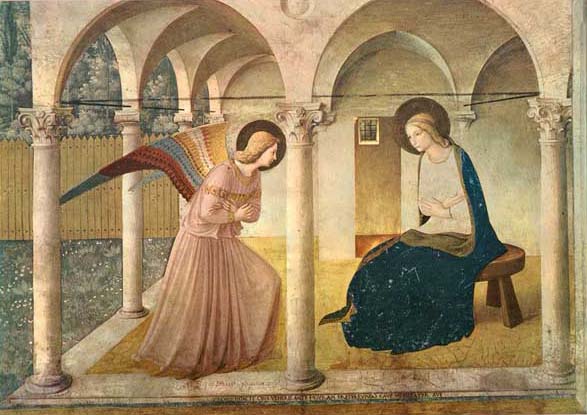
Fra Angelico's Angel of the Annunciation

Fra Angelico’s Angel of the Annunciation

In mediaeval times and up until the Renaissance, belief in the reality of angels was an absolute. You only have to look at the wonderful timber roofs of mediaeval churches, thronged with angels with their wings outspread around the roof bosses and the hammer beams; think of mediaeval art and Fra Angelico’s Angel of the Annunciation; go to a gallery of mediaeval or renaissance paintings and see how many angels are depicted there. The realm of the angels was clearly accepted as an absolute certainty and a factor of supreme importance in life, not only because angels were seen as the intermediaries between Heaven and Earth, but also because, as Steiner has described, in those times there were remnants of a kind of atavistic clairvoyance which allowed many people to have their own perceptions of the spiritual world and to report on this to others.

An angel on a hammer beam at the Church of St Agnes, Cawson, Norfolk. (Photo by Michael Rimmer)

An angel on a hammer beam at the Church of St Agnes, Cawson, Norfolk. (Photo by Michael Rimmer)

Then, in Steiner’s account of how humanity is evolving, we began to lose that ancient sense of clairvoyance and thus our awareness of the spiritual world. This was a necessary but very dangerous step in the evolution of humankind. It was necessary because as humans we have the unique privilege of developing freewill, which could only happen by entering an age in which our connection with the divine-spiritual beings and their will for our future appeared to be severed. And it was dangerous because this apparent severance from spirit existence has given the adverserial powers an opportunity they didn’t have before, which is to convince human beings through our science and technology that physical, material reality is the only reality; and thus to thwart our true destiny, which is to evolve into what Steiner called the Tenth Hierarchy. (I find Steiner’s terminology here confusing and for reasons which I go into below, will from now on refer to “order” rather than “hierarchy” for particular types of angel.) Steiner tells us that aeons from now, in a future incarnation of the Earth, humankind is destined to become the tenth order of angels – the order of Love and Freedom.

It is only humans, rather than angels, who have the potential to develop this highest form of freedom, because it is only humans who have descended this deeply into matter, where the divine and spiritual powers are no longer active. This is also why only human beings are capable of becoming atheists and denying the spirit – the angels cannot do this because they know the true reality, whereas through materialism and living in the realm of maya (illusion), we humans are free to decide what we choose to believe – and of course we will often make “wrong” choices. It is all part and parcel of our journey towards wisdom.

I’ll be writing a little bit more about this in Part 3 but for now I’ll just mention that for all of its downsides, Steiner tells us that materialism remains the vehicle for the initial development of human freedom. It was the task of materialistic science to lead us away from the overwhelming dominance of theology and theocracy in human affairs, and from the unfreedom that had for so long been associated with them. And, as Steiner repeatedly asserts, it is in our relationship as spiritual beings to the physical world that the possibility for human freedom first manifests itself. Put differently, materialism for all its faults and limitations had a very important task to perform, and it needed time to complete it – and if Steiner is correct, it’s still got another 250 years or so to run its course.

But what of the first nine orders of angels? I’ve prepared a table below to set out the thoughts of Steiner on the celestial order. Steiner seems to have adopted the scheme devised by a 6th century theological writer known rather mysteriously as pseudo-Dionysius the Areopagite. This same scheme was taken up by Thomas Aquinas, the great Dominican teacher (whom some claim to have been a previous incarnation of Steiner) and subsequently endorsed by the Catholic Church.

Now, I’m someone who finds the concept of “orders” and “hierarchy” very off-putting. It conjures up images of some kind of 19th century aristocratic or militaristic order of society, with everyone knowing their place:

“The rich man in his castle,

The poor man at his gate,

God made them high and lowly,

And ordered their estate.”

(These words come from a verse – usually omitted today – of the hymn All Things Bright and Beautiful.) Steiner encourages us not to see the orders of angels as a hierarchical, military-style ranking but more as a metaphor for some very profound truths about the unfolding of evolution. I think we should also bear in mind that these orders and hierarchies are working and co-operating together, rather than maintaining some kind of caste-like rigidity of separation.

I have to say that it is very confusing to try to follow all the different names and groupings that are given to the angels, not least by Steiner himself, who seems to use the words “order” and “hierarchy” interchangeably; plus there does seem to be some confusion among other writers about this topic. In this posting and in the table below I’m using the term “order” for one specific type of angel (eg the archangels are the 8th order); and “hierarchy” for a group of angels whose work goes together (eg the 1st Hierarchy consists of Seraphim, Cherubim and Thrones). Anyway, I hope that this table will at least give you a place to start in assembling your own thoughts on the matter.

In Part 2 of this 3-part posting, I will write about the angelic orders that Steiner mentions in the College Imagination, that is to say the angels of the 7th, 8th and 9th orders, who are the ones closest to us as human beings; and what these angels are seeking to achieve for humankind at the present time. In Part 3, I will write about Steiner’s concept of evil and the “adversely commanded” angels Lucifer and Ahriman, as well as the role of Michael, the great angel who is the spirit of our age. I will also be touching upon some huge dangers with which the adversarial powers are currently confronting humanity – and towards which we seem to be sleepwalking, ignorant and unaware of what is facing us.


THE CELESTIAL ORDER

The Holy Trinity
(Father, Son & Holy Spirit)

The Nine Orders of Angels and the Three Hierarchies

Screen Shot 2015-09-19 at 20.37.50


1 Comment

September 10, 2015 · 9:17 pm

A tent in which to pass a summer’s night

‘Our highest truths are but half-truths;

Think not to settle down for ever in any truth.

Make use of it as a tent in which to pass a summer’s night,

But build no house of it, or it will be your tomb.

When you first have an inkling of its insufficiency

And begin to descry a dim counter-truth looming up beyond,

Then weep not, but give thanks:

It is the Lord’s voice whispering,

“Take up thy bed and walk.” ‘

A.J. Balfour’s poem came to mind when, after my previous posting (“The terror of the infinite desert: atheists in the face of death”) I was challenged by one of the more prominent Waldorf critics, Alicia Hamberg, to say what kind of God I believed in; and more than that, to say what kind of God Rudolf Steiner may have believed in.

The question of what kind of God I believe in I will leave for another posting; and needless to say, I am unfitted to pronounce on Rudolf Steiner’s understanding of God, for the insights of a great initiate like Steiner are beyond anything that I could truly grasp or usefully comment on. What I will attempt to do in this posting, however, is to bring together some thoughts that may help to erect a tent of these “half-truths” to shelter us for a night or two during our journey towards understanding something of Steiner’s spiritual vision.

These half-truths are of course ones that appeal to me but may not appeal to other people. Why is it that we have so many diverging views among ourselves? In his Philosophy of Freedom, Steiner introduces us to the idea of twelve world-views:

“We must be in a position to go all round the world and accustom ourselves to the twelve different standpoints from which it can be contemplated. In terms of thought, all twelve standpoints are fully justifiable. For a thinker who can penetrate into the nature of thought, there is not one single conception of the world, but twelve that can be equally justified — so far justified as to permit of equally good reasons being thought out for each of them. There are twelve such justified conceptions of the world.”

I don’t want to go into this in any more detail now but if you want to explore it further you can of course google Philosophy of Freedom. The reason for mentioning it here is that, of the twelve world-views listed by Steiner, the one to which I am most drawn is called by him Spiritism; and the one that most atheists adhere to, I would suggest, is Materialism. According to Steiner, both viewpoints are fully justifiable, with equally good reasons being thought out for each of them; and because both are valid and rational, they satisfy us and on the whole, we don’t look beyond them. A materialist may find my approach illogical and unjustifiable and I will tend to find the materialist’s approach equally unsatisfactory. The point here is that the truth does not lie within my ‘spiritist’ world-view or your ‘materialist’ world- view but perhaps in a synthesis of the twelve different world-views, or even in a quite different place altogether. The implication is that both of us would be wrong if we were to insist that our view is the only right one. To acquire access to that synthesis, that all-round view of every aspect of the truth, is part of our journey towards wisdom.

I’ve quoted this passage from Tarjei Straume before, but it bears repeating:

“People who are influenced in their habits of thought, philosophies, historical perspectives etc. by anthroposophical studies, don’t always agree. On the contrary, they quite often collide on specific issues, concepts, and perspectives. This is inevitable, because anthroposophy is not an ideology, it’s not a religion, it’s not a lifestyle (although some lifestyles have been associated with it, perceptually), and it’s not a political agenda, the idea of the Threefold Social Order notwithstanding. It may however be classified as a doctrine, or a set of doctrines — not really comparable to religious doctrines, but more to scientific doctrines, say like the doctrine of heliocentrism that was introduced by Copernicus and Galileo in the 16th and 17th centuries — a theory that was officially prohibited by the Church in 1616 but is now so absorbed and widespread that anything that contradicts it is heresy. Thus it may be argued that the anthroposophical worldview is a relatively new heretical theory that may replace Copernicanism, Newtonianism, Darwinism, and Einsteinism in the future…

What it all boils down to, however, is that anthroposophy is nothing but a path to the Spirit available to everyone and basically compatible with any cultural or religious background, including secular humanism. As a matter of fact, humanism is the basis, the point of departure, for the epistemology that is the backdrop of anthroposophy and therefore also its backbone.”

This is clearly not the kind of humanism espoused by the British Humanist Association, whose slogan is: “For the one life we have”. How can they be so sure? Could it be that most of their members are people who take what Steiner calls the Materialist world-view? But these humanists may be surprised to read what Steiner had to say about religion in his 1899 essay on Egoism in Philosophy:

“One way man comes to terms with the outer world consists, therefore, in his regarding his inner being as something outer; he sets this inner being, which he has transferred into the outer world, both over nature and over himself as ruler and lawgiver.

This characterises the standpoint of the religious person. A divine world order is a creation of the human spirit. But the human being is not clear about the fact that the content of this world order has sprung from his own spirit. He therefore transfers it outside himself and subordinates himself to his own creation.

… This way of coming to terms with the world reveals a basic characteristic of human nature. No matter how unclear the human being might be about his relationship to the world, he nevertheless seeks within himself the yardstick by which to measure all things. Out of a kind of unconscious feeling of sovereignty he decides on the absolute value of all happenings. No matter how one studies this, one finds that there are countless people who believe themselves governed by gods; there are none who do not independently, over the heads of the gods, judge what pleases or displeases these gods. The religious person cannot set himself up as the lord of the world; but he does indeed determine, out of his own absolute power, the likes and dislikes of the ruler of the world.

One need only look at religious natures and one will find my assertions confirmed. What proclaimer of gods has not at the same time determined quite exactly what pleases these gods and what is repugnant to them? Every religion has its wise teachings about the cosmos, and each also asserts that its wisdom stems from one or more gods.

If one wants to characterise the standpoint of the religious person one must say: He seeks to judge the world out of himself, but he does not have the courage also to ascribe to himself the responsibility for this judgment; therefore he invents beings for himself in the outer world that he can saddle with this responsibility.

Such considerations seem to me to answer the question: What is religion? The content of religion springs from the human spirit. But the human spirit does not want to acknowledge this origin to itself. The human being submits himself to his own laws, but he regards these laws as foreign. He establishes himself as ruler over himself. Every religion establishes the human “I” as regent of the world. Religion’s being consists precisely in this, that it is not conscious of this fact. It regards as revelation from outside what it actually reveals to itself.

The human being wishes to stand at the topmost place in the world. But he does not dare to pronounce himself the pinnacle of creation. Therefore he invents gods in his own image and lets the world be ruled by them. When he thinks this way, he is thinking religiously.”

I doubt if there is any member of the British Humanist Association who would disagree with any of this and, indeed, it may come as a shock to some anthroposophists that Steiner held such views. The whole essay is well worth reading, as it leads on to some really insightful observations about the work of philosophers throughout the ages.

But Steiner is not content to leave things just with this piercing analysis of religious thinking – and this is where he diverges from secular humanists, who often stop at this point – because he goes on to say that active self-knowledge opens a person to the essential being of the world, with which he is inwardly then so united that he can say with equal truth, “I am” and “I am the world.” The other person’s self also is and is the world, so conflict and disagreement, belief and non-belief are simply irrelevant.

How does one acquire this active self-knowledge? In the last chapter of Steiner’s Riddles of Philosophy (1914), he refers to soul exercises given earlier in the book and elsewhere and says that these exercises can result in the soul unfolding a different consciousness than its ordinary one and thus arrive at spiritual perception. And it is only through this different spiritual perception that the soul can truly know itself and consciously experience itself in its essential being. He also realises that many people will not be able to go along with this:

“It is only too obvious that the adherents of many modern points of view will consign the world revealed here to the realm of mental aberration, of illusion, of hallucination, of auto-suggestion, and the like. One can only answer them that an earnest striving of the soul — working in the way just indicated — finds, in the inner, spiritual state which it has developed, the means to distinguish between illusion and spiritual reality; and these means are just as sure as those used in ordinary life, in a healthy state of soul, to distinguish between something imaginary and something actually perceived. One will search in vain for theoretical proof that the spiritual world characterised above is real; but such proof of the reality of the perceptual world does not exist either. In both cases it is the experience itself that determines how one is to judge.

What keeps many people from taking the step which, according to our presentation, alone offers a prospect of solving the riddles of philosophy is that they believe such a step will land them in a realm of nebulous mysticism. But anyone who has no soul predisposition toward such nebulous mysticism will, along the path just described, gain access to a world of soul experience that is just as crystal clear in itself as the structures of mathematical ideas…”

So Steiner is saying that through true perception of the nature of reality, the human ‘I’ can participate fully in the essential nature of everything – there is no longer a need to invent a God that is separate from ourselves because in fact we are ourselves, in the happy phrase of the late Sir George Trevelyan, droplets of divinity. What does this mean, both for us as human beings and in terms of Steiner’s own insights into the prime cause? There is much more to explore here!

2 Comments

Filed under Anthroposophy, Atheism, Humanism, Philosophy of Freedom, Rudolf Steiner

“Every school could use these methods…”

When one surveys the history of Waldorf schools following Rudolf Steiner’s death in 1925, it’s tempting to ask oneself about his intentions and expectations for the schools movement and compare them with what has actually happened. Did Steiner want Waldorf schools to spread throughout the world? Or did he want Waldorf methods to be taken up by other schools? Or perhaps a bit of both?

Rudolf Steiner in 1923.

I’ve recently come across some very interesting statements made by Steiner on the afternoon of 28th December 1923, at a meeting of the Swiss School Association held during the Christmas Conference in Dornach:

In addition to what I took the liberty of saying at the close of the last course which I was able to hold for the Swiss teachers, I have perhaps only a few more remarks to make in connection with the difficulties of the Swiss school movement. It seems to me that things do in part indeed depend on how the educational movement connected with anthroposophy is run here in Switzerland.

The Waldorf School in Germany has remained essentially in a position of isolation. Though there have been one or two further foundations, in Hamburg, Cologne and so on, the Waldorf School in Germany, in other words in a relatively extensive area, has remained a solitary example. It will remain to be seen, therefore, whether what is to be started in England as a kind of Waldorf school*, and also the school with three classes that already exists in Holland, will also to begin with remain as solitary examples.

first waldorf school

The very first Waldorf school opened in Stuttgart, Germany in 1919.


Apart from everything else it has to be said that the reason why these schools are still only isolated examples, and also why it can be expected that they will remain so for a long time, is simply that the present social circumstances really do make it impossible for an attitude to come about that could lead to the financing of a larger number of such schools. Experience over the years has shown this quite clearly. And this challenges us to think carefully about the whole direction we should take with our educational movement.

This is especially necessary with regard to Switzerland. For Switzerland is pervaded by a very strong sense for everything represented by the state. And now that the Swiss school association for independent education has been founded, I do believe that the chief difficulties will arise from this Swiss sense of statehood. Even less than anywhere else will it be possible here in Switzerland to find an opening for the belief that a truly independent school could be an example for a model method of education, or that schools such as this could be founded on a larger scale. We should not allow ourselves to be under any illusion in this respect. Aversion to a system of education that is independent of the state is very great here.

Of course what Herr Gnädiger has just said is right, namely that there will be interest in how things are done in a model school.

Least of all here in Switzerland can you expect the president of the Schweizerischer Schulverein, of whom you have spoken, to have any interest in the school other than that pertaining to its status as a model. Perhaps his interest will turn out to be such that he would like to influence Swiss state schools to take up certain methodological aspects from this model school. But this seems to me to be the only aspect that can be counted on to attract interest here in Switzerland. That is why it seems to me to be important to take up these two things wherever educational associations of the kind you have mentioned are founded; and also that many such associations should be founded, more and more of them!

Another aspect is that the crux of anthroposophical education is its method. The schools apply a certain method. It is not a question of any particular political direction but purely and simply of method. It is also not a question of any particular religious creed, or of seeing anthroposophy somehow as a religious creed. It is simply a question of method.

In the discussion that followed my lecture cycle my answer to questions on this was simply that the educational method represented here can be applied anywhere, wherever there is the good will to introduce it.

If this is done on the one hand, and if on the other hand — in order to create an understanding in wider circles — it is clearly emphasized that this is the proper method and that it is being applied in a school that can serve as a model, if these two points are given the main emphasis in the programme, if it is stressed that every school could use these methods and that a model school could demonstrate how fruitful they are, and if things are worked out neatly, then I believe that something could be achieved even in Switzerland. And then on the basis of these two points educational associations ought to be founded everywhere. But it would have to be made clear to everyone that the aim was not to found as many private schools as possible to compete with the state schools. In Switzerland such a thing would be regarded as something very peculiar and it would never be understood. But there would be an understanding for a model school which could be a source of inspiration for a method of education. Progress cannot be made in any other way. It is important to present these things to people in principle again and again and wherever the opportunity arises.

I believe it would be a good thing if you could always give the greatest prominence to these two aspects. They are perfectly true, and much damage has been done to us by the constant repetition of the view that Waldorf education can only be carried out in schools apart from the main stream, whereas I have constantly repeated that the methods can be applied in any school.

* This is a reference to the Priory School, Kings Langley, started by Margaret Cross and Hannah Clark as a pioneering co-educational boarding school in 1910. Miss Cross had been so inspired by Steiner that in 1922 she decided to turn her school over to the new Waldorf methods. Steiner visited the school at least once, probably twice, the only English school he ever visited.

The Priory School, Kings Langley, as Rudolf Steiner would have seen it when he visited on 16th April 1922.

Steiner is saying that he sees the need for a few model schools, which could be a source of inspiration for his method of education and which could also be used by any school, state or private, which has the good will to introduce it. He sees an important role for national education associations to promulgate his methods, rather than the creation of more and more schools. This implies that he wanted the national associations to fly the flag for Waldorf methods, while he wanted there to be a few model schools to act as demonstration centres for these methods, that could be visited by teachers and educationists from state and other independent schools. And he could hardly be clearer in stating that anthroposophical education has nothing to do with a political direction or a religious creed but is simply a question of method.

If Steiner had lived longer, perhaps we would have seen him encourage the development of school associations in each country. He would have wanted there to be a handful of Waldorf schools in each of these countries, but they would have acted as models of excellence and research in teaching and curriculum. He would also have wanted there to be the greatest possible interaction between the model schools and the rest of the educational culture of that country. One can envisage there would have been a much greater flow of teachers between state and Waldorf schools resulting in much more dialogue and cross-pollination of methods.

With the benefit of hindsight, it’s easy to see why events didn’t turn out in this way. After Steiner’s death, the tensions between members of the Vorstand in Dornach that had been held in check during his lifetime broke out; and these very public divisions in the executive split national anthroposophical societies as well. In the UK, the few Steiner Waldorf schools that were beginning to establish themselves had to do so against challenging odds. This constant struggle for everyday survival, alongside their teaching and administrative responsibilities, took up all the energies of these pioneers. Add to this a kind of isolationist mentality, arising perhaps from an almost arrogant sense of the superior virtues of their methods, and one can see how the independent Steiner Waldorf schools came to figure hardly at all as part of the national educational culture in their countries.

This is just one reason why I am pleased that we now have a number of publicly-funded Steiner academy schools, because they are already part of the pluralistic educational system of England in a way that the independent Steiner Waldorf schools have not on the whole managed to achieve. This gives hope for fruitful dialogue and exchanges with mainstream educational culture that can only benefit all parties, which was undoubtedly what Steiner had in mind. This could still happen and there are some encouraging signs of greater openness beginning to appear. As just one example, there is a link here and here to a 2-part article by Trevor Mepham, former principal of the Steiner Academy Hereford and current principal of the Steiner Academy Frome. Trevor’s article seems to me to be generous, open and non-dogmatic in its approach, as well as a gentle reminder to Steiner educators everywhere not to get too hung up on supposed principles and practice.

The Steiner Academy Hereford – the first of the new publicly-funded Steiner schools in England.

At the European level, one can also see encouraging signs of Steiner Waldorf schools opening up, for example by becoming involved with the School Education Gateway project funded by the European Union’s Erasmus +, the programme for education, training, youth and sport. Surely, the best and most effective gesture that Steiner Waldorf schools can make today is to say to colleagues in education around the world: “We have much to share and much to learn from one another. We don’t have all the answers but we would like to help develop the answers with you.”

2 Comments

Filed under Anthroposophy, Free Schools, Rudolf Steiner, Steiner Waldorf schools

Rudolf Steiner and the Chinese yam

It’s interesting to see how time and again during the life of Rudolf Steiner, a new body of knowledge was able to begin only once someone had asked him a significant question. Examples of this include:

1. In 1900, Marie von Sivers, a gifted young Russian (who was to become the future Frau Dr Steiner), came to Berlin in order to make the acquaintance of Rudolf Steiner. Soon after meeting him, she asked him a question which had preoccupied her. They came to call this the Chrysanthemum Tea moment, because the room in which they were having tea was full of those flowers. She asked Steiner if there wasn’t a need to call a new spiritual movement into life, one which would be appropriate for Europe and the West, since the Theosophical Society contained so much Eastern spirituality. Steiner replied that this would only be possible if it could arise from the depths of esoteric Christianity. Thus was born anthroposophy.

2. On April 23, 1919, after a lecture Steiner gave to the factory workers of the Waldorf Astoria cigarette factory in Stuttgart, Emil Molt, the company director, asked Steiner to take on the planning and leadership of a new school for the company’s workers. This led to the birth of the first ever Waldorf school.

3. In August 1923, in Penmaenmawr in Wales where Steiner was leading a summer school, Dr Ita Wegman asked him: “Would it not be possible to found a form of medicine based upon the mysteries?” This led to their collaboration in writing a book and the beginnings of anthroposophical medicine.

It seems as though an initiate can only bring something new to the world when requested to do so through an act of free will by another human being – the initiate cannot act to impose new ideas without the way being cleared by someone asking for them.

The story of the Chinese yam is another example of a significant question being asked of Steiner that led on to new research and knowledge. I’m indebted for the following account to Hannah Townsend’s review of Ralf Roessner’s book The Light Root in the Autumn 2014 issue of New View magazine (article not online).

To quote from Hannah’s review:

“Rudolf Steiner was apparently just about to depart from the gathering at Koberwitz where he had been giving the course of lectures that would lay the foundation for the development of biodynamic agriculture. This was in 1924 and the effects of humanity’s gradual slide into a one-sidedly materialistic thinking was beginning to have an effect on food. Mechanistic agricultural practices were starting to deplete produce of the cosmic forces that food should carry into the human diet if people are to be enabled to pursue their rightful spiritual development. (Food is more than solely a means of keeping our physical bodies alive, but more fundamentally a source of nourishment for human consciousness.)…

Roessner relates how, as Steiner waited for his car to arrive to take him to the train station, two of the course participants came up to him with a question. They wanted to know whether, if all the indications that he had given were followed, it would be enough to raise the quality of nutrition to give adequate spiritual nourishment for our times. The answer that Steiner gave seems to have been both surprising and direct:

‘It will not be sufficient, even in the most favourable circumstances,’ he said. ‘What should be done is to cultivate Dioscorea batatas in Europe so that it can take over from the potato as the staple diet…’ ”

Well, who could resist following up on such an intriguing story? Certainly not the anthropopper, who promptly went out and bought a copy of The Light Root by Ralf Roessner (£8.99 from Temple Lodge Publishing, ISBN 978 1 906999 63 6).

Here's what the Chinese yam (or light root) looks like when well grown.

Here’s what the Chinese yam (or light root) looks like when well grown. (Photo via Apios Institute)

It turns out that what the author calls the Light Root is a particular type of Chinese yam. The special quality of this particular yam is that it is able to incorporate within its physical substance large quantities of the light ether, of which most of our foods are nearly or completely lacking. Why does this lack of light ether matter? It matters because without the light ether it is far more difficult for us humans to become aware of ourselves in our true nature, ie as spiritual beings currently living within physical bodies. Without the light ether, materialism holds sway and people are unaware of anything other than physical, material reality. So it is possible that this plant is not only a valuable food but also something which in the future could be a decisive influence in the development of humanity. (My wife, a specialist in fertility and maternity reflexology, is convinced that the other food which contains light ether is breast milk – which, if true, is yet another reason why breast is best.)

Here of course we dive straight into controversy: what is this light ether, which most scientists, if asked, would say does not exist? Those who are familiar with Steiner’s concepts will know that he thinks in terms of a spectrum of realities, from the physical to the etheric to various gradations of the spiritual. Living organisms which have a physical body or form also have an etheric body or form, which is essentially an energy body that contains and forms the physical. It is this etheric body which maintains the physical body’s form until death.

According to Steiner, the etheric body is made up of four ethers: warmth ether, light ether, chemical/sound ether and life ether (he said that there are in fact seven ethers but only four of them are currently susceptible to investigation). Materialists won’t go along with any of this, of course. However, two researchers, Dennis Milner and Edward Smart, in their work with Kirlian-type photography, seem to have been able to detect the four ethers identified by Steiner. My friend, Dr Siegfried Trefzer, has also used Kirlian photography as a means to detect illnesses in the etheric body before they manifest in the physical body. Between them, the etheric and physical bodies contain the meridian lines and acupuncture points which create a structured and permeable web of energy that helps to maintain the health of our physical body. This level can be weakened by various factors including: electromagnetic pollution, poor diet, drug misuse, trauma, sedentary lifestyle, genetic factors etc. From all this, it is clear that the medicine of the future will have to encompass energy medicine if real progress is to be made in treating pain and disease.

I can remember staying in a boarding house at Cliftonville with my parents when I was a young boy. On the table next to ours at breakfast was a man who had an artificial leg below one knee, which was of course fascinating to me. I have never forgotten how he said that he was having pain, not where the artificial limb joined his leg, but below this – where the amputated leg had been. This phantom limb effect is another example of the etheric body. Even when the limb has been removed, sensation can be felt as if it were still there, because the etheric form of the limb is still there.

Anyway, back to Ralf Roessner’s book about the Chinese yam or, as he calls it, the “light root”, a term he has patented in Germany as “lichtwurzel”. Roessner found that he had to go to the original growing areas in China to find suitable plants, as the specimens he had got from France, Africa and America did not show anything like the expected light ether qualities. The ability to store light ether in the plant is dependent on growing the plant at a sufficient depth (the tubers need to be at least four feet deep) as tubers grown near the surface do not have the same qualities at all. In addition, it is only the male plants of the Chinese yam which have the ability to store the light ether. At harvest time, according to Roessner, these tubers have a radiance that is noticeable even to the untrained observer.

The author clearly does not expect a sympathetic hearing from materialistic science, saying at one point: “spiritual scientific research should not try to gain a place among present day natural science (on the one hand it is still in its infancy, on the other it is more the task of natural science to venture into the spiritual), it is only right to renounce any acknowledgement from natural science.”

One can see why he should be cautious – he claims that the light root was rescued from Atlantis and brought to China, that the light root is a plant which nourishes yin or what Steiner calls the Venus principle, that to describe the effect of the light root on the human being requires faculties which go beyond ordinary sense-perceptible observation. He says that the light root’s unique light ether potential is able directly to strengthen the body’s formative forces (ie the etheric body), which is thereby enabled to take up with more ‘clarity’ those cosmic formative forces which underlie all earthly growth processes. Roessner sees the light root as providing an intermediate stage between a light nutrition of the future and our current one-sidedly materialist nutrition which is becoming less and less capable of truly nourishing us.

I can see why a scientist wouldn’t want to go to Monsanto or some other large corporation to ask for a research grant to look into this. However, in a few years time, when spiritual research has done all the heavy lifting and the reality of the etheric body has been established, I can also see these same large corporations trying to patent the light root, either to suppress it or else to exploit it so that they can market food based on it as “strengthening the etheric body, lengthening your life.”

What is more, the light root does have the potential to be a popular staple food: it is apparently delicious, makes good chips, and can be used in soups, sauces, pies etc. It has the property of filling you up with a small amount, so would be good for slimmers, as well as an excellent food for people with little money. It even has a beautifying effect, bestowing smooth, silky skin and shiny, strong hair. So, yes, I can see the Monsantos or Nestles of this world spotting vast commercial opportunities further down the line.

How would you like your light root cooked? Chipped, fried, in a soup or sauce? Yam, yam!

How would you like your light root cooked? Chipped, fried, in a soup or sauce?
Yam, yam! (Photo via AliBaba.com)

In the meantime, Ralf Roessner is doing his best to promote light root products on his website (German language only). Processing the light root so as to preserve the light ether it contains has its challenges, as the magnetic field associated with electricity soaks up the light ether quality. Even the fan in a conventional oven causes damage, while microwaves completely destroy the quality of light ether. Roessner says that there is an urgent need to develop appliances such as graters, mills and mixers, where a motor can be installed away from the actual appliance. Clearly at present it is best to use the light root as a fresh food. It may be, of course that we in the West are not yet ready to swap the potato for the Chinese yam and it is therefore the role of people like Ralf Roessner and his colleagues to research and to keep the knowledge alive until that time when we begin to awaken from our deep materialistic sleep. In this, they deserve our thanks and respect for ploughing their lonely furrow on behalf of the future.

It seems significant that the light root has come out of China and that advocates of anthroposophical medicine and ancient Chinese medicine are finding more and more parallels in their approaches. Yvan Rioux, in a fascinating article in the Winter issue of New View magazine, says that: “When the Chinese tried to grasp the activity of an organ, they looked for psychic activities as well as biological processes because our internal landscape is the basis of our soul life. “ And he quotes Steiner from lectures given a century ago: “What makes consciousness possible is not the brain as a producer of consciousness but the processes of the body as a whole. These serve as a mirror reflecting the activities of the soul. The bodily organs as living body processes act as reflectors of psychic activities.1” And again: “We must know that, in spite of the fact that they are not fully penetrated by the life of consciousness, all the organs contain the source of what surges in us as our psychic life.2

How did Steiner know all this stuff? And where are the true scientists who, even if something does not fit within their current paradigm (or especially because it does not fit within the current paradigm), will say: ”We must look into these matters and if necessary, we must develop new theories, methods and techniques to enable us to do so.” Those are subjects that the anthropopper will return to in future postings.

1 Rudolf Steiner, Psychoanalysis and Spiritual Psychology

2 Rudolf Steiner, Occult Physiology

14 Comments

Filed under Anthroposophy, Rudolf Steiner

Franz Kafka meets Rudolf Steiner

Mention of Franz Kafka in my previous posting has reminded me that there was in fact a meeting between Kafka and Rudolf Steiner. It happened in Prague in March 1911. Steiner was in Prague delivering a series of lectures on the subject of An Occult Physiology. Kafka had first come across Steiner at Mrs Berta Fanta’s salon on Old Town Square, a famous meeting place for intellectuals during the two-decade period before the First World War. These gatherings were attended by professors at the German university in Prague, including Albert Einstein and Christian von Ehrenfels, as well as the up-and-coming younger generation such as Kafka and Max Brod. (Einstein also met Steiner at Mrs Fanta’s salon and attended several of Steiner’s lectures held in the Café Louvre, an Art Nouveau café on Národní třída, and was apparently impressed by Steiner’s views on non-Euclidean geometry.)

Rudolf Steiner in 1911, the year he met Franz Kafka

Rudolf Steiner in 1911, the year he met Franz Kafka

Kafka attended two of Steiner’s lectures and records his reactions in what seems to be an ironical tone (or is it perhaps just an intense observation in an attempt to understand?) in his diary entries of 26th and 28th March 1911. On 26th March he comments on Steiner’s rhetorical trick of giving full weight to the views of his opponents, so that “the listener now considers any refutation to be completely impossible and is more than satisfied with a cursory description of the possibility of a defence”; Kafka then observes: “Continual looking at the palm of the extended hand. Omission of the full stop. In general, the spoken sentence starts off from the speaker with its initial capital letter, curves in its course, as far as it can, out to the audience, and returns with the full stop to the speaker. But if the full stop is omitted then the sentence, no longer held in check, falls upon the listener immediately with full force.” Kafka was to do something similar in his own works, by writing long sentences that sometimes cover an entire page. Kafka’s sentences then deliver an unexpected impact just before the full stop, which gives a final meaning and focus to what has gone before.

On 28th March he comes back to Steiner in his diary, either referring to another or to the same lecture, which he proceeds to gently guy, interspersing this with comments about his neighbour in the audience:

“Dr Steiner is so very much taken up with his absent disciples. At the lecture the dead press so about him. Hunger for knowledge? But do they really need it? . . . Löwy Simon, soap dealer on Quai Moncey, Paris, got the best business advice from him . . . .The wife of the Hofrat therefore has in her notebook, How does One Achieve Knowledge of the Higher Worlds? At S. Löwy’s in Paris.”

Kafka would have been around 28 years old at this time. He seemed to find the tasks of daily existence very difficult, was often lonely and depressed and regarded himself as a perpetual outsider – a German speaker in Prague, a Jew among Christians. Although he had had encounters with some of the leading personalities of the age – apart from meeting Steiner, he had seen Nijinsky dance and had met Einstein, Rilke and Puccini – his experience of the wider world was limited. At university he studied law and then obtained jobs within first one, then another insurance company, work which he resented as it kept him away from his writing. He lived and worked within the same small area of Prague and its surroundings all his life. Despite a fervent longing to be independent, he spent the whole of his short life (he died at the age of 40, probably from starvation due to an inability to eat as a result of laryngeal tuberculosis) resenting that he was either living with his parents in what has been described as “an atmosphere of claustrophobic mutual surveillance” or else with one of his sisters. He had a strong sex drive but seems to have been unable to have satisfactory relationships with women, as he lacked the capacity for losing himself in loving another person. “For even the most intimate friend to set foot in my room,” he told his unfortunate fiancee, Felice Bauer, “fills me with terror.”

Franz Kafka with his fiancee, Felice Bauer

Franz Kafka with his fiancee, Felice Bauer

Kafka attributed his psychological difficulties to having “vigorously absorbed the negative element of the age in which I live.” He had a difficult relationship with his father, who was described by Kafka’s biographer Stanley Corngold as a “huge, selfish, overbearing businessman.” Kafka seems to have been psychic to some degree and in his diary admitted to suffering from “bouts of clairvoyance.”   A huge issue for him during this period was how to create for himself the necessary space for literature when his employment encroached upon his writing time and his family and society expected him to make a living, marry, and raise his own family. Whatever the reasons, in his writings Kafka captured like no other author before him themes such as father-son conflict, alienation, physical and psychological brutality, characters on a terrifying quest, encounters with arbitrary and unjust bureaucracy and mystical transformation.

In spite of what may have been his ironical tone in connection with Steiner’s lecture, Kafka evidently decided that Rudolf Steiner might be able to help him to find his life’s direction and made an appointment to see Steiner in his hotel room in Prague. Kafka records in his diary his impressions of this visit:

“In his room I try to show my humility, which I cannot feel, by seeking out a ridiculous place for my hat . I lay it down on a small wooden stand for lacing boots. . . Table in the middle, I sit facing the window, he on the left side of the table. . . . He begins with a few disconnected sentences. So you are Dr. Kafka? Have you been interested in theosophy long? But I push on with my prepared address: I feel that a great part of my being is striving toward theosophy, but at the same time I have the greatest fear of it. That is to say, I am afraid it will result in a new confusion which would be very bad for me, because even my present unhappiness consists only of confusion. This confusion is as follows: My happiness, my abilities, and every possibility of being useful in any way have always been in the literary field. And here I have, to be sure, experienced states (not many) which in my opinion correspond very closely to the clairvoyant states described by you, Herr Doktor, in which I completely dwelt in every idea, but also filled every idea, and in which I not only felt myself at my boundary, but at the boundary of the human in general. Only the calm of enthusiasm, which is probably characteristic of the clairvoyant, was still lacking in those states, even if not completely. I conclude this from the fact that I did not write the best of my works in those states. I cannot now devote myself completely to this literary field, as would be necessary and indeed for various reasons. Aside from my family relationships, I could not live by literature if only, to begin with, because of the slow maturing of my work and its special character; besides I am prevented also by my health and my character from devoting myself to what is, in the most favorable case, an uncertain life. I have therefore become an official in a social insurance agency. Now these two professions can never be reconciled with one another and admit a common fortune. The smallest good fortune in the one becomes a great misfortune in the other. . . . Outwardly, I fulfill my duties satisfactorily at the office, not my inner duties, however, and every unfulfilled inner duty becomes a misfortune that never leaves. And to these two never-to-be-reconciled endeavours shall I now add theosophy as a third? Will it not disturb both the others and itself be disturbed by both? . . . This is what I have come to ask you, Herr Doktor.”

It’s unfortunate for our curiosity that Kafka is so focused on himself and his problems that he doesn’t record how Steiner responded to this speech. All Kafka reports is this:

“He listened very attentively without apparently looking at me at all, entirely devoted to my words. He nodded from time to time, which he seems to consider an aid to strict concentration. At first a quiet head cold disturbed him, his nose ran, he kept working his handkerchief deep into his nose, one finger in each nostril.”

There is perhaps a little too much information in that last sentence and not enough anywhere else. There is no further mention of Steiner in the diaries, apart from one piece of advice from the same meeting: “Herr Kafka, essen Sie keine Eier.” (“Mr. Kafka, don’t eat eggs.”)

Can we make a guess at what else Steiner had said to him? It seems probable that Steiner realised that Kafka’s life would be a short one and that in his remaining time he would need to focus as much as possible on his writing. We may surmise that Steiner told Kafka to concentrate on literature above all else.

25 Comments

Filed under Anthroposophy, Franz Kafka, Rudolf Steiner