Author Archives: Jeremy Smith

Jeremy Smith's avatar

About Jeremy Smith

I’m currently organising a programme of talks and workshops on a part-time freelance basis for Emerson College in Forest Row, East Sussex in the UK. I’ve worked in various branches of education since 1986, in both employed and self-employed roles. Before that, I was the arts and entertainments officer for one of the London boroughs and before that I trained as an actor at the Mountview Theatre School. I’ve had an interest in the work of Rudolf Steiner for many years and have spent several years as the education facilitator in a Steiner school. I’ve also been the trustee of another Steiner school, have worked as a member of the executive group of the Steiner Waldorf Schools Fellowship and have been a lay inspector for Ofsted inspections of Steiner schools. Biodynamic agriculture, another of Steiner’s initiatives, is a huge interest of mine and I’m a shareholder of the Tablehurst & Plaw Hatch Farms Co-op in Forest Row, East Sussex. I’m also an executive director of Tablehurst Farm and have a part-time role as registered manager for the farm's care home.

Rudolf Steiner & Angels – The Current Work of the Angels within Human Beings

Part 2 of 3

In Part 1 of this posting, I wrote about the College Imagination and Steiner’s views on the nine orders of angels. In Part 2, we are going to look at the angelic orders that Steiner refers to in the College Imagination, that is to say the 3rd Hierarchy consisting of the Archai, Archangels and Angels of the 7th, 8th and 9th orders, who are the ones closest to us as human beings. We shall also look at some of the ways in which the angels are currently seeking to advance our evolution.

As we work together with colleagues, or in any community for that matter, it is helpful to acknowledge the presence of the angels, who are always ready to support our common work. Without their help, much that we set out to do would be too difficult, painful or disheartening to carry through to completion, or too misguided to be beneficial. With their help, true social innovation is possible. The angels support the creation of social initiatives that benefit individual societies and the continuing development of humankind.

By way of context, I hope it will be helpful here to say something as briefly as possible about Steiner’s teachings on the evolution of our solar system, and how the evolution of angels and humans has developed during this process. According to Steiner, our solar system has so far had four planetary stages, which he calls, somewhat confusingly, Ancient Saturn, Ancient Sun, Ancient Moon and Earth, this last being of course our present stage. This current stage of Earth will in time develop into three further stages or planetary embodiments, which Steiner calls Jupiter, Venus and Vulcan. In the meantime, our present Earth stage is due to continue until about the year 8000AD, when we shall start moving into the Jupiter planetary stage – so you can see that this is quite a long process! You can read more about Steiner’s views on these matters in his book, An Outline of Esoteric Science.

From Rudolf Steiner’s descriptions, it appears that humankind, in a variety of different forms, has participated in this evolution from the beginning. From the outset through to the very last stage, humans will have experienced a huge transformative process – from a human germ on Ancient Saturn to an angelic being, called the 10th order, in a future incarnation of the Earth.

Steiner also taught that each of the angelic orders has had the equivalent of a human stage in their own evolution, though of course their human stages were not like ours. Their evolutionary path is ahead of ours, with the angels of the 9th order being closest to us.

Angels (9th order)
Each of us – you, me, every one – has a guardian angel. Our very own dedicated guide in the spiritual world, it envelops us in unconditional love. Our angel gives us the safe space in which our higher selves can develop and eventually come into independent maturity. Impulses from our angel allow true ideas to stream into our consciousness. These guide us in our earthly tasks and relationships and give us strength to overcome the inevitable challenges we all meet along the way. Eventually, in the very distant future after a number of incarnations, we will take over this responsibility from the angels, rather like the way in which as we grow up we gradually find our independence from our parents. Until then, the angels’ unconditional love remains steadfast, guiding us along our way and helping to strengthen us.

Oriphiel

Oriphiel

Anael

Anael


Archangels (8th order)
Archangels unite groups of people, who have a common purpose or mission, by flowing in rhythmic motion amongst group members and their angels. They weave together mutual intentions and striving to help us form a sense of group identity, be it a community, family or nation. While angels give strength to each individual human, archangels inspire and give courage to each member of the group to work together to fulfill their common tasks. Whether forming a school, a team, a theatre company or a political movement etc., the work of the archangels helps form the group into a dynamic and viable whole. This group may well become able to receive higher spiritual intentions in order to meet challenges particular to its historical setting and time.

Zachariel

Zachariel

Raphael

Raphael


Steiner says that the archangels do not occupy themselves with the single individual, but have a wider task, which is to bring single lives into harmonious order with the life of larger human groups, as for instance with inhabitants of a particular nation.

Samael

Samael

Gabriel

Gabriel


Archai (7th order)
Archai, sometimes called Time Spirits, shine the light of intuition into the dynamic relationships or vessels that have been built with the aid of the archangels. The archai help us attune our efforts so as to be most fruitful at a particular time and place. We can see the results of their work in the rise and fall of various peoples and impulses over the course of human history.

Steiner says that the archai are even loftier beings than the archangels and they have a still higher task in the continuity of human existence. They regulate the earthly relations of whole human generations on earth. That which is called the Zeitgeist is the spiritual body of the archai. And Steiner gives an oddly intriguing idea here – he says that a strange muddle would come into the evolution of the earth if it were all left to chance, and pivotal figures such as Luther or Charlemagne were placed within any epoch, no matter which. This connection with the whole evolution of humanity over the whole earth, has to be thought out first; the right soul has to appear in harmony with the meaning of the whole earth’s development, and this process is regulated by the archai.

Michael's victory over the Devil - from St Michael's Church, Hamburg

Michael’s victory over the Devil – from St Michael’s Church, Hamburg


In the College Imagination, Steiner also refers to “the ruling spirit of our age”, by which he means Michael (whose name, Steiner insisted, is to be pronounced “Mi-cha-el” in three syllables, rather than the usual English pronunciation of that name), who from 1879 until around the year 2300, is acting as the spirit of the present age. Of the archai, Steiner mentions seven in particular who alternate as the serving spirits of the age. These seven archai are: Oriphiel (200BC – 150AD), Anael (150 – 500AD), Zachariel (500 – 850), Raphael (850 – 1190), Samael (1190 – 1510), Gabriel (1510 – 1879), Michael (1879 – 2300). This sequence should be understood as a repeating cycle, so for example Michael will be succeeded by Oriphiel in 2300.

In a lecture given in Zurich in 1918, Steiner asked the question: what are the angels doing in the astral bodies of human beings right now? A strange and rather obscure question you might think, but of course you have to bear in mind that Steiner’s view of the human being includes the idea that each of us has four bodies (the physical, etheric, and astral plus a fourth one, variously called the ego, I, self, entelechy or as I shall call it here, the individuality) which have evolved in us over aeons of time. We also have another three bodies in potential – the spirit self, the life spirit and spirit man – which are to come to full development in each of the succeeding planetary stages – the spirit self in the Jupiter stage, the life spirit in the Venus stage and finally the spirit man in the Vulcan stage, after which we shall no longer be in physical bodies.

At our present Earth stage and by comparison, the mineral kingdom has just one body, the physical; the plant kingdom has two bodies, the physical and the etheric; the animal kingdom has three bodies – physical, etheric and astral; while we humans have the same three bodies as the animals, plus the individuality.

We know about the work of the physical body but what is the role of these other bodies? The etheric body is essentially an energy body that contains and forms the physical. It is this etheric body which maintains the physical body’s form until death. The astral body provides us with awareness and self-awareness, our emotions and our feelings and intentions. The individuality is the immortal and inalienable core of a human being, which goes with us from one incarnation to the next.

When we go to sleep at night, the physical and etheric bodies remain in our bed, while the astral body and individuality go into the spiritual world for rest and inspiration and remain there until we wake up, when they re-enter the physical and etheric bodies. Have you ever experienced that sudden sensation of being jerked awake with a startle, just as you were dropping off to sleep? That is what happens when your astral body and individuality suddenly snap back into your physical body, because something has interrupted your process of falling asleep.

Anyway, Steiner asked the question – what are the angels doing in our astral bodies right now? And he answered that the angels of the 9th order are doing work on behalf of the angels of the 6th Order (Exusiai or Spirits of Form) by shaping images in us relating to the future evolution of humanity. And he says that:

“People may shy away from the notion that angels want to call forth ideals for the future in (us), but that is how it is. The process follows a specific principle, which is that in time to come no human being shall find peace in the enjoyment of happiness if others around him are unhappy. An impulse of absolute brotherliness, making all of humanity one, will govern social life…”

“There is also another impulse. The angels have specific objectives not only with regard to outer social life but also for the inner life. Here the aim they pursue with the images imprinted in the astral body is that in future every human being shall see a hidden divine principle in every other human being.”

“Mark you well, the intention underlying the work of the angels is that things shall change. In future we shall not consider human beings to be higher animals, considering their physical qualities in both theory and practice. Instead we are to meet every other human being with the full realisation that something of the divine foundations of the world is revealing itself in flesh and blood. To conceive humankind as an image revealed out of the world of the spirit, and to do so in profound seriousness, with all our strength – that is the impulse the angels lay into the images.”

“Once this is brought to realisation there will be a definite consequence. All independent religious feeling developing in humanity in time to come will depend on the individual being recognised in the image of God in real, practical terms and not mere theory. There will then be no need for religious compulsion, for every encounter between individuals will be a religious act, a sacrament, and there will be no more need for a church with physical buildings and institutions to maintain religious life. The church, if it understands itself rightly, must consider it to be its sole aim to render itself superfluous on the physical plane as the whole of life becomes an expression of the realm that lies beyond the senses. Such, at least, is the reason behind the work of the angels – to bestow complete religious freedom on humanity.”

And Steiner says there is a third objective the angels have, which is to enable human beings to reach the spirit through thinking, experiencing the reality of the spirit in their thinking.

The results of these three impulses will be, first: that each of us shall have a far deeper interest in every other human being than we are inclined to have today; second, that the Christ impulse means complete religious freedom for humanity and that the only true Christianity is one that makes absolute religious freedom possible; and third, that we shall gain irrefutable insight into the spiritual nature of the world.

Steiner emphasises, however, that these three results are subject to humankind’s free will, as well as the intervention of other spirits involved in world evolution, who have an interest in deflecting humankind from its proper course. These spirits are what Steiner calls the ahrimanic and luciferic spirits, who bring evil into the world. I shall be writing more about these “adversely commanded” angels and Steiner’s concept of evil in Part 3 of this posting.

6 Comments

Filed under Angels, Rudolf Steiner

Rudolf Steiner and Angels – Angels and Human Destiny

Part 1 of 3

A smiling Angel Gabriel from Reims Cathedral

A smiling Angel Gabriel from Reims Cathedral

Before the opening of the first Steiner Waldorf school in Stuttgart in 1919, Rudolf Steiner had less than three weeks to prepare the first twelve Waldorf teachers, who were dedicated to incorporating a living, spirit-filled view of the human being into their teaching. Steiner knew that the teachers’ continuing development into engaged, enthusiastic and open-minded human beings was central to the healthy functioning of the school and to the education they hoped to bring to the children. Therefore, from the beginning, he urged them to develop capacities within themselves to learn how to ask for and receive spiritual guidance and assistance in their work, and he warned them that were it not for this spiritual help, it was likely that they would find the task of founding the school overwhelming and be tempted to give up. On the first day of training, he offered this imaginative picture, now often called the College Imagination, of how beings of the spiritual world support our daily work, even if this collaboration is often unseen and unacknowledged by us.

“We wish to form our thoughts in such a way that we may be conscious that:

Behind each of us stands his Angel, gently laying his hands on the heads of each. This Angel gives you the strength which you need.

Above your heads there sweep the circling Archangels. They carry from one to the other what each has to give the other. They unite your souls. Thereby you are given the courage of which you stand in need.

Out of this courage the Archangels form a chalice.

The light of wisdom is given to us by the exalted beings of the Archai, who are not limited to the circling movements, but who, coming forth from primal beginnings, manifest themselves and disappear into primal distances. They reveal themselves only in the form of a drop of light in this place. Into the chalice of courage there falls a drop of light, enlightening our times, bestowed by the ruling Spirit of our Age.”

Steiner was referring to angels, archangels and archai and the one whom he considers as the ruling spirit of our age, the Archangel Michael. In this 3-part posting we’ll be looking at each of these in turn. We’ll also look at Ahriman and Lucifer, those beings called by Steiner the “adversely commanded” angels.

In the College Imagination, Steiner is saying that the angelic realm seeks to bring us unity, courage, wisdom and light (which for Steiner means the divine impulse of love). How very much we need those qualities at this time!

But today, in the age of the consciousness soul, how many of us believe in angels? Has anyone reading this ever experienced the presence of an angel? I am not clairvoyant, but once in my life, at a time of deepest despair and hopelessness, I was visited by three angels, whom I perceived not as forms but as three columns of energy (I’m sorry not to be able to be more descriptive). They were with me for about a quarter of an hour and the atmosphere in the room was extraordinary. After this experience I was able to carry on with the very difficult next stages of my life. I had been given courage, hope and reassurance and I knew with absolute certainty that I was not alone.

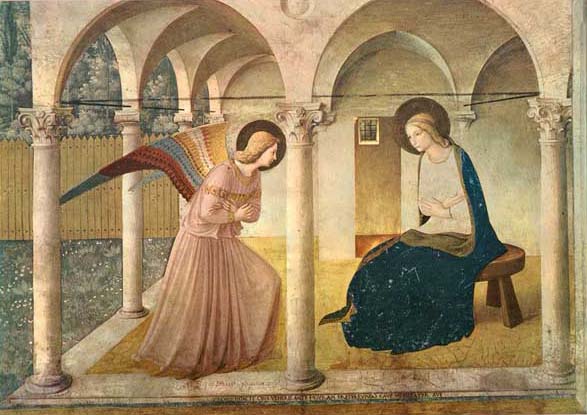
Fra Angelico's Angel of the Annunciation

Fra Angelico’s Angel of the Annunciation

In mediaeval times and up until the Renaissance, belief in the reality of angels was an absolute. You only have to look at the wonderful timber roofs of mediaeval churches, thronged with angels with their wings outspread around the roof bosses and the hammer beams; think of mediaeval art and Fra Angelico’s Angel of the Annunciation; go to a gallery of mediaeval or renaissance paintings and see how many angels are depicted there. The realm of the angels was clearly accepted as an absolute certainty and a factor of supreme importance in life, not only because angels were seen as the intermediaries between Heaven and Earth, but also because, as Steiner has described, in those times there were remnants of a kind of atavistic clairvoyance which allowed many people to have their own perceptions of the spiritual world and to report on this to others.

An angel on a hammer beam at the Church of St Agnes, Cawson, Norfolk. (Photo by Michael Rimmer)

An angel on a hammer beam at the Church of St Agnes, Cawson, Norfolk. (Photo by Michael Rimmer)

Then, in Steiner’s account of how humanity is evolving, we began to lose that ancient sense of clairvoyance and thus our awareness of the spiritual world. This was a necessary but very dangerous step in the evolution of humankind. It was necessary because as humans we have the unique privilege of developing freewill, which could only happen by entering an age in which our connection with the divine-spiritual beings and their will for our future appeared to be severed. And it was dangerous because this apparent severance from spirit existence has given the adverserial powers an opportunity they didn’t have before, which is to convince human beings through our science and technology that physical, material reality is the only reality; and thus to thwart our true destiny, which is to evolve into what Steiner called the Tenth Hierarchy. (I find Steiner’s terminology here confusing and for reasons which I go into below, will from now on refer to “order” rather than “hierarchy” for particular types of angel.) Steiner tells us that aeons from now, in a future incarnation of the Earth, humankind is destined to become the tenth order of angels – the order of Love and Freedom.

It is only humans, rather than angels, who have the potential to develop this highest form of freedom, because it is only humans who have descended this deeply into matter, where the divine and spiritual powers are no longer active. This is also why only human beings are capable of becoming atheists and denying the spirit – the angels cannot do this because they know the true reality, whereas through materialism and living in the realm of maya (illusion), we humans are free to decide what we choose to believe – and of course we will often make “wrong” choices. It is all part and parcel of our journey towards wisdom.

I’ll be writing a little bit more about this in Part 3 but for now I’ll just mention that for all of its downsides, Steiner tells us that materialism remains the vehicle for the initial development of human freedom. It was the task of materialistic science to lead us away from the overwhelming dominance of theology and theocracy in human affairs, and from the unfreedom that had for so long been associated with them. And, as Steiner repeatedly asserts, it is in our relationship as spiritual beings to the physical world that the possibility for human freedom first manifests itself. Put differently, materialism for all its faults and limitations had a very important task to perform, and it needed time to complete it – and if Steiner is correct, it’s still got another 250 years or so to run its course.

But what of the first nine orders of angels? I’ve prepared a table below to set out the thoughts of Steiner on the celestial order. Steiner seems to have adopted the scheme devised by a 6th century theological writer known rather mysteriously as pseudo-Dionysius the Areopagite. This same scheme was taken up by Thomas Aquinas, the great Dominican teacher (whom some claim to have been a previous incarnation of Steiner) and subsequently endorsed by the Catholic Church.

Now, I’m someone who finds the concept of “orders” and “hierarchy” very off-putting. It conjures up images of some kind of 19th century aristocratic or militaristic order of society, with everyone knowing their place:

“The rich man in his castle,

The poor man at his gate,

God made them high and lowly,

And ordered their estate.”

(These words come from a verse – usually omitted today – of the hymn All Things Bright and Beautiful.) Steiner encourages us not to see the orders of angels as a hierarchical, military-style ranking but more as a metaphor for some very profound truths about the unfolding of evolution. I think we should also bear in mind that these orders and hierarchies are working and co-operating together, rather than maintaining some kind of caste-like rigidity of separation.

I have to say that it is very confusing to try to follow all the different names and groupings that are given to the angels, not least by Steiner himself, who seems to use the words “order” and “hierarchy” interchangeably; plus there does seem to be some confusion among other writers about this topic. In this posting and in the table below I’m using the term “order” for one specific type of angel (eg the archangels are the 8th order); and “hierarchy” for a group of angels whose work goes together (eg the 1st Hierarchy consists of Seraphim, Cherubim and Thrones). Anyway, I hope that this table will at least give you a place to start in assembling your own thoughts on the matter.

In Part 2 of this 3-part posting, I will write about the angelic orders that Steiner mentions in the College Imagination, that is to say the angels of the 7th, 8th and 9th orders, who are the ones closest to us as human beings; and what these angels are seeking to achieve for humankind at the present time. In Part 3, I will write about Steiner’s concept of evil and the “adversely commanded” angels Lucifer and Ahriman, as well as the role of Michael, the great angel who is the spirit of our age. I will also be touching upon some huge dangers with which the adversarial powers are currently confronting humanity – and towards which we seem to be sleepwalking, ignorant and unaware of what is facing us.


THE CELESTIAL ORDER

The Holy Trinity
(Father, Son & Holy Spirit)

The Nine Orders of Angels and the Three Hierarchies

Screen Shot 2015-09-19 at 20.37.50


1 Comment

September 10, 2015 · 9:17 pm

A personal credo

What is it that you yourself believe, I was asked. A challenging question, and one which has taken me some while to think about. The A J Balfour poem I quoted in my post of 6th April 2015 contains the following lines:

“Our highest truths are but half-truths;

Think not to settle down for ever in any truth.

Make use of it as a tent in which to pass a summer’s night,

But build no house of it, or it will be your tomb.”

Those are wise words and I quote them again here to indicate that what follows is a summary of what today I believe to be true but which I may modify at some future time, as my own insights and understanding unfold. I also think that, at our present stage of human development, any truth ought to be regarded not as a literal, objective truth but as a metaphor for a truth way beyond what we are currently capable of comprehending. But you have to start from where you are and this is where I am right now.

I believe in a Prime Cause or God, the creator of all universes, the origin of life itself, a being that is at present beyond human comprehension but who has created everything that exists, and indeed is everything that exists, including countless other realms of life and existence stretching forth into infinite eternity.

I believe that I am part of God and so are you and so is everybody and everything else; and that God lives through us and understands its own nature through the experience of the totality of creation.

I believe that at the deepest levels of our being there is in each of us a yearning to return to union with God.

I believe that we get hints or glimpses of the nature of God the unmanifest, in many different ways, but especially through our experience of loving and of being loved.

I believe that the sun is a physical symbol of the Cosmic Christ, the great spirit who came from the spiritual sun and who overlighted Jesus of Nazareth for the last three years of his life; and who is as close to my idea of God as I can currently encompass.

I believe that, just as the sun shines on all, so the Cosmic Christ overlights all human beings, irrespective of race, nation, belief or non-belief.

I believe that the Cosmic Christ is also present within the etheric body of the earth, thus every aspect of the earth is holy and should be treated with reverence.

I believe that the Cosmic Christ is that aspect of God which gives light and warmth to all life and also permeates all life, so that all of creation, including each human being, has a spark of the divine sun within itself.

I believe that we are spiritual beings currently having human experiences in physical bodies; and that we are subject to a constant cycle of birth, death and re-birth over many lifetimes.

I believe that the divine spark within each of us grows during our successive incarnations on earth; and that after many lifetimes this spark grows into a fire strong enough to transmute the physical particles of our body into light itself.

I believe that, when this stage is reached, the soul is freed from the necessity to reincarnate; but that some great souls voluntarily reincarnate so as to help the rest of struggling humanity to make progress.

I believe that the overall pattern of our present life has been set by how we lived our previous lives; and that the pattern of our next lifetime is being determined by how we live each day of this life.

I believe that the purpose of human life on earth is:

  • to unfold the divine plan for each one of us, to work out our karma and develop our consciousness in ways that can only occur in physical incarnation
  • to prepare for our return to God and our ultimate destiny of becoming co-creators with God, by learning how to use our creativity and free will with wisdom
  • to release the spirit that is encased in all matter and so transform the world through love that the earth eventually becomes the planet of love, thus fulfilling the evolutionary task of humankind.

I believe that free will is a privilege that has been given only to human beings.

I believe that life on earth is governed not only by physical laws such as gravity and action/reaction but also by a number of cosmic laws, including:

  • Reincarnation, the Law of Rebirth
  • Karma, the Law of Cause and Effect
  • The Law of Opportunity
  • The Law of Balance and Equilibrium
  • The Law of Correspondences*

I believe that the most powerful and all-pervading force in the world is Love.

I believe that Evil is also a reality in human evolution, the task of which is to divert human beings from their true goals and evolutionary opportunities.

I believe that there is no such thing as time but only one continuous moment and that consciousness is the only thing that exists.

I believe that there is nothing and no-one, however small or overlooked, that is insignificant or meaningless.

I believe that human beings are part of a world in which everything is intimately connected with everything else and “That Art Thou” is a statement of profound truth.

I believe in the existence of angels and archangels of many kinds; and that each one of us has a guardian angel.

I believe in elemental beings and the need to acknowledge their existence and work with them for the benefit of all life.

I believe that there are very many forms of non-physical life and intelligence not only on the earth but throughout the countless universes that God has created.

I believe that ‘death’ (meaning permanent extinction or non-consciousness) does not exist in any of the universes and is an illusion within the human mind.

* I have written in more detail about these cosmic laws in my posting of September 16th 2014: “Karma and the Steiner Waldorf teacher.”

7 Comments

Filed under Anthroposophy, Karma, Personal Credo, What I believe

A little oil for our lamps

Once again I must express my gratitude to Alicia Hamberg, whose thoughts from a perspective that is often critical of anthroposophy, have from time to time provoked me into writing posts on this blog.

The proximate cause of what follows is something that Alicia wrote as a reply to my post of April 6th 2015, “The terror of the infinite desert: atheists in the face of death”. Here is part of what she said:

“You may very well be right that your approach — or illusion — is ‘rational’ in some ways, regardless of whether it conforms to truth. But it only works as long as you’re able to tell yourself that it is at least likely to be true! The second you start to doubt it — at least if this doubt is more than just a fleeting thought — its ability to comfort diminishes, because if there’s serious doubt, you can’t lay the worries entirely to rest! (As a side-note, what happens after death according to anthroposophy is not necessarily a comforting thought — it is quite daunting.)”

I mentioned in that posting that I’m someone who is certain that life continues after death and therefore I have no fear of dying (although I am of course afraid of a painful death or a long drawn-out disabling illness). But there is another aspect of death that I do find daunting and that is the possibility that one could be caught in a kind of limbo, unable to return to earth but either terrified or completely unaware of the possibility of moving on into the spiritual world.

As it happens, I’ve known some people with clairvoyant and healing abilities who are able to do what is called rescue work with souls who “get stuck” in the astral plane after death. This very unfortunate state can happen to people who during their earth lives have no belief in reincarnation or life after death, or who for whatever reason are very earth-bound – and it can last for hundreds or even thousands of years. It is these stuck souls who are sometimes perceived as ‘ghosts’. What seems to occur is that their very strong non-belief that life continues in a different form after death (or their shock, in the case of those who have died a violent death) prevents them from becoming aware of the higher frequency spiritual beings who have come to help them make the transition. This is where clairvoyants with a particular gift for this kind of rescue work can help, because their own “vibrations” are low enough (because they are still attached to their physical bodies) so that souls trapped in the astral plane can actually perceive these earthly helpers, and may begin to listen to their advice about how to move on.

According to a lecture given by Steiner in May 1913, “the earth is neither a mere transitional stage, nor a vale of despair, but it exists so that on it a spiritual knowledge can be developed which can then be carried upwards into the spiritual worlds.” More than this, he says that it is only on the earth that such knowledge can be acquired – it’s usually too late once you’ve died: “This is due to the fact that the content of earthly theosophy can only be acquired on earth within a physical body. It can then be made use of in the spiritual world but it must be attained within a physical body….” Steiner gave quite a few lectures in 1912 and 1913 on what life is like between death and re-birth. You can read them, if you’re interested, in the invaluable online RS Archive.

Steiner’s message in the quotation above (you can tell by the reference to theosophy that it was given at a time when he was still the general secretary of the German section of the Theosophical Society) is the same as the message of Jesus Christ’s parable of the Wise and Foolish Virgins. The parable does not criticise the foolish virgins for sleeping, because the wise ones also fall asleep – but instead it takes them to task for being unprepared, for not having the oil for their lamps. The oil we all need, so that our lamps can light us into the spiritual world when the time comes, is the knowledge of what to do when we die. It’s pretty astonishing that there is so little preparation for death – after all, we have the National Childbirth Trust and pregnancy classes for the beginning of physical incarnation but when it comes to excarnation, we have few equivalents for the final stages of life – although the soul midwifery movement is doing excellent work in this field.

Rescue workers say that the basics are not that complicated – all we need to do is recognise our deceased family members and friends and go with them, or sometimes just look for a beckoning light and then follow it. I do think that atheists in particular should be prepared to be open to such possibilities when they die, even if they despise themselves for entertaining such ideas – the alternative of getting stuck for centuries is too terrible to contemplate.

8 Comments

Filed under Anthroposophy, Atheism, Fear of Death

A Noah’s Ark for all our futures

Despite all my experiences in recent years, I’m still sometimes taken aback by the sheer antagonism towards applied anthroposophy that emanates from some people. No sooner had I tweeted the news that Chateau Palmer, one of the most starry wine producers in the Bordeaux firmament, has gone fully biodynamic and is receiving a price premium for its wines, than someone who tweets as GinaMakesWaves re-tweeted my post to all her 791 followers with the comment: “Biodynamic agriculture offers nothing over traditional organic and it practices animal cruelty”. She then followed up this absurd statement with: “Biodynamic agriculture is a main industry of anthroposophy, both with a complex Nazi past.”

Where to begin, when dealing with such wild assertions? Actually, I’m not going to bother; such wilful misunderstandings are Gina’s issue rather than mine. All I will say is: if you want to find out whether biodynamics practises animal cruelty, just go and visit a biodynamic farm and talk to the farmers and gardeners. As for a complex Nazi past, I wish I could say that no anthroposophist had ever flirted with Nazism, but I can’t say that, because in the 30s and 40s there were a few anthroposophists who leaned in that direction; no more than I can say that no anthroposophist has ever flirted with communism or conservatism or socialism or any other kind of –ism. Because anthroposophy attracts all types of people and, as they say in Yorkshire, there’s nowt as queer as folk.

But in my experience, anthropops are on the whole very decent and caring people, give or take the odd exception – rather like the general population, in fact.

This attack on biodynamics no doubt caught me on the raw, because I had just experienced an exceptionally heartwarming celebration of one farmer’s 21 years on a biodynamic farm, Tablehurst Farm in Forest Row, East Sussex. This was a Midsummer Celebration Lunch for Peter Brown, the farmer who with
his late wife Brigitte arrived at the farm in 1994 with their three children and turned the farm into a shining example of biodynamic and sustainable agriculture that is also a community-owned farm and in addition provides a home for adults with learning difficulties. You can see on the farm’s Facebook page lots of photos of the celebration lunch (scroll down past the cows and flowers), held in the beautifully-decorated Sheep Barn at Tablehurst.

Throughout these 21 years, Peter has dedicated himself to the wellbeing of the land, the plants, the animals and the people working on the farm, without any thought for building up any assets of his own. During this time, Peter has also taken on the executive directorship of the Biodynamic Agricultural Association and has been selflessly involved with many initiatives towards more sustainable forms of agriculture.

This lunch was not just a celebration of all that Peter Brown has achieved but it was also the launch of a fundraising campaign to build an eco-home on the farm for him to live in for the rest of his days. To do this, we aim to raise £100k, not only to build a home for Peter but also to provide housing improvements for the young farmers who are starting families on the farm. As a member of the fundraising committee, I spoke at the lunch and made the following points:

• The average age of a farm worker in Britain today is 59 years
• In conventional farms, 1 or 2 men will look after several hundred hectares of land
• According to an article in the respected trade journal, Farmers’ Weekly, some of England’s most productive agricultural land is at risk of becoming unprofitable within a generation due to soil erosion

I then compared and contrasted this with what is happening on Tablehurst Farm:

• Young men and women are flocking to the farm to work and some of them are starting families here
• The farm currently has 26 employees and growth looks set to continue
• You only have to walk across the farm to feel the wellbeing from the soil rising up towards you – the biodiversity on the farm is fantastic.

It’s clear that conventionally-managed farms with their monocultures, degraded soils, vast inputs of artificial fertilisers and pesticides and herbicides that pollute the soils and water and reduce biodiversity, are pursuing an unsustainable course.

By contrast, a farm like Tablehurst offers hope for the future. It shows that there are viable alternatives that can preserve and improve our soils, do not ask more of the land or the animals than they can give, and provide employment in situations where young people want to live, learn and start families. These farms are like a kind of Noah’s Ark for our collective future, showing that feeding the world and its burgeoning population does not have to be handed over to Monsanto and other large corporations. A much better, more human future is possible and biodynamic and sustainable agriculture is showing the way.

By the way, it’s just a month after we started fundraising for housing on the farm and we’ve already raised £25k (a quarter of our target). If you’d like to help, there are more details here.

11 Comments

Filed under Biodynamic farming, Biodynamics

What will survive of us is…

Death and mortality have been much on my mind lately.  You may have noticed this in the last two postings on this blog. Recent events have reinforced this theme; for example, I’ve just been to the Isle of Wight with cousins to scatter the ashes of my late aunt Gwen, while on the same day my wife went to a memorial gathering for Nick Thomas, a scientist, researcher and a former general secretary of the Anthroposophical Society in Great Britain, who died in April.

On the Isle of Wight, my cousins and I had a simple and dignified final leave-taking of Gwen; a poem was read, and the ashes were consigned to the sea, their traces marked by flowers which floated on the water, moving onwards and outwards with the patterns of the tide. Afterwards, we went for lunch in the pub where Gwen had once worked behind the bar, in the village where both Gwen and my parents had lived.

flowers on the sea

My relatives, two of whom had flown from the USA to say their farewells, wanted to take a last look at the house where Gwen had lived and also to look at my late parents’ home, where they had often been welcomed. So after lunch, we strolled the few yards to my parents’ house. We could scarcely recognise it, such was the extent of the changes made to the house by the new owners. Where was the tall hedge? Where was the climbing rose? Most of the front lawn had been covered over by a concrete driveway. The front door had now retreated behind a glass-filled porch. There was no longer any connection between this house and my parents.

We then walked slowly up the village street to see the house where Gwen had lived. This house, too, had been transformed by its new owner – instead of the white-painted brickwork we remembered, the entire surface of the house, even up to the top of the chimney-stack, had been pebble-dashed. This was a clear visual indication that this house, too, had changed and Gwen was not to be found there.

What can be said in the face of such finality? My parents, my aunt, Nick Thomas – all are gone. They, who seemed so alive, so present, are no longer in physical existence. And yet one still feels so connected, can hear their voices, can bring their faces and characters to mind. Surely they are still real, even though not physically with us. An atheist would say that I am being absurd, that consciousness dies with the physical body; we have just one life, that it comes out of nothingness and randomness, and at death there is complete extinction.

Nick Thomas

Nick Thomas

When I got home from the island, my wife told me about the memorial gathering at Rudolf Steiner House in London for Nick Thomas, at which many people had spoken about him. One of the most moving contributions came from 17-year old Flora Kaye, a student from the Kings Langley Steiner school, who got up to deliver a tribute she had written. A few days before Nick died, he had gone to the school, where he taught philosophy to the older classes, to say goodbye to the students. He had told them he would soon be leaving his body and was looking forward to the next stage. Flora felt that, perhaps unlike in lessons, she was now hearing Nick properly and this is what she had to say about it:

“To a man of great wisdom and inspiration.

Hello,

I hear you ended this form of living. I hear you no longer see with your eyes, hear with your ears and think with your brain. I hear you now. I hear you loudest now your silence becomes eternal, and I feel a pang of grief for not listening sooner. But this path leads me closest to learning more about you and more about myself and for that I am gratefully standing here.

I was told of your journey, your great mind and your warm heart. I then heard your voice and I still wasn’t ready to listen. My ears still developing, I only heard an echo of what you said, still searching within myself for the words you spoke to the world. The words you had been searching for long before my noise, my breath began.

And then I heard you loud. I watched your strength take you by your hand and lift you up. I saw you speaking out with all your heart, where others were too afraid to wonder.

I heard something extraordinary. I heard what I had been seeking.

I heard an embrace of love, of exquisite acceptance of the parting of breath. And most magically displayed, for all youth to witness. You stunned me, in awe I sat, having just experienced such raw expression, with open finality. Most of all I heard a man standing tall and mighty, at the doors, leaving the room with such love for that which you are departing from, and equal love for the next room you are entering.I heard today you stood up once more. I heard you departed with your breath. I heard so strongly your embrace of life, so alive were you.

So full of life are you.

Being witness to your death of life, I see that through dancing with death, you have become closer to life. And now you live on through another realm we call death, more loudly than ever do I hear you alive.

In memory of Nick Thomas.”

My wife said that one could have heard a pin drop after this contribution. It was as though Flora had introduced a note of holy truth, of what is truly real, into the gathering.

Philip Larkin, himself either an agnostic or an atheist and not known for his charitable feelings towards others, was nevertheless a true poet; and as a true poet, from time to time he was able to get in touch with a reality greater than his curmudgeonly persona would normally admit to. One of his best-known poems is An Arundel Tomb, inspired by the 14th century tomb of the Earl and Countess of Arundel in Chichester Cathedral. Above the tomb lie the carved statues of the Earl and his wife, as if asleep in bed:

The tomb of the Earl and Countess of Arundel in Chichester Cathedral (photo via E-Verse Radio)

The tomb of the Earl and Countess of Arundel in Chichester Cathedral
(photo via E-Verse Radio)

An Arundel Tomb

Side by side, their faces blurred
The earl and countess lie in stone,
Their proper habits vaguely shown
As jointed armour, stiffened pleat,
And that faint hint of the absurd–
The little dogs under their feet.

Such plainness of the pre-baroque
Hardly involves the eye, until
It meets his left hand gauntlet, still
Clasped empty in the other; and
One sees, with sharp tender shock,
His hand withdrawn, holding her hand.

They would not think to lie so long.
Such faithfulness in effigy
Was just a detail friends could see:
A sculptor’s sweet commissioned grace
Thrown off in helping to prolong
The Latin names around the base.

They would not guess how early in
Their supine stationary voyage
Their air would change to soundless damage,
Turn the old tenantry away;
How soon succeeding eyes begin
To look, not read. Rigidly they

Persisted, linked, through lengths and breadths
Of time. Snow fell, undated. Light
Each summer thronged the grass. A bright
Litter of birdcalls strewed the same
Bone-riddled ground. And up the paths
The endless altered people came,

Washing at their identity.
Now, helpless in the hollow of
An unarmorial age, a trough
Of smoke in slow suspended skeins
Above their scrap of history,
Only an attitude remains:

Time has transfigured them into
Untruth. The stone finality
They hardly meant has come to be
Their final blazon, and to prove
Our almost-instinct almost true:
What will survive of us is love.

Larkin’s poem is sometimes seen as ironical (eg the earl and countess lie in stone, with the word ‘lie’ to be taken in the sense of telling a lie – the stone tomb is a public statement that wouldn’t have corresponded to the actual human reality of the marriage) yet the last stanza of the poem, despite the “almost-instinct almost true”, seems to contradict his cynical pessimism. And indeed, it is true – what remains, what will survive of us after everything else has gone, is love.

4 Comments

Filed under Atheism, Atheists & Atheism, Fear of Death, Mortality

A tent in which to pass a summer’s night

‘Our highest truths are but half-truths;

Think not to settle down for ever in any truth.

Make use of it as a tent in which to pass a summer’s night,

But build no house of it, or it will be your tomb.

When you first have an inkling of its insufficiency

And begin to descry a dim counter-truth looming up beyond,

Then weep not, but give thanks:

It is the Lord’s voice whispering,

“Take up thy bed and walk.” ‘

A.J. Balfour’s poem came to mind when, after my previous posting (“The terror of the infinite desert: atheists in the face of death”) I was challenged by one of the more prominent Waldorf critics, Alicia Hamberg, to say what kind of God I believed in; and more than that, to say what kind of God Rudolf Steiner may have believed in.

The question of what kind of God I believe in I will leave for another posting; and needless to say, I am unfitted to pronounce on Rudolf Steiner’s understanding of God, for the insights of a great initiate like Steiner are beyond anything that I could truly grasp or usefully comment on. What I will attempt to do in this posting, however, is to bring together some thoughts that may help to erect a tent of these “half-truths” to shelter us for a night or two during our journey towards understanding something of Steiner’s spiritual vision.

These half-truths are of course ones that appeal to me but may not appeal to other people. Why is it that we have so many diverging views among ourselves? In his Philosophy of Freedom, Steiner introduces us to the idea of twelve world-views:

“We must be in a position to go all round the world and accustom ourselves to the twelve different standpoints from which it can be contemplated. In terms of thought, all twelve standpoints are fully justifiable. For a thinker who can penetrate into the nature of thought, there is not one single conception of the world, but twelve that can be equally justified — so far justified as to permit of equally good reasons being thought out for each of them. There are twelve such justified conceptions of the world.”

I don’t want to go into this in any more detail now but if you want to explore it further you can of course google Philosophy of Freedom. The reason for mentioning it here is that, of the twelve world-views listed by Steiner, the one to which I am most drawn is called by him Spiritism; and the one that most atheists adhere to, I would suggest, is Materialism. According to Steiner, both viewpoints are fully justifiable, with equally good reasons being thought out for each of them; and because both are valid and rational, they satisfy us and on the whole, we don’t look beyond them. A materialist may find my approach illogical and unjustifiable and I will tend to find the materialist’s approach equally unsatisfactory. The point here is that the truth does not lie within my ‘spiritist’ world-view or your ‘materialist’ world- view but perhaps in a synthesis of the twelve different world-views, or even in a quite different place altogether. The implication is that both of us would be wrong if we were to insist that our view is the only right one. To acquire access to that synthesis, that all-round view of every aspect of the truth, is part of our journey towards wisdom.

I’ve quoted this passage from Tarjei Straume before, but it bears repeating:

“People who are influenced in their habits of thought, philosophies, historical perspectives etc. by anthroposophical studies, don’t always agree. On the contrary, they quite often collide on specific issues, concepts, and perspectives. This is inevitable, because anthroposophy is not an ideology, it’s not a religion, it’s not a lifestyle (although some lifestyles have been associated with it, perceptually), and it’s not a political agenda, the idea of the Threefold Social Order notwithstanding. It may however be classified as a doctrine, or a set of doctrines — not really comparable to religious doctrines, but more to scientific doctrines, say like the doctrine of heliocentrism that was introduced by Copernicus and Galileo in the 16th and 17th centuries — a theory that was officially prohibited by the Church in 1616 but is now so absorbed and widespread that anything that contradicts it is heresy. Thus it may be argued that the anthroposophical worldview is a relatively new heretical theory that may replace Copernicanism, Newtonianism, Darwinism, and Einsteinism in the future…

What it all boils down to, however, is that anthroposophy is nothing but a path to the Spirit available to everyone and basically compatible with any cultural or religious background, including secular humanism. As a matter of fact, humanism is the basis, the point of departure, for the epistemology that is the backdrop of anthroposophy and therefore also its backbone.”

This is clearly not the kind of humanism espoused by the British Humanist Association, whose slogan is: “For the one life we have”. How can they be so sure? Could it be that most of their members are people who take what Steiner calls the Materialist world-view? But these humanists may be surprised to read what Steiner had to say about religion in his 1899 essay on Egoism in Philosophy:

“One way man comes to terms with the outer world consists, therefore, in his regarding his inner being as something outer; he sets this inner being, which he has transferred into the outer world, both over nature and over himself as ruler and lawgiver.

This characterises the standpoint of the religious person. A divine world order is a creation of the human spirit. But the human being is not clear about the fact that the content of this world order has sprung from his own spirit. He therefore transfers it outside himself and subordinates himself to his own creation.

… This way of coming to terms with the world reveals a basic characteristic of human nature. No matter how unclear the human being might be about his relationship to the world, he nevertheless seeks within himself the yardstick by which to measure all things. Out of a kind of unconscious feeling of sovereignty he decides on the absolute value of all happenings. No matter how one studies this, one finds that there are countless people who believe themselves governed by gods; there are none who do not independently, over the heads of the gods, judge what pleases or displeases these gods. The religious person cannot set himself up as the lord of the world; but he does indeed determine, out of his own absolute power, the likes and dislikes of the ruler of the world.

One need only look at religious natures and one will find my assertions confirmed. What proclaimer of gods has not at the same time determined quite exactly what pleases these gods and what is repugnant to them? Every religion has its wise teachings about the cosmos, and each also asserts that its wisdom stems from one or more gods.

If one wants to characterise the standpoint of the religious person one must say: He seeks to judge the world out of himself, but he does not have the courage also to ascribe to himself the responsibility for this judgment; therefore he invents beings for himself in the outer world that he can saddle with this responsibility.

Such considerations seem to me to answer the question: What is religion? The content of religion springs from the human spirit. But the human spirit does not want to acknowledge this origin to itself. The human being submits himself to his own laws, but he regards these laws as foreign. He establishes himself as ruler over himself. Every religion establishes the human “I” as regent of the world. Religion’s being consists precisely in this, that it is not conscious of this fact. It regards as revelation from outside what it actually reveals to itself.

The human being wishes to stand at the topmost place in the world. But he does not dare to pronounce himself the pinnacle of creation. Therefore he invents gods in his own image and lets the world be ruled by them. When he thinks this way, he is thinking religiously.”

I doubt if there is any member of the British Humanist Association who would disagree with any of this and, indeed, it may come as a shock to some anthroposophists that Steiner held such views. The whole essay is well worth reading, as it leads on to some really insightful observations about the work of philosophers throughout the ages.

But Steiner is not content to leave things just with this piercing analysis of religious thinking – and this is where he diverges from secular humanists, who often stop at this point – because he goes on to say that active self-knowledge opens a person to the essential being of the world, with which he is inwardly then so united that he can say with equal truth, “I am” and “I am the world.” The other person’s self also is and is the world, so conflict and disagreement, belief and non-belief are simply irrelevant.

How does one acquire this active self-knowledge? In the last chapter of Steiner’s Riddles of Philosophy (1914), he refers to soul exercises given earlier in the book and elsewhere and says that these exercises can result in the soul unfolding a different consciousness than its ordinary one and thus arrive at spiritual perception. And it is only through this different spiritual perception that the soul can truly know itself and consciously experience itself in its essential being. He also realises that many people will not be able to go along with this:

“It is only too obvious that the adherents of many modern points of view will consign the world revealed here to the realm of mental aberration, of illusion, of hallucination, of auto-suggestion, and the like. One can only answer them that an earnest striving of the soul — working in the way just indicated — finds, in the inner, spiritual state which it has developed, the means to distinguish between illusion and spiritual reality; and these means are just as sure as those used in ordinary life, in a healthy state of soul, to distinguish between something imaginary and something actually perceived. One will search in vain for theoretical proof that the spiritual world characterised above is real; but such proof of the reality of the perceptual world does not exist either. In both cases it is the experience itself that determines how one is to judge.

What keeps many people from taking the step which, according to our presentation, alone offers a prospect of solving the riddles of philosophy is that they believe such a step will land them in a realm of nebulous mysticism. But anyone who has no soul predisposition toward such nebulous mysticism will, along the path just described, gain access to a world of soul experience that is just as crystal clear in itself as the structures of mathematical ideas…”

So Steiner is saying that through true perception of the nature of reality, the human ‘I’ can participate fully in the essential nature of everything – there is no longer a need to invent a God that is separate from ourselves because in fact we are ourselves, in the happy phrase of the late Sir George Trevelyan, droplets of divinity. What does this mean, both for us as human beings and in terms of Steiner’s own insights into the prime cause? There is much more to explore here!

2 Comments

Filed under Anthroposophy, Atheism, Humanism, Philosophy of Freedom, Rudolf Steiner

The terror of the infinite desert: atheists in the face of death

When I was in my teenage years, I called myself an atheist. In my twenties, although still professing atheism if anyone asked about religious beliefs, I modified my stance to agnosticism. In my next decade, in 1984 when I was thirty three, I experienced an epiphany, which decisively changed my spiritual outlook. Since then, I’ve had other experiences which have made me certain that there is more in heaven and earth than is dreamed of in the atheist’s philosophy.

Today, atheism seems to me to be an adolescent phase of belief that some people get stuck in all their lives, either through a failure of imagination, a kind of anger with “God” or a rigidity of thinking. Nevertheless, many people persist with it and find it decidedly infra dig to hold any kind of view other than atheistic materialism.

If I’d been able to move in the literary and artistic circles to which I was most drawn when I was younger, I would like to have known successful writers such as Julian Barnes and Jenny Diski. If I’d ever got to meet them, I wouldn’t have had the intellectual self-confidence to say that I didn’t share their atheism, which to my mind has to some extent limited their capacity to be truly great writers; but I can still read their works with interest and enjoyment and the sympathy that comes from being of a similar generation. So when tragedy has struck them, as it has in recent years, and they have written about it, because that’s what writers do, my heart goes out to them as if they were long-standing friends whom I would help if I could.

Julian Barnes wrote a book about his fear of death called Nothing to be Frightened Of. With terrible irony this was published six months before his beloved wife, the literary agent Pat Kavanagh, was diagnosed with a brain tumour. She died in October 2008, just thirty-seven days after the diagnosis. They had been married since 1979. In Levels of Life, published in 2013, he writes about his grief: “I was 32 when we met, 62 when she died. The heart of my life; the life of my heart.” He contemplates suicide and goes so far as to work out how he will do it; but then he realises that he is his wife’s chief rememberer, and if he kills himself he will be killing her too.

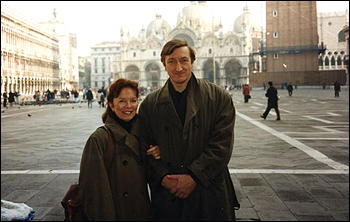
Pat Kavanagh & Julian Barnes in Venice - photo via the Daily Telegraph

Pat Kavanagh & Julian Barnes in Venice – photo via the Daily Telegraph

I feel that I know Jenny Diski well, even though we have never met, because I used to know people who could have been her; and she writes wonderfully well about herself. She had a pretty grim childhood and spent some of it as in- or outpatient at various psychiatric institutions. A natural rebel and a child of the ’60s, with all that that implies, she was taken into the Mornington Crescent home of the novelist Doris Lessing, whose son had told her about Jenny’s difficult family life. Eventually, Jenny was able to resume her education; and by the early 1970s was training as a teacher, starting a free school, and later publishing her first book. In September 2014, Jenny revealed in an article in the London Review of Books that she had been diagnosed with inoperable cancer. Since then, she has published several moving articles about her thoughts, feelings and experiences while facing death from cancer. In the 9th April 2015 issue, she expresses her views as an atheist about the nature of life and death by quoting both Samuel Beckett and Vladimir Nabokov

“I too shall cease and be as when I was not yet, only all over instead of in store.”

From an Abandoned Work (Beckett)

“The cradle rocks above an abyss, and common sense tells us that our existence is but a brief crack of light between two eternities of darkness” Speak, Memory (Nabokov)

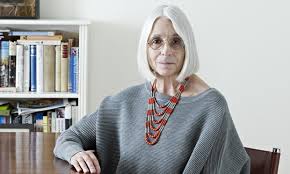
Jenny Diski - photo via The Guardian

Jenny Diski – photo via The Guardian

Neither Beckett nor Nabokov are writers I would go to for reassurance when facing death but Jenny finds some solace in the thought that we have but one life between nothingness:

“This thought, this fact, is a genuine comfort, the only one that works, to calm me down when the panic comes. It brings me real solace in the terror of the infinite desert. It doesn’t resolve the question (though as an atheist I don’t really have one), but it offers me familiarity with ‘the undiscovered country from whose bourn no traveler returns’. I’ve been there. I’ve done that. And it soothes. When I find myself trembling at the prospect of extinction, I can steady myself by thinking of the abyss that I have already experienced. Sometimes I can almost take a kindly, unhurried interest in my own extinction. The not-being that I have already been. I whisper it to myself, like a mantra or a lullaby.”

As someone who is certain that life continues after physical death, I can say that I have no fear of dying, although I do have fear of a painful death or a long drawn-out disabling illness. But for atheists it must be far worse. Here is what Julian Baggini, philosopher and author of “Atheism: A Very Short Introduction” has to say:

“I think it’s time we atheists ‘fessed up and admitted that life without God can sometimes be pretty grim. Appropriating the label “heathen” is part of this. Heathens are unredeemed outcasts from heaven who roam the planet without hope of surviving the deaths of their bodies. They may have values but they are not secured by any divine source. Yet we embrace this because we think it represents the truth. And so we don’t just get on and enjoy life, we embark on our own intellectual pilgrimages, trying to make some progress in a universe on which no meaning has been writ. The journey can be wonderful but it can also be arduous and it may end horribly. But there is no other way, and anyone who urges you to follow a path that they promise leads to a bright future is either gravely mistaken or a charlatan.”

So as someone who could be gravely mistaken but hopes he is not a charlatan, is there anything comforting I could say to Julian Barnes or Jenny Diski? I apologise to them in advance for this assumption that I can address them as familiars. Julian Barnes has written in Flaubert’s Parrot: “Why does the writing make us chase the writer? Why can’t we leave well enough alone? Why aren’t the books enough?” Well, Julian, we pay good money to buy your books, which seem to take us some way into your life, and so we like to imagine that we know, and can say things, to you.

I don’t think it would be any good for me to try to reason, since you will undoubtedly regard my standpoint as irrational (although I might ask in passing: how do you suppose that life can come from lifeless matter and randomness? It’s like saying that a corpse is the true being of Man).

Nor do I think that it would cut any ice with you if I were to refer to anthroposophy, as you would only roll your eyes at my gauche attempt to introduce something so foreign to intellectual good manners. From your perspective, it would require an unfeasibly large amount of disbelief-suspension to take on board Rudolf Steiner’s cosmology: etheric and astral bodies, planetary evolutions, elemental beings, Lucifer, Ahriman, asuras and the rest. It would be like Alice in Wonderland with the White Queen:

“Alice laughed: “There’s no use trying,” she said; “one can’t believe impossible things.”

“I daresay you haven’t had much practice,” said the Queen. “When I was younger, I always did it for half an hour a day. Why, sometimes I’ve believed as many as six impossible things before breakfast.”

But an even worse hurdle than getting past the jargon and the strange concepts, is that anthroposophy claims to be a science of the spirit, which implies that the results will be reproducible by anyone who masters the same necessary tools of cognition as Rudolf Steiner. Atheists find this claim particularly challenging in a way that they would not if anthroposophy called itself a religion. And this is a pity, because anthroposophy has great insights and indeed, comfort and reassurance for anyone who is scared of death.

One of the most important ways in which anthroposophy can help with this fear is by increasing understanding of the cosmic laws of karma and reincarnation that govern all our lives. The atheist’s key premise, of course, is that life and consciousness are inconceivable without a physical body – the existence of a living being without a physical counterpart is simply not possible and death extinguishes individual existence completely. Through anthroposophy we learn that this notion of one single life lived between not-being and extinction is simply wrong – a cruel illusion that can only increase the terror of death.

Anthroposophy tells us that the true reality of being human is that we are spiritual beings currently having human experiences in physical bodies. That is the true nature of what it means to be a human being – we come from the spirit and we will return to the spirit and this cycle continues over many lifetimes. And although this posting is about death, we should never forget that there is also life before birth, and indeed before conception. Steiner called this “unbornness” and said that the human soul’s will to incarnate exists before conception takes place.

If in former times we had been candidates for initiation, we might have experienced the reality of life beyond the physical body through what was called the “temple sleep”. After various trials, the priest or hierophant would have put us to sleep, then caused our etheric bodies to leave the physical bodies for three and a half days. During this time our etheric and astral bodies would have journeyed in the spiritual world. When our etheric bodies were brought back into the physical, we would have awakened and known with absolute certainty, through direct experience, of the reality of the spiritual world.

Human physical and metaphysical evolution has moved on and the temple sleep initiation ritual is no longer performed. Nowadays, comparable experiences can sometimes be had via shamanism. But in our present era, which extends from the 15th to the 35th century and is often called by anthroposophists the age of the consciousness soul, the spiritual world has largely withdrawn from the physical world for necessary reasons of human evolution. In Owen Barfield’s words, “Living in the consciousness soul man experiences isolation, loneliness, materialism, loss of faith in the spiritual world, above all, uncertainty. The soul has to make up its mind and to act in a positive way on its own unsupported initiative. And it finds great difficulty in doing so. For it is too much in the dark to be able to see any clear reason why it should, and it no longer feels the old (instinctive) promptings of the spirit within.”

But I suspect that anthroposophy is way beyond anything you want to hear at this stage, so perhaps you would prefer to know what a scientist has to say about these matters. I was interested to see reports in the press in 2013 of some comments made by a British doctor called Sam Parnia who is head of intensive care at the university hospital in New York and who specialises in what you might call resurrection, because he is an expert in resuscitation techniques for people who have suffered cardiac arrest. Dr. Parnia is also a researcher into near death experiences and what he calls actual death experiences. He has talked to many people about what they recall experiencing while they were dead in his intensive care unit. About half claim to have clear recollections, many of which involve looking down on the surgical team at work on their body or the familiar image of a bright threshold or a tunnel of light into which they were being drawn.   And when he was asked what conclusions he has drawn, he said this:

“When I first got interested in these mind/body questions, I was astonished to find that no-one had even begun to put forward a theory about exactly how neurons in the brain can generate thoughts. We always assume that all scientists believe the brain produces the mind, but in fact there are plenty who are not certain of that. Even prominent neuroscientists such as Sir John Eccles, a Nobel prizewinner, believe that we are never going to understand mind through neuronal activity. All I can say is what I have observed from my work. It seems that when consciousness shuts down in death, psyche or soul – by which I don’t mean ghosts, I mean your individual self – persists for at least those hours before you are resuscitated. From which you might justifiably begin to conclude that the brain is acting as an intermediary to manifest your idea of soul or self but it may not be the source or originator of it… I think that the evidence is beginning to suggest that we should keep open our minds to the possibility that memory, while obviously a scientific entity of some kind – I’m not saying it is magic or anything like that –is not neuronal.”

Dr Sam Parnia - photo via Stonybrook University

Dr Sam Parnia – photo via Stonybrook University

Well, there you have it – an eminent doctor and scientist who says that the mind and memory do not reside in the brain. Like you, Jenny and Julian, he does not have any religious faith, but he does observe that consciousness continues after “death”.

Is it possible that given a little more time and further research doctors might one day come to the conclusion that memory actually resides in something called the etheric body? We shall see! As Steiner said, “it is well to remember that, in the last analysis, there is nothing else in the universe beside consciousnesses…Thus beings in various states of consciousness are the only reality in the world.”

Let us leave the last word to Rainer Maria Rilke, to my mind a surer and wiser guide to the nature of reality than either Beckett or Nabokov:

“It is truly strange to no longer inhabit the earth,

to no longer practice customs barely acquired,

not to give a meaning of human futurity

to roses, and other expressly promising things:

no longer to be what one was in endlessly anxious hands,

and to set aside even one’s own

proper name like a broken plaything.

Strange: not to go on wishing one’s wishes. Strange

to see all that was once in place, floating

so loosely in space. And it’s hard being dead,

and full of retrieval, before one gradually feels

a little eternity…”

Rainer Maria Rilke – part of the first elegy from the Duino Elegies

8 Comments

Filed under Anthroposophy, Atheism, Dr Sam Parnia, Fear of Death, Jenny Diski, Julian Barnes

Is the establishment endorsing biodynamics?

I’ve often said that when biodynamic agriculture starts to go mainstream, it will be largely because the chattering classes and opinion-formers have discovered the special qualities of biodynamic wines. There is a delicious irony to this, of course, because anthroposophists on the whole do not approve of alcohol; so to see biodynamics beginning to win widespread and influential support through the excellence of biodynamic wine must be quite provoking to the more dyed-in-the-wool kind of anthropop.

Nevertheless, even I was taken aback to discover that the Financial Times’ distinguished wine correspondent, Jancis Robinson, is now speculating about the merits of biodynamic viticulture in improving the quality of wines at a time when climate change is causing difficulties for vine-growers. Here is what she had to say in her FT column of March 14/15:

“Vine-growers in the southern hemisphere are grappling with their earliest vintage ever, just one more effect of climate change. For us wine drinkers, the most striking effect has been the rise in alcohol levels. Hotter summers have played a key part in boosting average percentages of alcohol from roughly 12 – 12.5 in the 1980s to 13.5 – 14.5 today.

Growers have observed to their dismay that grapes have been accumulating the sugars that ferment into alcohol much faster than they have been accumulating all the interesting elements that result in a wine’s flavour, colour and tannins – the phenolics. … Who wants to drink a wine that can offer little other than alcohol?”

Ms Robinson then lists the various stratagems adopted by vine-growers to get around this problem, including picking grapes earlier, keeping grapes on the vine much longer and then adding acid, reducing the alcohol through intrusive techniques, experimenting with cunningly-timed irrigation to push phenolic ripening closer to sugar ripening etc – none of which sounds likely to improve the quality of the finished wine.

And here is Ms Robinson’s intriguing conclusion:

“But for many growers the world over, what makes balanced wines is balanced vines, which tends to mean old vines, dry farmed. And those who have adopted biodynamic viticulture – the barmy-sounding, hands-on nurturing of vines according to phases of the moon” (actually, Jancis, there’s rather more to it than that) – “report that vines ripen well-balanced grapes earlier and more completely than their conventionally farmed neighbours. Perhaps this is the answer.”

Well…when the FT’s wine correspondent can write in such terms, something is clearly going on. And here is a link to more evidence that biodynamics is receiving endorsement from the heights of the establishment, this time from Prince Charles.

The newspaper is having a pop at our future king, as usual; but the story must be absolutely true, because I read it in the Daily Mail.

1 Comment

Filed under Biodynamic farming, biodynamic viticulture, Biodynamics, Jancis Robinson, Prince Charles

Why Easter should remain a moveable feast

As we all know, journalists have staple seasonal themes that they return to with slight variations year after year. Thus in the summer, they write about school exam results and how A levels are not as rigorous as they used to be; in the autumn, when the clocks go back, they call for the abandonment of British Summer Time and if that should disadvantage the Scots, it’s no more than they deserve for their nationalist importunings; and in Spring they ask why is Easter so early/so late this year and why can’t we just pluck a fixed date out of the air and settle on that?

These journalists usually manage to find some politicians and even church representatives to back up their call to settle on one date. Secularists have suggested that Easter should fall on the second Sunday of April each year. The World Council of Churches in 1997 suggested replacing the current equation-based system for calculating the date with direct astronomical observation.

For Easter is indeed a moveable feast. To state it as simply as possible, Easter falls on the first Sunday after the first Full Moon after the Spring Equinox on 21st March. It can be as early as 22nd March, as it was in 1761 and 1818, but will not be again until 2285. It can be as late as 25th April but that hasn’t happened since 1943 and won’t recur until 2038 (although as we will see later, the church authorities got the 1943 date wrong). The commonest date is 19th April though the full cycle of Easter dates only repeats after 5,700,000 years.

Now all this is of course very untidy and much annoys bureaucrats, atheists, skeptics and planners who would like to have fixed public holiday dates – but these people are wholly ignorant of the fact that on the true Easter Sunday intensified cosmic energies flow into the earth.

To back up that statement, I’m going to refer to some remarkable experiments done by Lili Kolisko (1889 – 1976), who did investigative scientific work into etheric formative forces, following indications given by Rudolf Steiner. She had shown that it was possible to get an image of the life-force of a plant by making a highly potentised solution of the plant essence through very great dilution, and then adding a solution of certain minerals which represent planetary forces – Silver Nitrate, Iron Sulphate or Gold Chloride. A piece of litmus paper is placed upright in a saucer with the solution and the liquid, rising to a certain height, shows the most striking colours and shapes which reveal the invisible etheric forces working in the plant. The technique is known as capillary dynamolysis.

Lili Kolisko

Lili Kolisko

In 1943, by which time Mrs Kolisko was living in the UK and carrying out daily experiments with capillary dynamolysis, Easter fell shortly after the equinox on 28th March. The church authorities in England had ruled that the Easter Full Moon should be considered to be a month later and that the festival should be celebrated on 25th April. The Astronomer Royal maintained that the earlier date was correct. Mrs Kolisko set out through her experiments to see which of them was right. Every day she repeated her experiments and a certain pattern showed itself again and again, until on Sunday 28th March a resplendent form of shape and colour appeared, quite different from the others.

On the church authorities’ preferred Sunday of 25th April there was no difference from the pattern of any other day.

A similar strengthening of the etheric forces was revealed on the true Whitsuntide, six weeks later. So to anyone looking at the photos of these experiments, there can be no doubt whatever that a remarkable inpouring of spiritual power takes place on the true Easter Sunday and at Whitsun. It indicates that both Easter and Whitsun are cosmic events. If any of you want to read more about this, there is a monograph by Lili Kolisko, called Spirit in Matter, available here.

And I’m tempted to quote one of Steiner’s remarks from his autobiography, that materialism “looks at matter but is unaware that it is really spirit that it is looking at, only it is appearing in material form.”

But I don’t expect that this will become a staple seasonal theme for journalists any time soon.

Leave a comment

Filed under Anthroposophy, Lili Kolisko, Spiritual Science