Author Archives: Jeremy Smith

Jeremy Smith's avatar

About Jeremy Smith

I’m currently organising a programme of talks and workshops on a part-time freelance basis for Emerson College in Forest Row, East Sussex in the UK. I’ve worked in various branches of education since 1986, in both employed and self-employed roles. Before that, I was the arts and entertainments officer for one of the London boroughs and before that I trained as an actor at the Mountview Theatre School. I’ve had an interest in the work of Rudolf Steiner for many years and have spent several years as the education facilitator in a Steiner school. I’ve also been the trustee of another Steiner school, have worked as a member of the executive group of the Steiner Waldorf Schools Fellowship and have been a lay inspector for Ofsted inspections of Steiner schools. Biodynamic agriculture, another of Steiner’s initiatives, is a huge interest of mine and I’m a shareholder of the Tablehurst & Plaw Hatch Farms Co-op in Forest Row, East Sussex. I’m also an executive director of Tablehurst Farm and have a part-time role as registered manager for the farm's care home.

“Every school could use these methods…”

When one surveys the history of Waldorf schools following Rudolf Steiner’s death in 1925, it’s tempting to ask oneself about his intentions and expectations for the schools movement and compare them with what has actually happened. Did Steiner want Waldorf schools to spread throughout the world? Or did he want Waldorf methods to be taken up by other schools? Or perhaps a bit of both?

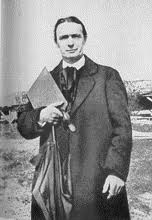
Rudolf Steiner in 1923.

I’ve recently come across some very interesting statements made by Steiner on the afternoon of 28th December 1923, at a meeting of the Swiss School Association held during the Christmas Conference in Dornach:

In addition to what I took the liberty of saying at the close of the last course which I was able to hold for the Swiss teachers, I have perhaps only a few more remarks to make in connection with the difficulties of the Swiss school movement. It seems to me that things do in part indeed depend on how the educational movement connected with anthroposophy is run here in Switzerland.

The Waldorf School in Germany has remained essentially in a position of isolation. Though there have been one or two further foundations, in Hamburg, Cologne and so on, the Waldorf School in Germany, in other words in a relatively extensive area, has remained a solitary example. It will remain to be seen, therefore, whether what is to be started in England as a kind of Waldorf school*, and also the school with three classes that already exists in Holland, will also to begin with remain as solitary examples.

first waldorf school

The very first Waldorf school opened in Stuttgart, Germany in 1919.


Apart from everything else it has to be said that the reason why these schools are still only isolated examples, and also why it can be expected that they will remain so for a long time, is simply that the present social circumstances really do make it impossible for an attitude to come about that could lead to the financing of a larger number of such schools. Experience over the years has shown this quite clearly. And this challenges us to think carefully about the whole direction we should take with our educational movement.

This is especially necessary with regard to Switzerland. For Switzerland is pervaded by a very strong sense for everything represented by the state. And now that the Swiss school association for independent education has been founded, I do believe that the chief difficulties will arise from this Swiss sense of statehood. Even less than anywhere else will it be possible here in Switzerland to find an opening for the belief that a truly independent school could be an example for a model method of education, or that schools such as this could be founded on a larger scale. We should not allow ourselves to be under any illusion in this respect. Aversion to a system of education that is independent of the state is very great here.

Of course what Herr Gnädiger has just said is right, namely that there will be interest in how things are done in a model school.

Least of all here in Switzerland can you expect the president of the Schweizerischer Schulverein, of whom you have spoken, to have any interest in the school other than that pertaining to its status as a model. Perhaps his interest will turn out to be such that he would like to influence Swiss state schools to take up certain methodological aspects from this model school. But this seems to me to be the only aspect that can be counted on to attract interest here in Switzerland. That is why it seems to me to be important to take up these two things wherever educational associations of the kind you have mentioned are founded; and also that many such associations should be founded, more and more of them!

Another aspect is that the crux of anthroposophical education is its method. The schools apply a certain method. It is not a question of any particular political direction but purely and simply of method. It is also not a question of any particular religious creed, or of seeing anthroposophy somehow as a religious creed. It is simply a question of method.

In the discussion that followed my lecture cycle my answer to questions on this was simply that the educational method represented here can be applied anywhere, wherever there is the good will to introduce it.

If this is done on the one hand, and if on the other hand — in order to create an understanding in wider circles — it is clearly emphasized that this is the proper method and that it is being applied in a school that can serve as a model, if these two points are given the main emphasis in the programme, if it is stressed that every school could use these methods and that a model school could demonstrate how fruitful they are, and if things are worked out neatly, then I believe that something could be achieved even in Switzerland. And then on the basis of these two points educational associations ought to be founded everywhere. But it would have to be made clear to everyone that the aim was not to found as many private schools as possible to compete with the state schools. In Switzerland such a thing would be regarded as something very peculiar and it would never be understood. But there would be an understanding for a model school which could be a source of inspiration for a method of education. Progress cannot be made in any other way. It is important to present these things to people in principle again and again and wherever the opportunity arises.

I believe it would be a good thing if you could always give the greatest prominence to these two aspects. They are perfectly true, and much damage has been done to us by the constant repetition of the view that Waldorf education can only be carried out in schools apart from the main stream, whereas I have constantly repeated that the methods can be applied in any school.

* This is a reference to the Priory School, Kings Langley, started by Margaret Cross and Hannah Clark as a pioneering co-educational boarding school in 1910. Miss Cross had been so inspired by Steiner that in 1922 she decided to turn her school over to the new Waldorf methods. Steiner visited the school at least once, probably twice, the only English school he ever visited.

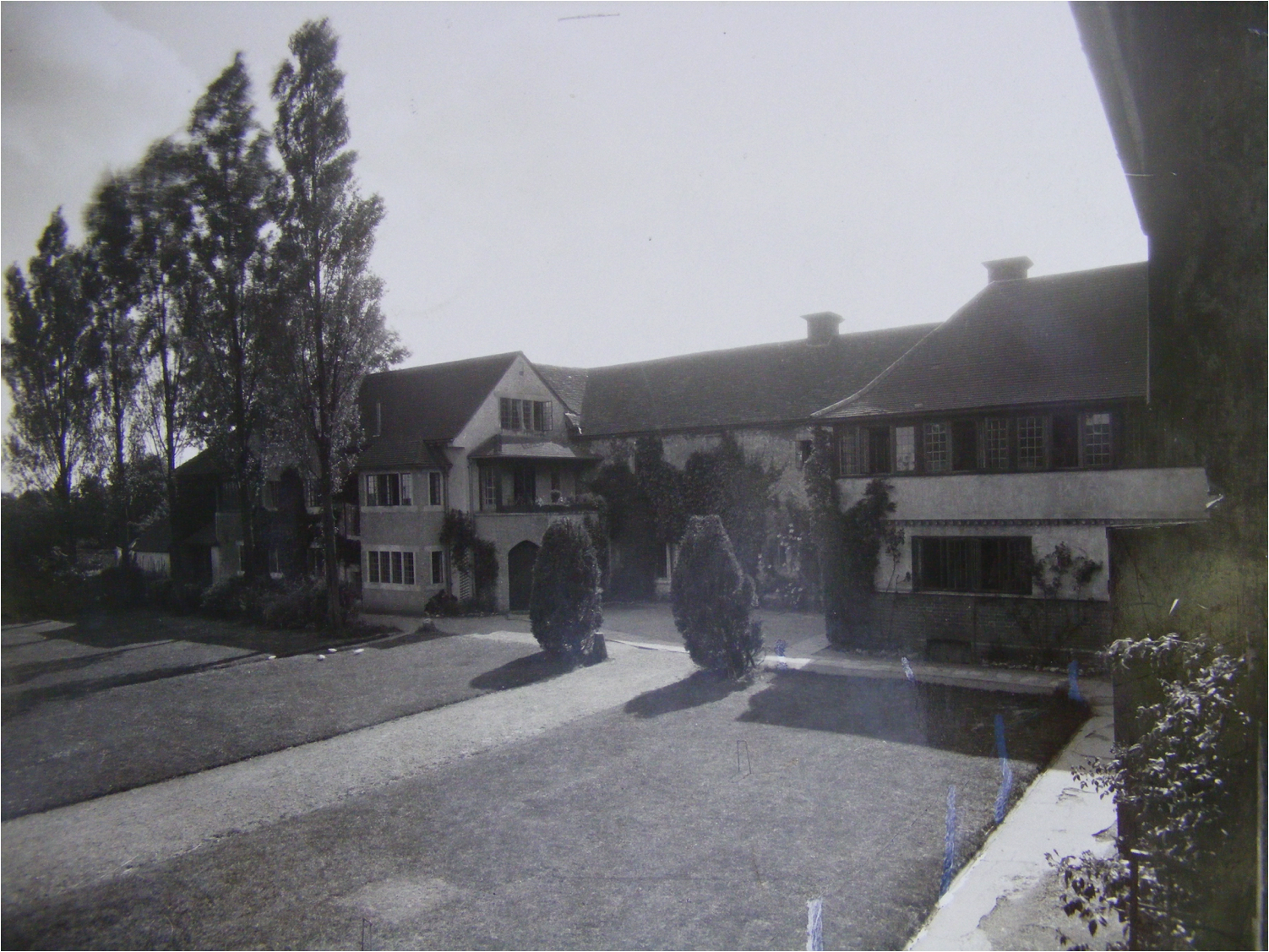
The Priory School, Kings Langley, as Rudolf Steiner would have seen it when he visited on 16th April 1922.

Steiner is saying that he sees the need for a few model schools, which could be a source of inspiration for his method of education and which could also be used by any school, state or private, which has the good will to introduce it. He sees an important role for national education associations to promulgate his methods, rather than the creation of more and more schools. This implies that he wanted the national associations to fly the flag for Waldorf methods, while he wanted there to be a few model schools to act as demonstration centres for these methods, that could be visited by teachers and educationists from state and other independent schools. And he could hardly be clearer in stating that anthroposophical education has nothing to do with a political direction or a religious creed but is simply a question of method.

If Steiner had lived longer, perhaps we would have seen him encourage the development of school associations in each country. He would have wanted there to be a handful of Waldorf schools in each of these countries, but they would have acted as models of excellence and research in teaching and curriculum. He would also have wanted there to be the greatest possible interaction between the model schools and the rest of the educational culture of that country. One can envisage there would have been a much greater flow of teachers between state and Waldorf schools resulting in much more dialogue and cross-pollination of methods.

With the benefit of hindsight, it’s easy to see why events didn’t turn out in this way. After Steiner’s death, the tensions between members of the Vorstand in Dornach that had been held in check during his lifetime broke out; and these very public divisions in the executive split national anthroposophical societies as well. In the UK, the few Steiner Waldorf schools that were beginning to establish themselves had to do so against challenging odds. This constant struggle for everyday survival, alongside their teaching and administrative responsibilities, took up all the energies of these pioneers. Add to this a kind of isolationist mentality, arising perhaps from an almost arrogant sense of the superior virtues of their methods, and one can see how the independent Steiner Waldorf schools came to figure hardly at all as part of the national educational culture in their countries.

This is just one reason why I am pleased that we now have a number of publicly-funded Steiner academy schools, because they are already part of the pluralistic educational system of England in a way that the independent Steiner Waldorf schools have not on the whole managed to achieve. This gives hope for fruitful dialogue and exchanges with mainstream educational culture that can only benefit all parties, which was undoubtedly what Steiner had in mind. This could still happen and there are some encouraging signs of greater openness beginning to appear. As just one example, there is a link here and here to a 2-part article by Trevor Mepham, former principal of the Steiner Academy Hereford and current principal of the Steiner Academy Frome. Trevor’s article seems to me to be generous, open and non-dogmatic in its approach, as well as a gentle reminder to Steiner educators everywhere not to get too hung up on supposed principles and practice.

The Steiner Academy Hereford – the first of the new publicly-funded Steiner schools in England.

At the European level, one can also see encouraging signs of Steiner Waldorf schools opening up, for example by becoming involved with the School Education Gateway project funded by the European Union’s Erasmus +, the programme for education, training, youth and sport. Surely, the best and most effective gesture that Steiner Waldorf schools can make today is to say to colleagues in education around the world: “We have much to share and much to learn from one another. We don’t have all the answers but we would like to help develop the answers with you.”

2 Comments

Filed under Anthroposophy, Free Schools, Rudolf Steiner, Steiner Waldorf schools

The Milk of Human Kindness

When the anthropopper was a boy growing up in north London, milk was delivered in pint bottles to our doorstep by the milkman from either the London Co-operative Society or the rival United Dairies. You had a choice of Gold Top, ie milk from Jersey cows with an inch or two of cream at the top of the bottle, ideal for pouring out onto desserts or fruit salads; Silver Top, which was whole milk with less cream than Jersey milk; Red Top, which was homogenised milk. By special request, you could occasionally get Green Top, which was raw (unpasteurised) milk. There was also sterilised milk, a kind of precursor of UHT milk, which came in a different pint bottle with a metal crown cap instead of a foil top and you needed a beer bottle opener to get at it.

UD milkman

A United Dairies milkman in the 1950s. (photo via 1900s.org.uk)

It was considered anti-social not to wash out the bottles before returning them. I can remember being outraged by the snobbishness of a comment, from the romantic novelist Barbara Cartland, that when she was out canvassing for the Conservatives, she could always tell if a household voted Labour because those were the houses where the people didn’t wash their milk bottles before putting them out on the step.

Following legislation from the Attlee–led Labour government after the Second World War, each child at school was entitled to one-third of a pint of milk (one bottle per pupil), which you either drank with a straw from a big box of Sweetheart brand straws, or if you were a boy and wanted to show off, you drank straight from the bottle. School milk was stopped by Margaret Thatcher in the 1970s, and she was promptly dubbed “Margaret Thatcher, Milk Snatcher” for this mean-spirited edict.

Autre temps, autre moeurs. Decades later there are few, if any daily doorstep deliveries and instead people get their milk once or twice a week in cartons or plastic bottles from the supermarkets. All milk is pasteurised and most of it is heavily processed, homogenised and either semi-skimmed or skimmed. Raw milk is unavailable in shops. As milk has become more and more processed to ensure longer shelf life, milk allergies are becoming more frequent and many doctors are having to advise their patients to avoid milk products altogether. What is more, supermarkets which use milk as a ‘loss leader’ are said to be placing intolerable pricing pressures on dairy farmers to provide cheaper and cheaper milk. These farmers are warning that the price of milk, which has fallen to just 22p a pint in the likes of Asda, Aldi and Iceland, and is now cheaper than some bottled water, could force many of them out of business unless drastic action is taken. The number of dairy farms in Britain has halved since 2002, to fewer than 10,000, and a further reduction is expected, according to the National Farmers’ Union.

The results of all this on animal welfare can be imagined. When more and more cattle are penned together, they are likely to become stressed and consequently to do one another and the cowman harm. In such a situation, horns are seen as an impediment to easy management and even as a danger, so the cows are routinely de-horned. Horns, however, are far more than just two things that sit on top of the cow’s head. To quote from a leaflet issued by my local biodynamic farm:

Horns are sense organs and have a very real function within the whole metabolism of the organism. This function is often difficult to describe because it concerns organic processes which go beyond what is immediately sense-perceptible. Cattle with horns are more awake and discerning of their fodder. Horns are made of hard siliceous substances and through their unique form have the capacity to prevent the dissipation of vital forces released through the animal’s metabolism. They are instead reflected back, ‘digested’ once again and incorporated within the animal’s excretion products. It is this function of the horn within the organism of the cow which is later made use of in the preparation of biodynamic horn manure. It is, however, not only the quality of manure which is affected, but also that of …the milk.

I don’t understand why it is that animal welfare groups, who campaign for humane conditions for farm animals and the right of these animals to express their true nature, have not taken up the issue of de-horning cattle. De-horned cattle are animals which have been deprived of a vital part of their anatomy mainly for economic reasons.

The herd of beautiful MRI cows, all with their horns, at Old Plaw Hatch Farm.

The herd of beautiful MRI cows, all with their horns, at Old Plaw Hatch Farm.

The anthropopper is fortunate enough to live near a biodynamic farm, where he can buy raw milk in glass bottles, at a cost of 90p per pint plus 50p returnable deposit on the bottle. The milk comes from the farm’s own herd of beautiful Meuse Rhine Issel (MRI) cattle, each of which has its horns. You can read more about them here.

Bottles of raw milk and other dairy products at the Old Plaw Hatch Farm Shop in Sussex.

Bottles of raw milk and other dairy products at the Old Plaw Hatch Farm Shop in Sussex.

The farm also has its own dairy, which produces cream, yoghurt, kefir and wonderful cheeses, all made from raw milk. Raw milk has more nutrients than its pasteurised equivalent, tastes better and it’s said that many people with milk allergies can drink it without ill effects. All I know is that the dairy products are excellent, the cows are happy and so are the customers.

Is raw milk safe? Pasteurisation, after all, was introduced to protect people from the danger of catching tuberculosis, listeria and brucellosis via milk – and milk is an excellent medium for microbial growth. There is a useful discussion of the issues here:

At my local biodynamic farm, the milk is tested routinely by the Food Standards Agency (as is standard procedure for all dairy farms) for different bacterial types, TB and brucellosis and other harmful organisms. The farm also undergoes a programme of voluntary testing for all dairy produce. The dairy is an ‘assured premises’ which means that it has been passed by the Environmental Health Office and to show this carries the health mark We005UK. I’m convinced that not only is the milk safe to drink, it’s actually an outstanding source of nutrients including beneficial bacteria such as lactobacillus acidophilus, vitamins, enzymes and calcium.

I realise that most people are not able to buy raw milk because they are nowhere near an outlet. But here’s a very useful map of all those farms in the UK that provide raw milk.

???????????????????????????????

Please support these farms, because they are making a stand against the bullying of producers by supermarkets. They are also farms where you will find higher animal welfare standards and more sustainable agricultural methods. Bear in mind, though, that in most cases it’s only the biodynamic farms that will produce their raw milk from cattle with horns – and it’s these biodynamic practices that lead to the highest animal welfare and the very best raw milk and dairy products available anywhere.

Leave a comment

Filed under Agriculture, Biodynamic farming, De-horning cattle, Raw Milk

My audition piece for a Daily Mail editorial

The anthropopper is no fan of the Daily Mail, even though his father was at one time the printer of that newspaper back in the 1960s, in the days of hot metal Linotype machines. (For those of you outside the UK, the Daily Mail is a mid-market tabloid newspaper aimed at suburban conservatives who think that Britain has gone to the dogs – think of a print version of Fox News but without the slavish support for one particular political party. Its web version, Mail Online, is apparently the most viewed newspaper website in the world.)

The anthropopper finds something depressing about the formulaic nature of the Mail stories designed to provoke readers’ outrage over their breakfast cornflakes. It’s also sad to see any number of talented journalists take the Mail’s (reputedly generous) fees to churn out “why oh why” whinges about the social ills of the UK, as seen from the Mail’s editorial offices in Kensington and Chelsea.

Nevertheless, the anthropopper is not proud and an impending house purchase has focused his mind on the need to shore up the family finances; so in a departure from his usual subject matter, here is an audition try-out for the role of leader page comment writer at the Daily Mail. He can guarantee that, although tempted, he made no use whatsoever of the online Daily Mail Story Generator. No, what follows is all the anthropopper’s own work, just using standard Mail boilerplate text and attitudes. Lord Dacre, gissa job!

Lord Dacre, editor-in-chief at the Daily Mail (photo via The Guardian)

Lord Dacre, editor-in-chief at the Daily Mail (photo via The Guardian)

daily-mail-logo-vector1

END THE SHAME OF BRITAIN’S AVIAN DEPENDENCY CULTURE

When Sir William Beveridge wrote his report 70 years ago arguing for the creation of the welfare state he wanted to give the poor a hand up from the grim life they faced. But a dependency and entitlement culture has since emerged which provokes anger and disquiet among all right-thinking people.

Margaret Thatcher’s premiership had a central theme that wherever possible we should look out for ourselves rather than look to others for handouts. But despite her sterling efforts, the dependency culture has grown steadily over the past years, particularly during the spendthrift Labour years of Tony Blair and Gordon Brown. A sense of entitlement. A sense that the world owes us a living. A sense that not only is it possible to get handouts but that we have a right to them.

Nowhere are these corrosive attitudes more evident than in Britain’s back gardens, in the shameful displays of something-for-nothing fecklessness exhibited by our bird populations, many of them immigrants from abroad, who have entered Britain without proper checks, bypassing all border controls.

Day after day, exploiting the generosity of the British people, who spend increasing amounts out of their hard-earned taxed income on peanuts, fatballs and sunflower seeds, these featherbedded fliers come and gorge to their hearts’ content at the array of feeders set out in Britain’s suburban gardens.

Illegal immigrants exploiting the generosity of Britain's birdlovers (photo via

Illegal immigrants exploiting the generosity of Britain’s birdlovers (photo via BBC News)

Beveridge designed the welfare state for a tightly knit, deeply patriotic and overwhelmingly working-class society, dominated by the nuclear family. Britain in the Forties was an old-fashioned, conservative and collectivist world, in which birds pecked worms from lawns or searched branches for insects and only disreputable pigeons in Trafalgar Square expected passers-by to feed them. Seventy years on, we live in a very different Britain. In this age of selfishness and irresponsibility, much of it induced by lobbying from the vested interests of the RSPB, the work ethic of finches and blue tits has broken down to the point where they now come to the garden feeders as a matter of course. Many will not even think of feeding on a thistlehead or foraging in a currant bush.

Feckless blue tits seeking hand-outs (photo via

Feckless blue tits seeking hand-outs (photo via http://www.sheknows.co.uk)

‘Easy come, easy go’ is a profoundly destructive principle precisely because it is true. Our feathered friends deserve better from us than perpetuation of that disastrous philosophy.

Nobody objects to the existence of a safety net for those who really need it. But people are weary of the culture of avian entitlement. It is high time for Britain’s birds to stand on their own two feet.

1 Comment

Filed under Daily Mail leader article

Rudolf Steiner and the Chinese yam

It’s interesting to see how time and again during the life of Rudolf Steiner, a new body of knowledge was able to begin only once someone had asked him a significant question. Examples of this include:

1. In 1900, Marie von Sivers, a gifted young Russian (who was to become the future Frau Dr Steiner), came to Berlin in order to make the acquaintance of Rudolf Steiner. Soon after meeting him, she asked him a question which had preoccupied her. They came to call this the Chrysanthemum Tea moment, because the room in which they were having tea was full of those flowers. She asked Steiner if there wasn’t a need to call a new spiritual movement into life, one which would be appropriate for Europe and the West, since the Theosophical Society contained so much Eastern spirituality. Steiner replied that this would only be possible if it could arise from the depths of esoteric Christianity. Thus was born anthroposophy.

2. On April 23, 1919, after a lecture Steiner gave to the factory workers of the Waldorf Astoria cigarette factory in Stuttgart, Emil Molt, the company director, asked Steiner to take on the planning and leadership of a new school for the company’s workers. This led to the birth of the first ever Waldorf school.

3. In August 1923, in Penmaenmawr in Wales where Steiner was leading a summer school, Dr Ita Wegman asked him: “Would it not be possible to found a form of medicine based upon the mysteries?” This led to their collaboration in writing a book and the beginnings of anthroposophical medicine.

It seems as though an initiate can only bring something new to the world when requested to do so through an act of free will by another human being – the initiate cannot act to impose new ideas without the way being cleared by someone asking for them.

The story of the Chinese yam is another example of a significant question being asked of Steiner that led on to new research and knowledge. I’m indebted for the following account to Hannah Townsend’s review of Ralf Roessner’s book The Light Root in the Autumn 2014 issue of New View magazine (article not online).

To quote from Hannah’s review:

“Rudolf Steiner was apparently just about to depart from the gathering at Koberwitz where he had been giving the course of lectures that would lay the foundation for the development of biodynamic agriculture. This was in 1924 and the effects of humanity’s gradual slide into a one-sidedly materialistic thinking was beginning to have an effect on food. Mechanistic agricultural practices were starting to deplete produce of the cosmic forces that food should carry into the human diet if people are to be enabled to pursue their rightful spiritual development. (Food is more than solely a means of keeping our physical bodies alive, but more fundamentally a source of nourishment for human consciousness.)…

Roessner relates how, as Steiner waited for his car to arrive to take him to the train station, two of the course participants came up to him with a question. They wanted to know whether, if all the indications that he had given were followed, it would be enough to raise the quality of nutrition to give adequate spiritual nourishment for our times. The answer that Steiner gave seems to have been both surprising and direct:

‘It will not be sufficient, even in the most favourable circumstances,’ he said. ‘What should be done is to cultivate Dioscorea batatas in Europe so that it can take over from the potato as the staple diet…’ ”

Well, who could resist following up on such an intriguing story? Certainly not the anthropopper, who promptly went out and bought a copy of The Light Root by Ralf Roessner (£8.99 from Temple Lodge Publishing, ISBN 978 1 906999 63 6).

Here's what the Chinese yam (or light root) looks like when well grown.

Here’s what the Chinese yam (or light root) looks like when well grown. (Photo via Apios Institute)

It turns out that what the author calls the Light Root is a particular type of Chinese yam. The special quality of this particular yam is that it is able to incorporate within its physical substance large quantities of the light ether, of which most of our foods are nearly or completely lacking. Why does this lack of light ether matter? It matters because without the light ether it is far more difficult for us humans to become aware of ourselves in our true nature, ie as spiritual beings currently living within physical bodies. Without the light ether, materialism holds sway and people are unaware of anything other than physical, material reality. So it is possible that this plant is not only a valuable food but also something which in the future could be a decisive influence in the development of humanity. (My wife, a specialist in fertility and maternity reflexology, is convinced that the other food which contains light ether is breast milk – which, if true, is yet another reason why breast is best.)

Here of course we dive straight into controversy: what is this light ether, which most scientists, if asked, would say does not exist? Those who are familiar with Steiner’s concepts will know that he thinks in terms of a spectrum of realities, from the physical to the etheric to various gradations of the spiritual. Living organisms which have a physical body or form also have an etheric body or form, which is essentially an energy body that contains and forms the physical. It is this etheric body which maintains the physical body’s form until death.

According to Steiner, the etheric body is made up of four ethers: warmth ether, light ether, chemical/sound ether and life ether (he said that there are in fact seven ethers but only four of them are currently susceptible to investigation). Materialists won’t go along with any of this, of course. However, two researchers, Dennis Milner and Edward Smart, in their work with Kirlian-type photography, seem to have been able to detect the four ethers identified by Steiner. My friend, Dr Siegfried Trefzer, has also used Kirlian photography as a means to detect illnesses in the etheric body before they manifest in the physical body. Between them, the etheric and physical bodies contain the meridian lines and acupuncture points which create a structured and permeable web of energy that helps to maintain the health of our physical body. This level can be weakened by various factors including: electromagnetic pollution, poor diet, drug misuse, trauma, sedentary lifestyle, genetic factors etc. From all this, it is clear that the medicine of the future will have to encompass energy medicine if real progress is to be made in treating pain and disease.

I can remember staying in a boarding house at Cliftonville with my parents when I was a young boy. On the table next to ours at breakfast was a man who had an artificial leg below one knee, which was of course fascinating to me. I have never forgotten how he said that he was having pain, not where the artificial limb joined his leg, but below this – where the amputated leg had been. This phantom limb effect is another example of the etheric body. Even when the limb has been removed, sensation can be felt as if it were still there, because the etheric form of the limb is still there.

Anyway, back to Ralf Roessner’s book about the Chinese yam or, as he calls it, the “light root”, a term he has patented in Germany as “lichtwurzel”. Roessner found that he had to go to the original growing areas in China to find suitable plants, as the specimens he had got from France, Africa and America did not show anything like the expected light ether qualities. The ability to store light ether in the plant is dependent on growing the plant at a sufficient depth (the tubers need to be at least four feet deep) as tubers grown near the surface do not have the same qualities at all. In addition, it is only the male plants of the Chinese yam which have the ability to store the light ether. At harvest time, according to Roessner, these tubers have a radiance that is noticeable even to the untrained observer.

The author clearly does not expect a sympathetic hearing from materialistic science, saying at one point: “spiritual scientific research should not try to gain a place among present day natural science (on the one hand it is still in its infancy, on the other it is more the task of natural science to venture into the spiritual), it is only right to renounce any acknowledgement from natural science.”

One can see why he should be cautious – he claims that the light root was rescued from Atlantis and brought to China, that the light root is a plant which nourishes yin or what Steiner calls the Venus principle, that to describe the effect of the light root on the human being requires faculties which go beyond ordinary sense-perceptible observation. He says that the light root’s unique light ether potential is able directly to strengthen the body’s formative forces (ie the etheric body), which is thereby enabled to take up with more ‘clarity’ those cosmic formative forces which underlie all earthly growth processes. Roessner sees the light root as providing an intermediate stage between a light nutrition of the future and our current one-sidedly materialist nutrition which is becoming less and less capable of truly nourishing us.

I can see why a scientist wouldn’t want to go to Monsanto or some other large corporation to ask for a research grant to look into this. However, in a few years time, when spiritual research has done all the heavy lifting and the reality of the etheric body has been established, I can also see these same large corporations trying to patent the light root, either to suppress it or else to exploit it so that they can market food based on it as “strengthening the etheric body, lengthening your life.”

What is more, the light root does have the potential to be a popular staple food: it is apparently delicious, makes good chips, and can be used in soups, sauces, pies etc. It has the property of filling you up with a small amount, so would be good for slimmers, as well as an excellent food for people with little money. It even has a beautifying effect, bestowing smooth, silky skin and shiny, strong hair. So, yes, I can see the Monsantos or Nestles of this world spotting vast commercial opportunities further down the line.

How would you like your light root cooked? Chipped, fried, in a soup or sauce? Yam, yam!

How would you like your light root cooked? Chipped, fried, in a soup or sauce?
Yam, yam! (Photo via AliBaba.com)

In the meantime, Ralf Roessner is doing his best to promote light root products on his website (German language only). Processing the light root so as to preserve the light ether it contains has its challenges, as the magnetic field associated with electricity soaks up the light ether quality. Even the fan in a conventional oven causes damage, while microwaves completely destroy the quality of light ether. Roessner says that there is an urgent need to develop appliances such as graters, mills and mixers, where a motor can be installed away from the actual appliance. Clearly at present it is best to use the light root as a fresh food. It may be, of course that we in the West are not yet ready to swap the potato for the Chinese yam and it is therefore the role of people like Ralf Roessner and his colleagues to research and to keep the knowledge alive until that time when we begin to awaken from our deep materialistic sleep. In this, they deserve our thanks and respect for ploughing their lonely furrow on behalf of the future.

It seems significant that the light root has come out of China and that advocates of anthroposophical medicine and ancient Chinese medicine are finding more and more parallels in their approaches. Yvan Rioux, in a fascinating article in the Winter issue of New View magazine, says that: “When the Chinese tried to grasp the activity of an organ, they looked for psychic activities as well as biological processes because our internal landscape is the basis of our soul life. “ And he quotes Steiner from lectures given a century ago: “What makes consciousness possible is not the brain as a producer of consciousness but the processes of the body as a whole. These serve as a mirror reflecting the activities of the soul. The bodily organs as living body processes act as reflectors of psychic activities.1” And again: “We must know that, in spite of the fact that they are not fully penetrated by the life of consciousness, all the organs contain the source of what surges in us as our psychic life.2

How did Steiner know all this stuff? And where are the true scientists who, even if something does not fit within their current paradigm (or especially because it does not fit within the current paradigm), will say: ”We must look into these matters and if necessary, we must develop new theories, methods and techniques to enable us to do so.” Those are subjects that the anthropopper will return to in future postings.

1 Rudolf Steiner, Psychoanalysis and Spiritual Psychology

2 Rudolf Steiner, Occult Physiology

15 Comments

Filed under Anthroposophy, Rudolf Steiner

Franz Kafka meets Rudolf Steiner

Mention of Franz Kafka in my previous posting has reminded me that there was in fact a meeting between Kafka and Rudolf Steiner. It happened in Prague in March 1911. Steiner was in Prague delivering a series of lectures on the subject of An Occult Physiology. Kafka had first come across Steiner at Mrs Berta Fanta’s salon on Old Town Square, a famous meeting place for intellectuals during the two-decade period before the First World War. These gatherings were attended by professors at the German university in Prague, including Albert Einstein and Christian von Ehrenfels, as well as the up-and-coming younger generation such as Kafka and Max Brod. (Einstein also met Steiner at Mrs Fanta’s salon and attended several of Steiner’s lectures held in the Café Louvre, an Art Nouveau café on Národní třída, and was apparently impressed by Steiner’s views on non-Euclidean geometry.)

Rudolf Steiner in 1911, the year he met Franz Kafka

Rudolf Steiner in 1911, the year he met Franz Kafka

Kafka attended two of Steiner’s lectures and records his reactions in what seems to be an ironical tone (or is it perhaps just an intense observation in an attempt to understand?) in his diary entries of 26th and 28th March 1911. On 26th March he comments on Steiner’s rhetorical trick of giving full weight to the views of his opponents, so that “the listener now considers any refutation to be completely impossible and is more than satisfied with a cursory description of the possibility of a defence”; Kafka then observes: “Continual looking at the palm of the extended hand. Omission of the full stop. In general, the spoken sentence starts off from the speaker with its initial capital letter, curves in its course, as far as it can, out to the audience, and returns with the full stop to the speaker. But if the full stop is omitted then the sentence, no longer held in check, falls upon the listener immediately with full force.” Kafka was to do something similar in his own works, by writing long sentences that sometimes cover an entire page. Kafka’s sentences then deliver an unexpected impact just before the full stop, which gives a final meaning and focus to what has gone before.

On 28th March he comes back to Steiner in his diary, either referring to another or to the same lecture, which he proceeds to gently guy, interspersing this with comments about his neighbour in the audience:

“Dr Steiner is so very much taken up with his absent disciples. At the lecture the dead press so about him. Hunger for knowledge? But do they really need it? . . . Löwy Simon, soap dealer on Quai Moncey, Paris, got the best business advice from him . . . .The wife of the Hofrat therefore has in her notebook, How does One Achieve Knowledge of the Higher Worlds? At S. Löwy’s in Paris.”

Kafka would have been around 28 years old at this time. He seemed to find the tasks of daily existence very difficult, was often lonely and depressed and regarded himself as a perpetual outsider – a German speaker in Prague, a Jew among Christians. Although he had had encounters with some of the leading personalities of the age – apart from meeting Steiner, he had seen Nijinsky dance and had met Einstein, Rilke and Puccini – his experience of the wider world was limited. At university he studied law and then obtained jobs within first one, then another insurance company, work which he resented as it kept him away from his writing. He lived and worked within the same small area of Prague and its surroundings all his life. Despite a fervent longing to be independent, he spent the whole of his short life (he died at the age of 40, probably from starvation due to an inability to eat as a result of laryngeal tuberculosis) resenting that he was either living with his parents in what has been described as “an atmosphere of claustrophobic mutual surveillance” or else with one of his sisters. He had a strong sex drive but seems to have been unable to have satisfactory relationships with women, as he lacked the capacity for losing himself in loving another person. “For even the most intimate friend to set foot in my room,” he told his unfortunate fiancee, Felice Bauer, “fills me with terror.”

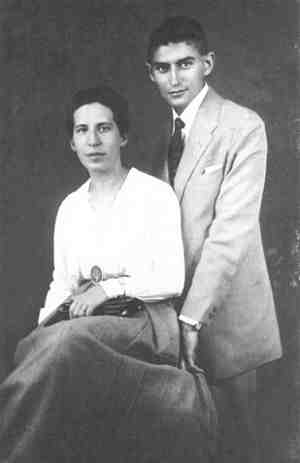
Franz Kafka with his fiancee, Felice Bauer

Franz Kafka with his fiancee, Felice Bauer

Kafka attributed his psychological difficulties to having “vigorously absorbed the negative element of the age in which I live.” He had a difficult relationship with his father, who was described by Kafka’s biographer Stanley Corngold as a “huge, selfish, overbearing businessman.” Kafka seems to have been psychic to some degree and in his diary admitted to suffering from “bouts of clairvoyance.”   A huge issue for him during this period was how to create for himself the necessary space for literature when his employment encroached upon his writing time and his family and society expected him to make a living, marry, and raise his own family. Whatever the reasons, in his writings Kafka captured like no other author before him themes such as father-son conflict, alienation, physical and psychological brutality, characters on a terrifying quest, encounters with arbitrary and unjust bureaucracy and mystical transformation.

In spite of what may have been his ironical tone in connection with Steiner’s lecture, Kafka evidently decided that Rudolf Steiner might be able to help him to find his life’s direction and made an appointment to see Steiner in his hotel room in Prague. Kafka records in his diary his impressions of this visit:

“In his room I try to show my humility, which I cannot feel, by seeking out a ridiculous place for my hat . I lay it down on a small wooden stand for lacing boots. . . Table in the middle, I sit facing the window, he on the left side of the table. . . . He begins with a few disconnected sentences. So you are Dr. Kafka? Have you been interested in theosophy long? But I push on with my prepared address: I feel that a great part of my being is striving toward theosophy, but at the same time I have the greatest fear of it. That is to say, I am afraid it will result in a new confusion which would be very bad for me, because even my present unhappiness consists only of confusion. This confusion is as follows: My happiness, my abilities, and every possibility of being useful in any way have always been in the literary field. And here I have, to be sure, experienced states (not many) which in my opinion correspond very closely to the clairvoyant states described by you, Herr Doktor, in which I completely dwelt in every idea, but also filled every idea, and in which I not only felt myself at my boundary, but at the boundary of the human in general. Only the calm of enthusiasm, which is probably characteristic of the clairvoyant, was still lacking in those states, even if not completely. I conclude this from the fact that I did not write the best of my works in those states. I cannot now devote myself completely to this literary field, as would be necessary and indeed for various reasons. Aside from my family relationships, I could not live by literature if only, to begin with, because of the slow maturing of my work and its special character; besides I am prevented also by my health and my character from devoting myself to what is, in the most favorable case, an uncertain life. I have therefore become an official in a social insurance agency. Now these two professions can never be reconciled with one another and admit a common fortune. The smallest good fortune in the one becomes a great misfortune in the other. . . . Outwardly, I fulfill my duties satisfactorily at the office, not my inner duties, however, and every unfulfilled inner duty becomes a misfortune that never leaves. And to these two never-to-be-reconciled endeavours shall I now add theosophy as a third? Will it not disturb both the others and itself be disturbed by both? . . . This is what I have come to ask you, Herr Doktor.”

It’s unfortunate for our curiosity that Kafka is so focused on himself and his problems that he doesn’t record how Steiner responded to this speech. All Kafka reports is this:

“He listened very attentively without apparently looking at me at all, entirely devoted to my words. He nodded from time to time, which he seems to consider an aid to strict concentration. At first a quiet head cold disturbed him, his nose ran, he kept working his handkerchief deep into his nose, one finger in each nostril.”

There is perhaps a little too much information in that last sentence and not enough anywhere else. There is no further mention of Steiner in the diaries, apart from one piece of advice from the same meeting: “Herr Kafka, essen Sie keine Eier.” (“Mr. Kafka, don’t eat eggs.”)

Can we make a guess at what else Steiner had said to him? It seems probable that Steiner realised that Kafka’s life would be a short one and that in his remaining time he would need to focus as much as possible on his writing. We may surmise that Steiner told Kafka to concentrate on literature above all else.

25 Comments

Filed under Anthroposophy, Franz Kafka, Rudolf Steiner

BT – Beyond Terrible

BT-Openreach-300mbps

The anthropopper’s blogging has been sadly curtailed in recent weeks ever since a house move in September and BT Openreach’s spectacular failure to provide a phone line and hence broadband access to the new address. This is despite increasingly desperate calls via the mobile to my service provider (since BT, which has the monopoly on installing phone lines in this country, will only speak to the service provider rather than the phone user) who can only say that they, like you and I, are in the hands of BT.   I had of course heard of BT’s reputational issues but couldn’t believe that anything like we have experienced was possible in a situation as simple as a change of occupancy; after all, the previous owners had had a phone line and surely it was just a question of us taking over the line?

I won’t bore you with the rest of the story but will simply say that if I had suggested it to Franz Kafka as a plotline for one of his novels he would have rejected it as implausible. However, today I’ve discovered from a report in The Guardian that there are some people who have had even worse experiences with BT Openreach than us – and these are not people living in the back of beyond but a group of Londoners in a block of flats less than six miles from BT’s headquarters.

Enough. Rant over. Normal blogging service will be resumed as soon as possible.

Leave a comment

Filed under British Telecom

The tables turned

Like many of us, I spend far too much time in front of a computer screen. I’m feeling the symptoms now – my eyes are strained, there’s a faint headache starting and my wrist tells me it’s time to swap hands or stop using the mouse.

At such moments, I try to take the advice in Wordsworth’s poem, “The Tables Turned”. In his day, of course, it was books rather than screens that caused eyestrain but the remedy is the same – get out into Nature and focus your eyes on blue skies and green trees.

William Wordsworth by Benjamin Robert Haydon © National Portrait Gallery, London

William Wordsworth by Benjamin Robert Haydon © National Portrait Gallery, London

UP! up! my Friend, and quit your books;
Or surely you’ll grow double:
Up! up! my Friend, and clear your looks;
Why all this toil and trouble?

The sun, above the mountain’s head,
A freshening lustre mellow
Through all the long green fields has spread,
His first sweet evening yellow.

Books! ’tis a dull and endless strife:
Come, hear the woodland linnet,
How sweet his music! on my life,
There’s more of wisdom in it.

And hark! how blithe the throstle sings!
He, too, is no mean preacher:
Come forth into the light of things,
Let Nature be your teacher.

She has a world of ready wealth,
Our minds and hearts to bless–
Spontaneous wisdom breathed by health,
Truth breathed by cheerfulness.

One impulse from a vernal wood
May teach you more of man,
Of moral evil and of good,
Than all the sages can.

Sweet is the lore which Nature brings;
Our meddling intellect
Mis-shapes the beauteous forms of things:–
We murder to dissect.

Enough of Science and of Art;
Close up those barren leaves;
Come forth, and bring with you a heart
That watches and receives.

William Wordsworth,Lyrical Ballads,1798.

It seems likely that Wordsworth shared with his near-contemporary in Germany, Johann Wolfgang von Goethe, an instinct for experiencing through observation the mysterious reality behind nature – a kind of simultaneous integration of spirit and matter.

Goethe had discovered not only through his own insights but also by way of the ideas of the 17th century Dutch philosopher Baruch Spinoza, that there was a deeper dimension in plant life, the realm of the “supersensuous plant archetype” lying beyond the empirically visible, touchable, smellable, classifiable plant.

Johann Wolfgang von Goethe

Johann Wolfgang von Goethe

To quote from Gordon L Miller’s introduction to his edition of Goethe’s The Metamorphosis of Plants:

 Goethe echoed Spinoza’s holistic vision of reality in his conviction that “spirit and matter, soul and body, thought and extension…are the necessary twin ingredients of the universe, and will forever be.” And in order for us to comprehend not only the outer material aspect but also the inner, ideal, or archetypal aspect of natural things, Goethe discovered that we correspondingly must employ both the eyes of the body and the “eyes of the mind,” both sensory and intuitive perception, “in constant and spirited harmony.” Goethe was especially struck by Spinoza’s proposition that “the more we understand particular things, the more we understand God,” and he coupled rigorous empiricism with precise imagination to see particular natural phenomena as concrete symbols of the universal principles, organizing ideas or inner laws of nature. Starting from sense perception of the outer particulars, Goethe’s scientific approach seeks the higher goal of an illuminating knowledge from within. This way of knowing – from the inside – is rooted ultimately in a harmony or identity between the human spirit and the informing spirit of nature, wherein “speaks one spirit to the other”  (Faust, line 425).

It’s particularly exciting in our present times to see the techniques of Goethean observation being extended into the social realm, thus providing new ways of working effectively with processes of social change. This development has been led by Allan Kaplan and Sue Davidoff of the South Africa-based Proteus Initiative – so it’s great news that they will be bringing a series of workshops to Emerson College (Sussex UK) in February and March 2015 (declaration of interest – I’m now working for Emerson College). The workshops are for all those whose work engages in the realm of human relationships and social change. Please email suzy.miller@emerson.org.uk if you would like to receive further details.

But my eyes are still straining and my wrist is aching – time to leave the computer for a while and see what one can discover through some Goethean or Wordsworthian observation. It’s time for a walk in Nature!

2 Comments

Filed under Emerson College UK, Goethe, Goetheanism

A few thoughts on leadership and management issues in Steiner Waldorf schools

Some years ago I ran a vision-building workshop for a Steiner school. To help me, I invited a very experienced businessman and friend, Mick Crews, not only because of his track record in similar workshops for big companies but also because he liked what he had already heard of Steiner Waldorf schools. As part of our preparations, I explained to Mick the ways in which the school sought to manage itself through the college of teachers system.   He listened very carefully and then he said: “It strikes me that, for your system to work, it requires a degree of personal integrity in the staff that you don’t find in any other walk of life”.

Steiner schools are trying to work with a model of self-governance as laid down by Rudolf Steiner in the 1920s, in which there was no head teacher and in which each teacher took a measure of responsibility for the running of the school, above and beyond their normal teaching duties. Why did Steiner advocate this system, which the schools have tried to implement ever since?

Those of us who have struggled with the challenges of running the school in the college of teachers system have always told ourselves that Steiner gave this daunting task to the schools as a kind of necessary preparation for working in a way that will increasingly come to the fore as humanity develops, that is in a non-hierarchical, consensual system that gets away from top-down, centrally-driven thinking and decision making. There’s no denying that it does have some real advantages:

  • The sense that teachers have (or are more likely to have) of professional autonomy and of shared collective responsibility for the children and the school
  • The willingness that teachers have (or should have) to take a larger view of their role beyond their immediate job description
  • The opportunity that teachers have not only to meet and discuss anything related to teaching, curriculum and the pupils but also to share their experiences, take initiatives and learn from one another

Out of these conditions arise several benefits for the school and the pupils, which would otherwise be far less likely to exist. They include:

  • Better relationships between teachers and pupils than seems to be the case in many other schools
  • Pupils, who because of the Waldorf curriculum running alongside the examination courses, tend to be well-rounded and “interesting” individuals
  • A tangible quality of warmth about the education that makes for a supportive and encouraging atmosphere within the school
  • Teachers able to work as true professionals rather than classroom managers

However, if not handled well by all concerned, the college of teachers system can also display some more difficult aspects:

  • a management approach in which everybody has nominal responsibility but only a few take active responsibility
  • lack of time, and lack of expertise in complex areas such as employment law
  • lack of individual accountability
  • lack of clarity in the role of College (is it the spiritual heart-organ of the school, a permanent teacher training academy, a school management body, or all of these and more?)

The effect of these difficulties can sometimes lead to:

  • slowness in coming to decisions
  • poor communications with other parts of the school community, eg lack of clarity for parents about whom they should approach when faced with a problem
  • poor communications with teachers who are not on College
  • weakness in overall pedagogical management and inadequate self-management by some teachers
  • inherent risk of conflict of interest when teachers set their own standards
  • slowness in responding to difficult situations which then become crises
  • slow and sometimes inappropriate or inadequate responses to the outside world’s demands;
  • occasional failures to deal effectively and quickly with under-performance of teachers or difficulties within classes
  • problems in keeping up to date with advances in teaching practice, with legislation and with what is going on in other parts of the educational world
  • inadequate pastoral care for staff

There are additional complexities in running a Steiner school which do not apply to other schooling systems, and these are to do with the way in which Steiner’s teaching encompassed not only his method of education but also its spiritual basis in anthroposophy and its socio-economic basis in “threefolding”. For reasons of concision, these complexities are not dealt with here, although perhaps I will return to them in a future posting.

In a system so dependent on the astonishing insights of one man who died in 1925, the schools movement is now, to use a phrase originated by Steve Sagarin of Great Barrington Waldorf School, like a restaurant without a chef. Sagarin asks: “How can Waldorf schools address this absence? There is no single right or appropriate model. Democratic or aristocratic, consensus decision-making or mandates, it doesn’t matter. Each school community must solve this conundrum for itself.”

A former mentor and a good friend of mine, Helen Weatherhead, a very experienced Steiner class teacher, has said to me: “It doesn’t matter which system you have in place – what really decides whether a school works well or not is the constellation of people within the staff of that school”. And of course, that’s absolutely right – well-motivated people of good will, aligned around a single purpose, will make the best of any system of school management. Here we come back to the point Mick Crews made about the required degree of personal integrity, which in my experience is only sometimes higher in Steiner schools than that found in other walks of life. But perhaps it’s because Steiner schools aspire to such high ideals, and because parents invest so much belief and hope in the education, that when things go wrong or are badly handled by the school, the disillusion and anger expressed by these parents can be overwhelming.

If one reads the Conferenzen, (the record of the teachers’ meetings with Steiner at the first Waldorf school in Stuttgart), it is clear that up until he became seriously ill in late 1924, Steiner and the teachers continued to evolve the management system in the light of difficulties that were experienced. At no point did they arrive at a definitive system and, indeed, it is ironic that up until his final illness, Steiner continued to act as a kind of visiting headmaster to whose views every one deferred.

Nearly a century after Steiner’s death we have vastly different educational and political circumstances to deal with. To mention only the most obvious, teachers’ workloads have increased, external regulations and inspections have multiplied, employment law, health and safety regulations and child protection legislation have made running a school a truly complex operation; and everyone working in a school wants to maintain a healthy work/life balance rather than spend many evenings and weekends in teachers’ meetings.

Despite all of this, most Steiner schools have persisted with the college of teachers system or variants, although it doesn’t work well in terms of managing the school in today’s circumstances. The independent Steiner schools, which have so many excellent qualities, are usually not at their best either in customer care or quality control and they are perhaps twenty or thirty years behind in their attitudes to these concepts when compared with what is happening in the other parts of the schools’ sector in the UK.

I except from this the newly founded Steiner academies, which are publicly funded and required to maintain more stringent governance than is usually the case in the independent schools. The UK government has made it a condition that there should be a principal in each of these schools who is personally accountable to them for the running of the school. It will be interesting to see in the coming years what sort of modus vivendi will evolve between the principal and the college of teachers (where there is one) in these Steiner academy schools.

The leadership and management roles of the council of trustees should also not be forgotten. Indeed, the idea that Steiner schools are run by the faculty through the college of teachers is only partially correct. It would be more accurate to say that, under current charity law, the council of trustees is responsible for everything that happens within the school and that they devolve certain of their responsibilities to the college of teachers. At the school with which I am most familiar, the trustees reserve to themselves decisions about financial, legal and regulatory matters, while devolving responsibility for all pedagogical matters to College.

I have myself been a trustee at a much smaller Steiner school of more recent creation, and it has very different problems and issues from the larger and longer-established schools. For a time, its trustees, who were mainly parents at the school, had to micro-manage everything and there was no college of teachers, although there were regular faculty meetings. The school is now moving towards a system in which the school management team (on which faculty, trustees and administration are represented) assumes more and more functions devolved from the trustees. Another Steiner school of which I’m aware has done away completely with its college of teachers and replaced it by a system of mandates and teacher-meetings. Several schools have appointed education facilitators (full-time educational administrators) whose role it is to deal with those many aspects of running a school that the teachers do not have time for in their College meetings. The Steiner Academy Hereford, the first of the new publicly-funded Steiner schools, appointed a principal and deputy principal to work alongside the college of teachers, and this is a pattern that may be repeated in schools that are currently seeking to become academies under the government’s “free schools” initiative. All of these examples serve to illustrate Sagarin’s point that each school must work out its own solutions according to its own unique situation.

This ‘unique situation’ or the exceptional autonomy of each Steiner school is also both a strength and a weakness. It’s a strength inasmuch as autonomy allows each school to develop its own character and culture to the maximum. It’s also a weakness because a wide range of autonomous individual schools makes coordinated responses to movement-wide problems very difficult. This lack of centralised authority makes it almost impossible to fix problems that individual schools have been unable to solve for themselves.

A recent conversation with Christopher Clouder has led me to question whether we might not in any case have misunderstood how Steiner’s indications for school management came about. Christopher said that he had been looking through some of the books in Steiner’s library, which is stored at the Goetheanum in Dornach. While turning the pages of a book on educational reform written by someone called Kirschlager, Christopher noticed some passages which had been heavily underscored by Steiner. They contained the same thoughts with which we are familiar in any discussion of leadership in Steiner schools: there should be no head master, the school should not be dictated to by the state, the school should be a republican academy. If these ideas were current in educational circles in Germany in the 1920s, is it possible that Steiner, rather than bringing a vital concept for the development of humanity in the future from his vast spiritual insight, was simply aligning himself with the advanced educational thinking of his time? If this really is the case, then we can surely now free ourselves from the letter of what was done in Stuttgart all those years ago and concentrate instead on translating the essence of Steiner’s intentions into the very different circumstances of today.

How easy it would be if Steiner was still around to tell us how to do things in the very changed circumstances of the 21st century! What wouldn’t we give to be able to ask Steiner for more information, for greater detail, on a whole host of issues? But we can’t – and so it is necessary for the movement to have the courage to adapt and move on in response to the needs of our times. As Steiner said to Margarita Woloschin: “One is never ready for a task, one evolves into it.”

10 Comments

Filed under Anthroposophy, Free Schools, Rudolf Steiner, Steiner Waldorf schools, Threefolding

Different strokes for different folks

Following my recent post on “The issue that isn’t going away – leadership and management in Steiner Waldorf schools”, there was a minor flurry of comments from some of those who are critical of Steiner Waldorf schools. I will mention here just two of them:

Mark Hayes of the Steiner’s Mirror blog said:

“I think that the common lack of effective leadership stems from the collegiate management structure which originated with Steiner himself and the first Waldorf school, of course. I also suggest that the movement’s rigidity in this respect stems from the kind of unquestioning adulation for Steiner many share, as in your final paragraph.

Having said that, I have the impression that the mandate system used in many Steiner schools was an attempt to evolve from the fully collegiate approach, though I’ve seen little evidence that it has made much difference.

Does the SWSF still have an oversight role in the UK? Can grievances not satisfactorily resolved at school level still be taken there? If not, what role does it now have?”

Well, Mark, what I would say is that all sorts of variations have been tried in order to make the college of teachers system more responsive and effective, including the mandate system – I will be saying more about this in another posting soon, which will look in some detail at leadership and management issues.

I can’t speak for others but please do not assume that I have “unquestioning adulation” for Steiner – if I did, I would have failed as someone who seeks to work with anthroposophy. My appreciation of Steiner’s greatness has arisen over years of study, not just of anthroposophy but also of other spiritually-oriented philosophies. I have found that if you try to live and work with a new idea over a period of time, you will soon discover whether it has truth for you, because something within you will resonate with it. And if it sounds fantastical and cannot be verified, either within your own being or by some other means, then you can simply dismiss it, or say: interesting, if true. I understand that not everyone will share my assessment of Steiner, nor am I asking that they should.

Re SWSF, if I recall correctly, they no longer have a “final court of appeal “ role, which in the complaints procedures of most schools is reserved for the school’s Council of Trustees. What SWSF does do is to provide a Code of Practice, which spells out both Basic and Best Practice procedures; and in recent times, it has also introduced a Quality mark, which is awarded only to those schools which have undergone a rigorous outside assessment.

Melanie Byng has tweeted to say:

“your essential problem is that very few people agree Steiner was ‘a great initiate & one of the most remarkable human beings’ etc & most of these people don’t think it’s a good idea to base an education system on the ideas of ‘a great initiate’ or clairvoyant.”

I’m sure you’re right, Melanie, that not everyone will want such a system, but then as the marketing people say: “It’s different strokes for different folks.” Some people will want Montessori, some will want Froebel, some will want their local comprehensive, and there may even be a few who will want Steiner. What’s wrong with that?

Most parents will do their due diligence in researching the school they want for their child and there is plenty about Steiner schools on the internet, both pro- and anti-. Steiner schools are also much better these days in making statements about anthroposophy on their websites and in their prospectuses, so there should be fewer and fewer parents who are unaware of it.

If I might be excused a personal example, my wife and I were very happy to choose a Steiner school for our daughter, because we had done our due diligence and we did know fairly exactly what to expect; and it has worked very well for our daughter, both socially (like most Steiner pupils you meet, she is well-rounded, engaged with life, well-socialised, articulate and independent-minded) and academically (3 A*s at A level, a first class degree, and is now doing her MA at the Courtauld Institute). There are many others like her, both academic and non-academic types, who are able to find their way into adult life as free-thinking, creative and positive members of society. I saw it every year when I was working in a Steiner school and we said goodbye at the end of Summer term to the students leaving after their A-levels. These are fine young people that give one faith in the future of humanity – and any education system that can produce such results is doing quite a lot right.

1 Comment

Filed under Anthroposophy, Rudolf Steiner, Steiner Waldorf schools, Waldorf critics

The issue that isn’t going away – leadership and management in Steiner Waldorf schools

Two sad little messages from Steiner free school applicants have just been posted:

From North Devon:

“As you may be aware, the next round of Free School applications is in October 2014. Unfortunately all recent applications for Steiner Academies have been turned down by the Department of Education. The feeling is that they are trying to establish how the Steiner education system can progress within their guidelines.

It has therefore been decided that it would be best to wait until after the general election in 2015 before considering another application.

We know that this will leave many disappointed parents and children, not to mention the hard working support team who helped with the initial application and events, but hopefully next year will enable us to move forward. We would like to thank all of you for your kind support.”

And from Leeds:

“After a couple of very trying months, the team has decided to withdraw its application for a new Steiner School in Leeds. The main reason for this decision was our inability to recruit the kind of outstanding leader which the Department of Education and the New Schools Network wanted us to have. We were also concerned by the lack of alternative schools which have been successful in the last application round- the window for alternatives to receive state funding seems to have closed.

It is with a heavy heart over many years of hard work, effort, hopes and commitment that we’d like to say thank you for your support. We understand that this decision must be as disappointing to you as it is to us.”

I don’t know much about the background to these stories, though it is rumoured that Lord Nash, the schools minister in the Department for Education with responsibility for the free schools programme, is not keen to let through any more Steiner academies. What I do know is that Steiner Waldorf education in the UK is in a difficult phase, much of it due to our slowness to evolve our practices and professionalism.   The main reason for this is that the private schools are unable to improve themselves sufficiently because of the weaknesses of leadership and management inherent in the college of teachers system.

The message from Leeds quoted above is indicative that the independent Steiner schools’ movement in the UK is not producing sufficient numbers of people with the leadership or management experience (or perhaps the motivation) necessary to take on the role of principal in the new academy schools. The latest free school to be approved, Steiner Academy Bristol, has appointed a teacher from a non-Waldorf background as principal.

But it’s not just the new publicly-funded academies which are affected by these weaknesses – the recent closures of the Steiner schools in Aberdeen and Glasgow were ultimately caused by inadequacies in the management of those schools.

That’s not to say that there aren’t people within the independent schools who could become principals – I know some highly capable individuals, some of them leading quite unhappy and frustrated lives because of their inability to express fully their leadership talents within the college of teachers system to which they are so committed.

Nor, from what I gather, is the situation much better in the USA. A well-placed correspondent has written: “Our North American Waldorf schools, with a few notable exceptions, are not very well led. Few are even moderately successful at the institutional level. The root cause of this is cultural and it exists movement-wide. But it more or less guarantees that we will continue to alienate families by the hundreds across the country year after year, because lack of effective leadership means that real problems are not addressed effectively or in a timely manner. For all of our strengths as a movement we will have to do a lot better at managing operations if we are going to significantly reduce the number of legitimate complaints about individual schools.”

A powerful expression of such parental alienation has recently appeared in this Open Letter to Waldorf Educators.

My own feeling, which I have come to with reluctance as someone who has worked in an independent school and loves the education and its many strengths and wonderful qualities, is that the future of Steiner Waldorf education in this country will be safeguarded mainly by the state-funded academy schools, in which a principal works alongside the college. The Steiner academies are doing very good work, as is shown in the Ofsted reports for the Hereford and Frome schools; they are heavily over-subscribed and they have widespread parental support.

The roots of our present difficulties are manifold and I will be writing about them in my next posting. The independent Steiner schools struggle against great odds and yet most of them continue to achieve wonderful outcomes for their pupils and parents. What I wish to express right now is that Steiner Waldorf educators are working with the name of Rudolf Steiner, who was in my view a great initiate and one of the most remarkable human beings of the 20th or indeed any century. For us to provide anything in Steiner’s name that is less than consistently good is in a way a kind of betrayal – and this to me is unacceptable.

2 Comments

Filed under Free Schools, Rudolf Steiner, Steiner Waldorf schools