Author Archives: Jeremy Smith

Jeremy Smith's avatar

About Jeremy Smith

I’m currently organising a programme of talks and workshops on a part-time freelance basis for Emerson College in Forest Row, East Sussex in the UK. I’ve worked in various branches of education since 1986, in both employed and self-employed roles. Before that, I was the arts and entertainments officer for one of the London boroughs and before that I trained as an actor at the Mountview Theatre School. I’ve had an interest in the work of Rudolf Steiner for many years and have spent several years as the education facilitator in a Steiner school. I’ve also been the trustee of another Steiner school, have worked as a member of the executive group of the Steiner Waldorf Schools Fellowship and have been a lay inspector for Ofsted inspections of Steiner schools. Biodynamic agriculture, another of Steiner’s initiatives, is a huge interest of mine and I’m a shareholder of the Tablehurst & Plaw Hatch Farms Co-op in Forest Row, East Sussex. I’m also an executive director of Tablehurst Farm and have a part-time role as registered manager for the farm's care home.

The Pianist of Yarmouk

Last month a very special event took place at Emerson College in Forest Row, East Sussex – a concert by Aeham Ahmad, known as the Pianist of Yarmouk.

For four years, Aeham Ahmad played his piano as an act of human solidarity during the devastating war in Syria. In the suburb of Yarmouk, on the outskirts of the Syrian capital, Damascus, he wheeled out his piano to perform in the streets, playing for the local children and neighbours who were looking for some respite from the misery and hardship of a long siege, during which many starved. He would sit at his piano, in the midst of all the rubble and destruction, and would play to keep up the spirits of the local people.

Aeham

Aeham Ahmad, seated at his piano amidst the ruins of Yarmouk (photo via Irish Times)

This was dangerous work; he has a scar on his forehead and another on his hand, where a tendon was severed by shrapnel and sewn back together by a carpenter, who agreed to operate on him because the doctors had all fled. He has mental scars, too, and thinks constantly of the people he left behind in Yarmouk, which the UN branded a “death camp” last year; and of Zaineb, a young girl murdered by a sniper, as she sang beside him.

Ahmad’s piano was eventually destroyed by Isis, burned before his eyes. His family’s music shop, which housed thousands of instruments – 1,200 ouds, 600 guitars, and pianos – was bombed to pieces by Syrian regime forces. In 2015, unable to carry on any longer, the pianist finally fled Syria, crossing Turkey and risking death on the Mediterranean, before arriving in Germany. His wife, two young sons, and parents have now joined him.

During his concert to a packed audience at Emerson College, we heard the extraordinarily emotive playing of Aeham as he evokes what it felt like to be under siege and bombardment, veering between an outraged resistance to injustice and descent into total despair. Occasionally, his voice erupted in a wail of wordless horror and grief and his hands pounded the keys or plucked and thumped the piano strings. You can hear  and see him here.

Between the musical pieces, Barbara Schiller from stART International (an anthroposophical organisation based in Germany which works with traumatised refugee children), read extracts from Aeham’s book about his experiences, The Pianist of Yarmouk.

This concert, called ‘Art for Peace’, was a collaboration between Emerson College, stART International, and Aeham Ahmad. For the refugee children with whom stART International works, life has changed fundamentally and will never be as it was before their exile. Traumatic experiences such as war, escape from dangers in the home country or natural disasters are particularly harmful to children and stART international considers its task to be to assist children in these situations. They have found that artistic or playful activities under pedagogical and trauma-therapeutic guidance directly activate the self-healing and power of resistance of the child and thereby help it to regain its stability and inner balance.  A report here shows just how difficult life is for these children who live in the refugee camps.

On the morning following the concert, Aeham and Barbara led a workshop for people interested to find out more about trauma pedagogy and emergency aid for children. As a result of the generous response from the concert audience, we were able to make a significant donation to the work of stART International; and the College is in discussion with them about possible further collaboration in the future.

Aeham Ahmad is now a YouTube star. Initially, he was anxious about being recorded, and astonished when the videos began to go viral. Later, he realised that the internet gave him a kind of freedom, bridging the gap between his experiences in Yarmouk, and those of us in the rest of the world who are gradually becoming aware that there is no essential separation between ourselves and all the people who are suffering in conflicts such as in Syria, Afghanistan and Iraq.

If you would like to make a donation to the work of stART International, you can do so using these details:

stART international e.V. – Postbank München –

BIC/SWIFT: PBNKDEFF – IBAN: DE56 7001 0080 0009 0098 05

2 Comments

Filed under Aeham Ahmad, Emerson College UK, stART International, The Pianist of Yarmouk

Brexit and the future in the light of Rudolf Steiner’s social thinking

As readers of this blog may recall, I voted for the United Kingdom (UK) to leave the European Union (EU) in the referendum of 23rd June 2016 and set out my reasons here and here. Most anthroposophists I know took a different view and voted for the UK to remain in the EU.

Since then, it has been clear that Brexit has split the country in two, not along the traditional Conservative/Labour party lines but instead between families, communities, towns and countryside, old and young, between businesses large and small and between the home nations of England, Scotland, Wales and Northern Ireland. The governments of Theresa May and Boris Johnson have both failed to get their versions of a Withdrawal Agreement through the UK Parliament and with no other options on the table, there will now be a general election on 12th December.

It will probably be the most significant election in the lifetime of any UK citizen born since 1945. It will decide whether Brexit happens, whether Britain has the most left-wing or the most right-wing government in its history, whether the Scottish Nationalists are able to secure a second independence referendum and whether Britain’s two–party system can survive. Many people think the election result will fail to produce a clear majority for any party, an outcome which would mean that the Brexit agony is prolonged.

A former head of the UK’s secret intelligence service (MI6), Sir John Sawers, has said that the country is having “a political nervous breakdown.” Others have said that Brexit can be compared to an earthquake in which pent-up forces are suddenly released, tearing open new fault lines and energising old ones such as inequality, de-industrialisation, globalisation, imperial retreat, immigration and austerity. The divisions are deep, debate has too often descended into abuse and positions are entrenched on both sides of the argument.

Nor is this a phenomenon just confined to the UK; there is a wider fragmentation going on across the world. Europeans and Americans alike have grown disenchanted with politics as usual. In Europe, the financial crisis of 2008 and especially the refugee crisis of 2015 dealt a major blow to centrist parties that advocated open markets and open borders. Greeks resented the economic austerity measures imposed on them by the EU. Germans were not offered a vote on Chancellor Angela Merkel’s decision to allow more than 1 million refugees into their country. As a result, many voters across Europe no longer view mainstream political parties as representing their interests. Far-right populist parties have been the biggest beneficiaries of this growing resentment. Today, such parties have a presence in 23 out of the 28 national parliaments of the EU.

Beyond Europe, we are seeing the unravelling of the international order and the realisation by many unscrupulous leaders that there are now few penalties for the breaching of what were hitherto regarded as international norms. Among the many unfortunate results of Donald Trump’s presidency is the undermining of NATO and the inculcation of a new sense of impunity in the leaders of countries such as Myanmar, Syria, Cameroon, Yemen, Turkey, Venezuela, Egypt, Russia, China, Saudi Arabia, Israel, Iran, Nigeria, South Sudan and in many other places around the world. They have reached the conclusion that they can get away with actions that would previously have brought serious consequences upon their heads.

It is also now clear to me that the Russians under Vladimir Putin are working hard in myriad ways to break up the EU and that, for reasons about which we can only speculate, Donald Trump is working to their agenda.

In the UK, our experience since the Brexit vote has been one of national humiliation and the realisation that the British constitution is in crisis and our government has been no match for its counterparts in Europe. Alongside this, many of the institutions which we have hitherto seen as stable, are now showing signs of falling apart, including the royal family – the latest manifestation of this is the crisis over Prince Andrew and his friendship with the late Jeffrey Epstein. It is entirely possible that this will lead to a drastic slimming-down of the royal family once the present 93-year old Queen has died, and perhaps there could even be some kind of a British republic in years to come. The UK itself could break up as a result of Brexit: it doesn’t take too much imagination to see Northern Ireland becoming part of a unified island of Ireland before long as a consequence of Boris Johnson’s proposed Brexit deal and the perceived betrayal of Unionist voters;  and because of Brexit, Scotland is also pressing for a new referendum on independence from the rest of the UK.

But what is really going on behind all this turmoil? As an anthroposophist, I can’t avoid the thought that the kinds of division we are seeing here in the UK and around the world are precursor events for what Rudolf Steiner described in a lecture given in 1919 as the forthcoming incarnation of Ahriman. This is indicated by the finely balanced nature of the divisions, which make resolution through one side winning a clear majority very difficult to achieve, thus keeping everyone in a state of high tension and conflict for as long as possible. We see this phenomenon around the world, most obviously in the UK in Brexit but also in the USA in the chasm between Republicans and Democrats; and these divisions are happening everywhere one looks. Whatever can separate people into opposing groups, or alienate us from mutual understanding, or drive wedges between us, strengthens Ahriman’s impulse. Increasing fragmentation in society is one of the hallmarks of the operations of the adversarial powers.

In the meantime, I ask myself what Rudolf Steiner might be saying to us about Brexit, were he here to advise us. Insofar as Brexit has been inspired by populist nationalism, it is clear that Steiner would have seen it as unhelpful and retrograde. Steiner’s view on nationalism was that it was directly opposed to the Michael-impulse, which recognises that humanity is a living organism, the ‘human universal’, and which asks us to realise that we are free individual members of one body of humanity. If the Michael-impulse were to be taken up by humankind, as seems to be happening more and more, particularly with young people, then wars, economic exploitation and environmental degradation will come to be seen as anachronistic. Nothing, Rudolf Steiner states, can be really attained in our time through the forces of what he called a ‘Mars culture’, a warlike culture; and “what can make this epoch great must be brought about from the forces of the spiritual life.” Steiner speaks of the fostering of nationalism as an idea implanted in human minds by Ahriman and states without ambiguity: “There is nothing more inimical to truth than nationalism.” Untruth will prevail, the exact opposite of what we need today, as long as nationalism prevails.

There is an interesting paradox here that, despite the fact we are living through the most materialist epoch in human history, in which humans are cut off from a living connection to the spiritual world, it is in this fifth post-Atlantean age that we have the greatest possibility of making ourselves spiritual. We are seeing many signs of this already.

Insofar as Brexit has been inspired by popular revulsion at the lies of politicians (such as the late Edward Heath, the prime minister who in 1973 took us into what was then called the European Economic Community (EEC or Common Market) while telling us that it was simply an economic club), or the corporatist and anti-democratic structures of the EU, then Brexit could be seen as a phenomenon arising from what Steiner called the karma of untruthfulness.

My daughter asked me recently whether, if I had known back in 2016 what Brexit was going to lead to, would I still have voted the same way? My reply was that I still shared the viewpoint of statesmen such as Winston Churchill, Clement Attlee, Ernest Bevin and Charles de Gaulle that Britain is not a natural fit for membership of what they foresaw as the United States of Europe; and while I wished the EU well, I also couldn’t ignore its many flaws and downsides as listed in my earlier blog articles.

But my daughter’s question also made me realise that back in 2016 I had not given sufficient weight to the most important, the over-riding purpose of the EU: which, of course, is peace between the former warring nations of Europe. This aspect may have been glaringly obvious to many other people but it was not so clear to me, concentrated as I was on economic and environmental issues and the ‘democratic deficit’ in EU institutions. I now think that on balance I was wrong and that, despite all my misgivings about the EU, I should have voted to Remain – particularly given the Russian and Trump-inspired attempts to break up the EU.

I would have been able to do this with a good conscience in the 2016 referendum if the EU had shown the slightest sign that it recognised the need for fundamental reform; instead, after David Cameron’s failed round of negotiations in 2015 and early 2016, it sent him back to the UK without even a fig-leaf to cover his embarrassment. I think Steiner would also have recognised this difficult aspect of the EU, which is brought about by the tendency of the European Commission to behave as though it were a nation state in its own right – a perverse development of nationalistic thinking projected through and on behalf of all the nation states of the EU.

At Tablehurst Farm in East Sussex where I work, we have a small farm study group which has just finished reading and discussing Steiner’s lecture series, The Social Future, six lectures which he gave 100 years ago in Zurich on the theme of threefolding and social rebirth. Here is a passage from the sixth lecture, which is entitled National and International Life in the Threefold Social Organism. Steiner was speaking in 1919, in the context of the recent ending of the First World War but also in his experience of the building of the first Goetheanum in Dornach, where during the whole of the war, people of many nations had been working together without any lessening of understanding between each other despite the national tensions which were also certainly present.

“… Many people speak of the spirit today who do not know that the spirit must be interpreted. When the spirit is understood, it is found to be something which does not separate but unites men, because it can be traced back to the inmost being of man, and because one human being brings forth the same as another, and because he fully understands that other. So that when we actually spiritualise that which otherwise finds expression as individualism in the imagination of one people, the single peoples will become simply the manifold expression of that which, to spiritual perception, is one. Then, over the whole earth, people will find it possible to tolerate the different national peculiarities, because there will be no need for an abstract uniformity everywhere; the concrete one, found through spiritual perception, will find means of expression in manifold ways. By this means the many will be able to understand each other in the spiritual unity. Then, from the many kinds of understanding of the unity, they will be able to frame articles for a League of Nations, and then, out of the spiritual conditions, out of the spiritual understanding, legal statutes can arise which will unite the nations. Then in the individual peoples that will appear which is possible to every people, namely, interest in the production and consumption carried on by other peoples. Then through the spiritual life, the legal and judicial life of the peoples, one nation will really be able to develop an understanding of other nations and peoples over the whole earth. People must make up their minds to recognise the spirit in this department of life, or they will be obliged to renounce all hope of bringing about any improvement, no matter how well-intentioned their statutes may be.”

John Davy, who until his premature death from a brain tumour in 1984, was expected to succeed Francis Edmunds as director of Emerson College, wrote the following account:

“Steiner’s social thinking can be adequately grasped only in the context of his view of history, which he saw, in direct contrast to Marx, as shaped fundamentally by inner changes in human consciousness in which higher spiritual beings are actively participating. Just in this century, quite new experiences are awakening in the human soul. (Since Steiner’s time this is a good deal more apparent than it was then.) But we cannot expect to build a healthy social order except on the basis of a true and deep insight not only into the material but also into the soul and spiritual nature and needs of human beings as they are today.

These needs are characterised by a powerful tension between the search for community and the experience of individuality. Community, in the sense of material interdependence, is the basic fact of economic life and of the world economy in which it is embedded today. Yet individuality, in the sense of independence of mind and freedom of speech, is essential to every creative endeavour, to all innovation, and to the realisation of the human spirit in the arts and sciences. Without spiritual freedom, our culture will wither and die.

Individuality and community, Steiner urged, can be lifted out of conflict only if they are recognised not as contradictions but as a creative polarity rooted in the essential nature of human beings. Each pole can bear fruit only if it has its appropriate social forms. We need forms that ensure freedom for all expression of spiritual life, and forms that promote brotherhood in economic life. But the health of this polarity depends on a full recognition for a third human need and function, the social relationships between people which concern our feeling for human rights. Here again, Steiner emphasised that we need to develop a distinct realm of social organisation to support this sphere, inspired by a concern for equality – not equality of spiritual capacity or material circumstance, but that sense of equality that awakens through recognition of the essential spiritual nature of every human being. In this lies the meaning and source of every person’s right also to freedom of spirit and to material sustenance.”

Back in 2016 when I voted in the referendum, I took the view that the EU was unlikely to change because of the need for unanimous voting of all 28 member-states before a Treaty could be amended – in such circumstances, the UK would be better off on its own where, however difficult it might be to achieve worthwhile change, it was not totally impossible. Now, when I look at the leading advocates for Brexit (people such as Boris Johnson, Nigel Farage, Michael Gove, Jacob Rees-Mogg, Ann Widdecombe, Iain Duncan Smith) and ask myself whether, if they are in Parliament after 12th December they are likely to advance social forms “that ensure freedom for all expression of spiritual life” or that “promote brotherhood in economic life”, then the answer is sadly all too obvious.

By contrast, the EU’s human rights policy is focused around civil, political, economic, social and cultural rights. It is there in some of its Treaties and Charters, and although these are sometimes honoured more in the breach than the observance, it is clear to me that it is within the EU that Steiner’s social thinking is more likely to be realised. So I now think that I was wrong to vote Leave on June 23rd 2016 – mea culpa, mea maxima culpa.


1 Rudolf Steiner, quoted in Chapter 9 of Bernard Nesfield-Cookson’s book, Michael and the Two-Horned Beast 

2 ibid.

71 Comments

Filed under Brexit

A new beginning for Steiner schools in England?

I was contacted today by a journalist in Europe who wanted to speak with me about Steiner schools in England. This is what she wrote:

“Dear Jeremy,

I am a journalist working for the Franco-German tv channel ARTE, at a weekly program about European issues and challenges called Vox Pop. I am currently preparing an investigative report about Steiner Schools in Europe, and will also do a focus in England given the current situation.

I believe it started with issues at Kings Langley School… Since this school has been part of your life for a long time, I’d like to talk with you, for a background , off the record conversation. Could I call you, for example tomorrow?

Thank you

Kind regards”

This is how I replied:

“Dear _______,

Since you are offering an ‘off the record’ conversation, I’m assuming that you are hoping for highly critical remarks about Steiner schools. This is not my position at all – Steiner education is among the very best kinds of education when it is done well. The remarks on my blog about the Kings Langley school were written more in sorrow than in anger, because my view is that the school lost its way quite badly and in its failings has done a huge disservice to Steiner schools everywhere.

Having said that, the Kings Langley school also gave a good education to my daughter and to many other pupils and this should also be recorded. The situation with many of the Steiner schools in England is currently giving concern and there is an article here by Sylvie Sklan which you may find helpful in this connection:

https://www.erziehungskunst.de/en/news/news/every-cloud-has-a-silver-lining-the-future-of-steiner-schools-in-england/

I’ve not worked in a Steiner school since 2014 and doubt if anything I could say would be up to date. I hope your report will be a rounded look at the education and not just a hatchet job.

Kind regards,

Jeremy”


The article linked to above by Sylvie Sklan (a former colleague of mine on the Steiner Waldorf Schools Fellowship executive group) is a useful summation of the situation in the English Steiner schools at this point.

The Fellowship itself is moving on – Sylvie has retired, as have Kevin and Jane Avison, and the only one of my former colleagues still in post is the excellent Janni Nicol, who does a wonderful job of representing Steiner Waldorf early years education. A new team has come in, headed up by Fran Russell, who was instrumental in creating and nurturing the Greenwich Steiner School. Here is what the most recent Fellowship newsletter has to say about the current situation in the English schools:

“Steiner Education in England continues to go through turbulent waters, although we have certainly passed one cataract now with Ofsted having completed its round of the schools, as Ofsted’s Amanda Spielman’s letter signifies. While many people will have various reactions to this, it is important to appreciate that it concludes a period of uncertainty and whether good or bad, right or wrong, justified or not –to put it simplistically- we now know where we stand.

This can be seen as a new beginning with greater things to come. Certainly, in some countries that have gone through not dissimilar phases, something much stronger has emerged. It is probably important to remind ourselves that, while teachers, schools, school leaders and trustees, the SWSF and anybody who is interested in Steiner Education, navigate the emotional currents and turmoil of this wild water we are working towards a future where Steiner Education represents an established and well-respected stream within the educational landscape.

The Fellowship has engaged with Ofsted and the DFE in recent months through meetings and conversations and we have been able to establish a useful stream of communication, enabling us to maintain exemptions, advise on inspection styles going forward and inform the regulators regarding the content and context of Steiner Education. It is clear that in this context the Fellowship is invaluable as an associative body for Steiner Schools, as the DFE and Ofsted have stated that they will not engage with individuals or individual schools.

Furthermore, the Fellowship has also been actively engaged with Avanti and the Regional Schools Commissioners in order to ensure that, as far as possible, while the re-brokering of the academies is still underway, the commitment to the Steiner Waldorf Curriculum is maintained”.

To return to Sylvie Sklan’s article, in which she refers to the taking over of 3 out of the 4 publicly funded academies by a multi-academy trust, the Avanti Schools Trust: she says that “it remains to be seen as to how authentic a school ‘inspired by Waldorf principles’ can be”.

The omens are not promising; here, for example is a report in Schools Week that says Avanti has insisted that it never intended to keep the schools Steiner.

Sylvie also refers to the Avanti Foundation which has taken over the former Rudolf Steiner School Kings Langley, and which she says is separate from the Avanti Schools Trust. A report in the local newspaper Tring Today says that the new school is not being allowed to open by Ofsted as it has failed some pre-registration checks.

So it appears that the situation for Steiner schools in England continues dire. Can these schools in partnership with the new Fellowship gradually help themselves on to an upwards trajectory and away from disaster? Time will tell.

11 Comments

Filed under Kings Langley, Leadership in Steiner Waldorf Schools, Ofsted, RSSKL, Steiner Waldorf schools

Do you know the provenance of your petrol?

For the past two weeks, I’ve been travelling in Zambia, Zimbabwe and South Africa on a family holiday. In the last seven days of that time, I’ve had no access to the internet or a mobile phone signal so have not been able to deal with comments made to this blog – my apologies to anyone whose comment has been delayed during this time.

One evening during this holiday, in the Satara camp in the heart of the Kruger National Park in South Africa, I had a very interesting conversation with Joe Milewski, one of my two brothers-in-law, and I record here my gratitude to him for sparking the idea for this post. Joe was saying that he is sick of paying money to the big oil companies for petrol or diesel but without being told the country of origin of those fuels. If you ask the filling station staff, they won’t know; if you ask the companies themselves, they will say it is impossible to give that information because so much of the oil is blended from different sources.

Which are the main oil-producing countries? The top ten, in terms of the numbers of barrels of crude oil produced each day, are:

  1. USA
  2. Saudi Arabia
  3. Russia
  4. Iraq
  5. Iran
  6. China
  7. Canada
  8. United Arab Emirates
  9. Kuwait
  10. India

The next ten, from 11-20, includes countries such as Venezuela, Angola, Kazakhstan, Algeria, Oman and Libya. You can see the full list here.

If one thinks about the large sums of money which, as car owners, we hand over each year to the oil companies, it’s a puzzle why so few of us go on to ask which countries are receiving their cut of that money. Should we really be helping to prop up dictators, kleptocrats and oppressors of their peoples by buying their petrol? Surely it’s time that we knew the provenance of the fuel we are buying so that we have an opportunity of making an informed choice?

After all, we do know the provenance of most other consumer purchases that we make. If I buy meat or cheese or fruit or clothing, I know from which country they originate. If I buy coffee, I know it comes from Columbia or Costa Rica or Brazil etc. Even if I buy a blend of coffees or teas, I will be told which countries contributed the ingredients.  I can find out where my tap water comes from just by asking the water company. Why can I not similarly know the origins of the fuel I put in my car, even if it’s a blend? It can’t be beyond the wit of oil executives to devise a system that would allow this to happen; so it must be because they don’t want us to know, fearing that consumer focus would then turn towards the various dodgy regimes with whom the oil companies are doing business.

It’s a sad fact that the discovery of oil in a particular country or region, which should be a blessing in terms of the work and wealth it brings, is far too often a curse that blights the people, entrenches corrupt governments and pollutes the environment. From what we know of the countries on the list above, it is apparent that many of them are notorious for corruption, human rights abuse or are dictatorships. Only those countries which have a mature democratic process and a judicial system free from government control seem to be able to distribute to their wider populations the benefits that flow from being an oil producer. Of the top twenty producers, the only ones which could be described in these terms are: USA, Canada, India and Norway.

Ethical consumers who wanted to buy petrol only from the countries on that short list would soon find it nearly impossible to fill their tank; and that of course is the point, which the oil companies don’t want us to realise: oil is a dirty business which perpetuates corruption and injustice in the world and makes us all complicit in it.


31 Comments

Filed under oil business

Crossing the Creepy Line

In my last post, which dealt with the drive towards the merging of humankind with machines, I quoted Rudolf Steiner to the effect that this was something that could not and should not be stopped but was bound to happen:

“These things will not fail to appear; they will come. What we are concerned with is whether, in the course of world history, they are entrusted to people who are familiar in a selfless way with the great aims of earthly evolution and who structure these things for the health of human beings or whether they are enacted by groups of human beings who exploit these things in an egotistical or in a group-egotistical sense. That is what matters”.

(from Lecture 12 of the series The Reappearance of Christ in the Etheric, 1910)

So the real issue with artificial intelligence (AI) and the mechanisation of human beings is not whether this should happen, (because it inevitably will) but whether it can be done in a way that will be of benefit to humanity without being exploitative or dangerous. It is fundamentally a question of morality. In a lecture given in 1923, Steiner said:

“(…) we can be sure that no moral impulse intervenes in the mechanism of a machine. There is no direct connection between the moral world order and machines. Consequently, when the human organism is presented as a kind of machine, as happens more and more often in the modern scientific outlook, the same then applies to us, and moral impulses are only an illusion. At best, we can hope that some being, made known to us through revelation, will intervene in the moral world order, reward the good, and punish the evil people. But we cannot see a connection between moral impulses and physical processes inherent in the order of the world”.

(from Earthly Knowledge and Heavenly Wisdom, 9 lectures given in Dornach in February 1923, GA221)

If there is no connection between moral impulses and physical processes inherent in the order of the world, then it is clear that, if we are to ensure that AI does not become a disaster for humankind, then human morality becomes of overwhelming importance. But as we know, in situations where there is money to be made and power to be exercised, then morality can become the first casualty.

In a famous interview in 2010, Eric Schmidt, who up until this year was Google’s chairman, said in relation to AI that Google’s policy is to get right up to the “creepy line” but not to cross it. His view at the time was that to implant electrodes in somebody’s brain would be to cross that creepy line, “at least until the technology gets better”.

In an earlier post, I quoted the tech showman and entrepreneur extraordinaire Elon Musk’s warning that AI is more dangerous than the threat posed by dictator Kim Jong-un’s regime in North Korea. Mr Musk took to Twitter to say: “If you’re not concerned about AI safety, you should be. Vastly more risk than North Korea.” He posted the comment along with an image of the anti-gambling addiction poster with the slogan: “In the end the machines will win.” Mr Musk added: “Nobody likes being regulated, but everything (cars, planes, food, drugs, etc) that’s a danger to the public is regulated. AI should be too”. Mr Musk has warned in the past that AI should be better regulated since it poses an “existential threat” to human civilisation. He has also compared developers creating AI to people summoning demons they cannot control.

2017 Vanity Fair Oscar Party Hosted By Graydon Carter

Elon Musk (photo via Fortune)

Elon Musk knows whereof he speaks, because as well as running Tesla (electric cars) and SpaceX (putting satellites for 5G into space and working towards the ultimate aim of building a self-sustaining city on Mars), he is also the founder of Neuralink, a company whose aim is to facilitate direct communications between people and machines. Naturally, as with all these companies, the claim is that they are doing this to help people with severely damaged brains or nervous systems. But in a glitzy presentation in San Francisco earlier this month, Mr Musk spoke of more futuristic plans that can give humans “the option of merging with artificial intelligence” by exchanging thoughts with a computer, so as to augment the mental capacity of healthy people.

There are literally hundreds of companies and academic labs working in the expanding field of neurotechnology. They are all seeking to develop different types of interface between brains and computers for medical and recreational purposes. Neuralink, however, is the only one that aims for “symbiosis with AI” as a business goal. Its researchers have issued a 12-page scientific paper with details of a prototype device which has been implanted in the brains of rats and it seems likely from hints dropped at the San Francisco presentation that tests are already being carried out on monkeys. The company is hoping to get permission from the US Food and Drug Administration to begin a clinical trial in patients with brain damage next year.

Neuralink’s first experiments inserted 3,000 electrodes into the brains of rats but it plans to raise this to 10,000 in an early clinical version. The company has devised a surgical robot to insert the electrodes through small holes in the skull and then weave them through the brain in flexible threads, each thinner than a human hair. The robot has a vision system designed to avoid blood vessels and place the electrodes in specific brain regions. The version for humans will exchange neuronal data between the electrodes and an external computer via a processor with a wireless transmitter implanted behind the ear. Eric Schmidt’s “creepy line” is now being crossed.

Where Elon Musk seeks to score over competitors is by providing large numbers of electrodes in the brain, so that there can be a fast flow of information between the brain and the computer. “The thing that will ultimately constrain our ability to be symbiotic with AI is bandwidth”, he says. Mr Musk added that: “after solving a bunch of brain-related diseases, (the point is) mitigating the existential threat of AI”.

There is no doubt that Neuralink’s research into brain/computer interfaces will offer hope for restoring neurologic function for people with spinal cord injury, stroke, traumatic brain injury or other diseases or injuries of the nervous system. But as Mr Musk has implied, AI can also offer more offensive, anti-life possibilities. As artificial intelligence puts its best public face forward in terms of helping those with brain or nervous system disorders, governments around the world are increasingly investing in another of its applications: autonomous weapons systems. Many are already developing programmes and technologies that they hope will give them an edge over their adversaries, creating mounting pressure for others to follow suit.

lethal via Leading Edge

Lethal Autonomous Weapons (photo via Leading Edge)

It’s clear that we are now in the early stages of an AI arms race. Much like the nuclear arms race of the 20th century, this type of military escalation poses a threat to all humanity and is ultimately unwinnable. It incentivises speed over safety and ethics in the development of new technologies, and as these technologies proliferate they offer no long-term advantage to any one player. You might think that governments would have learned these lessons from past mistakes but this is apparently not so; the utter futility and immorality of these programmes makes one despair. The United States, China, Russia, the United Kingdom, France, Israel, and South Korea are all known to be developing AI for military purposes. Further information can be found at  State of AI: Artificial intelligence, the military, and increasingly autonomous weapons, a report by Pax.

Is all this as scary as it sounds? In his new book Novacene: The Coming Age of Hyperintelligence, the veteran scientist James Lovelock reflects on the future of life on Earth and the prospect of superintelligent machines. Lovelock made his name with his “Gaia hypothesis,” the idea that the Earth can be understood as a single, complex, self-regulating system, much like an organism. Now in his 100th year, Lovelock says that the machines of the future “will have designed and built themselves from the AI systems we have already constructed. These will soon become thousands, then millions of times more intelligent than us”. But Lovelock gives two reasons why he does not think that we should see this as the apocalypse.

Lovelock via Wikipedia

James Lovelock (photo via Wikipedia)

The first reason is that the machines will need us, because they too will be threatened by global warming: “by remarkable chance, it happens that the upper temperature for both organic and electronic life on the ocean planet Earth are almost identical and close to 50C”. Therefore both machines and humans have an interest in ensuring a cool planet and the machines will join us in finding new ways to undo the damage we have done and re-engineer the planet back to climate equilibrium. (Though why the machines will need human beings rather than trees to do this is less clear.)

The second reason is Lovelock’s view that understanding the universe is the real purpose of life. The Earth gave rise to humans as the first stage of this process but it will be our hyperintelligent machines “that will lead the cosmos to self-knowledge”. My own view of Lovelock’s planetary perspective that the rise of machines is an evolutionary inevitability is somewhat coloured by his support for nuclear power; he regards as “auto-genocide” our reluctance to embrace nuclear power in order to stop fossil-fuel-induced global warming. There is, nevertheless, some reason to believe that Lovelock’s thinking and in particular his Gaia hypothesis, has been influenced by Rudolf Steiner, whose work was brought to Lovelock’s attention by his friend, William Golding, the novelist and author of Lord of the Flies. There is a fascinating account of this in an article by Michael Ruse, published online in the Southern Cross Review.

Rudolf Steiner, who a century ago foresaw the present drive towards merging humankind with machines, was also the person who told us what would need to happen if this was not to end in disaster for the human race. Here are two quotations on this theme:

“A driving force which can only be moral, that is the idea of the future; a most important force, with which culture must be inoculated, if it is not to fall back on itself. The mechanical and the moral must interpenetrate each other, because the mechanical is nothing without the moral. Today we stand hard on this frontier. In the future, machines will be driven not only by water and steam but by spiritual force, by spiritual morality. This power is symbolized by the Tau sign and was indeed poetically symbolized by the image of the Holy Grail.”

(from The Temple Legend, The Royal Art in a New Form, Berlin, Lecture 20, January 2, 1906)

“Humanity must learn to deal with nature as the gods themselves have done: not building machines in an indifferent way, but doing everything as an act of divine service and bringing the sacramental into everything. The real demons have to be really driven out by treating the handling of machinery as something sacred.”

(from The Karma of Vocation, Dornach, April 27, 1916)


33 Comments

Filed under Artificial Intelligence, Merging of Humans and Machines, Neuralink

Under the Gaze of Uriel

 The following is the text of an address given as part of the Midsummer Festival organised by the Anthroposophical Society in Sussex, held on Sunday 23rd June 2019 at Emerson College.

 We are now at the Summer Solstice and the St John’s Festival, that time of the year when in the Northern Hemisphere we have our longest day and shortest night. Rudolf Steiner, in a lecture given on 12thOctober 1923, said that the great archangel most associated with this time of year is Uriel: and that Uriel directs his countenance and clear piercing gaze down towards the Earth and perceives disturbing shapes which continually gather and dissolve, gather and dissolve again. These shapes, Steiner says, are “human errors upon which Uriel directs his earnest gaze. Here during the height of summer, the imperfections of mankind are searchingly surveyed and contrasted with the morality implicit in the natural world. Now we see how at midsummer human errors are woven into the regular crystals which are formed in the normal course of Nature. On the other hand, all that is human virtue and human excellence rises up with silver-gleaming lines and is seen as the clouds that envelop Uriel”.

Uriel via wikimedia

Uriel directing his gaze at human errors. (Photo via Wikimedia)

So Midsummer is a time when, under the gaze of Uriel, the spiritual world looks with especial closeness at our human actions and motivations. This is a good time of year for us to do the same and look closely at what we humans are doing in the world.

Almost 60 years ago, someone who was inspired by anthroposophy wrote a book which woke up the world to the dangers of the unregulated use of pesticides. Rachel Carson wrote Silent Spring, which was published in 1962. Her book has been rightly acknowledged as one of the all-time great pieces of science writing, detailing the scale of the damage being done by human-applied chemicals to the environment and all its denizens.  It had a huge impact and led to awareness and legislation at least in part controlling the damage caused by pesticides such as DDT.

Rachel Carson photo via BBC

Rachel Carson (photo via BBC)

In a letter written in 1958 to a friend, soon after she began the research that would lead to her book, Rachel Carson spoke about how difficult it had been for her to believe what was happening. She said:

“Some of the thoughts that came were so unattractive to me that I rejected them completely,  for the old ideas die hard, especially when they are emotionally as well as intellectually dear to one…that the stream of life would flow on through time in whatever course that God had appointed for it …And to suppose that, however the physical environment might mould Life, that Life could never assume the power to change drastically – or even destroy – the physical world. These beliefs have almost been part of me for as long as I have thought about such things. To have them even vaguely threatened was so shocking that, as I have said, I shut my mind – refused to acknowledge what I couldn’t help seeing.”

Today, sixty years on, we are witnessing even greater threats to the web of life on Earth and it is perhaps even more difficult for us than it was for Carson to acknowledge and take on board the scale of the challenges now facing all of life. This is the first time in our history, for example, that through the activities of humankind, the entire global climate is shifting to what may be our permanent disadvantage; and we are also in the middle of what scientists are calling the Sixth Great Extinction of species, again caused by our activities.

But if that isn’t enough, there are still other challenges coming up fast to confront us. It was last year, just shortly after Midsummer, that during the annual conference of the Anthroposophical Society in Great Britain, we were shocked by the message that Nicanor Perlas brought about the threats posed by the advent of artificial intelligence. Nicanor has written a book about this, which no doubt many of you will have read, and it has a stark and scary title. His book is called Humanity’s Last Stand and in it he estimates that humanity has about 20 years to find ways in which artificial super intelligence, (ASI) can be aligned with human values; if we are not able to do this, we are likely to be totally overwhelmed by materialistic technology. If Uriel is casting his gaze on the leading advocates for ASI, he will be observing people who believe that humans are nothing more than complex biological machines.

Perlas via Right Livelihood Award

Nicanor Perlas (photo via Right Livelihood Award)

If you believe human beings are nothing more than complex biological machines, then you open up your fellow humans to some disturbing outcomes; we can see, for example what is happening in China right now, where with the power of AI the governing Communist Party is developing extensive new tools for a comprehensive method of political and social control. They have given this a harmless sounding name – they are calling it “social credit.” But what it means is a total surveillance society, in which nothing you can do is hidden from the authorities. If the Chinese state gives you a poor social credit score, then your life becomes very severely constrained. You may be prevented from graduating, or travelling on some train lines, or buying an airline ticket, or buying a property, taking out a loan or even filling your car with fuel.

Now of course, no Western government would dare go so far as they are going in China, though no doubt some of them would like to. The irony of this is that the Chinese social-credit system is based explicitly on a familiar, Western model: the credit score, which we all know about. Data brokers trace the timely manner in which we pay our debts, giving us a score that’s used by lenders and mortgage providers. We also have social-style scores, and anyone who has shopped online with eBay has a rating on shipping times and communication, while Uber drivers and passengers both rate each other; if your score falls too far, you’re out of luck.

The Chinese genius, if you can call it that, was to take credit scoring as a tool of social discipline to its logical conclusion. They have extended their control across the entire range of interactions any member of modern society is more or less compelled to pursue by the very style and structure of contemporary life.

But of course there are many other phenomena of our time that are truly disturbing; there are so many shapes of human error for Uriel to gaze upon – but this evening I would like to focus on just one of them, which is the move to merge humankind with machines and technology.

Rudolf Steiner, of course, foresaw all of this, as far back as 1910. This is what he said in Lecture 12 of the series ‘The Reappearance of Christ in the Etheric’:

(…) “the will is there to harness human energy to mechanical energy. These things should not be treated by fighting against them. That is a completely false view. These things will not fail to appear; they will come. What we are concerned with is whether, in the course of world history, they are entrusted to people who are familiar in a selfless way with the great aims of earthly evolution and who structure these things for the health of human beings or whether they are enacted by groups of human beings who exploit these things in an egotistical or in a group-egotistical sense. That is what matters. It is not a question of the what in this case; the what is sure to come. It is a question of the how, how one tackles these situations. The what lies simply in the meaning of earthly evolution. The welding together of the human nature with the mechanical nature will be a problem of great significance for the remainder of earthly evolution”.

That’s quite a statement, isn’t it? “The welding together of the human nature with the mechanical nature will be a problem of great significance for the remainder of earthly evolution”. And in our time it’s being led not by people who structure these things for the health of human beings but by those whom Steiner describes as exploiting these things in an egotistical or group-egotistical sense.

How are they doing this? It is being presented to us not as a threat to our essential humanity but as a kind of species transformation through medical science and technology. The promise is that we will become new kinds of human beings as our bodies, minds and relationships with the environment and with mechanical devices become altered in fundamental ways.

The prediction by futurologists such as Google’s Ray Kurzweil is that we human beings will become more god-like as we become more machine-like and as machines develop more god-like powers. Kurzweil says that we humans are nothing special in the animal kingdom: we have no immortal soul, there is no essential human self and our thoughts and emotions are the product of electrochemical impulses which can in the future be modelled by algorithms. Our future lies in the hands of technical experts – in biotechnology, artificial intelligence, cognitive and computer science. New tools will become parts of our bodies. We will have bionic hands, feet and eyes, while nanorobots will move through our bloodstream looking out for disease and repairing the damage of age and injury. We shall have wearable and implanted devices to expand our senses and alter our moods, while biological tools will enter our cells, remodel our genes and give us new and better flesh, blood and neurons. Does that sound wonderful to you, or terrifying?
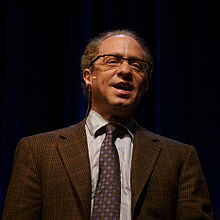
Kurzweil via Wikipedia

Ray Kurzweil (photo via Wikipedia)

Another futurologist, Yuval Noah Harari, says it is a fact that the “last days of Homo sapiens are fast approaching, and that our species will be replaced “by completely different beings who possess not only different physiques, but also very different cognitive and emotional worlds”. Ordinary human beings will become surplus to requirements, as wars will be waged by drones and work will be done by robots: “Some economists predict that sooner or later, unenhanced humans will be completely useless”. Algorithms embedded in silicon and metal will replace algorithms embedded in flesh, which as Harari points out, is what biology and computer science tells us is all we really are anyway. Things have apparently gone so far that some in Silicon Valley already refer to human beings as ‘meat puppets’.

But things are going still further: Harari says that human beings will cease to be free agents, that their autonomy will be taken over by algorithms – written at first by human beings but ultimately by algorithm-writing machines. As this happens, liberal society will disintegrate as we will no longer be able to sustain belief in the uniqueness of the free human being as the basis of liberal social order. He says that: “We – or our heirs – will probably require a brand-new package of religious beliefs and political institutions.”
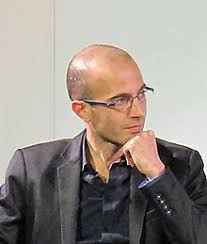
harari via wikipedia

Yuval Noah Harari (photo via Wikipedia)

This new religion will be called Dataism. It will be accompanied by the dissolution of the boundaries between humans, animals, machines and social systems, all of which will be seen as algorithmic information processing systems. The concepts of ‘right’ and ‘wrong’ will be replaced by the primacy of the free flow of information. The “cosmic data-processing system” will be what God once was: “It will be everywhere and will control everything, and humans are destined to merge into it.”

Rudolf Steiner has told us what is the true challenge of our age: he says “it is humanity’s task in this period to come to grips with evil as an impulse in the evolution of the world”. The task for the fifth post-Atlantean period, he says, is a particularly difficult one:

“As you see, a great many temptations face humanity. When the powers of evil gradually appear, it is natural that man is more likely under the circumstances to give in to this evil in all realms, rather than taking up the struggle to allow what appears to him as evil to be put in the service of the good in world evolution. Yet this must happen: the evil must to a certain degree be placed at the service of the good in world evolution”.

And it does seem as though we are indeed at a new point in world and human evolution. In this connection I remember a quotation from the late visionary poet and playwright Christopher Fry, who in his play, A Sleep of Prisoners, has one of the characters say the following:

The human heart can go the lengths of God.
Dark and cold we may be, but this is no winter now.
The frozen misery of centuries breaks, cracks, begins to move.
The thunder is the thunder of the floes, the thaw, the flood,
the upstart Spring.
Thank God our time is now, when wrong comes up,
to face us everywhere
Never to leave us till we take the longest stride of soul
men ever took.

Affairs are now soul size,

The enterprise is exploration unto God.

So that is what we are about in this age – we have chosen to be here at this time when human beings are making a massive evolutionary shift. This is a terrifying but also really exciting time to be here on Earth; and adopting a Luddite approach to emerging technology is not the required response. Steiner tells us:

“It would be the worst possible mistake to say that we should resist what technology has brought into modern life, that we should protect ourselves from Ahriman by cutting ourselves off from modern life. In a certain sense this would be spiritual cowardice. The real remedy for this is not to let the forces of the modern soul weaken and cut themselves off from modern life, but to make the forces of the soul strong so that they can stand up to modern life. A courageous approach to modern life is necessitated by world karma, and that is why true spiritual science possesses the characteristic of requiring an effort of the soul, a really hard effort”.

Alongside courage and hard effort, we also need hope, what Steiner in one of his verses refers to as “all-sustaining hope”. So here are a few reasons why, despite everything, I’m still hopeful and optimistic.

On a personal level, I’m encouraged by listening to the speakers who come here to give talks at Emerson; we have had some wonderful speakers who are alerting us to what is going on in the world and who are giving us real pointers to the future. I was particularly impressed recently by a representative of the Youth Section from Dornach, and the work that that Section is doing on a research project into young people’s attitudes towards spirituality across 23 different countries. I’m also blessed to work on these Emerson talks with some fine young colleagues. And in Liz Attwell’s inspirational talk 2 weeks ago, we heard of her intuition that it is the young people of today who are birthing a new Christ impulse. She also said that many of the dark things we are experiencing are just the inevitable flotsam and jetsam thrown up by this new impulse – and I’m sure she’s right.

Because of all this and so much more I am conscious of how lucky we are to live here and to know that Emerson College, Tablehurst and Plaw Hatch farms, Michael Hall School, Peredur, Tobias and Nutley Hall are all here. We live in an island of sanity amongst the surrounding seas of illusion and although we have some adjustments to make so that we can look the modern world square in the face (what is happening to the Waldorf schools is a case in point here), we are nevertheless strong and resolute.

And beyond our locality, I see all sorts of hopeful developments happening. Just this week, for example, we heard that an American billionaire has given £150 million to the University of Oxford to fund a new centre to look into the ethics of artificial intelligence. His name is Stephen Schwarzman and he said: “I think the scientists agree that they want AI introduced in an ethical way, because they don’t want to experience the downsides. I think this is one of the major issues of our age, because AI is going to come, it’s really unstoppable. It’s not just AI, it’s robotics and all other kinds of computer science innovations”. That echoes what Steiner said back in 1910. And on 12th June the UK government committed us to zero net emissions by 2050, which is definite progress – and there are now 18 out of 28 EU countries which have also pledged to go carbon-neutral by 2050.

I am also amused by and take pity on the idiocies of our atheistic futurologists.  Ray Kurzweil, for example, that incredibly clever man and chief futurologist of Google, is also, rather endearingly, an idiot. He believes in cryonics, which for those of you who don’t know about it, is a technique of freezing dead bodies in the hope that science in the future may find a way to bring the corpses back to life. Ray Kurzweil has booked himself a place for when he dies with a leading American cryonics company, which charges $200,000 to deep-freeze a full body or, if you’re a cheapskate, $80,000 for just a head. The process involves getting to the patient as soon as possible after clinical death has been pronounced and then cooling the body over the next few days to bring it down to -196C using nitrogen gas. Your corpse is then placed in a shiny steel capsule with a bullet-proof viewing window and stays there until the day when science has sufficiently advanced to bring you back to life. I am not making this up – this is genuinely what cryonics is about; and Ray Kurzweil has signed up for this. The poor man doesn’t realise that he is already immortal! If he’d just read Steiner and informed himself about what a human being really is, he could have saved himself $200,000!

I comfort myself with the thought that in the final analysis, Ahriman and his minions will always lose. They always lose because they lack the capacity to love or understand those who can love. Nicanor Perlas in his book repeats a story that Bernard Lievegoed says was given by Steiner in a letter to a widow. In this letter, Steiner says he saw the image of Ahriman sitting in a cave under the earth. He works. He writes things down, counting and counting, calculating and calculating. He tries to build up a whole world out of a new mathematics (and of course AI algorithms are part of the new mathematics). There, Steiner says, Michael stands beside him waiting. For Michael knows that he will make the final addition. Michael with his sword, will make the sum. The moment has not yet come. Michael is waiting, standing by the side, waiting. He can do this when people on earth are there fighting and going with him. With Uriel, we weigh up and understand; with Michael, we act without fear on the basis of that understanding. And that is the really important point – in this present age of the consciousness soul, Michael can only act if we help him to do it. But if we do, he will in turn help us to find much more positive outcomes from the extreme technologies that are threatening our existence today. So it really is up to all of us to play our part in this huge battle.

And finally, I would like to leave you with this verse of Steiner’s:

“We must eradicate from the soul all fear and terror of what comes towards Man out of the future. We must acquire serenity in all feelings and sensations about the future.

We must look forward with absolute equanimity to everything that may come. And we must think only that whatever comes is given to us by a world-directive full of wisdom.

It is part of what we must learn in this age, namely, to live out of pure trust, without any security in existence – trust in the ever-present help of the spiritual world.

Truly, nothing else will do if our courage is not to fail us. And let us seek the awakening from within ourselves Every morning and every evening”.

41 Comments

Filed under Ahriman, Artificial Intelligence, Cryonics, Evil, Futurology, Rudolf Steiner, Spiritual Science, Uriel

“Do you believe in an afterlife?”

On most Saturdays, if I’m not too busy with other things, I go to a shop in our village and buy a copy of the Financial Times Weekend. I do this, not because I have any interest in the financial markets but because at the weekend the Financial Times transforms itself into the best UK newspaper in terms of its coverage of things that do interest me – politics, world affairs, the arts, book reviews, gardening etc.

One of the features I always look at is the ‘Inventory” column in the FT Weekend magazine, in which they interview a well-known person and ask them a standard set of 18 questions, eg: What was your childhood or earliest ambition? Private school or state school? Who was or still is your mentor? How physically fit are you? Ambition or talent: which matters more to success? etc. The question I always find myself turning to first of all is: “Do you believe in an afterlife?”

This week the subject was Bobby Gillespie, a musician who co-founded the band Primal Scream in 1982. His answer to the question was: “I don’t. I do believe in a universal energy – we’re all part of each other. We’re just the human race”.

The previous week the interviewee was Kate Clanchy, who is a teacher, writer and poet who was appointed MBE for services to literature in 2018. Her response to the question was: “No. Maybe only a literary afterlife – I think that’s one of the reasons to write. Your words can live on. I believe in the human capacity to remember each other and love each other”.

These two responses are fairly typical of answers to this question. I haven’t kept a tally but my guess is that around 8 out of 10 interviewees say that they have no belief in an afterlife.  I find myself vaguely disturbed by these results. Why is it that so many people who are prominent in public and cultural life seem to know so little about the reality of what it is to be a human being?

A slightly different question was asked of the great psychiatrist Carl Jung in a TV programme called “Face to Face” in October 1959 when he was interviewed by John Freeman. Jung, who was 84 at the time and was still active in his field, spoke to Freeman about education, religions, consciousness, human nature and his relationship to Freud. When Freeman asked Jung whether he believed in God, Jung’s reply was: “I don’t need to believe, I know”.

carl-jung-9359134-1-402

Carl Jung

This reply has caused something of an outcry, both at the time and in the years since; in 2006 the biologist and convinced atheist Richard Dawkins accused Jung of “blind faith”. I don’t think this is a fair accusation. Jung had worked hard on himself all his life and had worked extensively with a wide range of patients so could speak with the authority of a lifetime of inner exploration. Four years earlier, in another interview, Jung had expanded a little on this theme: “All that I have learned has led me step by step to an unshakeable conviction of the existence of God. I only believe in what I know. And that eliminates believing. Therefore I do not take his existence on belief – I know that he exists”.

Jung’s view, given in letters after these interviews, is that there is something very real and mysterious, which we all call God, but the images of God we all hold are different and inadequate. He seems to have been suggesting that we should recognise that any and all images of God are always different from the actual nature of God.

In that same interview with John Freeman, Jung said this: “We need more understanding of human nature, because the only danger that exists is man himself — he is the great danger, and we are pitifully unaware of it. We know nothing of man — far too little.” Anthroposophists of course would tend to agree with Jung; but we would also go beyond Jung in our view that we already know quite a lot about what it means to be a human being, not only during our physical incarnations but also in our soul and spiritual natures.

I sometimes wonder what I might reply in the highly unlikely event that I was interviewed and asked whether I believed in an afterlife. I should probably say: “Yes I do, and also in many ‘before’ lives as well as afterlives to come”. But this sort of conviction seems to be uncommon today, when a kind of solipsistic cynicism about anything other than the material is more usual.  A quotation from the late, great comic, Peter Cook, sums up this attitude for me: “As I looked out into the night sky, across all those infinite stars, it made me realise how insignificant they are”.

But what would Carl Jung have said if he had been asked about the possibility of an afterlife? Writing in 1934, he commented:

“Critical rationalism has apparently eliminated, along with so many other mythic conceptions, the idea of life after death. This could only have happened because nowadays most people identify themselves almost exclusively with their consciousness, and imagine that they are only what they know about themselves. Yet anyone with even a smattering of psychology can see how limited this knowledge is. Rationalism and doctrinarism are the disease of our time; they pretend to have all the answers. But a great deal will yet be discovered which our present limited view would have ruled out as impossible”.

To my mind, Jung is quite infuriating on this topic – evasive, long-winded and seemingly unwilling to state publicly his private convictions. Jung obviously decided to remain completely empirical in his public observations, confining his work to inner soul images. Jung also speaks of psychoanalysis as the only initiatory path available in the modern Western world.

This is not so, of course, and this is just one reason why for me Steiner is of much more interest than Jung: it is because Steiner has an absolutely clear understanding and knowledge of the transcendent and is able to observe the invisible spiritual realms and report what he has seen. Whereas Jung kept his work firmly in the region of the soul, Steiner was able to develop his capacities of consciousness so as to reveal the nature of the spirit – and to teach how other people can develop these capacities as well.

RudolfSteiner1911

Rudolf Steiner in 1911.

There is a danger here and that is that Steiner’s teachings, taken on their own, and without any conscious connection to one’s own soul life and inner experience, can lead one to fall into anthroposophy as though it were a religion – which it emphatically is not.  Anthroposophy, in fact, is a path of research and hard meditative work leading to various outcomes in consciousness, thinking, feeling and willing. This is quite a tall order for people living in a culture in which materialistic individualism reigns and there is no connection to the collective forces of the soul – but it is a necessary path to take if one wishes to understand the physical-soul-spiritual wholeness of the human being.

46 Comments

Filed under Anthroposophy, Carl Jung, Rudolf Steiner

How objective are Ofsted inspections of Steiner schools in England?

Those of you who are familiar with my recent posts about the current intensive Ofsted inspections of Steiner schools in England will be aware that I have my suspicions about the motives behind this scrutiny blitz by inspectors.

One of the puzzling features is that schools which have previously been awarded a ‘Good’ rating are now being told that they are ‘Inadequate’.  A recent example is that of Michael Hall in Forest Row, East Sussex, often seen as the flagship Steiner school in the UK, which in October 2018 was found by inspectors to be ‘Good’ in five areas and ‘Outstanding’ in Early Years; and just six months later was suddenly ‘Inadequate’ in four out of eight areas. What lies behind this sudden 180 degree turn away from previous inspection findings?

Ofsted would no doubt say that the main factor behind this change is that they have taken back in-house the inspections of Steiner schools previously carried out by School Inspection Service Ltd (SIS), whose inspections were themselves inspected annually by Ofsted and found recently to be insufficiently rigorous. SIS has now apparently taken the decision to close itself down, though there is nothing to indicate this on their website.

Ofsted chief inspector Amanda Spielman wrote to Damian Hinds, the Secretary of State for Education (ie the government’s education minister) that: “The results of our monitoring work of SIS (…) gave me cause for concern: the inspections we monitored lacked rigour, particularly in relation to safeguarding. (…) I am aware that SIS has taken the decision to cease operating. I know our officials are already working together, along with the Independent Schools Inspectorate (ISI), to ensure that all schools previously under the SIS umbrella are inspected by an alternative inspectorate.”

I have to declare an interest here, as for a brief period in 2014/15 I was a lay inspector with SIS and accompanied the inspectors on a few of their visits to Steiner schools. Part of my role was to advise these very experienced inspectors on aspects of Steiner Waldorf education with which they may not have been familiar, but my work was not a statutory part of the inspection process. As readers of previous posts on this topic will know, I formed a high opinion of the inspectors with whom I worked, all of whom were formerly Her Majesty’s Inspectors of Education (HMIs) and who were led during my time by Simon Bennett and then by Mrs Jane Cooper, herself a former principal officer at Ofsted.

Indeed, Amanda Spielman wrote to Jane Cooper in March 2018 enclosing a copy of Ofsted’s report on the inspections carried out by SIS and said: “I would like to take this opportunity to thank you for your professionalism during the year”. This may be a standard sign-off but it is hardly the comment one would expect to see about the head of an organisation whose contract Ofsted were about to close down.

So what happened that made Ofsted decide to terminate SIS? In a nutshell, the Rudolf Steiner School Kings Langley happened. My assumption is that, following concerns expressed by RSSKL parents writing to Ofsted and the government minister about safeguarding and other issues, Ofsted took over the inspections at the school which had previously been carried out by SIS.  The school then failed several inspections in the period up to its closure in July 2018. The failures of RSSKL inevitably put Ofsted’s spotlight on all the other Steiner schools in England (the other UK home nations have separate school inspectorates), with the results we are seeing today.

These results, although definitely a cause for concern about the future of Steiner schools in England, are somewhat mixed. To give just two examples, St Paul’s Steiner School in Islington, North London, was inspected in March this year and was rated ‘Good’ in all areas – a wonderful achievement for a small school housed in a redundant church building and facing all kinds of difficulties. By contrast, Wynstones School, on the outskirts of Gloucester, founded in 1937 and one of the longest-established Steiner schools in the UK, was also inspected in March 2019 and was rated ‘Inadequate’ in each category. At its previous full inspection in 2016, it had been rated as ‘Good’.

The inspectors found that Wynstones had failed to carry out all the necessary checks and training for staff and volunteers, and had not adequately monitored the quality of teaching, learning and assessment – the latter being a common finding in Ofsted’s recent inspections of Steiner schools. They also noted that the pupils’ “spiritual, moral, social and cultural development is strong”. This is also a common finding during inspections of Steiner schools. The pupils are in very good shape, despite what Ofsted perceives as failings in teaching, learning and pupil assessment.

It seems unlikely that this situation has occurred only recently, so how was it that SIS apparently missed these shortcomings and Ofsted has since picked up on them? One clue to why this may be so can be found in the latest report on Michael Hall school, in which the inspector noted, among other things:

  • Leaders and trustees have an overgenerous view of the quality of education that the school provides. In particular, leaders’ monitoring of teaching and learning is ineffective.
  • Teaching, learning and assessment are weak in some phases of the school. This means that many pupils do not make the progress they could.
  • Systems to assess pupils’ progress are underdeveloped, impacting negatively on the progress pupils make.
  • Too often, teachers plan learning that does not meet the needs of pupils of different abilities.

On the other hand, the inspector also recorded that:

  • The sixth form is effective. Students do well because the quality of teaching and learning is consistently good or better.
  • Pupils’ social and emotional development is served well by the school’s curriculum.
  • Safeguarding is effective. Pupils’ welfare, health and safety have a high priority at the school.
  • The curriculum provides particularly well for pupils’ spiritual, moral, social and cultural development. There are also strengths in certain subjects that are delivered by specialists, including languages and gymnastics for instance. Dance, drama and music are also strengths, as is the delivery of eurythmy.
  • The school’s extra-curricular offer is strong. Pupils enjoy a wide range of trips and educational visits to enrich their main lessons. The lead inspector enjoyed an impressive choral performance given by the upper school during the inspection. Older pupils look forward to their annual tour of Italy towards the end of their time at the school. Younger pupils benefit from the use of the school’s extensive grounds and gardens.
  • Pupils are increasingly well prepared for life in modern Britain. The school’s curriculum promotes tolerance and respect well. Pupils’ understanding of equality and difference is strong. This is particularly the case with older pupils, who are eloquent and well equipped to understand the different issues that living in modern Britain brings.

It is inconceivable to me how a school which has achieved all of this for its pupils can be characterised at the top of the report by the phrase: “This is an inadequate school”. It is clear that this verdict is grossly unjust.

Putting aside my suspicions of an instruction from government ministers to Ofsted to fail a few Steiner schools pour encourager les autres, what it indicates to me is that, while the SIS inspectors were of course aware of disparities between mainstream expectations of teaching and learning and the practice in many Steiner schools – and took good care to point these out as areas for improvement –  they also took a holistic view of Steiner education, because they could see the results in the pupils at the top of the school. SIS inspectors made great efforts to understand the education and what the teachers are trying to achieve, and so could take a rounded view of the outcomes; while perhaps it is possible that Ofsted inspectors come in to the schools with their standard model and assumptions and find that Steiner education does not conform to it.

Now I am not arguing that there are no inadequacies in Steiner schools, because there most certainly are. As I’ve written elsewhere, my view is that the College of Teachers model of school management, unless very carefully carried out by people of great integrity and selflessness, is not fit for purpose in today’s conditions; and in particular the College system tends to bring about situations in which there may be insufficient leadership of teaching, learning, assessment and curriculum development in some Steiner schools. My contention is that, if Steiner schools in the UK can find a way to overcome their reluctance to allow individuals to exercise leadership in key parts of the school, then some truly wonderful achievements will come about that could offer inspirational examples for other parts of the education sector. If Steiner education is to survive in England under the Ofsted inspection regime, amended leadership models and wider professional development work will have to become an imperative.

Amanda Spielman has written: “Across the state and independent sectors, there is a wide variety of educational philosophies, and successful schools can be run in a variety of ways. Ofsted does not have a preferred model. However, there are fundamentals that need to be in place: good governance, clear lines of responsibility and effective safeguarding procedures”.

Ofsted may not have a preferred model and Ms Spielman’s points about good governance etc are well made; but I question whether Ofsted understands or is really open to systems which are different from what is found in the mainstream. Take, for example, this experience of an Ofsted inspection as related by a Montessori school. This is a highly detailed and forensic taking-apart of the inadequacies of an Ofsted inspection as applied to a school in the Montessori system and it raises questions in my mind about whether Ofsted can usefully inspect an education method if it does not fully understand it. I could wish that some Steiner teachers would apply a similar analysis to their own experiences of recent Ofsted inspections.

I mentioned Rudolf Steiner School Kings Langley earlier. It was the school that educated my daughter and where I worked for several years and which was a huge part of my life from 1998 to 2014. The school is now planning to re-open in September 2019 as the Langley Hill Independent School under the sponsorshipship of the Avanti Schools Trust, which is also a sponsor of state-funded Hindu faith schools in the UK. Langley Hill describes itself as a Waldorf-inspired school. This may be a path on which a number of Steiner schools strike out in the future and reminds me irresistibly of Graeme Whiting, a former teacher at RSSKL who, with his wife Sarah, wanted to start a Waldorf-inspired school without the complications of trying to manage it through a College of Teachers. Their school, the Acorn School at Nailsworth in Gloucestershire, is very successful, as the latest Ofsted report attests.

RSSKL’s sad fate, coming after my own testing times there, has been a source of frequent angst and agonising for me. Recently I decided that I needed to bring some kind of closure to all this and so resolved to get rid of all my documentation relating to RSSKL. One evening I lit a fire in our garden and then solemnly burnt every single file and paper relating to my time at the Kings Langley school. Perhaps it was just coincidence that the next evening I got a call from a friend, a very experienced former teacher at RSSKL, who on the night of my bonfire had attended a public meeting at the school to meet Adrian Hubbard, who she told me had just been appointed as the first Principal of the new school. Mr Hubbard, whom I don’t know and had never heard of before, has been teaching in China and flew back there after this meeting. When he introduced himself to the assembled parents and friends of the school, he began by saying: “I owe this job to Jeremy Smith. I have been reading his blog while in China and decided to find out more about the school and in the process discovered that it is seeking to re-open and was advertising for a principal. I applied and here I am.”

I told my friend that Mr Hubbard will have done himself no favours with some of the people there by mentioning me – but of course I was delighted, as this seemed like a natural and positive completion of my own long, karmic journey with the school at Kings Langley. And as Mr Hubbard is apparently a follower of this blog and may be reading these lines while still in China, I hope he will accept my very best wishes for the successful renaissance of a good and special school – no longer a Steiner school but nevertheless a Waldorf-inspired one, which will always have a place in my heart.

26 Comments

Filed under Kings Langley, Leadership in Steiner Waldorf Schools, Ofsted, RSSKL, Steiner Waldorf schools

Why has eurythmy not yet gone mainstream?

I write this piece with some hesitancy and doubt, being only too aware of how little I know about the subject. Yet I feel that these present times are calling for a new type of eurythmy and that it is vital for all our futures that eurythmy should evolve to meet a new set of needs. It has often puzzled me as to why, among the various initiatives brought by Rudolf Steiner, only eurythmy has so far not been able to gain some measure of mainstream acceptance – why is this?

Before looking at some of the reasons why this might be so, it should be explained for those who are not yet familiar with eurythmy, that it is an art of movement developed by Rudolf Steiner in the early 20thcentury, so as to create a visible expression of the sounds, forms and dynamics that the human larynx makes while interacting with the environment during the activity of speaking and or singing. Why the larynx? It is because the larynx, like the foot or the hand (as we know from reflexology), contains within itself the whole map of the human being. You can see a performance of eurythmy from the stage of the Goetheanum in Dornach, here on YouTube.

In eurythmy the inner qualities of speech and song are made visible, and not the feelings evoked by what is heard. The performer becomes both the speech and the music so that the hidden inner life within them is revealed. This inner life is found in our etheric body.1

So eurythmy is thus an art of etheric movement, which as far as I am aware, makes the whole concept of eurythmy quite unique as a form of movement in the West. Steiner first developed eurythmy in 1912 and, like other developments he introduced (eg Waldorf education, anthroposophical medicine, and the birth of anthroposophy itself), it came about through a question brought to him by someone else. The questioner in this case was Clara Smits, who was looking for a career in movement for her daughter, Lori. Although Lori was still in her teens, Steiner began to introduce her to a new art of movement through exercises and imaginative pictures.

It soon became clear that eurythmy could be not only an art but also a health-promoting activity, and specific exercises for a wide variety of medical conditions were developed and came to be known as ‘curative eurythmy’or ‘eurythmy therapy’.

In 1919 the first Waldorf School opened and eurythmy was introduced as an integral part of the curriculum. Like the rest of the curriculum introduced by Steiner, the eurythmy lessons develop through the school in tune with the development of the children.

Since it was first created just over 100 years ago, eurythmy has developed into four main areas:

  1. As a performance art
  2. As a pedagogical activity within Steiner Waldorf schools
  3. As a curative therapy
  4. As Applied Eurythmy 2

I first came across eurythmy when I was a parent at my daughter’s Steiner school and saw performances of it by pupils and sometimes by teachers and/or visiting eurythmy troupes. Later, when I started to work at the school, I also became aware of curative eurythmy to help individual pupils. Later still, long after I had left the school, I was fortunate enough to receive curative eurythmy for some health issues of my own.

It’s curious how topics for this blog come about. I had no intention of writing about eurythmy until I received an email from a dear friend, Anne Davison, who said that she had for some reason felt moved to send me an article written about eurythmy by a friend of hers in New York. In my reply to thank her for the article, I said that: “… my view of eurythmy as a performing art is that it is severely hampered by two main factors: i) that for anyone who, like me, does not have an understanding derived from years of study and/or experience, it requires truly inspired performers if it is not to become a touch boring as a visual spectacle; and ii) that it really is time for eurythmists to evolve their art beyond the wearing of floaty coloured silk garments and to start to engage with the more visceral issues of today.”

I added that: “I have had a little bit of experience of curative eurythmy and I would like to have much more of it; I think it is a very profound and truly valuable addition to the healing repertoire.”

Anne replied to say that she agreed with me; she had gone to Dornach in the 1980s and had seen some performances of eurythmy. She thought that “men in floaty garments on their tippy toes was not such a good look. And, at a time when I was bent on ‘earth’ consciousness, I thought eurythmy was too ‘high’…(spiritual?).”

This accorded with my own responses to stage performances of eurythmy, and also reminded me of one performance that by contrast I had really enjoyed. It was at my daughter’s school and was by a group of boys from Class 12, who had been working with a newly-arrived eurythmy teacher to devise their own performance based on Martin Luther King’s famous “I have a dream” speech. While a speaker spoke out the words, these teenage boys moved rhythmically, thumping the ground with wooden staves as though to summon the earth to witness them. It was powerful and moving, demonstrating how to harness aggressive young male energy in the service of a high ideal – truly eurythmy for our times. As we applauded and cheered at the end of the performance, we heard a teacher behind us say: “That’s not real eurythmy.”

It was interesting that the performance which I and many others had found so inspiring, vital and relevant was decried by some teachers as “not being real eurythmy”. A short while later, the eurythmy teacher who had devised this production with the boys left the school, no doubt having been made aware that her approach to eurythmy was not welcome there.

That this kind of subtle bullying was a wider phenomenon, by those who thought they knew how eurythmy should and should not be done, came home to me when I read the following in Dean Pollard’s blog about his experiences at Dornach:

“During the breaks and after a eurythmy performance, the greater portion of the audience and especially the eurythmy students and teachers, were all in conflict and discussion around what they witnessed in the eurythmy performance. ‘Was that really eurythmy or not?’, or ‘It was way too athletic to be eurythmy’ or: ‘Too astral to be true etheric movement.’ Get real, people! For god’s sake, stop and look at that behavior.  If so many anthroposophists spend so much time disagreeing about what is Eurythmy or etheric movement,  how the hell do you expect the rest of the world to understand it?….Do some of you even care if anyone else on this planet has a grounded experience of Rudolf Steiner’s work?”

Later in the same piece, Dean says:

“If there is one thing that my experiences as a eurythmist have taught me, it is that as soon as human movements tend toward dance-like, physically strong or athletic expression,  the typically trained eurythmist will make statements and claims that what they are seeing is not ‘etheric movement’ but ‘physical movement’, or that what they are witnessing is ‘etherically bruising’. (…)

What is passed on as ‘etheric movement’ by eurythmy training centers can be easily summed up as, learning how to lead your movements from almost entirely the head and upper torso areas.  Sports and athletic movements, due to the sheer physics of the activity, must utilize and lead from the lower movement center and in concordance with the torso and head, thus inhabiting, articulating and using the entire human body as an instrument of expression. That is the paradox … it has become an acceptable, common practice to access the trunk (lower movement center) only during the naughty humorous portion of a eurythmy performance, but not encouraged to be developed any further by eurythmy students as part of their training.”

The floaty clothes, the subtle snobbery and the exclusiveness builds a picture of the shadow side of anthroposophy that one comes across occasionally. It is found in those anthroposophical enterprises that have ignored Karl Konig’s advice that “Tradition is nurturing the flame, not worshipping the ashes.” It is the same phenomenon seen in too many Steiner Waldorf schools right now, which have failed to evolve and develop their practice to meet the needs of the times – and as a result are facing severe problems.

Why I find this to be so relevant brings us back to my friend Anne Davison, who is a highly-developed channel in her own right. This is an excerpt from the April 2019 channelling on her website:

“The etheric body – the first layer in the human energy field – is disturbed. Everyone feels they are being prodded and cajoled and disturbed, as though somebody or something is poking into their etheric field.

The way to think of the current times is that the earth’s etheric field is being nudged and prodded, cajoled by universal energies that wish to destabilise the earth, destabilise individuals, in order now for a new etheric to take its place on planet earth. There really is a sense that everything has wobbled and changed and disturbed the status quo.

When this status quo has been disturbed in the etheric around individuals, and around the earth, it does have a huge effect; it feels so uncomfortable. And this discomfort makes you feel that things have to change. The disturbance tells you that we can’t carry on like this; there has to be a different way of doing so many things. And it’s urgent. (…)

Values and structures within society, were set up on old understandings; on a hierarchical (and monetary) system where there could never be equality, where certain people had value and others didn’t. This must change. Equality has to be universal.

When the etheric realigns, resettles its new form and influence, individually and collectively, it changes our understanding of how we are in the world. We will feel comfortable in this new world, in the new order where there are no anomalies, and no exceptions and no ‘specials’. We can live our lives in the most productive, caring, understanding and accepting way, with no special religions or companies or people telling us what to do.

In the coming weeks and months the realisation that there is no consensus for the old politics, the old monetary system, the old work system, will be a revelation to many, many people who will truly be relieved not to be on the treadmill of the old regime. They will realise in some way that this is what they have been waiting for. A conviction to change the hearts and minds of other people in a new recognition of what it is to be human on planet earth.”


I started this piece by outlining my doubts about expressing views on something of which I have far too little knowledge. I’m also conscious of the hard struggle that eurythmists endure to keep their art going in the face of lack of wider recognition, limited financial resources and public incomprehension. I also have my own positive experiences of the very real benefits of curative eurythmy. So what I am saying here is not said to discourage eurythmists on their difficult path but on the contrary to encourage them to find new ways to communicate and celebrate the vital contribution that eurythmy can make in these times when the etheric is shifting for all of us. Floaty coloured silks won’t cut it any more…


According to Steiner, the etheric body is essentially an energy body that contains and forms the physical. It is this etheric body which maintains the physical body’s form until death. Next to the etheric body is the astral body, which provides us with awareness and self-awareness, our emotions and our feelings and intentions. Then comes the ego, the immortal and inalienable core of a human being, which goes with us from one incarnation to the next. When we go to sleep at night, the physical and etheric bodies remain in our bed, while the astral body and ego go into the spiritual world for rest and inspiration and remain there until we wake up, when they re-enter the physical and etheric bodies.

“Applied Eurythmy is the application of the principles and elements of Artistic, Pedagogical, and Therapeutic Eurythmy into an individual’s work and leisure activities. Whether you use a shovel or a ball, jog or sweep, drive or ride, bringing moments of focused attention to everyday habitual movement patterns in the light of Applied Eurythmy can engender a natural reverence, respect, and playfulness to your connection with the universal in and around you.”  (Definition from Dean Pollard’s blog.)

45 Comments

Filed under Eurythmy

What next for Steiner Waldorf schools in England?

After my recent posts on the troubles affecting Steiner Waldorf schools in England, I’ve come in for a certain amount of criticism from some anthroposophists, who think that it’s not a good idea to wash dirty linen in public.

One friend and anthroposophical colleague, a former teacher, told me that I should be putting across a more hopeful message instead of reinforcing all the doom and gloom in the media. She also felt that my recent blog posts may have given the impression that I am a critic of Steiner Waldorf education rather than a supporter.

After this dressing-down from my friend, I got home to find the following in my inbox from the magazine Schools Week:

Two Steiner schools criticised by Ofsted over safeguarding failures have been warned they face being moved to new sponsors.

Steiner Academy Bristol and Steiner Academy Frome have been issued with termination warning notices by Lisa Mannall, the regional schools commissioner for the south west of England.

The schools, which follow the teachings of Rudolf Steiner, were placed in special measures following unannounced Ofsted inspections last November. It means three of the four state-funded Steiner free schools in England are now rated inadequate.

Inspectors said the schools did not have high enough expectations of pupils and warned safeguarding was “not effective”.

Staff at the Steiner Academy Bristol also “unnecessarily” used physical intervention, they found. Steiner Academy Exeter, which was placed in special measures in October, has already received a “minded to terminate” notice from the government, which was published in December.

The damning reports, published last month, along with “deeply concerning” findings in other Steiner institutions raised by chief inspector of schools Amanda Spielman, prompted the education secretary Damian Hinds to grant Ofsted special powers to inspect all Steiner schools in England, including 21 private schools”.

This news item was yet another reminder that Steiner Waldorf schools in England are facing an existential crisis and why burying our heads in the sand is not a wise strategy. However uncomfortable it may be for supporters of Steiner Waldorf education (amongst whom I include myself, it should go without saying), we must nevertheless look this crisis clearly in the face and consider what needs to change now.  To quote from Amanda Spielman’s letter of 31st January 2019 to the Secretary of State for Education, referring to the nine inspections so far carried out by Ofsted:

“All the inspection reports have now been published on Ofsted’s website. Six of the nine ‘overall effectiveness’ judgements from full inspections were inadequate and three were requires improvement.

None of the schools was judged good or outstanding for overall effectiveness. A significant number were inadequate in all areas, and a number of the independent schools inspected failed to meet the department’s independent school standards”.

Here is the passage that worries me most in Spielman’s letter:

“Given the prevalence and seriousness of these issues across both state-funded and independent Steiner schools, they raise questions about whether these common failures are a result of the underlying principles of Steiner education. Across the state and independent sectors, there is a wide variety of educational philosophies, and successful schools can be run in a variety of ways. Ofsted does not have a preferred model. However, there are fundamentals that need to be in place: good governance, clear lines of responsibility and effective safeguarding procedures. While we did find some examples of this during these inspections, they were very much in the minority. I therefore urge you to consider and further investigate why so many of the Steiner schools inspected are neither protecting children adequately nor giving them a good standard of education”.

Damian Hinds has not so far responded to this request to approve an investigation into whether the “underlying principles” of Steiner education result in failures of leadership, governance and safeguarding but the prospect of such an intervention must be deeply concerning for the whole movement.

I’m told that a current trustee of the now-closed Rudolf Steiner School Kings Langley, when asked for her reflections on what had happened, said simply that the school had been unprofessional. If that is the case, and if that also applies to some of the other schools which have been recently inspected, then the challenge for other Steiner schools is: how can they become more professional in terms that will be recognised by Ofsted – but without losing the essence of Steiner Waldorf education?  This must be possible to achieve, because the Steiner Academy Hereford was rated Good in all areas by Ofsted in its latest inspection – which means that there is no inherent reason why other Steiner schools can’t do the same.

I was therefore pleased to hear that the Anthroposophical Society in Great Britain is now funding someone with experience of Hereford’s methods to provide consultancy to other schools in England. The Society is also providing sponsorship for schools to send teachers to this year’s Easter Conference in April at Michael Hall, which will be on the themes of revival and renewal of Steiner Waldorf education. I was also heartened to see that the Steiner Waldorf Schools Fellowship is inviting expressions of interest to undertake research at PhD or EdD level into the following questions:

  • What are the outcomes of Steiner Education in the UK?
  • What does a contemporary Steiner Curriculum look like in modern Britain?
  • What does the leadership/governance structure look like for a contemporary Steiner School in modern Britain?

As a result of a meeting of 17 schools at Rudolf Steiner House in London on 8th December, four working groups have been formed to look at Steiner Waldorf approaches to:

  • Assessment of children’s learning
  • Appraisal of teachers
  • Leadership and management training
  • Curriculum development

This is all good news and it fits in with what was said to me recently by a kindergarten teacher, that “this crisis will be the making of Steiner Waldorf education in this country”.

It’s not just in schools or in England that these challenges are being faced; anyone working in anthroposophical social care, for example, will be aware of what happened in the Camphill movement and how the model of care established by Karl König has had to evolve beyond the original in the face of increased regulatory requirements. The problem with governmental and societal demands for increased safeguarding and accountability is that they are always accompanied by a narrowing of the cultural and spiritual life, because of insurance-based risk aversion and ever-more prescriptive laws and regulations. But if Steiner Waldorf schools can show that, despite the increasing restrictions, they are improving and can mobilise their parents in defence of the education, then as has been seen in the USA with charter schools facing similar challenges, it becomes very difficult for a politician to close them down.

Even if the schools do manage to get overwhelming parental support, there will always be necessary improvement work for them to do and they cannot afford to rest on their historical laurels. For people working in those schools, the question of the division between leadership and the individual responsibility of each member of staff has to be addressed.  What are the qualities needed by leaders in Steiner schools and are they different from the qualities needed by leaders in mainstream schools? What forms of school organisation and governance will deliver a really well-managed and well-led Steiner Waldorf school nowadays?

Finally, how can we improve the training of teachers in Steiner Waldorf schools? It is clear that further developments are needed, but who is to do it and how is it to be resourced and accredited? There is also a need for conversion courses, for teachers in the mainstream schools who would love to work as Steiner teachers in a creative and fulfilling professional environment. In this connection, I was delighted to see that the Steiner Academy Hereford has received a small grant to set up a pilot scheme for qualified mainstream teachers who wish to convert to becoming class or subject teachers within Steiner Waldorf schools. They received 30 applications for this scheme, which shows there is a real appetite for working in a school environment which encourages imagination and creativity.

The Steiner Waldorf schools in England are currently facing huge challenges and some of them may be forced to close. This is the present reality. But those which can rise to meet and overcome these challenges will become stronger, more effective and yes, more professional. If these schools are to continue to offer an education in the name of Rudolf Steiner, then nothing less will do.

40 Comments

Filed under Leadership in Steiner Waldorf Schools, Ofsted, Steiner Waldorf schools