Category Archives: Rudolf Steiner

The Evolution of the Michael Impulse

In my last post and elsewhere in this blog, I’ve written about what Steiner called the “War in Heaven” which took place between 1841 and 1879. This battle was waged between angels of the higher hierarchies and some of the spirits of darkness, and it ended with these spirits of darkness being cast down from the spiritual world to the earth. This made the heavens free of these beings but had the unfortunate effect of making the earth full of them. This has led on to what I have called the most terrible century in the whole of human history in terms of war and multiple other causes of human misery.

Why did this happen? According to Steiner, these spirits of darkness wanted to be able to prevent the spiritual wisdom, which was due to be revealed from the 20th century onwards, from flowing into human souls. Only by the removal of these hindering beings from the spiritual realm could our human hearts and minds begin to open to receive from the angels the spiritual knowledge for which we are destined – but the corollary of this was that the opposing spirits of darkness are now here on earth and in fact living within our blood and nervous systems, where they make it their business to spread confusion and to prevent human understanding of spiritual truths.

One of the consequences of this is that clear thinking by human beings is now an absolute necessity – in fact, Steiner says that with regard to what he calls “the inner necessities of evolution”, clarity of thinking is now as essential as eating and drinking are to the maintenance of physical life. Since 1879, we must actively strive for spirituality – if we desire it.

Another consequence is that human beings in their souls more and more come to resemble their thought – to resemble what they regard as knowledge. So if, for example, you are a Darwinian and believe the only possible truth to be that human beings have descended from the animals, then Steiner suggests that you will fashion a kind of consciousness for yourself in which you will perceive your own likeness to animal nature and will therefore be unable to understand the shortcomings of your conception of what it is to be a human being. Since 1879, what we think ourselves to be, that we are obliged to become.

The spirits of darkness attach particular value to the breeding of confusion among us humans, in the hope that we will fail to form correctly the thoughts and ideas into which, after death, we will be transformed. The Gods were bound to make it possible for us to become what we make of ourselves, so that we may attain full and free consciousness of the Self, and find the way that leads from the animal to the Divine – but this freedom, at a time when it was evolutionarily necessary for us to begin to realise that the soul is what it thinks itself to be, has also allowed the spirits of darkness to counter really effective thinking with untruths, eg the idea that all that remains of one who has died is what is decaying in the earth or is ashes in the urn. It really matters to our individual futures whether we, on the one hand, cherish in our souls the thought of those who have died living on in the spiritual world, or on the other hand, succumb to the atheistical notion that on death there is an extinction of consciousness and all that is left of us is something rotting in the grave.

It was the Archangel Michael who won the War in Heaven and who since 1879 has been the time spirit of our age. I have sometimes felt that Michael has placed a terrible burden on humanity by casting down the spirits of darkness to find their new dwelling-place within human beings; but in my wiser moments, I can see that this has in fact been a necessary but very difficult chapter in the evolution of human freedom. Michael himself is evolving and Steiner has spoken of this in a lecture he gave in 1913:

“At no time in human evolution have two successive epochs been so radically different from one another as that which has just run its course and the epoch upon which we are now entering (ie before and after 1879). And never before have souls been more alien to one another than will be the souls of those who incline to what is spiritual and the souls who still adhere to what past centuries have brought. Nor will it be long before those who believe they stand firmly in materialistic monism will be quite out of date in comparison with those who are earnestly seeking an understanding of super-sensible worlds. For since the last third of the nineteenth century a spiritual ‘tidal wave’ from higher worlds has been flowing into our world, and making it possible for man to understand the way in which human and world evolution are spiritually guided.

If one wants to understand the evolution of mankind, one must understand that Michael too has evolved: one must understand that it is the same Being who paved the way for the preparation of the Mystery of Golgotha, and who now in our day paves the way for the understanding of the Mystery of Golgotha. Then, however, he was a Folk Spirit, now he is a Time Spirit; then he was the Messenger of Jahve, now he is the Messenger of Christ. We speak of the Christ in the right way when we speak of Michael and his mission, knowing that Michael, who was formerly the bearer of the Jehovah-mission, is now the bearer of the Mission of the Christ.

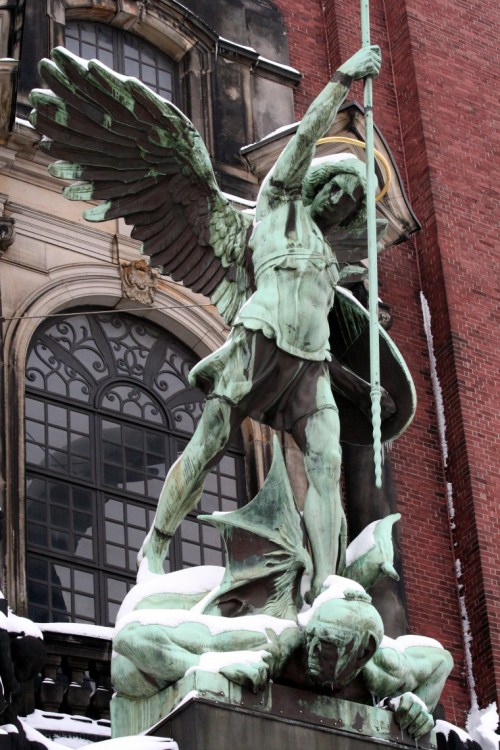
That is an important Imagination, — Michael overcoming the Dragon. To receive the inflow of spiritual life into the sense world, — from now on, that is the service of Michael. We serve Michael by overcoming the Dragon that is trying to grow to his full height and strength in ideas which during the past epoch produced materialism and which now threaten to prolong their life on into the future. To defeat this means to stand in the service of Michael. That is the victory of Michael over the Dragon. It is the old picture over again, which for earlier times had another meaning and which must now acquire the right meaning for our age. When we are conscious of the part we have to play as men of a new age, then our task can stand before us in the picture of Michael conquering the Dragon.

Let us take this picture and make of it an Imagination. Let us try to understand our times through knowing ourselves to be in a spiritual guidance that is the true spiritual guidance of our age, and that can be the spiritual guidance of every human soul who is sincerely and honestly seeking evolution on the path of spiritual life.

The Adversary has found his abode in man. Michael has remained true to his nature. When man turns to Michael with that part of his life which has its origin in the higher spirituality, then there arises in the soul of man the inward fight of Michael and the Dragon.”

Michael St Michael's Church Hamburg

Michael’s victory over the Devil – from St Michael’s Church, Hamburg

18 Comments

Filed under Angels, Archangel Michael, Atheism, Rudolf Steiner

How should we deal with evil?

I’m still reflecting on the phenomenon of evil that was the subject of my last post, and in particular the statement from Rudolf Steiner with which that post ended: “What people in our epoch must learn is the need to wage a fully conscious fight against the evil that is making its way into human evolution.”

Steiner was speaking at the time of the First World War. He was undoubtedly looking ahead to all the horrors that were to be visited on human beings in the 20th and 21st centuries and to our present time, in which unspeakable depravities are being committed, often in the name of God.

Rudolf Steiner exhorted people to wake up and to observe what was really going on, not only behind the façade of political and economic events but also beyond our immediate physical reality. Almost exactly 100 years ago, and not long after the Russian revolution, he spoke in terms that are just as relevant today:

“At the present time of severe trials it must be quite natural to anyone who has a heartfelt interest in the endeavours of anthroposophical spiritual science to reflect upon the relations existing between the fact that this spiritual-scientific movement started at the beginning of the twentieth century to send its impulses into the evolution of mankind and the other fact that mankind of the present age has been engulfed by catastrophic events. How catastrophic these events are for mankind has not yet been fully understood, for people are accustomed today to a life without the spirit. To live without the spirit, however, is to live superficially; and to live superficially causes human beings to sleep away the important impressions of the events taking place around them. To sleep through important events is a special characteristic of the human being of the present age. There are few people today who arrive at an adequate conception of the severity and incisiveness of present-day events. Most of them live from day to day.”

Why has there been this intensification, a kind of industrialisation, of the scale of evil on this Earth? And how can we wake up to what is really going on and begin to counteract “the evil that is making its way into human evolution”?

By way of context, I have written in an earlier posting about what Steiner called “the war in heaven” that took place over the period 1840 to 1879 between the Archangel Michael and the dark angels. I won’t repeat it here, except to say that since that time, when these dark forces were cast out of heaven and into the earth, they have been working within the blood and nervous system of human beings in an attempt to reverse both human and angelic evolution.

It is no coincidence that since the fall to earth of these dark angels, humanity has endured what must surely be the most terrible century in the whole of human history.

Rudolf Steiner speaks of the Archangel Michael who maintains the balance in the world between too much disembodied fantasy (dominated by Lucifer) and too much cold intellectuality and materialism (dominated by Ahriman). Lucifer and Ahriman are in Steiner’s view two polarities of evil but they are also actual spiritual beings, who are active within humanity. They are evil in the sense that they both strive to hinder the human being’s spiritual development. But Steiner does not have a simplistic view of Lucifer and Ahriman as merely oppositional to humanity; in a lecture given in Munich on February 17th 1918, he had this to say:

“The spiritual Beings, whose task it was to fight against the Michaelic principle, were the same ones whose task it was to bring differentiation into humanity, to split unified humanity into races and peoples, to bring about all those differences connected with the blood, with nerves, with temperament. This had to happen. We may call these spiritual beings who had to bring such differentiation into humanity “Ahrimanic” Beings. We may call them such, but we must realise that the Ahrimanic principle was a necessity in the whole course of human evolution.” (Schmidt Number S-3482)

Christ and Michael hold the balance between these two polarities and they work closely together, for Michael is known as the Countenance of Christ. By casting down the angels of darkness into the earth, it is almost as though Michael has inflicted a situation in which human beings have had to suffer far, far more than would have been the case if we had been left to our own devices. And here we come to a strange paradox, which is that the forces of both good and evil proceed from God.

This is a powerful reason why many people say they do not believe in God, for how can a god of love who is omnipotent, omniscient and omnipresent allow phenomena such as Islamic State to exist? Yet initiates tell us that God has two aspects, which when understood and viewed correctly, enable us to see the purpose of evil. Evil can be viewed as the unevolved and undeveloped aspect of life, the force which tests us and absorbs and removes that which is unwanted. The illumined soul will not attempt to get rid of evil by attacking it, but by radiating love, light, beauty and truth.

I find this a difficult concept to understand and accept. If I were given the opportunity to prevent an assault on a Yazidi girl by killing the Islamic State fighter who had imprisoned and raped her, then I would choose to shoot him as though he were a rabid dog. I would take on that karma quite willingly. I don’t think that any amount of radiating love, light, beauty and truth would do much to save that young girl in such circumstances. Clearly, and as must be evident to all who know me, I’ve still some way to go before becoming an illumined soul. 🙂

Nevertheless, I can see that the general point holds, and that by fighting evil on its own terms, we are merely strengthening and perpetuating its effects. So what might Steiner have meant when he called on us to wage a fully conscious fight against the evil that is making its way into human evolution?

First, we need to understand what is the fundamental trait of all human evil. According to Steiner, speaking in Berlin on 15th January 1914, “all human evil proceeds from what we call egotism. In the whole scope and range of ‘wrong’, from the smallest oversight to the most serious crime, whether the imperfection or evil originates more in the body or in the soul, egotism is the fundamental trait which underlies it all… and that the path which leads beyond evil here in the physical world is the one upon which we combat egotism.”

But there is another paradox here, and it’s a tricky one, to do with the dual nature of the soul: qualities which in our physical sense-world appear as egotism, are the very same qualities which need to be strengthened and intensified if we are to ascend into the world of spirit. Steiner tells us that it is only when the soul has developed a self-rooted ego-strength that it can begin to rise up into the higher worlds of spirit; in other words, the soul in the spiritual world between death and rebirth is mainly concerned with itself and its own destiny resulting from its previous earthly lives. This is necessary because in the spiritual world the more a soul has strengthened itself and developed its potential, the more it can participate and serve the whole – the soul has to draw out from the ego what is inherent in itself, otherwise it has nothing to offer.

This strengthening and empowering of our ego in the spiritual world between death and a new birth is what enables us to prepare an incarnation in the physical world in which our outer thoughts and actions can become as unegotistic as possible. And it is only in the physical world, here on Earth, that we can find the conditions which allow us to overcome egotism. Earth gives us the opportunity to develop altruism and unselfishness, and to break the habit of egotism, so as to become more moral. It is by understanding this paradox that Steiner gives us the key to avoiding the evil that is otherwise inherent in each one of us:

“What does this dual nature of the soul actually mean for us? It means that we must be very careful not to falsely transpose something that has its rightful place in one world – the intensification of inner strength in the world of spirit – to another, the physical world, except when we are attempting to penetrate the world of spirit. It means that only evil will come of the human being allowing his earthly sense-nature to be permeated by this inner intensification and self-consolidation, even though this is exactly what the realm of spirit requires…what is absolutely necessary for spiritual progress, perfecting and intensifying one’s own being, is a source of evil and wrong if transposed directly upon the things of outer, physical life…Whether we enter the spiritual world through self-development or by passing over the threshold of death, we must dwell there within the inner strength of our being. Yet we cannot manage this unless we develop altruism in the physical world. Altruism in the physical world has its mirror-image in the rightful egotism needed in the world of spirit.” (ibid.)

This is quite a tough concept to grasp and to compound the difficulty, Steiner gives us here what seems to be a counter-intuitive understanding of the origin of evil:

“So we can begin to answer the question about the origin of evil and wrong-doing in the world. It comes about when we allow our better, higher nature (not our worst) to descend and be submerged in the physical realm, a realm which cannot as such be evil. It comes about when we develop qualities in the physical realm which do not belong there, which have their rightful place in the realm of spirit. Why do we have a potential for evil? Because we are also spiritual beings! Because we have to be able to develop those qualities when we penetrate into the spiritual world, which become bad when we apply them in the physical…What brings about evil is misapplying spiritual qualities to physical life. If we could not be evil, we could not be spiritual beings either. Without the characteristics which make us evil, we could not enter the spiritual world.” (ibid.)

Steiner also tells us that, since the beginning of the fifth post-Atlantean epoch, the propensity for evil lies in the subconscious of every person, and that there is no crime, however dreadful, that each one of us, as people of the fifth post-Atlantean epoch, does not have the potential to commit. And he asks:

“What on earth is the reason for these forces in the universe which infiltrate our being? They are certainly not there in order to bring about evil acts in human society. They no more exist to provoke us to criminal actions than the forces of death exist to make us die; they are present in the universe so as to awaken in us a propensity, once the consciousness soul has developed, for opening ourselves to the life of spirit…These forces of evil are active in the universe. We must assimilate them, and by so doing we implant in our being the seed which enables us to have conscious experience of the spirit. In the context of our social order they appear in a perverted form, but they really do not exist to incite us to evil acts. They exist to enable people at the stage of the consciousness soul to break through to the life of the spirit.”

These are indeed difficult ideas to understand, and they need much thought and reflection before one can begin to make any sense of them. But Steiner helps us by indicating where all these struggles will ultimately lead: the forming of a community of human beings with emancipated, independent and differentiated egos:

“This is the mission of the Earth, expressed through love: that one ego learns to encounter another in freedom. No love is perfect that proceeds from coercion, from being linked or bound together through necessity. Only when each ego is so free and independent that it can choose not to love, is its love an entirely free gift. This is really the aim of the divine plan – to make the ego so independent that it can offer the free, individual gift of love even to God…The ego therefore represents the promise of the human being’s highest goal. But if it does not find love, if it hardens inwardly, it is also the tempter that casts us into the abyss. Then it becomes what separates people from each other, leading them ultimately to the great War of All against All – not only the war of nation against nation (for the concept of nations will then no longer have anything like the significance it possesses today) but the war of each single individual against every other in all realms of life; the war of class against class, caste against caste, the war between different generations and races. In all realms of life, then, the ego will become the focus of strife and contention, which is why we say that it can lead both to the highest and to the lowest possible qualities.”

We are coming up to a very difficult period in human physical existence, which anthroposophists characterise as the actual incarnation in physical form of the great dark archangel, Ahriman. This will be the last of three unique incarnations of which Steiner spoke – the incarnation of Lucifer in about 3000 BC (believed by many to have been as the Yellow Emperor in China, he of the terracotta army); the incarnation of Christ in Palestine two thousand years ago; and the incarnation of Ahriman “before only a part of the third millennium of he post-Christian era has elapsed”, probably in America. Each of these incarnations is prepared for many years, indeed centuries, in advance, and we can see quite clearly already the kind of evil influences that the future Ahrimanic incarnation is bringing to bear upon our human societies. As I said earlier, the past one hundred years has been the most terrible century in the whole of human history and the evil is worsening and intensifying as we approach the actual incarnation. In a lecture given in 1919, Steiner told us the following:

“Just as there was an incarnation of Lucifer in the flesh and an incarnation of Christ in the flesh, so, before only a part of the third millennium of the post-Christian era has elapsed, there will be, in the West, an actual incarnation of Ahriman: Ahriman in the flesh. Humanity on earth cannot escape this incarnation of Ahriman. It will come inevitably. But what matters is that people shall find the right vantage point from which to confront it.

Whenever preparation is being made for incarnations of this character, we must be alert to certain indicative trends in evolution. A being like Ahriman, who will incarnate in the West in time to come, prepares for this incarnation in advance. With a view to his incarnation on the earth, Ahriman guides certain forces in evolution in such a way that they may be of the greatest possible advantage to him. And evil would result were people to live on in a state of drowsy unawareness, unable to recognise certain phenomena in life as preparations for Ahriman’s incarnation in the flesh. The right stand can be taken only by recognising in one or another series of events the preparation that is being made by Ahriman for his earthly existence. And the time has now come for individual human beings to know what tendencies and events around them are machinations of Ahriman, helping him to prepare for his approaching incarnation.

It would undoubtedly be of the greatest benefit to Ahriman if he could succeed in preventing the vast majority of people from perceiving what would make for their true well-being, if the vast majority of people were to regard these preparations for the Ahriman incarnation as progressive and good for evolution. If Ahriman were able to slink into a humanity unaware of his coming, that would gladden him most of all. It is for this reason that the occurrences and trends in which Ahriman is working for his future incarnation must be brought to light.”

I recently attended a talk given at Emerson College by T.H (Thomas) Meyer, in which he reminded us of a passage towards the end of Steiner’s fourth Mystery Drama, The Soul’s Awakening. Thomas drew our attention to a scene between the initiate, Benedictus, and another character whom Benedictus at first does not recognise:

Benedictus:  Who are you, who come to shadow-life from out the chaos of my soul horizon?

Ahriman: (aside) He sees, but yet he does not recognise me and so he will not cause me painful terror when at his side I try to use my power.

(Ahriman then tries to tempt Benedictus with special spiritual knowledge but Benedictus does not take the bait.)

Benedictus: Whoever you may be, you only serve the good, when for yourself you will not strive, or when you lose yourself in human thinking, to rise anew in cosmic revolution.

Ahriman: It is high time for me to turn away in haste from his horizon, for when his sight can think me as in truth I really am, there will arise and grow within his thinking part of the power that will slowly destroy me. (Ahriman disappears.)

So the play is telling us that when we can see Ahriman as he really is, in all his manifestations and influences, then there will arise and grow within our thinking part of the power that will slowly destroy Ahriman. Our best way to prepare ourselves for the evil that is making its way into human evolution is to be alert to what is really going on; and to recognise Ahriman in all his guises and in all the countless ways in which his influence is affecting us and our fellow human beings.

In the same lecture I quoted last, Steiner said:

“To the extent to which people can be roused into conducting their affairs not for material ends alone and into regarding a free and independent spiritual life, equally with economic life, as an integral part of the social organism — to that same extent Ahriman’s incarnation will be awaited with an attitude worthy of humanity.”

I will be touching upon some of the more grotesquely distorted and evil aspects of our present-day economic life, and how these can affect the free and independent spiritual life, in my next post.

 

65 Comments

Filed under Ahriman, Angels, Archangel Michael, Evil, Lucifer, Rudolf Steiner

Thoughts from Nice

The anthropopper is enjoying a few days off in France right now, house-sitting for his in-laws. They live in a hill village between Nice and Vence, with views over the Baie des Anges. Sitting here besides the pool, under the shade of an old olive tree, in the warmth of what the poet Apollinaire called “la paix solaire”, I watch a solitary eagle rising and circling on the thermal currents in the cloudless azure sky. The only sounds are the endless chirping of the cicadas and the chime of the clock on the church bell tower marking the hours. Occasionally, a gentle breeze sends a subtle waft of scent in my direction from the climbing jasmine at the corner of the house. An idyllic scene indeed, an earthly paradise.

And yet if I walk to the other end of the pool and look out towards the south-east, just beyond the valley of the Var river, I can see in the distance the artificial promontory into the sea on which sits the runway of Nice Airport, where our plane had landed three days before. Outside the airport, the palm tree and flower-lined Promenade des Anglais runs alongside the sea into the centre of Nice; and it was there, just a fortnight before we arrived, that a hired truck came to a halt outside the Hotel Negresco, unable to proceed further in its murderous rampage because of the quantity of mashed and mangled human bodies choking its running gear.

My wife met someone who knew one of the victims; all that had been found of her, the sole identifying feature, was one of her hands. Apart from the 84 people who were murdered, there are many others who have lost limbs and who will bear the physical and mental scars for the remainder of their lives. Some of the members of the emergency services who had had to deal with the aftermath are themselves suffering post-traumatic stress disorder, after seeing sights that no-one should ever have to witness. After the attacks in Paris, Nice and the even more recent murder in Normandy of an elderly priest celebrating Mass, France itself is in a state of shock and disbelief. La belle France, la douce France, how can it have come to this?

To try to gain some small insight into what is really going on right now, those of us who are anthroposophists will turn to what Rudolf Steiner had to say about the nature of evil. From his spiritual perception, Steiner was able to describe the various forces of evil in our time, as well as their main opponent, the Archangel Michael. In our materialistic and sceptical times, many people will find it difficult to take seriously the concept of spirits of darkness and beings of light; and yet for some of us, it is only when we take these concepts as worthy of serious consideration that we can begin to make some sort of sense of this battle of cosmic dimensions in which we are all involved.

Those of you who are familiar with anthroposophy or who have been reading this blog for some time, will be aware of Steiner’s concept of the two poles of evil, which he calls Lucifer and Ahriman, and which I have written about here. But there are other hierarchies of evil I have previously hesitated to mention because I find them too horrifying and disturbing; yet since it seems to me that what is happening now bears the unmistakeable stamp of these hierarchies, I shall have to face my own fears and go into the area of what St John in the Book of Revelation called “the two-horned Beast.” This two-horned Beast is the antithesis of the Being of Christ, and is designated by the mystical number 666. Rudolf Steiner interprets this number as signifying the name of the Sun Demon, Sorat, the adversary of Christ. It is Sorat’s goal to destroy both the human ‘I’ (the Self or ego) and the earth. 666 is also the number of those human beings who “out of their own cunning free-will have become black magicians by placing spiritual forces in the service of their own egotism.” (GA 104a, 21/05/09)

I am convinced that what we are seeing in the phenomenon of Isis, Daesh, Islamic State or whatever one calls it, is inextricably tied up with the workings of black magic. It is only when what Steiner calls the ABC of black magic is being practiced that humans actually set out along that route which will bring them to Sorat:

“The ABC consists in the pupil of a black magician being taught to destroy life quite consciously, and in doing so to cause as much pain as possible and to feel a certain satisfaction in it…The beginning in black magic is to cut and stab into living flesh … This draws the pupil closer and closer to the being described as the two-horned Beast.” (GA 104, 29/06/08) Steiner also says that: “in certain schools of black magic the followers are taught the horrible and diabolical practice of gashing living animals with a knife at the precise part of the body which will generate this or that force in the wielder of the knife.” (GA 94, 02/06/06).

My suspicion is that IS followers no longer bother to practice on animals but instead go straight to work on their human victims. They are even getting children to learn how to behead their hostages.

Steiner continues: “In no way can one so readily assimilate destructive astral forces as by killing. Every killing of a being possessing an astral body evokes an intensification of the most brutal egotism. It signifies a growing increase of power. In schools of black magic, therefore, instruction is first given as to how one cuts into animals.” (ibid.)

So murder, sex and the infliction of pain (we should note that these are also major preoccupations of our Western entertainment culture) are the essential prerequisites for black magic to unfold. The black magician gains sensual pleasure in cruelty; the urge to kill creates a void around themselves in the astral world in which their egotistic desires can unfold. This void in the astral world is created by acquiring power through seizing the life force of another living being, by deliberately killing or destroying it. The first rule of black magic is: Life must be conquered. (GA 94, 02/06/06)

It is in this context that we should look at the actions of the adherents of Islamic State. We should note first of all that many of the people who get caught up in it are very far from the ideal of the good Muslim. The driver of the Nice truck, a 31-year old Tunisian man, was known to police because of allegations of threats, violence and thefts over the last six years, and he had been given a suspended six-month prison sentence earlier this year after being convicted of violence with a weapon. The man’s father, who lives in Tunisia, has revealed that his son showed signs of mental health issues — having had multiple nervous breakdowns and volatile behavior. The man was also said to have had sex with both men and women, beaten his wife, taken alcohol and used drugs. Similarly, at least two of the men involved in the Paris attack at Le Bataclan music venue were people who smoked drugs, drank alcohol and had convictions for petty crime. So these were people who one could say did not have much of a stake in society and were vulnerable to manipulation by more powerfully-minded individuals.

Hitherto-suppressed reports are now starting to emerge from police who were involved in the aftermath of the attack on Le Bataclan in Paris. These police reports found evidence of torture on the bodies of some of the 89 victims. This includes the gouging-out of eyes, the cutting-off of testicles and stuffing them in the mouth of the victim, and the stabbing of female genitals. If these reports are true, they indicate that black magical practices of inflicting maximum pain, horror and humiliation while killing were being used.

While the Islamic State group is losing territory in its self-styled caliphate, it is tightening its grip on the estimated 3,000 Yazidi women and girls held as sex slaves. These women were captured in August 2014 after IS overran Sinjar in northwestern Iraq. In a fusion of ancient barbaric practices and modern technology, IS sells the women like packaged goods on smart phone apps and shares databases that contain their photographs and the names of their “owners” to prevent their escape through IS checkpoints. In June this year, 19 Yazidi women who refused to have sex with IS fighters were burnt to death in iron cages in Mosul. For those that remain, multiple rape and beatings are the reality, these being techniques of black magical practice through which the oppressors can assimilate their victims’ astral energies. IS has actually issued a “rape handbook” to its fighters, with fifteen rules of how rapes may or may not be carried out on “infidel women”.

Steiner says that: “The black magician draws the most powerful forces out of the morass of sensuality. The purpose of sexual rites is to introduce such magic into these circles.” (GA 93a, 17/10/05)

The favoured IS method of beheading its victims (as seen in the UK with the attempted beheading of Fusilier Lee Rigby) or throat-slitting (as done with Fr Jacques Hamel in Normandy) are also standard black magical practices. Fr Hamel is reported to have said: “Va-t-en, Satan!” (Begone, Satan!) to his attacker. This is an exact naming of the force that was possessing his attacker, and by making it clear that he recognised what it was he was facing, the priest was helping to defuse the worst of the effects.

Those people who would seek to turn opinion against Muslims in the wake of such Islamic State atrocities should recall Steiner’s statement that after Christ’s crucifixion in what he calls the “Mystery of Golgotha” which blunted Sorat’s aim 2000 years ago, a second wave of attack came from Soratian forces in the 7th century AD through the Persian academy of Gondi-Shapur but this attack was largely thwarted by the creation of another counterforce – the religion of Islam. According to Steiner:

“Through the appearance of Mohammed and his visionary religious teaching, there was a deadening of the influence that was meant to go out from Gondi-Shapur. Above all, in those regions where it was wished to spread the Gnostic wisdom of Gondi-Shapur, Mohammed took the ground from under its feet…Here you can see the wisdom in world history; we come to know the truth about Mohammedanism only when, in addition to other things, we know that Mohammedanism was destined to deaden the Gnostic wisdom of Gondi-Shapur, to take from it the strong ahrimanically seductive force which would otherwise have been exercised upon mankind.” (GA 184, 12/10/18)

Furthermore, it was only though the convergence of Christianity and Islam during the period from the mid-sixth century to the thirteenth century that it was possible for our modern culture to come into being. In the monasteries of mediaeval Western Europe, Arabian concepts of philosophy and science started to influence Christian clerics.

So for us to turn against Muslims in the wake of IS atrocities is not only unjust and counter-productive, it also fails to recognise how the advent of Islam saved our own societies in the West all those centuries ago. To get through our present crises, fear and hatred are precisely the wrong answers. Instead, France, Germany, Britain and the rest will have to learn how to cherish and better integrate our Muslim citizens.

That is not to deny, however, that some current Islamic beliefs are in serious and urgent need of overhaul, particularly notions regarding paradise. A recent opinion piece by Kamel Daoud in the International New York Times contended that some Muslims, including those drawn to Islamic State, are giving up on any idea of improving life on Earth through independence, egalitarianism, development, wealth creation or justice. Their dreams have been destroyed by the authoritarian regimes, corruption and political failures in the Arab world, and the marginalisation of Muslims within Western societies. In their place, paradise is the new country dreamed of by the poor, the unemployed and the jihadists. Its main selling point is women, who are promised in vast numbers as a reward for the righteous. The women of paradise, the houris, are beautiful, submissive, languorous virgins.

This rather begs the question of what the Islamic paradise offers to women. If men can have dozens of virgins, what do the women get? It seems that the woman’s heavenly reward is to be her husband’s happy wife throughout eternity, the two of them destined to enjoy perpetual conjugal felicity (though presumably the husband is still taking full advantage of the houris).

But it cannot be ignored that this fantasy of eternal bliss requires that, before you can get to heaven, you first have to die. If you don’t have much else going for you here on earth, or if you are angry with the manifold injustices you see around you, then the prospect of a glorious death and entry into paradise may be tempting.

It does, however, take much more than a desire for paradise to turn a human being into the kind of creature that can force children into becoming soldiers who kill and behead hostages; that can throw homosexuals from rooftops; that can enslave and rape Yazidi women and girls in the belief that they are less than human; that can torture and behead its victims, bury them alive or burn them to death inside cages. For this, it takes black magicians who are able to create powerful egregora or thought forms, which can then take over the consciousness of those whose souls have become susceptible. Let us recognise what we are truly dealing with here: Rudolf Steiner speaks of human beings possessed by Sorat to such a degree that one could have every reason to doubt whether they are really members of the human race.

It was only in the twentieth century that humankind was first subjected to the Soratian attacks without the luciferic and ahrimanic masks that were previously used to lead human beings astray in preparation. We saw this with the decisions of politicans and generals in the First World War that led to 17 million deaths and 20 million wounded; we saw it in the rise to power of Adolf Hitler in 1933 (the year when Steiner said more and more individuals would start to become aware of Christ in the etheric body of the earth), and whose racial extermination policies would lead to the death of 6 million Jews and an overall death toll during the Second World War of between 50 to 80 million; we saw it in the rulership of Joseph Stalin in the Soviet Union, who was responsible for the deaths of 20 million of his fellow citizens; or of Mao-Tse-Tung, who between 1958 and 1962 was responsible for the deaths of 45 million people, who were worked, starved or beaten to death; or of Pol Pot whose Khmer Rouge were said to be responsible for the deaths of 2 million Cambodians. We saw it again in the massacre of up to 1 million Tutsis in Rwanda by Hutus in 1994, and in the war in Bosnia-Herzegovina and the ethnic cleansing and genocide that took place there. These examples from the last century could be multiplied and the present century is shaping up to be just as bad.

Whereas Ahriman’s aim is to lead us into an ever-intensifying form of brain-bound, earth-bound materialistic thinking, and Lucifer’s is to tempt us into believing that we are gods, the aim of Sorat the Antichrist, the Sun Demon, is to destroy the human ‘I” (the Self, the bearer of the Christ principle or the indwelling divinity in the human being) and to destroy the earth itself, which the ‘I’ needs for the future development of the human soul. Climate change, war, the sixth great extinction, genocide, materialism, racism, and human degradation – these are all facets of attacks from the same enemy. This is the true scale of the battle with which we are now engaged.

About this, Rudolf Steiner said: “What people in our epoch must learn is the need to wage a fully conscious fight against the evil that is making its way into human evolution.” In my next post, I will try to look at this in more detail.

162 Comments

Filed under Ahriman, Anthroposophy, Black Magic, Evil, Islam, Islamic State, Lucifer, Mohammed, Rudolf Steiner, Sorat

Brexit, new wine and old bottles – what is really going on?

Since 23rd June, when a majority of the British people voted to leave the European Union, it has seemed as though the entire country is in a kind of prolonged post-referendum stew. Many of those who voted Remain are feeling angry – angry towards those who voted Leave, angry towards David Cameron for making such a thorough miscalculation of such an important issue for grubby short-term political ends, angry that a continent united peacefully after the Second World War now looks set to unravel, and angry about the possibility that the United Kingdom may cease to exist if the Scottish people (who voted to Remain) now vote for independence. London has been in a state of shock – how dare a few million provincials in a “foreign” country called England do this to them? There have been calls for a second referendum, with millions signing a petition to that effect, in a vain bid to persuade parliament somehow to overrule the referendum result.

As an anthroposophist, I know that being on the losing side can be painful. After all, as Hermann Poppelbaum once said, “If one is to pursue a life spent in the promotion of anthroposophy, it is necessary to develop an entirely new relationship to failure.” But even so, the reaction of those who were unhappy with the result of the British referendum has been extraordinary: there have been splits in settled communities and dissension between old and young, rich and poor, metropolitan types and country dwellers, and even within families. A friend spoke about a married couple she knows: the husband voted Leave, the wife voted Remain. After the result, they didn’t speak to one another for three days and things are still decidedly frosty between them.

My own family has not been immune from this. My French in-laws emailed to say in Asterix-speak: “Ils sonts fous, ces Anglais”, and made it politely but decidedly clear that in their view I was naïve, idealistic and quite mistaken in my reasons for voting Leave. My son expressed the same view, but in angrier, more indignant language and accused my generation of having betrayed younger people. Why it is seen as unworldly to have ideals while trying to take a view beyond the immediate, I’m not quite sure; but I try to reassure myself about these idealistic tendencies of mine with the following quotation from Rudolf Steiner’s Renewal of the Social Organism:

“It is too easy to dismiss as impractical idealism any attempt to proceed from bread-and-butter issues to ideas. People do not see how impractical their accustomed way of life is, how it is based on unviable thoughts. Such thoughts are deeply rooted within present-day social life. If we try to get at the root of the ‘social question’, we are bound to see that at present even the most material demands of life can be mastered only by proceeding to the thoughts that underlie the co-operation of people in a community.”

For it is clear from the referendum result that co-operation between the people in the various British communities is breaking down. To quote from an article by Brendan O’Neill in The Spectator:

 “The most striking thing about Britain’s break with the EU is this: it’s the poor wot done it. Council-estate dwellers, Sun readers, people who didn’t get good GCSE results (which is primarily an indicator of class, not stupidity): they rose up, they tramped to the polling station, and they said no to the EU.

It was like a second peasants’ revolt, though no pitchforks this time. The statistics are extraordinary. The well-to-do voted Remain, the down-at-heel demanded to Leave. The Brexiteer/Remainer divide splits almost perfectly, and beautifully, along class lines. Of local authorities that have a high number of manufacturing jobs, a whopping 86 per cent voted Leave. Of those bits of Britain with low manufacturing, only 42 per cent did so. Of local authorities with average house prices of less than £282,000, 79 per cent voted Leave; where house prices are above that figure, just 28 per cent did so. Of the 240 local authorities that have low education levels — i.e. more than a quarter of adults do not have five A to Cs at GCSE — 83 per cent voted Leave. Then there’s pay, the basic gauge of one’s place in the pecking order: 77 per cent of local authorities in which lots of people earn a low wage (of less than £23,000) voted Leave, compared with only 35 per cent of areas with decent pay packets.

It’s this stark: if you do physical labour, live in a modest home and have never darkened the door of a university, you’re far more likely to have said ‘screw you’ to the EU than the bloke in the leafier neighbouring borough who has a nicer existence. Of course there are discrepancies. The 16 local authorities in Scotland that have high manufacturing levels voted Remain rather than Leave. But for the most part, class was the deciding factor in the vote. This, for me, is the most breathtaking fact: of the 50 areas of Britain that have the highest number of people in social classes D and E — semi-skilled and unskilled workers and unemployed people — only three voted Remain. Three. That means 47 very poor areas, in unison, said no to the thing the establishment insisted they should say yes to.”

As for the mainstream political parties, they seem to have gone through a collective nervous breakdown. The Tories have demonstrated yet again their capacity for ruthlessness and backstabbing amongst colleagues; while Theresa May has outgamed them all and clawed and fought her way to the top of the greasy pole. One Tory MP was quoted as saying: “The thing about Theresa is that she knifes you in the front”. It seems this was meant as a compliment. The Labour Party is currently in meltdown, with the Parliamentary Labour Party divorced from its voters, its members and from its leader, Jeremy Corbyn, who is facing a leadership challenge from two former members of his shadow cabinet. The referendum has revealed just how incompatible the various sections of the Labour electorate have become and it is not inconceivable that the Labour Party will split into two or more new parties.

Many young people are upset about the result, despite the fact that according to Sky Data only 36 per cent of 18-24 year olds bothered to vote in the referendum, compared with 75 per cent of 45 year olds and 83 per cent of people over 65. This first became obvious when a young woman went viral on YouTube describing her bewilderment that her vote had actually had a real grown-up effect on the life of the nation. “I didn’t realise,” she kept saying, and, “I thought I might get another chance to vote again.” She is of course a product of the re-sit generation, which grew up facing only exams which could be re-taken until a favourable result was gained. So the attitude that a democratic vote can be taken again if you don’t like the result is not perhaps surprising; indeed, we saw the EU adopt that approach with the Nice Treaty and then again with the Lisbon Treaty when voters in Ireland did not vote in the approved way.

What most of these young people don’t seem to have realised is that reports of the enormity of the change that emerged on June 24th are misplaced. It may not be as seismic as people have assumed. The truth is that the world is controlled by the corporate sector, especially the banking sector, and will continue to be so whether the UK is part of the EU or not. It’s a strange paradox that all these radical young people who voted Remain were on the same side as the major neoliberal institutions – from the Bank of England, the Conservative government and the Corporation of London to the EBRD, OECD, World Bank and the US government.

It’s also worth noting that in this age of social media we are increasingly living in what has been called a “filter bubble”, in which our information sources are becoming ever more filtered and self-socialised, because we are only associating with people who live and think like us. Here’s what internet guru Tom Steinberg said about this on his Facebook page just after the result:

“I am actively searching through Facebook for people celebrating the Brexit leave victory, but the filter bubble is SO strong, and extends SO far into things like Facebook’s custom search that I can’t find anyone who is happy despite the fact that over half the country is clearly jubilant today and despite the fact that I’m *actively* looking to hear what they are saying.

This echo-chamber problem is now SO severe and SO chronic that I can only only beg any friends I have who actually work for Facebook and other major social media and technology to urgently tell their leaders that to not act on this problem now is tantamount to actively supporting and funding the tearing apart of the fabric of our societies. Just because they aren’t like anarchists or terrorists – they’re not doing the tearing apart on purpose – is no excuse – the effect is the same, we’re getting countries where one half just doesn’t know anything at all about the other.”

As I mentioned in my last post, I thought it was foolish of the EU to treat David Cameron’s call for meaningful reform with such contempt and to send him back to the UK with barely a fig leaf to cover his embarrassment. The EU is now reaping the consequences, and it is surely time, as Angela Merkel seems to have realised, to get shot of Jean-Claude Juncker as head of the European Commission. Interestingly, the Dutch prime minister, Mark Rutte, has come up with some useful suggestions for reform of the EU. He’d like to introduce some new rules: the EU would only act in areas where other member states could not. It would agree that any of its directives could be vetoed if a third of national parliaments rejected them. Such changes could have provided a blueprint for precisely the kind of far-reaching reform that Cameron was seeking and had promised to the British people. If he had got a deal like that, I might even have voted Remain myself, despite all my other concerns about the EU. Rutte’s overall point is that sovereignty – and democracy – matters. But this was not to be, and Cameron had to fall on his sword.

If, as the referendum result seems to show, a social and political cleavage is deepening in our country, what can be done? What is really going on? We are in truly turbulent times. Since the Brexit vote, we have had the publication of the Chilcot Report into the Iraq War, the conclusions of which will surely mean that Tony Blair spends the remainder of his life fighting lawsuits from bereaved families as well as moves to impeach him from people such as Alex Salmond of the Scottish National Party. Nor are these convulsions confined to the UK; in recent days, we have had the murder of more than eighty people in Nice by what is assumed to be an Islamist terrorist, an event which seems certain to strengthen the appeal to French voters of Marine Le Pen and her Front National party, who are also arguing for a Frexit referendum; we have had an attempted military coup in Turkey; and we have the prospect of Donald Trump in the USA presidency from November.

To turn from the ridiculous to the sublime, I have found this passage from a lecture that Steiner gave in November 1919 to be meaningful:

 “…Now we live in the age of the Michael Revelation. It exists like the other revelations. But it does not force itself upon the human being because man has entered his evolution of freedom. We must go out to meet the revelation of Michael, we must prepare ourselves so that he sends into us the strongest forces and we become conscious of the super-sensible in the immediate surroundings of the earth. Do not fail to recognise what this Michael revelation would signify for men of the present and the future if men were to approach it in freedom. Do not fail to recognise that men of today strive for a solution of the social question out of the remnants of ancient states of consciousness.

All the problems that could be solved out of the ancient states of human consciousness have been solved. The earth is on the descending stage of its evolution. The demands which arise today cannot be solved with the thinking of the past. They can only be solved by a mankind with a new soul constitution. It is our task so to direct our activity that it may assist the rise of this new soul constitution in mankind.”

What did Steiner mean by the Michael revelation? He was referring to the Archangel Michael, the Time Spirit for our age, and Steiner saw the Michael Impulse as the theme needed to transform modern human consciousness. Stated very simply, this Michael impulse is to help us all to receive the inflow of the spiritual world into our material, physical world.

I daresay that quite a few people will be scornful of moving from a sober discussion of the political and social realities around Brexit to mention of the non-material influences on these matters; but to my mind, at a time when all our established systems are breaking down, when our leaders are discredited and clearly at a loss as how to proceed, and all the hidden dark secrets of our society are coming to the light of day, it is impossible to understand what is going on without a larger view of human consciousness than is provided by the materialist outlook. Right now we are surely seeing some of the effects of the Michaelic impulse on our “ancient states of human consciousness”. As always, the poets and artists get there before us, and W B Yeats described what is now happening, in a poem written in 1919, the same year in which Steiner delivered the lecture quoted here.

THE SECOND COMING

Turning and turning in the widening gyre

The falcon cannot hear the falconer;

Things fall apart; the centre cannot hold;

Mere anarchy is loosed upon the world,

The blood-dimmed tide is loosed, and everywhere

The ceremony of innocence is drowned;

The best lack all conviction, while the worst

Are full of passionate intensity.


Surely some revelation is at hand;

Surely the Second Coming is at hand.

The Second Coming! Hardly are those words out

When a vast image out of Spiritus Mundi

Troubles my sight: a waste of desert sand;

A shape with lion body and the head of a man,

A gaze blank and pitiless as the sun,

Is moving its slow thighs, while all about it

Wind shadows of the indignant desert birds.


The darkness drops again but now I know

That twenty centuries of stony sleep

Were vexed to nightmare by a rocking cradle,

And what rough beast, its hour come round at last,

Slouches towards Bethlehem to be born?


Steiner ended the lecture quoted above with this warning:

“Externally, humankind approaches today serious battles. In regard to these serious battles which are only at their beginning … and which will lead the old impulses of Earth evolution ad absurdum, there are no political, economical, or spiritual remedies to be taken from the pharmacy of past historical evolution. For from these past times come the elements of fermentation which first, have brought Europe to the brink of the abyss, which will array Asia and America against each other, and which are preparing a battle over the whole earth. This leading ad absurdum of human evolution can be counteracted alone by that which leads men on the path toward the spiritual: the Michael path which finds its continuation in the Christ Path.”

Jesus Christ put it this way: “And no man putteth new wine into old bottles: else the new wine doth burst the bottles, and the wine is spilled, and the bottles will be marred: but new wine must be put into new bottles.”

In the UK, Europe and America we are seeing that the politicians are unable to keep the old machinery working. They pull the old levers, more and more frantically, but the effect is less and less. We see the old social orders are breaking down, and new cultures are rising up. For some reason, the politicians and the media people are usually the last to realise what is going on, while everywhere around them people are starting to resist the old certainties and a tendency to disorder begins to emerge. Our western civilisation is changing in the age of the consciousness soul and under the influence of the Michael impulse; and a certain amount of chaos is inevitable as we move to a different kind of order. The new wine needs new bottles.


112 Comments

Filed under Anthroposophy, Brexit, European Union, Jesus Christ, Rudolf Steiner

Reflections on the British Referendum

The British referendum campaign to decide whether Britain should leave or remain within the European Union has been in some ways a strange and rather depressing experience, not helped by our weather during June: monsoon-style rainfall and flash flooding in many places. Opinion polls in the weeks leading up to the vote on 23rd June wavered between a slight lead for Remain to a slight lead for Leave. There was then a truly tragic event: the murder of Jo Cox, the member of parliament for Batley & Spen in West Yorkshire. She was shot and stabbed by a man who reportedly called out “Britain First”, the name of an extremist right wing party. Jo Cox had been an MP for only one year but she had already made a mark across party lines with her humanitarian campaign for Syria. She was 41 years old, married, with two young children. By all accounts, she was a kind of secular saint, the kind of politician that any country should cherish in an age when so many people regard their elected representatives with contempt and cynicism. Jo Cox had been a fervent advocate for Remain and her death seems to have coincided with opinion polling showing increasing support for Remain and the tide turning against Leave. It was distasteful to see some of the leaders of the Remain campaign try to suggest that her death was in some way the fault of those who want to leave the EU.

It was also depressing to see both sides trying to scare voters with increasingly apocalyptic pictures of the disasters that would occur if we didn’t vote their way. As an advocate for ending our membership of the EU, I particularly disliked the way in which, instead of making the principled and reasoned case for leaving the EU, many of those politicians campaigning on the Leave side stoked up fears about immigration. The nadir was reached with a poster from the UK Independence Party, which showed a snaking queue of refugees from Syria together with the slogan “Breaking Point”.

Yet there is also something very stirring about what has just happened. I’m writing this on the day that the referendum results have shown, against all the expectations of the London-based commentariat, that Britain has voted to leave the EU. We have listened to the warnings of experts, the pleas of the vast majority of MPs, the threats of the Prime Minister, the Chancellor of the Exchequer, the Governor of the Bank of England and the President of the USA; and still a majority of British people have said No to the EU. We’ve done the thing almost everyone with power and influence said that we shouldn’t and have taken a leap into the dark, trusting in our own judgement that the EU was not right for us. We have expressed a vote of no confidence in the establishment. Such independence of spirit, such freedom of thought, is the essence of democracy and it is very stirring.

This is one of the very few ballots I’ve experienced in which my vote has counted for anything; in Britain’s “first past the post” electoral system, my votes over many elections are usually wasted. But in a referendum, every vote has an equal weight, and it is a pleasant change to experience a ballot which is truly democratic. One result of all this will surely be a demand in the future for reforms to Britain’s current electoral system.

The outcome of the referendum has revealed a divided Britain, in which many young people voted Remain and many older people voted Leave; London was pitched against the rest of England and Wales; Scotland was in opposition to England; the prosperous were versus the poor; and the political parties were out of step with their supporters. Does Britain, as a homogeneous society, still exist?

This result will be a salutary shock to London, which voted overwhelmingly for Remain. It is revealed as an arrogant and centralising city state, out of touch with the rest of England. London has for years been like a kind of black hole, sucking in capital and resources that should have been spread much more widely. Brexit will begin to redress the balance.

This result is also a profound shock to the mainstream political parties. Prime Minister David Cameron, who had pledged to call the referendum as a device to unite his Conservative Party against the UK Independence Party just ahead of the 2015 general election, an election which he had not expected to win, was then forced after his party’s surprise victory to implement his pledge. By nailing his colours so firmly to the Remain mast, he has now ensured his own political demise and has announced that he will step down by October this year. The Parliamentary Labour Party too, is showing poor judgment: instead of examining how the party has become so divorced from its core voters, some of its MPs are now planning a coup against their leader, Jeremy Corbyn, for being insufficiently enthusiastic about staying in the EU.

There are other questions which will come to the fore in the weeks and months ahead. What will this result mean for Northern Ireland, which voted to Remain, and which has a land border with another EU country, Ireland? It has already led to renewed calls from Sinn Fein for a United Ireland. What will it mean for Gibraltar, which also voted to Remain, and is now likely to come under an increasingly aggressive campaign of harassment and non-co-operation from Spain? Above all, will the Scottish National Party now seek to hold a second referendum on Scottish independence?

But there are perhaps even bigger questions for the European Union itself. When David Cameron came back from the EU after his failed negotiations for meaningful reform, I thought at the time that European Commission president Jean-Claude Juncker and his colleagues had made a serious misjudgment by treating Cameron with contempt – and so it has proved. The EU has been judged by this referendum and found wanting. Other member-states will now be lining up to tell it so. Fundamentally, this is about the right of people across Europe to elect the people who make key decisions in their lives. Polls have shown between a quarter and third of people across Europe are now deeply hostile to the European project. The economies of southern Europe are immobilised by a straitjacket strapped on to them by Brussels and Frau Merkel.

As I said in my previous post about the EU, it was set up not only to be deliberately anti-democratic but also to be a vehicle for the banks and big multi-national corporations. It is also extremely difficult to reform the EU, because this would require changes to the treaties, which in turn require unanimous agreement from all member-countries. Britain was taken by its leaders into the EU in 1973 on the basis of a deliberate deception and as a result our governing elites are now reaping in the referendum result what Rudolf Steiner called “the karma of untruthfulness”.

I do not want what now follows after Brexit to be business as usual. We need to reassure Europe that we’ll be good neighbours, reassure migrants here that they are welcome, and reassure the 48 per cent who voted for Remain that they are not strangers in their own country. Both Conservative and Labour parties have failed in their own ways and we now need to find new ways and a new story. Future British governments need to be true one-nation governments, working towards a situation in which towns like Sunderland and Swansea no longer feel cut off from the politics of a metropolitan elite.

Internationally, Brexit has given an opportunity to Britain (whether it survives as the United Kingdom or whether it splits into its constituent nations), to start a debate about forming a new organisation of nation states that can offer a more hopeful vision of the future than that provided by the corporate plutocrats of the EU. There is an alternative to corporate domination and the environmental destruction and massive inequality it brings. Real social change begins, like Brexit, with non-cooperation with the existing system. Once we make the choice to stop co-operating with a system we find immoral, we can begin to build an alternative. By discussing these ideas with other countries around the world, we can start to build a new global economy in which every community has food and water security and locally produced renewable energy. This then creates the foundations for a more peaceful world.

Just over a week ago, my wife and I paid a visit to Lewes Castle, a Norman castle which stands at the highest point of Lewes, the county town of East Sussex. It was built in around 1069 by William de Warenne, the son-in-law of William the Conqueror. While I was there, it struck me that the Norman domination and ruthless suppression of the Anglo Saxon inhabitants of England and the Celts of Wales has cast a kind of shadow over the British Isles for nearly 1,000 years. In one of the castle rooms, I came across this quotation about the Normans in an exhibition display:

 “…and they filled the land full of castles. They cruelly oppressed the wretched men of the land with castle works. And when the castles were made they filled them with devils and evil men.”

(Anglo-Saxon Chronicle, 1137)

This energy of domination, cruelty and adversarial politics has shaped the British nation in the centuries since then and echoes of it still survive today in Westminster. What is Brexit really about, I wonder? Is it possible that it marks the beginning of something that will lead to the decline and fall of this Norman model of dealing with other people and other countries? Could we be about to find our way towards a new and more heart-centred approach to what it means to be British and European citizens of the world? I feel that it really could be so.


117 Comments

Filed under Brexit, European Union, Norman Conquest, Rudolf Steiner

The School of Unselfishness

I’ve just been reading one of Rudolf Steiner’s more esoteric lectures, The Four Sacrifices of Christ, which he gave in Basle, Switzerland, on 1st June 1914. It’s a remarkable lecture, in which Steiner says that in earlier ages the Christ intervened three times in human affairs before he was incarnated in the human body of Jesus of Nazareth and underwent the crucifixion. Steiner has some mind-stretching things to say about unselfishness, extending the concept to our eyes, the natural world, our vital organs, and our thinking, feeling and willing. For reasons of concision, I don’t want to say anything more here but would recommend that you read the lecture for yourself.

What I do want to focus on in this post, however, is the importance of Steiner’s overall message from the lecture, which is how very much the quality of unselfishness is needed today:

“It must come to be realised that a school of unselfishness is needed in our present culture. A renewing of responsibility, a deepening of man’s moral life, can only come through a training in unselfishness, and under the conditions of the present age only those can go through this school who have won for themselves an understanding of real, all-pervading selflessness.”

Well, our present age certainly provides us with a schooling in the consequences of selfishness, which we see every day in its personal, national and international manifestations. Our current paradigm, which stems from the model of Anglo-American capitalism, was started in Britain on the basis of self-interest, greed, fear, exploitation of natural resources and dominion over others and has now become our most successful export. It’s sad to see that this has been taken up with enthusiasm in countries such as India and China. It is this model that has brought us to our present pass in which, if everyone on the planet consumed as much as the average US citizen, four Earths would be needed to sustain us. It is this fundamental selfishness which has led us to the crazy position that now threatens the entire planet.

So we need to pay urgent attention to Steiner’s message that “under the influence of materialism the natural unselfishness of mankind was lost to an extent that will be fully realised only in the distant future. But by contemplating the Mystery of Golgotha, by permeating our knowledge of it with all our feeling, we may acquire again, with our whole soul-being, an education in selflessness. We may say that what Christ did for earthly evolution was included in the fundamental impulse of selflessness, and what He may become for the conscious development of the human soul is the school of unselfishness.”

But unselfishness is so rare these days, such an unexpected phenomenon in human culture, that I had to rack my brain to find some current examples that might inspire us. Thinking about it for a while, I came across some instances close to home – literally so in my first example.

About a year ago we moved to a new house and just lately I’ve been enjoying myself by planning a small orchard in our garden. While considering which varieties of apple, pear, plum, etc to grow, I’ve had to think about rootstocks. Many fruit trees do not grow on their own roots but instead skilled nurserymen and women graft scions of desirable varieties onto special rootstocks. These rootstocks control factors such as rate of growth, size of tree and the age at which trees come into bearing. Many of these rootstocks were developed at the East Malling Research Station in Kent during the early decades of the 20th century. The breakthroughs made there were so successful that today 80% of the world’s apple orchards grow on rootstocks pioneered in East Malling. Very many home gardeners (soon to include me) have also benefited from these discoveries. The point about this is that these rootstocks were never patented but simply released into the world as a self-evident good that should not be exploited for profit. As such, they spread rapidly around the globe and are now to be found in many countries.

Evelyn Dunbar A 1944 Pastoral: Land Girls Pruning at East Malling 1944 (3′ x 4′: 91 x 121cm) Manchester City Art Gallery

My second example of unselfishness is also close to home, or rather, to work. I have a part-time job at Tablehurst Community Farm in Forest Row, East Sussex. Both Tablehurst and its sister farm, Plaw Hatch, farm on land which is owned by St Anthony’s Trust, a local charity whose charitable objectives include the training of biodynamic farmers and growers. The Tablehurst land was given – yes, given – to the Trust in a magnificent altruistic gesture by Emerson College in 2004. St Anthony’s Trust, in turn, has carried out a truly revolutionary act when seen against today’s society norms. It has refused to use the land as an asset to be borrowed against or mortgaged. Instead, it says to the farms: you can farm this land and use the buildings on the land, as long as you undertake to farm biodynamically. The farms pay very reasonable rents to the Trust, which in turn invests in the training of tomorrow’s farmers and growers. These acts of unselfishness have enabled two flourishing community farm enterprises to grow and develop and to employ between them nearly sixty people who produce superb food for their local communities, while looking after the land, the plants and the animals to the highest standards of husbandry. Capital to support new farm infrastructure and machinery is raised through the financial support of the community rather than through taking out loans.

Cows-and-kids-442x590

Future farmers leading the cows to a new field at Tablehurst Community Farm

This could never have happened in that situation which is so common today, where land is treated as a fast-appreciating capital asset either to be sold to enrich the owner or to be used as security against loans, and which then saddles the farmer with huge debts to be serviced, which is rather like having a noose around your neck. Imagine what could be the effect on agriculture if a similar model were to be taken up by communities around the world and if we were to say to farmers: “Farms today need the active support of their neighbouring communities. We believe that local farms supplying local customers is the best way of ensuring food security, wholesome food for us and our families, and kindness toward land and animals; and therefore as a community we are going to provide you with land so that you can farm on our behalf and with our support, without the need to get into debt.” Such collective acts of unselfishness would transform our world – the Monsanto model of farming would wither as if under a drenching of glyphosate.

The third example of unselfishness will be known to most of us; the pharmacist Sir Alexander Fleming is revered not just because of his discovery of penicillin – the antibiotic that has saved millions of lives – but also due to his efforts to ensure that it was freely available to as much of the world’s population as possible. Fleming could have become a hugely wealthy man if he had decided to control and license the substance, but he understood that penicillin’s potential to overcome diseases such as syphilis, gangrene and tuberculosis meant it had to be released into the world to serve the greater good. Fleming chose not to patent his discovery of penicillin, stating, “I did not invent penicillin. Nature did that. I only discovered it by accident.” Fleming’s goal was to develop a cheap and effective drug that would be available to all the world. It has saved millions of lives since.

Alexander Fleming

Sir Alexander Fleming – photo via http://www.educationscotland.gov.uk

This story doesn’t end quite so happily, however, since selfishness and greed crept back in. In 1939, Dr. Howard Florey, a future Nobel Laureate, and three colleagues at Oxford University began intensive research and were able to demonstrate penicillin’s ability to kill infectious bacteria. As the war with Germany continued to drain industrial and government resources, the British scientists could not produce the quantities of penicillin needed for clinical trials on humans and turned to the United States for help. They were quickly referred to a laboratory in Peoria, Illinois, where scientists were already working on fermentation methods to increase the growth rate of fungal cultures. On July 9, 1941, Howard Florey and other scientists from Oxford University came to the US with a valuable package containing a small amount of penicillin and began work at Peoria.

By November 26, 1941, Dr Andrew J. Moyer, the lab’s expert on the nutrition of moulds, had succeeded, with the assistance of one of the Oxford scientists, in increasing the yields of penicillin 10 times. In 1943, the required clinical trials were performed and penicillin was shown to be the most effective antibacterial agent to date. Penicillin production was quickly scaled up and became available in quantity to treat Allied soldiers wounded on D-Day.

As a result of their work, Fleming and two members of the British group were awarded the Nobel Prize. Dr. Moyer from the Peoria laboratory was inducted into the Inventors’ Hall of Fame and both the British and Peoria laboratories were designated as International Historic Chemical Landmarks. However, on May 25, 1948, Dr Moyer was granted a patent for a method of the mass production of penicillin and thus became a very rich man.

Until this day the British regret that, for ethical reasons, they had asked Florey not to file for a patent on penicillin. The University of Oxford never got its share from the fabulous profits made from penicillin in the US and, to add insult to injury, the UK had to pay licensing fees to US companies.

We could say that Big Pharma has carried on in exactly the same way ever since; and today, despite the mounting evidence of increasing germ resistance to existing antibiotics, the giant pharmaceutical corporations are not researching new antibiotics because they don’t think there will be enough money in it for them. “Without urgent, coordinated action by many stakeholders, the world is headed for a post-antibiotic era, in which common infections and minor injuries which have been treatable for decades can once again kill,” warned Dr Keiji Fukuda, who is the World Health Organisation’s assistant director general for health security.

Antibiotics are usually only prescribed for a week or so, meaning that they are less lucrative than treatments for conditions – like high cholesterol – which have to be taken daily over a long period. So we can see that the selfishness of these big corporations is likely to lead directly to the post-antibiotic era and the return of deaths caused by common infections and minor injuries warned of by the WHO. It seems relevant to quote again from Steiner’s lecture:

 “…In relation to our moral life, our understanding of the world, and in relation to all the activities of our consciousness soul, we must first become selfless. This is a duty of our present culture to the future. Mankind must become more and more selfless; therein lies the future of right living, and of all the deeds of love possible to earthly humanity. Our conscious life is and must be on its way to unselfishness. In a certain connection, essential unselfishness already exists in us, and it would be the greatest misfortune for earthly man if certain sections of his being were as self-seeking as he still is in his moral, intellectual and emotional life”

One final example of unselfishness and what it can mean for the world, so as to end on a more cheerful note. Beyond the fact that you are using it to read these words, the Web has undeniably had a major impact on a large part of the world’s population. It’s certainly one of the most significant inventions of recent times, and one of the reasons it has taken off in such a spectacular way, and led to so many further innovations, was because Sir Tim Berners-Lee decided not to patent it. No patent, so no royalty cheques for Sir Tim; but this farsighted act of unselfishness allowed the Web to spread around the world.


6 Comments

Filed under Biodynamic farming, Emerson College UK, Rudolf Steiner

The surpassing strangeness of Rudolf Steiner

What a hornets’ nest one brings about one’s ears when trying to write honestly and rationally about Rudolf Steiner and some of the more difficult issues of interpretation concerning his speeches and writings.

When in my last posting on this blog I suggested that Steiner was not seen at his best in the comments he made on French language and culture during his meetings with the teachers at the first Waldorf school, this provoked reactions all round among both pro- and anti-Steiner factions. Some of the pro-Steiner people adopted a tone of regret that I had been so naïve as to go into such troubled territory. One commenter said: “He (Steiner) gives his usual thorough attention to the concern of switching from French to Russian.  The remark in question, concerning the transplanting of the black race into Europe, is being misunderstood.  Unfortunately, it is Jeremy that is instigating it as an indication of Steiner’s racial prejudice”.

Of the anti-Steiner people, Tom Mellett was gleeful to see that there were one or two anthroposophists who were prepared to acknowledge that Rudolf Steiner was a fallible human being as well as a high initiate, while struggling to conceal his relish that there was dissension in the Steiner camp. The real attitude of the antis, however, was displayed by their intellectual guru, Peter Staudenmaier, who commented: “When the denizens of the more clueless corners of the English-speaking anthroposophical world profess themselves shocked, shocked! at discovering some rebarbative passage by Steiner, they have no idea how much else they are missing. Until they learn more about what their founder actually taught, it will be hard for them to make basic sense of their own ideological inheritance”.

Well, mote and beam, Staudi, mote and beam. Though I have in the past expressed gratitude to him for his genuinely useful work in bringing little-known (to me, at least) information about the history of anthroposophy and anthroposophists, Staudi’s weakness is that he does not seem able to move beyond his antipathy towards Steiner so as to see the man as a rounded whole, in his greatness, his strangeness and his humanness.

Add to this Staudi’s unfortunate habit of treating anthroposophists with contempt and scorn when they do not know or agree with everything he knows or thinks he knows, and we end up with very little chance of a reasonable dialogue – which is quite a missed opportunity.

I wonder why it is so difficult for people to take on board the fact that Steiner was not only a remarkable phenomenon, a truly great man with a huge range of achievements but also a human being, which by definition implies fallibility? Human beings are dualities, as Steiner himself taught; that is to say, each one of us has a light side and a dark side. Why is there such a need, among both pro- and anti-factions, for Steiner to have been a perfect human being, incapable of error? Is it an impossible paradox that someone, whose formative years were in the latter part of the 19th century in Central Europe and whose main work was in the early years of the 20th century, should be at one and the same time not only a high initiate with access to extraordinary knowledge and wisdom but also a man of his time, with some of the attitudes of his age and nation?

steiner-marie-rudolf

Marie and Rudolf Steiner

I don’t agree with those anthroposophists who engage in all sorts of casuistry to demonstrate that Steiner didn’t have any racism in his outlook. I do agree with Dr Adrian Anderson, who in his paper Opponents and Critics: Criticism of Steiner and Anthroposophy, says the following:

“… Anyone who can discern the spiritual integrity of Steiner, as evidenced in his teachings on ethics and spirituality, is aware that he was certainly not a person who harbours dislike, and encourages hostility of, people based on their racial characteristics. Those who study Steiner carefully, encounter ideas which have a profoundly spiritual nature. But this argument is of little weight with those who cannot, or do not want to, see the integrity of Steiner.

For example Steiner mentioned, in what amounts to a direct and total breach of modern anti-racism criteria, that the colour of the skin itself is an expression of various etheric and astral energies, and that these give a specific tone to the way the human mind manifests. It is true that when he was talking about this, he emphasised that the worthiness of the human being itself, of any racial origin, is not the theme, and is not being assessed in his lecture. But despite these words, any person today in assessing Steiner’s works against the modern definition of racism, has no option other than to conclude that they are to be defined today as racist; for logically viewed, this is simply the fact of the matter. And students of Steiner need to note this fact well”.

As I said in the previous posting, readers today need to come to their own conclusions about which Steiner they are meeting when they read any of the forty volumes of his writings or the thousands of lecture transcripts. Are they reading Steiner the initiate, or Steiner the man of his time, or Steiner the fallible human being? For myself, there are many times when I feel exalted, inspired and humbled by what Steiner has written or spoken and those passages are the ones that I take to have come from Steiner the high initiate. There are other times, but only a few, when I find passages by Steiner to be simply bizarre, plain wrong or even offensive. On occasion, when one looks more deeply into the matter, it’s possible to see that Steiner is unfolding some really interesting and difficult ideas that challenge our present-day attitudes and opinions; and sometimes one thinks he is just way off-beam and the sheer strangeness of his thought seems very remote from our life and times. But my overriding impression is of Steiner’s great love for all humanity, his vision of our future, his genius and his wisdom.

There are some people, of course, who for whatever reason, can never begin to approach the surpassing strangeness and visionary genius of Rudolf Steiner with anything other than antipathy or hatred. Marie Steiner wrote about this after his death:

“… On 30th March, 1925 Rudolf Steiner passed away.

His life, consecrated wholly to the sacrificial service of humanity, was requited with unspeakable hostility; his way of knowledge was transformed into a path of thorns. But he walked the whole way, and mastered it for all humanity. He broke through the limits of knowledge; they are no longer there. Before us lies this road of knowledge in the crystal clarity of thoughts …. He raised human understanding up to the spirit; permeated this understanding and united it with the spiritual being of the cosmos. In this he achieved the greatest human deed. The greatest deed of the Gods he taught us to understand; the greatest human deed he achieved. How could he escape being hated with all the demonic power of which Hell is capable?

But he repaid with love the misunderstanding brought against him”.

190 Comments

Filed under Anthroposophy, Marie Steiner, Rudolf Steiner, Staudenmaier

Jeremy Paxman and Rudolf Steiner on French language and culture

Jeremy Paxman, the BBC broadcaster who hosts University Challenge and was formerly the anchorman on the Newsnight programme, has upset French speakers by attacking their language as “useless” and saying that the French nation’s achievements are “long past”. According to Mr Paxman, learning French instead of English, especially in Francophone countries such as Tunisia, Algeria and Morocco, sets people back in the modern world. Paxman went on to say:

“No one is going to deny that, historically, France has enhanced civilisation. European culture would be a thin thing without Montaigne, Descartes, Debussy and Cézanne, to say nothing of the dictator’s dictator, Napoleon Bonaparte.

The problem is that it is all long past and the new world is anglophone. In the centuries-long struggle between English and French there is one victor, and to pretend otherwise is like suggesting that Johnny Hallyday is the future of pop.

The outcome of the struggle is clear: English is the language of science, technology, travel, entertainment and sport. To be a citizen of the world it is the one language that you must have.”

Jeremy Paxman

Jeremy Paxman – photo via The Guardian


Needless to say, Paxman’s attack has riled a great many people, not all of them French. It also reminded me of something I had read in the Conferenzen (the record of Steiner’s meetings with the teachers at the first Waldorf school in Stuttgart) so I went to look it up. Sure enough, in the meeting which took place on Wednesday 14th February 1923, one of the participants, Dr Karutz, brought a proposal to replace the teaching of French with another language such as Russian. Rudolf Steiner responded at some length to this proposal. What he had to say would have been music to the ears of Jeremy Paxman:

“…The fact is that what France is doing today is like the last throes or the last frantic outburst of a declining nation, a nation that is fading out of earth evolution, only in history these last throes last a long time. A spiritual view of European history shows this aspect very clearly, of course. The French character is the first vanguard of decadent Rome, the declining Romanic nations of Europe…

Now this whole phenomenon of decadence in French national culture is not least visible in their language. The French language is one of those languages one can learn in Europe at present which, if I may put it like this, drives man’s soul to the very surface of his being. It would be the one in which, to put it paradoxically, it is easiest to tell lies honestly. It lends itself most easily to telling lies candidly and honestly, because it is no longer connected with man’s inner nature. It is spoken entirely on the human being’s surface.

This determines the soul attitude of both the French language and the French character. The soul bearing is such that the French language takes command of the soul. Whilst with a German person the inner configuration of the language puts the soul under the domination of the will element, the moment you speak French it has a numbing effect and takes over command. It is a language that violates the soul and therefore makes it hollow, and thus under the influence of the language, French culture hollows one out. Anyone who has a feeling for these things can always sense that in fact no soul is forthcoming in the French character, only a culture which has grown formal and rigid. The difference is this, that in French you are dependent on the language taking command over you. In French you have not got that endless freedom that you have in German, and which we ought to make use of, the freedom to put the subject in any position we like, all according to its inner significance.

It is not for pedagogical reasons that French is included in children’s education….The aim was to give French the status which Latin had had at the grammar school. They pretended that French had the same educational value as Latin. But this is not true. Latin always contains an inner logic. If you learn Latin you imbibe logic instinctively. This is not the case with French. The French language is no longer based on logic but has become mere phraseology… – and French no doubt does have a fundamentally alienating effect on the children, so that we would certainly like to see the teaching of it gradually disappearing for reasons of its innate quality. It is also quite obvious that in the future it will go.”

One can imagine Jeremy Paxman nodding his head vigorously in agreement, were he ever to read these things. To me, however, these passages show Steiner in a pretty poor light. One has to enter a caveat here about the Conferenzen transcripts, relying as they do on shorthand records, which may have been of a fragmentary nature. But whenever there was an extensive address by Steiner, as in this case, the transcripts can usually be considered as reasonably authentic. So it seems likely that these were indeed Steiner’s views on the French language and culture.

Here we encounter a difficulty which modern-day readers will come across from time to time, where they will need to decide which Steiner they are meeting. By this I mean:

Is it Steiner the great initiate?

Is it Steiner the man of his time and nation?

Is it Steiner the fallible human being who can make mistakes?

In the passages above, we are not seeing anything of Steiner the initiate, but rather Steiner as a man of his time and nation. We should remember that he was speaking less than five years after the end of the First World War, a war which Germany had lost decisively. Could it be that behind his remarks there lies a kind of anger that the Central European culture of which he himself was such an ornament, had been so overthrown and shattered; whereas the French, on the coat-tails of the British and Americans, had found themselves on the winning side. This is surely Steiner speaking from the “normal” level of consciousness rather than the sublime; it could also be Steiner the man, who sees clearly the same shortcomings in French language and culture that have been identified by Jeremy Paxman, but is expressing himself with a chauvinistic bias that undermines any objectivity that might otherwise be there.

Steiner goes on to express his view that the school will have to teach French for the time being because it is necessary for the pupils to reach examination levels in languages in a sound pedagogical way by the time they are eighteen. He says: “Taking it for granted that it is justified that our pupils have this opportunity of attaining certain educational levels, it is necessary that we plan our language lessons the way we have to. We must swallow the pill until something different arises”.

Steiner, Marie Steiner, Wegman

Rudolf Steiner, flanked on his right by Ita Wegman and Marie Steiner on his left.


Steiner then returns to what I can only describe as his prejudiced views:

“As a language French is deader than Latin was in the Middle Ages when it was already a dead language. In the case of Latin there was more spirit alive in it when it was ecclesiastical and dog Latin than there is in French today. It is the French temperament, their blood, that keeps their language going. The language is actually dead, and the spoken language is a corpse. This appears most strongly of all in the French poetry of the nineteenth century. No doubt about it, the soul becomes corrupted through using the French language. It gives one nothing except the possibility of a certain phraseology. And people who speak French with enthusiasm proceed to transfer this to other languages. It is also possible at the present time that the French will even ruin their own blood, the very element which has kept their language going as a corpse. That is a terrible thing the French people are doing to other people, the frightful cultural brutality of transplanting black people to Europe. It affects France itself worst of all. This has an incredibly strong effect on the blood, the race. This will substantially add to French decadence. The French nation will be weakened as a race”.

This is quite shocking stuff from Steiner and of course it is nonsense. Steiner was clearly speaking here as an Austrian of his times and as a fallible human being who makes mistakes. To describe French poetry of the nineteenth century as a corpse, which presumably includes the poetry of Baudelaire, Verlaine and Mallarme, is simply to be absurd; one suspects that Steiner’s real problem was with the sensual and sexual elements of these poems. He would no doubt have regarded Baudelaire and Verlaine as decadent and depraved, which is rather to miss the point made by St Julian of Norwich that “sin is behovely” (useful or necessary) in our development as human beings, and that ultimately “all shall be well and all manner of things shall be well” – while in the meantime, the work of these French poets is part of the patrimony of human culture in the West.

The comment on black people is grossly offensive and typical of the prejudices of his times. The man who was speaking here was not the same Steiner who could speak the following out of his higher self: “What must never be forgotten is that the proclamations to the Shepherds and to the Kings contained a message for all mankind – for the earth is common to all. In that the revelation to the shepherds was from the earth, it was a revelation that may not be differentiated according to nationality. And in that the Magi received the proclamation of the sun and heavens, this too was a revelation destined for all mankind. For when the sun has shone upon the territory of one people, it shines upon the territory of another. The heavens are common to all; the earth is common to all. The impulse of the ‘human universal’ is in very truth quickened by Christianity.”

To return to the teacher-meeting: after all this, a teacher says that French has been abolished in Bavarian state schools and Steiner comments: “If it suggests itself here (i.e. were the Bavarian decision to be repeated in Wurttemburg), we shall shed no tears over the French language. Perhaps the French teachers will say something?” One can imagine the poor French language teachers who had had to listen to this demolition of their subject and who must have felt as though they had been absolutely flattened, both in terms of self-worth and in the eyes of their colleagues, just recovering themselves sufficiently to stammer out a feeble response: “We could not do it just on the spur of the moment”.

What do French teachers in today’s Steiner Waldorf schools make of all this, I wonder? In the meantime, I note that one of the new publicly funded schools, the Steiner Academy Frome, does not teach French, nor even German, but only Spanish and Mandarin. Jeremy Paxman would no doubt approve.

80 Comments

Filed under Anthroposophy, France, French language and culture, Rudolf Steiner

The Archbishop of Canterbury wants to sabotage Easter

My positive Easter mood, as conveyed in my last post, was quickly overshadowed by no less a person than the Archbishop of Canterbury, the Most Reverend Justin Welby.

Archbishop Justin was heard on the news programmes brightly announcing how, after more than a thousand years of Easter being a moveable feast, he had hopes of reaching agreement with the other churches to settle upon a fixed date for Easter. He said he would “love” to see Easter become a fixed date by the time he retires. But he added that it might take up to a decade for that to happen:

“I would expect between five and 10 years’ time – I wouldn’t expect it earlier than that not least because most people have probably printed their calendars for the next five years.”

Mr Welby said that he will consult with other authorities including Pope Francis and the Coptic Pope to negotiate a change to the date. It is very unlikely that any change will be made without the full assent of all those authorities.

Mr Welby did warn however that churches have been attempting since the tenth century to fix the date of the festival, which at the moment is set with reference to the moon and the sun. The legal foundation for changing the date of Easter has been in law since the Easter Act of 1928. But for it to be changed, churches need to assent to it — though the law allows the Government to simply decide to fix the date, authorities have deferred to churches since it was passed.

Since the fourth century, the date of Easter has fallen on the first Sunday, after the first full moon, after the spring equinox. That means that it can vary hugely from year-to-year. In 2017 for example, Easter Sunday will fall on April 16, and in 2018 it will be on April 1.

I wrote about this a year ago, in my post “Why Easter should remain a moveable feast” and there I set out details of some fascinating experiments done by the late Lili Kolisko, following indications given by Rudolf Steiner. These experiments demonstrate clearly that on the true date of Easter, there is an influx of cosmic energies of resurrection to the Earth. When worked with by priests and worshippers in Easter services, these energies have a hugely beneficial influence on all creation, whether the priests and congregations are aware of it or not. It will be yet another triumph for the oppositional forces if this energy is not used on the true Easter day.

Just before Easter, I decided to write to Justin Welby to ask him to re-consider. The reply I got from his correspondence secretary was very worrying:

“Dear Mr Smith – Archbishop Justin has now left London to spend Holy Week and Easter in Canterbury and so I have been asked to write thanking you for your message.  The proposal to fix the date of Easter was made by the Coptic Pope Tawadros II, after discussions with Pope Francis and the Ecumenical Patriarch.  The proposal is at an early stage of discussion between the main Christian denominations.  The world-wide Anglican Communion is not leading on this but the Primates of the Communion, meeting in Canterbury recently, were supportive of the idea.”

How sad it is that these princes of the Christian church seem to have no knowledge of the true esoteric meaning and power of Easter. On March 25th, I sat with the farm team at Tablehurst Community Farm to listen to a reading of a passage from Emil Bock’s book, “The Three Years”, which described the real meaning of what was happening on that first Good Friday. It was a sobering thought to discover there was more true feeling and understanding of Easter in that simple gathering than exists among all the primates and popes of the Christian denominations.

Perhaps Archbishop Justin sees himself as a moderniser, in the mould of Tony Blair, bringing new thinking to fusty old institutions. But perhaps, also like Tony Blair, he hasn’t got the first idea of what it is he is tinkering with, and will bring disaster in his wake. Mr Welby would like to retire knowing that he has secured a fixed date for Easter – this would be his legacy. Instead, it will be another triumph for those who hate the spirit, if all the churches celebrate Easter on a day when none of the great Easter cosmic energies of resurrection is coming into the Earth. For anyone who cares about this, it’s time to start writing to these churchmen – we’ve got five years or so to get them to think again.

9 Comments

Filed under Archbishop of Canterbury, Easter, Justin Welby, Lili Kolisko, Rudolf Steiner

Thoughts on Easter

Tablehurst sheep and lamb

Proud mother and 10-minute old lamb at Tablehurst Community Farm


After a hectic but very enjoyable Lambing Day on March 19th, with hundreds of visitors at Tablehurst Farm, we went in the evening to Lewes, the county town of East Sussex, for an inspiring performance of Bach’s St John Passion. To go from little lambs to the Lamb of God is a wonderful way to get into the Easter mood; and it also got me reflecting on Easter as the festival of death and resurrection, the death of Jesus Christ and his subsequent rebirth into a new life.

When I was a child and indeed for many years afterwards, I could never understand what was meant when teachers and priests said things like “Christ died to save our sins” and “Christ died that we may live”. And actually, I’m not sure that those teachers and priests knew what they meant, either. How could someone dying a horrible death 2000 years ago have had any practical effect on our lives today? And how did that death redeem my small sins or help me to live? There is a mystery here and I didn’t receive any explanation that made sense to me while I was growing up.

As I got older and particularly as I began to enquire more widely into esoteric matters, I started to get a glimmer of understanding into these questions. Rudolf Steiner’s works have been particularly helpful in this respect.

From his youth, Steiner possessed complete clairvoyance so that the spiritual worlds were as open to him as the material world is to us. Having developed this power of exploring higher worlds he set about his investigations and was able to research back to the dim past of human and planetary evolution. To his astonishment, he discovered that the descent of the Christ into physical existence was the absolutely central event of evolution, what he sometimes called “the turning point of time”. Of this period in his life Steiner writes in his autobiography: “I stood before the Mystery of Golgotha in a most profound inward festival of knowledge” and it is a fact that from about 1910 onwards Steiner’s entire teaching is Christo-centric.

Naturally this teaching does not always conform to church dogma, for Steiner’s spiritual research enabled him to arrive at esoteric truths and then express them without the need to pay lip service to what was taught by the churches. Some of you may remember David Jenkins, who was Bishop of Durham from 1984 to 1994. He enraged newspapers like the Daily Mail and the more thick-headed rent-a-quote type of MP by saying that the resurrection was not of a physical body, an idea which he described as “conjuring tricks with bones.” The poor bishop was trying to give out information from esoteric Christianity rather than the fairy story that the Church hitherto had thought was all we could understand – but clearly there were still some people who didn’t want to take off their baby shoes.

It’s also disappointing to have to spell out the following but if I don’t do so, there are people who will try to drive sectarian wedges between Steiner and others. So let it be understood that behind everything Steiner says is the concept that life is a divine oneness and that humankind is one great family. The Christ impulse illumines every race, creed and nation, and there is nothing sectarian about it – Truth and Love are there for every human being, of whatever race and whether atheist or believer.

Esoteric Christianity sees the man Jesus as the human vehicle for the cosmic being of the Christ. What do we mean by the Christ and why did this cosmic being need a human vehicle? The name “Christ” comes from the Greek “Christos” and it refers to an exalted being of the spiritual Sun. We need to re-think materialistic science’s view that the celestial bodies are just balls of gas or types of nuclear reactor in the skies – the solar system as seen with Steiner’s spiritual knowledge is a huge living organism filled with living thought. Here we have to try to encompass the concept of a solar system filled with spirit and being. This is not the time to go into Steiner’s picture of the evolution of the solar system and the way in which the celestial bodies became related to each other but those who are interested can read more in Steiner’s book, An Outline of Esoteric Science. If we can nevertheless hold on to this picture of the celestial bodies as spheres of activity for spiritual beings, then we might also see that evolution has both a spiritual and a physical aspect.

Steiner says that the overlighting of Jesus of Nazareth by the Cosmic Christ took place at the time when the 30-year old Jesus was baptised in the River Jordan by John the Baptist. This was when the Christ incarnated into the body of Jesus. In the Gospel of St Matthew we read: “and lo, the heavens were opened unto him and he saw the Spirit of God descending like a dove and lighting upon him.” For three years after the Baptism, the Christ lived in this body of Jesus until his death on the cross.

Turning now to Steiner’s comments on Easter, he says here something about the true significance of the Festival for us:

“When a mighty individuality like that of the Christ Jesus comes to the aid of entire humanity, it is his sacrifice in death which permeates the karma of mankind. He helped to carry the karma of the whole of humanity, and we may be quite sure that redemption through Christ Jesus was absorbed and assimilated by the totality of human karma.”

An amazing thought, and one which to me helps to make sense of the saying that Christ died to save us from our sins. What Steiner is conveying here is that when Christ died on the cross he took on a huge part of the karma of humanity, which had it not been redeemed in this way, would have led us into more and more darkness and materiality. Instead, Christ’s deed began the slow but sure upward ascent away from materialism in which we are now engaged. Now, this materialism still has a long way to run, apparently for another 2,500 years or so, and indeed it has not yet reached the peak of its intensity – but we are all now on an upward path.

Unusual and startling as some may find Steiner’s insights, personally I find them very helpful in understanding the true meaning of Easter. Steiner goes on to talk about the enormous significance of Easter for human evolution:

“Christ Jesus experiences death, as commemorated by Good Friday. He remains in the grave for the period of three days, this representing His coalescence with earthly existence. This period between Good Friday and Easter Sunday is celebrated in Christendom as a festival of mourning. Finally, Easter Sunday is the day on which the central being of Christianity arises from the grave. It is the memorial day of this event. That is the essential substance of Easter: the death, the interval in the grave, and the Resurrection of Christ Jesus.”

“The essential point is that in the thirtieth year of His life… the primal Being of the Sun, the Christ Himself…took up His abode in the body of Jesus of Nazareth. That is what underlies the Mystery of Golgotha as the primal fruit of the whole life of the Earth.”

“It is, however, characteristic of the modern evolution of Christianity that the thought of Good Friday (i.e. the Crucifixion)…has come ever more to the fore, and the thought of the Resurrection — the true Easter thought — has gradually retired. Thoughts on Easter must point especially to a time in which man must experience the resurrection of his being through the Spirit. We have need of Easter thoughts, and of a full understanding of such thoughts…It is the Christ we have need of, however, the Christ Whom we can seek in our own inner beings, and Who at once appears when we do seek Him…We have need of the vivid consciousness of the eternity of the Spirit.”

Notice there that Steiner has said that the true thought of Easter is Resurrection and not the concentration on the Crucifixion. In other words, the more important aspect of Easter is not death and mourning but the possibility of new life and the return of awareness of the spirit to human consciousness. He says:

“We will never be able to grasp the true thought of Easter unless we realise that in speaking of the Christ we must look upwards from what is merely earthly to what is cosmic….Christ came down among men in order to unite the souls of men with the Cosmic Spirit. Only a true expounder of the Gospel of Christ points out that what we see in the physical sun is the outward expression of the Spirit of our universe — the resurrecting Spirit of our universe.”

And in fact Steiner gives us the most tremendous thought, one which I find changes my conception of what it is to walk this Earth. He says that since Christ’s descent into hell and resurrection, Christ has lived in the etheric body of the Earth and can be experienced by those who have developed the necessary supersensible perception. Steiner says that there will be no Second Coming of Christ in a physical body. There is no need for the Christ to incarnate again and live through a physical body and so pass through death. That was done once and for all and will not be repeated.

So if the Christ really is in the etheric body of the Earth, what does that mean for us? Well, it certainly can make a difference to how you walk on the earth itself. If the Christ is there, then you are literally treading on holy ground every time you take a step, wherever you may be. And if He is indeed present invisibly throughout the whole etheric field of the Earth, then He is truly within the etheric body of every form, every tree and plant, every animal. Christ came for the benefit of all creation, not just human beings. But with our normal intellectual processes we cannot consciously experience this. If we can raise our thinking and awareness, however, there we shall find Him.

Now, here’s another thought – what would it mean for the world if instead of dashing about heedlessly, we walked with the awareness that we are treading on the etheric body of Christ, and that by doing this with loving consciousness, we are helping to release the spiritual substance locked up in matter and thereby transforming it – what might that do to the world? What might that do to our selves?

Happy Easter!

Easter languages

18 Comments

Filed under Anthroposophy, Cosmic Christ, Easter, Jesus Christ, Rudolf Steiner