
The MysTech online conference on the theme of ‘Facing the Incarnation of Ahriman’ was held from 7th to 10th August 2025. Organised by Andrew Linnell and his colleagues, it offered an impressive range of talks by some excellent speakers. I was not able to listen to all sixteen speakers, but I did manage to hear presentations from: Inessa Burdich, Harrie Salman, Bastiaan Baan, Benjamin Cherry, Adriana Koulias, Doug Smith, Florian Sydow, Robert McKay, Are Thoresen and Andrew Linnell. The text of my own talk is given below.
In a lecture given in Dornach on 18th November 1917, Rudolf Steiner said: “What people in our epoch must learn is the need to wage a fully conscious fight against the evil that is making its way into human evolution.”
The epoch to which Steiner was referring is our present stage of human development which he called the Age of the Consciousness Soul, or the fifth post-Atlantean epoch. This has been with us since the early 15th century and it will last for around 2,200 years, ending approximately in the year 3600 of our present era. Steiner tells us that, since the beginning of this Age, the propensity for evil lies in the subconscious of every person, and that there is no crime, however dreadful, that each one of us, as people of this epoch, does not have the potential to commit. Paradoxically, confronting this reality is the only way that we can solve the riddle of evil, which is the most important task of our age.
The existence of evil is also, of course, a powerful reason why many people say they do not believe in God, for how can a god of love who is omnipotent, omniscient and omnipresent allow evil phenomena to exist? Yet initiates tell us that God has two aspects, which when understood and viewed correctly, enable us to see the purpose of evil. Evil can be seen as the unevolved and undeveloped aspect of life, the force which tests us and absorbs and removes that which is unwanted.
So this is the scale of the challenge each of us is facing in this very difficult period in human physical existence. Anthroposophists characterise our present time as one in which we shall see the actual incarnation of the great dark archangel, Ahriman. Ahriman could be defined as the power which prevents man in his physical-sense world existence from perceiving the spiritual-soul beings lying behind the surface of our physical world – but Ahriman is also an actual being, whose incarnation in physical form is imminent. This will be the last of three unique incarnations of which Steiner spoke – the first was the incarnation of Lucifer in about 3000 BCE (believed by many to have been as the Yellow Emperor in China, he of the terracotta army); the second was the incarnation of Christ in Palestine two thousand years ago; and the third will be the incarnation of Ahriman, which to quote Steiner will take place “before only a part of the third millennium of the post-Christian era has elapsed”, probably in the USA. Each of these incarnations is prepared for many years, indeed centuries, in advance, and we can see quite clearly already the kind of evil influences that the future Ahrimanic incarnation is bringing to bear upon our human societies.
In my view, the past one hundred and fifty years has been the most terrible period in the whole of human history and the evil is worsening and intensifying as we approach the actual incarnation. Some of the notable characteristics of what is happening across the world right now include:
A huge increase in personal stress levels
A loss of faith or confidence in governments and public institutions of all kinds, both nationally and internationally
Rancour and divisions between families, friends and colleagues, with irreconcilable positions taken on issues of the day
A collapse of the systems on which we all rely, including the international rules-based order
The gradual disappearance of many of the old certainties on which society is based.
For anthroposophists, these social phenomena indicate that what is happening is Ahrimanic, clear signs of the impending incarnation of the being that Christ called the ‘ruler of this world’. Wherever we look, we see many examples which are indicative of this and perhaps even of the actual incarnation itself. The signs are all around us, and you don’t need me to list them. We are all aware of the ever-increasing range of threats which confront humanity and the entire web of life.
For me, the Covid pandemic has been one of the most significant of the Ahrimanic phenomena. Covid is a viral disease, which means that it is mineral in nature and does not have its own life processes and therefore needs a host organism so it can reproduce itself. But it also has astonishing intelligence, for example in the resistance it can develop to medicines, or in the way it can mutate, partly in response to vaccinations. But I can’t help asking, where does this astonishing intelligence live? In what being does this intelligence reside?
Second, the Covid pandemic produced fear, much of it stoked by deliberate government policy, as well as anxiety and division between people, even within families. It also led governments to dismantle existing civil liberties with an ease that they had not expected to find in Western democracies. It became impossible to have a fruitful exchange of views between those taking different standpoints and we saw instead heightened emotions, rejection and hatred of other people’s opinions. This process was driven even further by our news outlets and social media, who censored the views of anyone, even distinguished professors of medicine, whose expert opinion did not fit the official line. Again, one must ask: whose interests are being served by this fracturing of social cohesion?
Such attitudes have also radiated out into wider society, causing dissension between ordinary people. We see it internationally and we see it also in our national lives, with both the USA and the UK having more divided societies than ever before. And during Covid we also began to see discord and division growing in our localities. Here are just two examples of these polarised attitudes from the time of Covid, from my own local community: the first one was told to me by a woman who has a mother in a care home. This woman did not want to have the jabs and was told that as a result not only would she not be able to visit her mother but that unless she had both jabs her mother would no longer be able to stay in the care home! The second comes from someone who runs a kindergarten, who at the height of the pandemic was told by some parents that if she herself had the jabs, then they would remove their children from the kindergarten. Tyranny runs in both directions… Such unkindness and the breaking-down of relationships are characteristic of the impending incarnation.
When contemplating a theme as weighty as the incarnation of Ahriman, it is helpful to have in our minds a picture of ourselves as human beings and our current evolutionary progress. For we are undoubtedly at a significant point of change and our evolution can go either in the way intended by the spiritual hierarchies or else in the direction wished for and worked towards by Ahriman and his helpers. The issue is still in the balance and the outcome depends on each one of us.
Anthroposophy teaches us that we human beings are engaged on a path of development that leads us to ever higher levels of consciousness and existence. And it’s clear today that we are at a critical point along that path. What we are now being called upon to do is to connect and work with our higher spiritual self, which everyone of us has and which Steiner calls the ‘I ‘or higher ego: the image of God, our true nature, which is within each of us.
It is particularly confusing for us at this time that there are three processes going on simultaneously, some of which are cause for despair and others which are as, Ita Wegman said in another context, “full of future”.
The first process is that we are coming to the end of the old path of development, which brought widespread prosperity and progress; but which also increasingly led us to materialism, selfishness, greed and disconnection from the environment and the spiritual world, and hence to the multiple crises facing us. It is the breaking-down of this first process which we tend to see reflected in our news media. That is also the aspect which Ahriman and his helpers want us to focus on because it induces great fear in us. This old developmental stage made us become who we are today: independent personalities with an ‘I‘ and self-consciousness. But now that humanity has accomplished this developmental stage, the old path is breaking up and is slowly coming to an end amidst chaos and confusion, which increases the fear and uncertainty felt by so many people.
The second process is that a new way of being is seeking to be born, as the old is breaking down all around us. This is occurring as people ask themselves questions on their life paths, search for answers, go through processes of change and, as a result, perceive, think, and do things differently. This new kind of consciousness, arising as it does from inner transformation, is happening everywhere and can be recognised worldwide. It is leading to the emergence of a new culture in which people connect to their feelings, think about what they believe, make conscious choices, know what values they stand for, and consciously interact and cooperate with other people and with nature. It is those who can ride the wave of this change who are creating the new culture.
The third process is about building new ways of being. Instead of an attitude of competition and rivalry, opposing and fighting each other, people are increasingly seeking connection and cooperation. Instead of blindly obeying an authority outside our self, we would rather trust our own authority, our own inner knowing. This is accompanied by a shift of perception from separateness to wholeness – the recognition that we are connected to the greater whole in all aspects of life and reality, our humanity, the earth, the cosmos, everything that lives. There is an increasing realisation that everything is dependent on everything else.
One way of looking at this might be to say that humanity has lived in a state of adolescence for two thousand years. Now it is time for us to grow up, become true adults and work for unity and understanding throughout the world. We have progressed in our intelligence and our mastery of scientific discoveries but our capacities for wisdom and love have not progressed to the same extent. We have uncovered the workings of the laws that govern Nature without being sufficiently attuned to the Cosmic Law as it is reflected in Nature; and have thus brought ourselves ever closer to destruction.
In this MysTech conference we are considering the role of Ahriman but we should also consider other adversary forces. Steiner spoke about another spiritual entity, an opposing principle to the Lamb of Christ, that he calls the ‘Sun Demon’ or ‘Sorat’. It is this being, the adversary of the Lamb, who is literally the anti-Christ. It is an open question for me as to how much Sorat, and his demonic helpers, the Asuras, have been behind the work of Ahriman during the last century and a half. Whereas Ahriman’s aim is to lead us into an ever-intensifying form of brain-bound, earth-bound materialistic thinking, and Lucifer’s is to tempt us into disembodied fantasy and to believing that we are gods, the aim of Sorat the Antichrist, the Sun Demon, is to destroy the human ‘I’ (the Self, the bearer of the Christ principle or the indwelling divinity in the human being), to drag us towards the so-called Eighth Sphere and to destroy the Earth itself, which our ‘I’ needs for the future development of the human soul. Yes, we and the Earth need each other for our evolutionary paths. Climate change, war, the sixth great extinction, genocide, materialism, racism, and transhumanism – these are all facets of attacks from the same enemy. This is the true scale of the battle with which we are now engaged.
A quick explanation about the expression just used, the Eighth Sphere. Anthroposophy teaches us that humankind in its total evolution from the very beginning to the end of time must pass through seven planetary spheres, which correspond to our seven bodies, which are members or aspects of our being. We are currently in the Fourth Sphere, which is our dear planet Earth and which corresponds to our ‘I’ or higher ego, the individuality which we take with us from incarnation to incarnation. Over aeons we have already lived through the first three spheres which are: Saturn, which corresponds to the physical body; the Sun, which corresponds to the etheric body; and the Moon which corresponds with the astral body. There are three further bodies which we have within ourselves as potential for future development, that is to say Spirit Self, Life Spirit and Spirit Man. (You can read more about these seven bodies or members of the human constitution in Steiner’s book Outline of Esoteric Science.) The adversarial forces are working together to try to divert us from our natural evolutionary progress through the seven planetary spheres, and to take us instead into the Eighth Sphere. If they are successful in this, it means that we would be unable to progress with evolution, nor have the possibility of the encounter with Christ, but instead we would be thrown back to a lower level. Both Ahriman and the Asuras work from the Eighth Sphere. This is the realm which the religions call Hell.
Steiner says that in their will to evil and in their fullness of power, the Asuras surpass both the Luciferic and the Ahrimanic beings:
“The Asuras – the evil ones – are beings who are again one degree higher in their will to evil than the ahrimanic beings and two degrees higher than the luciferic ones.“
“These are the beings who strive towards the Eighth Sphere. They want to compress matter more and more, so that it cannot be spiritualised again, i.e. returned to its original state. They want to drag human beings down into the Eighth Sphere and thus snatch us away from progressive development and its goal – the Christ.“
And alongside this, we are also facing the challenges brought to us by transhumanism. Many scientists, technologists and engineers are working on the development of these concepts, which in a nutshell are designed to transcend human limitations through technological interventions within the human body. Targeted genetic, neurotechnological, prosthetic and pharmacological interventions are meant to optimize our bodies, feelings and brain and broaden them so that biologically programmed human limitations, such as sickness, ageing and death can be overcome and ultimately left behind. Andrew Linnell, our conference organiser, and several other of our speakers, specialise in these matters and I am hoping they will have more to say about them during this weekend. (They did!)
A prominent figure in all of this is Ray Kurzweil, Google’s former futurologist, who is a leading computer scientist and inventor. His prediction, made in his book The Singularity is Near, is that we human beings will become more godlike as we become more machine-like and as machines develop more god-like powers. Kurzweil says that we humans are nothing special in the animal kingdom: we have no immortal soul, there is no essential human self and our thoughts and emotions are the product of electrochemical impulses which can in the future be modelled by algorithms. Our future lies in the hands of technologists, people who are experts in biotechnology, artificial intelligence, cognitive and computer science. Their work will produce new tools that will become parts of our bodies. We will have bionic hands, feet and eyes, while nanorobots will move through our bloodstream looking out for disease and repairing the damage of age and injury. We shall have wearable and implanted devices to expand our senses and alter our moods, while biological tools will enter our cells, remodel our genes and give us new and better flesh, blood and neurons.
it is clear that Kurzweil, who is a highly intelligent man, is nevertheless one of the Useful Idiots preparing the way for Ahriman. As part-evidence for my statement that Kurzweil is an idiot, it should be noted that he has joined the Alcor Life Extension Foundation, a cryonics company. In the event of his death, Kurzweil plans for his corpse to be perfused with cryoprotectants, vitrified in liquid nitrogen, and stored at an Alcor facility in the hope that future medical technology will be able to repair his tissues and revive him. If only he had studied Steiner, he’d know that his consciousness is already immortal and he could have saved himself $200,000!
But it does seem quite possible that those of us alive today are likely to be the last generation of pure human beings that the world will know. Within a single generation the transhumanists intend that we will become a hybrid species of biological and synthetic bodies. Ray Kurzweil says: “Some people find this frightening. But [The Singularity] is going to be beautiful and will expand our consciousness in ways we can barely imagine, like a person who is deaf hearing the most exquisite symphony for the first time.” But it’s surely also possible that these developments will limit our ability to think, to love, to adapt to the conditions of the emerging world in a healthy way. Behind all this is Ahriman, who wants us to lose our capacity for emotion, empathy, intimacy and forgiveness – the very qualities that we value and cherish in our humanness.
The historian of humankind, Yuval Noah Harari, also points to a near future in which “people will no longer regard themselves as autonomous beings who follow their own wishes according to their life, but rather as a collection of biochemical mechanisms that are constantly monitored and directed by a network of electronic algorithms”. He says that “Humans, giraffes, viruses are all algorithms. They differ from computers in so far as they are biochemical algorithms which have evolved at the caprice of natural selection over millennia.” “The individual authentic self is no more real than the immortal Christian soul, Santa Claus or the Easter bunny.” As a not entirely humorous aside, my wife has a fear that in the future those of us who refuse to be microchipped or to accept technological improvements to our bodies will be forced by the rest of society to live in nature reserves where we can be visited and observed as quaint throwbacks by the medically enhanced ‘normal’ people, as a kind of millennium seedbank of the human genome.
Do all these phenomena mean that Ahriman has already incarnated? Rudolf Steiner predicted that Ahriman would incarnate in the flesh in the first part of the third millennium in which we are now living. The details of how, when and in whom this incarnation would happen have of course been the subject of much speculation since Steiner spoke about this over one hundred years ago. Steiner also said at a meeting with young people in Breslau that Ahriman will do everything in his power to advance the moment of his incarnation as much as he can. Steiner then mentions the year 1998, which for anyone interested in numerology is 666 multiplied by 3.
My own view is that, rather in the way that the incarnation of Jesus Christ was preceded for around 500 years by all kinds of what might be called precursor indications, the various phenomena we are seeing now are also indications of what is heading our way. At present, I don’t see any convincing candidates for the role of Ahriman, despite strong competition among current world leaders, so even if Ahriman is now here in a physical body, he has not yet assumed the prominence we might expect.
For how long will these evil times last? Here is a quotation from the great Bulgarian master, Beinsa Douno, also known as Peter Deunov (1864 – 1944), who was a contemporary of Steiner – they had a high regard for one another. This excerpt comes from a talk with his followers during the 1920s, and it still seems highly relevant to our situation now:
“The ‘end of the world’ manifests itself through the cleansing of the old humanity, so that a new humanity can come in that place. This cleansing (…) has been carried out for a period of 45 years. This period began in 1900 and will end in 1945. You are all eyewitnesses to what happened during this period.”
“From 1945 will begin another period, which will also last 45 years until 1990. Such times come and such power comes, that whoever opposes it will lay his bones on the ground. A great dictatorship ensues (…) “
“After this period there will be a short break until 1999 (…). And then a new period will come, with an even more terrible dictatorship (…). It will also last 45 years.”
That takes us to the year 2044. So, if Peter Deunov is correct, we can expect around another twenty years where these Ahrimanic phenomena will intensify and worsen, years which will perhaps include the actual incarnation.
Steiner did not specify what exactly Ahriman would do on earth, and what sort of person he might be in the flesh. But in a lecture given in Bern on 4th November 1919, he said that during his incarnation, Ahriman would seek “to utterly mislead and corrupt humanity on earth.” He also said in 1922: “And what is it that these Ahrimanic beings are seeking to bring about? They set themselves the task of keeping man on the Earth by every possible means. You know from the book Occult Science that the Earth will one day pass over into the Jupiter condition. That is what these beings want to prevent. They want to prevent man from developing in a regular way together with the Earth and then passing over into the Jupiter condition in a normal way. They want to preserve the Earth as Earth and mankind for the Earth. Hence these beings work unceasingly and with great intensity to achieve their purpose.”
But Steiner also says repeatedly in the lectures that this incarnation could not and should not be averted. It has to happen and, in the right conditions, might even benefit human evolution. The really important thing is that people should be sufficiently awake to recognise Ahriman for what he is. Only if Ahriman were to go unrecognised would this event be wholly calamitous for the evolution of the earth and humanity.
There’s no doubt that Ahriman has an easier task than one could wish. He finds it easy to persuade humans to give up their future to him, because Ahriman can work through the seat of human desires – our pride, greed, laziness, lust or wish for power – but Christ can only reach us through our ‘I’ or higher self and this means that the struggle is not an equal one. Our ‘I’ has so to develop that it can in time learn to recognise and resist the many temptations offered by Lucifer and Ahriman. These two adversarial forces work as allies at the present time, even though they appeal to different instincts in us. The way to deal with these two poles of Evil is to seek the point of balance between them, which is represented by Christ.
One has to recognise, however, that the behaviour over centuries of some Christians, some churches and some supposedly Christian nations has combined to make the name ‘Jesus Christ’ distasteful to many people today. This is another area where Ahriman has been working effectively.
To quote from the very useful AnthroWiki website, “Jesus Christ is the name for the unique and singular earthly embodiment of the Christ in the body of Jesus of Nazareth. According to Steiner’s research, this incarnation began with the baptism in the Jordan River, which occurred around the 30th year of Jesus’ life, and was completed with his death on Golgotha”.
“Through the Mystery of Golgotha, the Christ Power, which originally worked from the Sun, united with the Earth. This is a spiritual fact that stands above all denominational religious confessions and is also not bound to the name ‘Christ’ that is in common use among us”. As Steiner emphasised: ‘Never will he who recognises the Christ-being insist that the name of the Christ remain.’ ” In other words, we shouldn’t get upset if other people use a different term for the universal fact of Christ. And Steiner has made the stupendous statement that “the ‘I’ in human beings is microcosmically the same as Christ is macrocosmically for the world.”
Just lately I have been reading Travels on the Northern Path of Initiation by the anthroposophical writer and seer, Are Thoresen, in which he offers an intriguing update on Steiner’s descriptions of Ahriman’s incarnation. Thoresen is in supersensible contact with the Nordic angelic being Vidar, whom he describes as continuing the work of Michael as an Archangel, and who is the outer and shining aura of Christ himself. Thoresen asked Vidar about the future incarnation of Ahriman. To quote from the book:
“Vidar’s answer was clear and simple, and as I slowly pondered this it made more and more sense. He said that Ahriman was already in the process of incarnating, at this very time, but he is incarnating in all of us, with the help – or by being given cover by – the asuric beings. It is extremely important to understand this.” Are Thoresen is one of the speakers who will be taking part in this conference so I’m hoping that he will be saying more about all of this during this weekend. (No, he spoke instead about ways of entering the spiritual worlds.)
And whether you agree with Steiner or Thoresen or even with neither of them, one real challenge of these times is how to get through them without succumbing to despair. For me, the pain consists in seeing what is happening and realising that the vast majority of our fellow human beings, although they know that we are living in a very troubled world, are oblivious to what is really going on. And what is really going on, to borrow the title of a book by Bernard Lievegoed, is The Battle for the Soul. According to Lievegoed, because the human spirit is unassailable, the opposing powers therefore direct their efforts against the soul. The human soul is the real battlefield of the war between the powers of good and evil. What the Ahrimanic powers are attempting is to obscure the human soul or even to destroy it, so that the human ‘I’ is unable to gain the experience it needs on Earth for its healthy evolution.
Ahriman is also working very hard to ensure that we humans are unaware of the second coming of Christ, which according to Rudolf Steiner will not be a physical incarnation this time around. That was done once and for all 2000 years ago and will not be repeated. Steiner says that since about 1933, the Christ has been available to human beings in the etheric field and that more and more of us will be able to have the experience of an encounter with Christ. We know how Ahriman dealt with this threat in 1933, by assisting the rise of Hitler to power in Germany, thus creating more assaults on the human soul that diverted us from awareness of what was happening in the etheric realm. By keeping the eyes of most of humanity fixed firmly on the material world, and completely unaware of any other reality, Ahriman has kept knowledge of the second coming from our souls.
Why is it that we have come to this particular crisis in our time? After all, humans have been killing one another and behaving with utter selfishness and greed for centuries. What has made the difference now? Why has there been this intensification, a kind of industrialisation, of the scale of evil on this Earth? And how can we wake up to what is really going on and begin to counteract “the evil that is making its way into human evolution”?
This relates to what Steiner called “the war in heaven” that took place over the period 1840 to 1879 between the Archangel Michael and the dark angels. Since that time, when Michael cast out these dark forces from heaven and into the earth, these adversarial powers have been working within the blood and nervous systems of human beings in an attempt to reverse both human and angelic evolution. It is no coincidence that since the fall to earth of these dark angels, humanity is being forced to endure what I have already called the most terrible one hundred and fifty years in the whole of human history.
But we should also bear in mind that at this time, in this 21st century, all signs point towards the emergence of a new world amidst the old, dying world. That new world originates not from outside our selves but from the inner life of us humans. It is derived from the divine core that lives and works inside every individual human soul. This means that the development of every individual on earth is of the utmost importance.
And what looks right now as though the triumph of Ahriman is a foregone conclusion, may not be quite as strong and solid as it appears, because as we know from the past, despite many victories in battle along the way, in the end Ahriman always loses the war. I suspect he will lose this time as well because there is a resilience in human life and the natural world which, when allied with the love of Christ and our innate capacities for empathy, compassion and kindness, give certainty that truth and real human values will outlast and survive the worst that can be done to us, or that we can do to ourselves.
But in the meantime, how can we counter Ahriman and find the strength and resilience to live through these terrible times? We can hope that increasing numbers of people will discover what it truly is to be a human being; that is to say, we humans are beings with one foot in the material world and another in the spiritual world; that spiritual world to which we return between earthly lives and which is our real home. Here on Earth, we have something which is not available to us in the spiritual world – and that is the privilege and the challenge of free will, something which allows us to experience both the good and the bad sides of our natures over many lives and through this process to grow and evolve in freedom through our own decisions.
In a way, we should be grateful to the Ahrimanic beings who, in this spiritual evolutionary process play an essential part. Not only are they instrumental in the forming of the human being’s constitution in all its beauty and darkness, but they also play an important role in bringing us face-to-face with the consequences of our actions and decisions and hence also the forming of our destiny and karma.
It is all too easy to feel that the struggle is hopeless. Whenever I am feeling overwhelmed by the sheer scale of the challenges facing all of life on Earth, the following words from Judith von Halle can give me new courage:
“The consistent psychical-spiritual work of an individual, or of a few individuals, can have an enormous influence on the physical and spiritual conditions of the world! When someone asks: What can I as one person do to influence world events? – the answer is: everything! If people could only see with physical eyes the effect on the macrocosmic context that the decision and its implementation to consistently practise only one meditation by a single person, then probably no one would hesitate to undertake such an exercise themselves. For the possibilities are enormous! Allow me to give you this as the greatest consolation, as the strongest ray of hope in the present situation. The individual person holds the world’s fate in his hands. This is the gift of the Christ, who sees the individual I as a deity, who treats it as a deity. (…) Spiritual life must become a reality in our hearts and therefore in our higher consciousness. We must develop a feeling in our souls for the true, the beautiful and the good that resides in this spiritual life.”
And I also feel it important to concentrate on those areas of life where one can make a difference, rather than wasting time and emotion on problems which are way beyond one’s capacity to influence. Each of us is now being called upon to do all that we can to help in the evolution and progress of human life. In the face of the current massive onslaught which is seeking to re-define what it means to be a human being, any project which concentrates on true human needs and values is a worthwhile antidote to the poison of our times. People are trying to help in their own myriad ways: artists through their creative work, teachers and parents through educating and bringing up children, activists through changing policies and laws, and any of us through our encounters in daily life. If we can be people of initiative, rather than passive sponges soaking up whatever is done to us, humanity will survive the incarnation of Ahriman.
We should remember a saying of St Francis that: “All the darkness in the world cannot extinguish the light of a single candle.” A few people working with and for the light can counteract the negative workings of thousands of others. If you can get together regularly with one or two other people to pray for humanity and all life on the Earth, then the effect of this will be much greater than you can possibly imagine.
In a lecture given at Dornach on 1st November 1919, Rudolf Steiner said the following: “To the extent to which people can be roused into conducting their affairs not for material ends alone but also so as to incorporate a free and independent spiritual life alongside economic life, as an integral part of the social organism — to that same extent Ahriman’s incarnation will be awaited with an attitude worthy of humanity.”
I’m going to finish with a prayer by Paul King, who is a translator for Temple Lodge Publishing and also a member of the meditation group which meets in our house:
Light of the world,
Great Sun-Spirit of the Earth!
May Your light enlighten our heads,
May Your love warm our hearts,
May Your peace pacify our strife!
Thank you for listening and I look forward very much to the rest of this conference!
Category Archives: Anthroposophy
Facing the Incarnation of Ahriman “with an attitude worthy of humanity”
Filed under Ahriman, Anthroposophy, Archangel Michael, Cryonics, Evil, Judith von Halle, Lucifer, Ray Kurzweil, Sorat
“See that ye be not troubled.”
As I get older, I think quite often about extinction, not only my own but also the fate of wider humanity and life on Earth. I’m now 72 years old so if one imagines life to be divided into sections of 21 years, then given a reasonable life expectancy of 84 years, I am now approaching the second half of the fourth quarter of my life. My mother and father died at the ages of 85 and 89 respectively, so perhaps I may get a little more time than 84 years, depending on heredity and as Hamlet put it, the thousand natural shocks that flesh is heir to. But in any case, it’s clear that my death is not that many years away. This is a natural time to reflect on what one has experienced, to try to make sense of the state of the world and to prepare for what is to come.
As an anthroposophist, with a view of what it is to be a human being, including the cycle of incarnation and excarnation which each of us goes through over many lifetimes, I have no fear of my next death, although I hope not to have a violent end or a painful or protracted illness leading up to it. But it’s surely not unreasonable to be fearful of the forces lining up against life on Earth, including an increasingly unstable climate, nuclear war, mass extinction of species, and unregulated artificial general intelligence which is shaping up to be our equivalent of the asteroid that finished off the dinosaurs.
These forces lead many people to conclude that, although Planet Earth may come through the onslaught, it’s entirely possible that humankind will not; and even, that it doesn’t really matter. Nature will survive and that is the bigger picture. Articles such as these from the BBC Science Focus website and Scientific American assume that humans will join the 99% of other species which have become extinct over the history of the Earth.
Scientists who, in the main, tend to be rationalists and atheists, have only a limited view of what it is to be a human being and so they underplay the importance of humanity and our role on Earth. They believe that human beings evolved accidentally from some protoplasm in the primeval mud; if you were to say to them that matter in itself has no living quality and it is the presence of spirit that gives life to matter, they would regard you as an imbecile. They cannot see, or perhaps they prefer not to recognise, that there is order in the cosmos and on the Earth and that it is vanishingly unlikely that all of this is the result of accidental processes. What they do see is the utter irrationality of human beings and their leaders, who in our present time are bringing all of us and our beautiful home planet Earth to catastrophe. In the face of such folly, humans can be dispensed with, and the planet will get on perfectly well without us.
Anthroposophists on the other hand tend to be much more positive about the role of human beings on Earth. I’ve just been reading an interesting article by Dan McKanan, who is the Ralph Waldo Emerson Senior Lecturer in Divinity at Harvard Divinity School. One passage struck me:
“There is much less despair in the anthroposophical milieu than in other communities of environmentalists. One reason for this is that they don’t see humanity in itself as an environmental problem. They truly believe that human activity, if rightly directed, can make the world a better place for other creatures. Another reason is that they are radical believers in evolution. They don’t think the environmental goal is to remake some past Eden; rather, it is to help every individual and every species continue on its path of development, in relationship with everything else. Perhaps the most important factor, though, is that seeing the best in everything and remaining open to new ideas are integral to the spiritual practice of anthroposophy. They are, in fact, two of the “basic exercises” that Rudolf Steiner recommended all of his students to practice on a daily basis. Not every person connected to an anthroposophical initiative practises these, but enough do that they set a positive tone for everyone else. Since I spend most of my time in academic and leftist contexts, both of which can foster an ultracritical ethos, I treasure the opportunity to spend time with people for whom affirmation and appreciation are core spiritual disciplines.”
Whether or not the Earth needs humans is essentially a spiritual question. We know that every kingdom of nature embodies spirit, up to its own degree. For example, plants embody the etheric, although the conscious aspects of this are not incarnated but remain in higher worlds; and this is so, too, with the other kingdoms. Human beings, however, are the only ones in which Spirit/I or Ego incarnates on Earth and this is a wondrous miracle in itself – think of the magnitude of evolution that this took.
If humans were to be wiped out, so are further evolutionary possibilities for both Earth and humankind. It would exclude the possibility of that spirit coming to the Earth to develop even higher qualities, eg Spirit Self and the continuing evolutionary development of humans into completely spiritualised human beings. Nature, with all her astounding beauty and majesty, is not enough, and evolution would have to start again. Christ came to the Earth so that this Spirit/I or Ego in humans would find the path of upward evolution – would be Christianised, either consciously, or for many people, unconsciously. What would the Earth be if human beings die out? Nature would remain, of course, but with Spirit still locked up, coiled within matter, unable to express its destiny.
Nature is lifted up by human beings, as she cannot do this for herself, not even when assisted by the best intentions of the environmentalists. Only spiritually aware human beings can do this, with the abilities of Christ given to us to make it possible. Two examples out of many of how we can help the travails of the Earth: participation in the Act of Consecration of Man, one of the seven sacraments of the Christian Community, which can be experienced by those with clairvoyant abilities as sending deep healing right into the heart of the Earth; and the use of the biodynamic preparations by farmers and growers, which are of huge benefit to the soil and to the elemental world. But what if we were not there…?
If we were not there, the true purpose of human beings and the Earth in their evolution together could not happen in the way that has been envisaged by the community of cosmic intelligences. So therefore, despite the ongoing assault on humanity from the Asuric, Ahrimanic and Soratic forces, I don’t believe that these oppositional powers will finally prevail.
On a personal level, at the time of the Cuban missile crisis in 1962 when I was 11 years old, and at the height of the standoff between Khrushchev and Kennedy, I remember riding my bike through our local park and thinking that in a few hours’ time, I and everything I could see around me might be vapourised. All of my generation has lived with this fear throughout our lives; and each succeeding generation has had additional fears to worry about since then. A 2021 poll by the University of Bath of 10,000 16 to 25-year-olds around the world found that 56 per cent of them agreed with the statement that humanity is doomed.
This is the direct result of the work of the oppositional powers, whose influence on human beings has made the last century and a half the most terrible in all history. Anthroposophists believe that this is part and parcel of what it is to live in this age of the Consciousness Soul, when most humans are unaware of the reality of the spiritual world and have no conscious access to sources of comfort or reassurance at this time of deep trial in human evolution. They are therefore unaware of the unique role that human beings are called upon to perform in the joint evolution of the Earth and humankind.
As I contemplate my own mortality and the fading away of many certainties in daily life formerly taken for granted, I try to maintain equanimity in the face of all the horror that is happening in the world. It’s very worthwhile to read Matthew Chapter 24 in the Bible to gain perspective on these times. Verse 6 is particularly notable for this extraordinary statement: “And ye shall hear of wars and rumours of wars: see that ye be not troubled: for all these things must come to pass, but the end is not yet.”
Filed under Anthroposophy
Anthroposophy and the Battle for the Soul – a talk for Easter
This is the text of a talk I gave at Emerson College on Easter Sunday, 9th April 2023, as part of the Easter Festival organised by the Anthroposophical Society in Sussex (ASiS).
A little while ago, Eva Davies and I were having a conversation about the role today of a local society like ASiS and asking ourselves, if it’s not too absurd a question, what on earth can a handful of people like us do in the face of the overwhelming onslaught of evil throughout the world?
As there are some of us here who are fairly new to anthroposophy, it should be explained that the founder of anthroposophy, Rudolf Steiner, possessed exceptional faculties of clairvoyant consciousness. For him, unlike for most of us, the heavenly world of higher beings was completely open; and he was able to use his faculties to extend scientific research beyond the existing parameters of natural science, so as to investigate the non-physical, spiritual realities of life. Steiner’s viewpoint, which could be described as esoteric or cosmic Christianity, went beyond the teachings of the Catholic and Protestant Churches but was nevertheless fundamentally Christian and he was able through his researches to describe the crucifixion and resurrection of Christ as the central point of human evolution.
Interestingly, Steiner does not make a straight distinction between Good on the one hand and Evil on the other. Instead, he identifies two poles of Evil, which he calls Lucifer and Ahriman. Between these two poles, Christ holds the balance in the middle. Steiner saw Lucifer and Ahriman as not only forces or tendencies which affect humankind and draw us towards evil; but he also saw them as actual beings, who have had or are about to have physical incarnations. Lucifer’s incarnation was in China, in about 2500 BC. The incarnation of Christ was 2000 years ago, as we know. Ahriman’s incarnation is due about now, which is why we’re having such difficult times.
Steiner has told us that the incarnation of Ahriman is due “before even a part of the third of millennium after Christ will have passed” and cannot be averted. It will happen. He has also told us: it can bring good over the long term insofar as we wake up to the spirit through resistance against Ahriman’s materialistic impulses. But if Ahriman is not recognised, his influence will be harmful. Steiner also said at a meeting with young people in Breslau (which was then in Germany and is now Wroclaw in Poland), that Ahriman will do everything in his power to advance the moment of his incarnation as much as he can. Steiner then mentions the year 1998, which for anyone interested in numerology is 666 multiplied by 3. I’m intrigued to note that it was about then, actually in 1999, that Vladimir Putin came to power.
We are undoubtedly living in the precursor years of Ahriman’s incarnation, even if not yet during the actual incarnation. The signs are all around us and like me, you will probably have your own list of Ahrimanic phenomena in our times. There are so many to choose from, ranging from the apparently trivial to the alarmingly serious and it is difficult to keep up with all the negative developments that are happening throughout the world. Thank goodness there are also many positive developments which seem to arise in response to the Ahrimanic symptoms.
For me, Covid has been one of the most significant of the Ahrimanic phenomena. Covid is a viral disease, which means that it is mineral in nature and does not have its own life processes, and therefore needs a host organism so it can reproduce itself. But it also has astonishing intelligence, for example in the resistance it can develop to medicines, or in the way it can mutate, partly in response to vaccinations. But I can’t help asking, where does this astonishing intelligence live? In what being does this intelligence reside?
Second, the Covid pandemic produced fear, much of it stoked by deliberate government policy, as well as anxiety and division between people, even within families. It also led governments to dismantle existing civil liberties with an ease that they had not expected to find in Western democracies. It became impossible to have a fruitful exchange of views between different standpoints and we saw instead heightened emotions, rejection and hatred of other people’s opinions. This process was driven even further by our news outlets and social media, who censored the views of anyone, even distinguished professors of medicine, whose expert opinion did not fit the official line. Some of you may remember what happened to the Great Barrington Declaration, which was rubbished by the WHO. Again, one must ask: whose interests are being served by this fracturing of social cohesion?
And of course, Russia’s illegal and brutal war in Ukraine is another prime symptom of the Ahrimanic assault on humanity. At first, it was almost impossible to believe that such a thing could be happening, that in the 21st century one European nation could invade another to seize its territory and kill and terrorise its people. And yet it has happened and is continuing, with no sign of an end to these horrors. Vladimir Putin has turned Russia into a rogue state, a mafia-led kleptocracy, a pariah among nations and all the more terrible because it possesses over 6000 nuclear weapons. The Russian Army, in directing its assault on the ordinary citizens of Ukraine, has become a byword for corruption and brutality, inhumanity and incompetence. Russia, in the words of one Russian journalist who dares to oppose Putin’s war, will wash in the shame of these actions for decades to come. And now we are beginning to see a growing alliance between Russia and China, two autocracies finding common cause in opposition to the Western democracies and bringing with them the possibility of World War III over Taiwan.
What times we are living through! And of course there are so many other symptoms we could notice, whether it’s artificial intelligence and the gradual merging of humans and machines, about which even Elon Musk has called for a 6-month pause to assess the dangers; climate breakdown; the subversion of truth and morality in the post-Truth society; GMO and gene editing, about which the latest UK Government law, the so-called Genetic Technology (Precision Breeding) Act 2023 received Royal Assent on 23rd March. Poor King Charles! I can’t believe he was happy to sign that into law.
Here, I think, it is relevant to quote what Rudolf Steiner had to say in the Karmic Relations lecture given in Dornach on 4th August, 1924:
“For the anthroposophist this proverb must hold good. He must say to himself: ‘Now that I have become an anthroposophist through my karma, the impulses which have been able to draw me to Anthroposophy require me to be attentive and alert.’”
Yes: we must be attentive and alert; and Steiner has also said that: “The important thing is that humanity should not sleep through Ahriman’s appearance.” This brings me back to the question I asked earlier: what should be the role of a local society like ASiS and what can a handful of anthroposophists do in the face of developing evil throughout the world? Eva Davies and I, during the conversation which prompted these thoughts, came to the conclusion that one of the most useful things we can do is really to be attentive and alert to any and every manifestation of Ahrimanic impulses in the world – to really see what is going on and come to a view on where these diverse phenomena are leading us. We won’t be able to change them – but by seeing them for what they are, we remove part of their power over us. But it’s quite astonishing how insidious and subtle these Ahrimanic influences are, and the ability they have to manifest in the most unexpected places; and I’d like to share with you just two, rather startling and shocking examples that I’ve noticed.
And because today is Easter Day, I’ll begin with a threat to Easter from a most unexpected source. Easter is of course a ‘moveable feast’, meaning that it is a festival whose date changes each year. To state it as simply as possible, Easter falls on the first Sunday after the first Full Moon after the Spring Equinox on 21stMarch. It can be as early as 22nd March, as it was in 1761 and 1818, but will not be again until 2285. It can be as late as 25th April but that hasn’t happened since 1943 and won’t recur until 2038. The commonest date for Easter Sunday is 19th April though the full cycle of Easter dates only repeats after 5,700,000 years.
Now all this is of course very untidy and much annoys bureaucrats, atheists and planners, all of whom would like to have fixed public holiday dates – but such people are wholly ignorant of the fact that on the true Easter Sunday intensified cosmic energies flow into the earth.
To back up that statement, I’m going to refer to some remarkable experiments done by Lili Kolisko (1889 – 1976), who did investigative scientific work into etheric formative forces, following indications given by Rudolf Steiner. She had shown that it was possible to get an image of the life-force of a plant by making a highly potentised solution of the plant essence through very great dilution, and then adding a solution of certain minerals which represent planetary forces – Silver Nitrate, Iron Sulphate or Gold Chloride. A piece of litmus paper is placed upright in a saucer with the solution and the liquid, rising to a certain height, shows the most striking colours and shapes which reveal the invisible etheric forces working in the plant. The technique is known as capillary dynamolysis.
In 1943, by which time Mrs Kolisko was living in the UK and carrying out daily experiments with capillary dynamolysis, Easter fell shortly after the equinox on 28th March. The church authorities in England had ruled that the Easter Full Moon should be considered to be a month later and that the festival should be celebrated on 25th April. The Astronomer Royal, however, disagreed and maintained that the earlier date was correct. Mrs Kolisko set out through her experiments to see which of them was right. Every day she repeated her experiments and a certain pattern showed itself again and again, until on Sunday 28th March a resplendent form of shape and colour appeared, quite different from the others. So the Astronomer Royal was correct and the church authorities got it wrong – on their preferred Sunday of 25th April there was no difference from the pattern of any other day.
A similar strengthening of the etheric forces was revealed on the true Whitsuntide, which is also a moveable feast because it is always on the seventh Sunday after Easter. So to anyone looking at the photos of these experiments, there can be no doubt whatever that a remarkable inpouring of spiritual power takes place on the true Easter Sunday and at Whitsun. It indicates that both Easter and Whitsun are cosmic events. These photos can be seen in a monograph by Lili Kolisko, called Spirit in Matter – just google for it and you will find it.
Wouldn’t it be wonderful for the Ahrimanic forces if they could somehow undermine the cosmic power of Easter Day? Well, they have found a way to do this and I’m sorry to say that it involves the Archbishop of Canterbury, Justin Welby.
In 2016, Archbishop Justin announced how, after more than a thousand years of Easter being a moveable feast, he had hopes of reaching agreement with the other churches to settle upon a fixed date for Easter. He said he would “love” to see Easter become a fixed date by the time he retires.
Mr Welby said that he will consult with other authorities including Pope Francis and the Coptic Pope to negotiate a change to the date. It is very unlikely that any change will be made without the full assent of all those authorities. So with the active help of the Archbishop of Canterbury and possibly the leaders of other churches as well, Easter is likely to become a fixed date in the calendar and thus an event of cosmic significance, which is the occasion for a huge influx of spiritual power that affects all life on Earth, will be diminished to no more than an ordinary day. It would prevent humans from participating in this cosmic event, which as Rudolf Steiner told Ita Wegman offers a moment of revelation in which Christ may be experienced. What a great result for Ahriman, made even more satisfying by the fact that it is the leaders of the Christian churches who will have brought it about!
But even the undermining of Easter as a cosmic event might be considered less important than what Ahriman appears to be working on in connection with reincarnation. Those of you who are sports fans will probably not like what I’m about to say. Just over 100 years ago, Rudolf Steiner warned in a lecture given on 9th July 1918 (GA181) about high initiates in Anglo-American circles (by this he means secret brotherhoods of oppositional powers) who have a programme to undermine gradually the normal process of reincarnation. This is what Steiner had to say:
“They cultivate especially the powers of perception belonging to the body which strengthen the subjection of man to the body, through the incoming of forces not belonging entirely to the body but binding it to the earth. (…) A strong physical sense of relationship between the human body and the earthly elements is to be acquired. This strong feeling of relationship between the creature in the physical body and the earth exists to-day in certain species of apes, which have it as their soul-life. In them it can be studied physiologically and zoologically. What is present there can be gradually formed into a “system of instruction for human beings”; all that has to be done is to develop the coarse side of relationship with nature into a system of bodily education. (In saying this I am neither railing nor criticising; I am merely stating facts.) Thus it will be possible to bring about a sort of practical Darwinism, intensifying the relation of man to what binds him to the earth in a certain sense, to “monkeyfy” him. That is the practical side. It will be pursued through the intensive cultivation — ostensibly instinctive but in fact carefully directed — of sports and such-like things. This fetters the soul, drawing it into a sense of kinship with the earthly, with the earth itself, and so a spiritual ideal such as I have described is set up. By this means the continuing alternation of spiritual life and physical life will be overcome, and by degrees the ideal will be realised of living in future periods of earth-evolution as a kind of “phantom”; of dwelling on earth in this guise.” In other words, a kind of ghost, unable to move on to the heavenly world after death.
Steiner was not an enthusiast for sport and there are many quotations demonstrating this. Here is just one: “The excessive pursuit of sport is Darwinism in practice. Theoretical Darwinism is to assert that man comes from the animals. Sport is practical Darwinism, it proclaims an ethic which leads man back again.” (Study of Man, Lecture 13)
Returning to Steiner’s 1918 lecture (GA181), he went on to say that: “The Anglo-American people (and I think by this phrase he means the secret brotherhoods referred to earlier) strives for this strange ideal: no longer to return into earthly bodies, but to have an ever-increasing influence on the earth through the medium of living souls, whilst they themselves become more and more earthbound as disembodied souls. A very interesting point is that this ideal can be appropriately followed only by the male population, and hence, in spite of all political endeavours, an increasing difference between men and women will arise in Anglo-American civilization. Anglo-American spiritual life will in essence descend to future ages through women; while that which lives in male bodies will strive towards such an ideal as I have described. This will set the pattern of the future Anglo-American race.”
Now because what Steiner has to say here is so startling, let us try to be clear about his meaning. He is saying that the over-emphasis on sports, games, athletics and so on are among the forces of hindrance in modern civilisation. This is because the concentration on physical prowess and skill fetters the soul, in his phrase, drawing it too closely to kinship with the earth, so that after death, instead of making the normal transition to the spiritual world and to eventual reincarnation, the soul stays not just disembodied but also earthbound – it is unable to move on to the heavenly world. And these disembodied souls who remain close to the earth then have the ability to influence living souls on earth with the Ahrimanic illusion that the only reality lies in materialism. That is a truly startling observation, which he followed up by saying that it is male bodies who will be most affected by this and therefore Anglo-American spiritual life will in essence descend to future ages through women. My assumption about this statement is that in Steiner’s day, the audiences at football and other sports were overwhelmingly male; and the women therefore were less likely to succumb to the unseen soul influences present at those events. And perhaps we might also say that the devotion required to be a mother (and protect the next generation) and the channelling of spiritual forces in childbirth predisposes women to a higher attunement to wellbeing and family harmony – hence women have an increased likelihood of possessing loving heart forces naturally resistant to Ahrimanic impulses.
But Steiner was of course speaking over 100 years ago and the situation regarding women and sport has been transformed since then. We now have enthusiasm throughout the world, not just in the Anglo-American countries, for women and girls’ football. The FIFA Women’s World Cup was first held in China in 1991 and 176 national teams now participate internationally. Here in the UK, the England women’s team is praised for being more successful than the men’s team and players have recently been awarded MBEs and OBEs. The sport is poised to grow and grow, with women and girls being encouraged to take part at all levels of the game. Even in the Middle East and North Africa, countries such as Morocco, Tunisia, Egypt, Algeria, Palestine, Turkey, Jordan, Iran, Lebanon, Syria and Israel have had large-scale competitions and national teams – and since 2020, countries that have traditionally been seen as extreme like Saudi Arabia, Oman, Qatar, Somalia, Mauritania and Sudan have begun to develop women’s football in order to raise their international profiles and to distance themselves from their conservative pasts.
Steiner was warning not of the elimination of the knowledge of reincarnation but the gradual elimination of reincarnation itself. One has to ask: Is the worldwide growth of women’s football just one indication among many that Ahriman is working far more effectively for this end than even Steiner himself had supposed? And what is it that these Ahrimanic beings are seeking to bring about? According to Steiner: “They set themselves the task of keeping man on the Earth by every possible means. You know from the book Occult Science that the Earth will one day pass over into the Jupiter condition. That is what these beings want to prevent. They want to prevent man from developing in a regular way together with the Earth and then passing over into the Jupiter condition in a normal way. They want to preserve the Earth as Earth and mankind for the Earth. Hence these beings work unceasingly and with great intensity to achieve their purpose.” (1922-12-03-GA219)
Now, I am not a fan of sport – I’d much rather read a book or listen to music or do some gardening – so perhaps I can be accused of bias; and when I discussed Steiner’s ideas recently with a well-known anthroposophist and sports fan in this village, he thought what I was saying was nonsense – so I am under no illusion that what I’ve just said will gain any acceptance even in our own circles, let alone in the wider world. But Steiner did not criticise modern sport and athletics because he wasn’t interested in them, but because of the effects he could perceive them having on us. He saw much of sport as being unhelpful in what he considered to be really important, ie that we should realise that we are not just creatures of flesh and blood but that we are actually spiritual beings who are currently having human experiences within our physical bodies. You are of course free to assert that Steiner was wrong about sport and its effects – but then I think you have to explain how and why Steiner was wrong.
There’s no doubt that Ahriman has an easier task than one could wish. He finds it easy to persuade humans to give up their future to him, because Ahriman can work through the seat of our desires – our pride, greed, laziness, lust or wish for power – but Christ can only work through our I or individuality and this means that the struggle is not an equal one. Our individuality has so to develop itself that it can in time learn to recognise and resist the many temptations offered by Lucifer and Ahriman. The two forces work in harmony at the present time, even though they appeal to different instincts in us. The way to deal with these two poles of Evil is to seek the balance in the middle, which is represented by Christ.
And I also have to acknowledge that, although Steiner talks about the “regular” way in which Earth and humanity evolve together and the “normal” way in which the Earth will pass one day into the Jupiter condition, how many of our fellow humans actually believe these things? By the time after many aeons when the Jupiter condition occurs, humans will no longer be in physical bodies. I’m fairly sure that most humans may not like the sound of this and would much prefer to stay with what they know, which is what Ahriman is offering them, ie to keep humankind earthbound and in physical bodies. Better the Devil you know, especially when he offers you such a wide range of sports and entertainments…
And whether you agree with Steiner or not, the real challenge of these times is how to get through them without succumbing to despair. For me, the pain consists of seeing what is happening and realising that the vast majority of our fellow human beings, although they know that we are living in a troubled world, are oblivious to what is really going on. And what I think is really going on, to borrow the title of a book by Bernard Lievegoed, is The Battle for the Soul. According to Lievegoed, because the human spirit is unassailable, the opposing powers therefore direct their efforts against the soul. The human soul is the real battlefield of the war between the powers of good and evil. What the Ahrimanic powers are attempting is to obscure the human soul or even to destroy it, so that the human ‘I’ is unable to gain experience through it.
Ahriman is also working very hard to ensure that we humans are unaware of the second coming of Christ, which according to Rudolf Steiner will not be a physical incarnation this time around. That was done once and for all 2000 years ago and will not be repeated. Steiner says that since about 1933, the Christ has been available to human beings in the etheric field and that more and more of us will be able to have the experience of an encounter with Christ. We know how Ahriman dealt with this threat in 1933, by bringing Hitler to power in Germany, thus creating more assaults on the human soul that diverted us from awareness of what was happening in the etheric realm. By keeping the eyes of most of humanity fixed firmly on the material world, and completely unaware of any other reality, Ahriman has kept knowledge of the second coming from our souls.
In 1916, Rudolf Steiner said that at the beginning of the 21st century, evil will appear in a form which at that time could not be described. His audience in 1916, even though they were enduring the horrors of the First World War, would not have been able to understand or take in a detailed description of the evils which we ourselves are having to live through at this time. As I mentioned during the Michaelmas address last September, the ecological crisis and the multiple other crises confronting humanity are at root just one crisis, that of our human consciousness. The state of the outer world is a direct reflection of the state of the human soul.
But before we sink into despair, let us remind ourselves of the larger context. The Earth is the location for human evolution, even though in our real natures, human beings are not earthly creatures, but are instead of spiritual and cosmic origin. The human body is a sheath, a container for soul and spirit. We had to sink into earth-bound materialism in order to understand what freedom means and to make a positive choice for freedom. But now, during this age of the Consciousness Soul, we are learning that lesson and are awakening in earthly existence to the full power of the ego, the ‘I’, and as a result we are gradually turning once again towards the cosmos.
We are at that stage now, with humankind once again on an upward journey towards our true nature. It is of course that upward trajectory which the Ahrimanic powers are seeking to divert, through various schemes to keep human beings fettered to the Earth and the prevailing materialist consciousness. Here I’d like to quote from a 1929 essay by Ita Wegman called ‘The Mystery of the Earth’, which also brings us back to Easter:
“The purpose of earthly evolution lies in this turning-back of man to the cosmos. Out of his own power the human being could never achieve this. For he could not have brought about a complete reversal in the direction which evolution took. So a cosmic impulse had to be inserted into the course of earthly and human evolution. This happened when a cosmic being, the sublime Sun Being Himself, the Christ, descended to the Earth and through His death on the cross united himself with everything terrestrial, thus transforming the Earth in its innermost essence.”
And this is a quotation from Rudolf Steiner’s Lecture VIII from The Principle of Spiritual Economy:
“… when the Mystery of Golgotha happened, human beings received the ability to muster from within the strength necessary to elevate themselves and lead themselves upward into the spiritual worlds. The Christ descended much deeper than had those previous leaders of the world and of mankind: not only did He bring heavenly forces into the earthly body, but also He spiritualized this earthly body in such a way that it now became possible for human beings to find the way back into the spiritual world with the help of these very forces.” ~Rudolf Steiner GA 109 https://rsarchive.org/Lectures/19090411p02.html
So let us try to remember that we are now on the upward path back to realising our true nature as spiritual beings who are currently having human experiences within physical bodies, despite all that Ahriman can do to deceive us. Let us do our best to be alert and attentive to all the tricks, wiles and illusions being practised on us with the aim of diverting us from our path, because by observing and identifying what is really going on, we are doing as much as we can at this time to ensure that Ahriman fails in his attempts.
It is anthroposophy which can make us aware of these larger truths and provide us with the protection we need to come through this Battle for the Soul with our essential humanity still intact. I’d like to finish this address with a verse from Rudolf Steiner, which is almost like an answer to the question Eva Davies and I had asked ourselves about the role of anthroposophists at this time. It is called ‘To the Berlin Friends’ and he wrote it in November 1923 but every word of it could have been written to describe our situation today.
Mankind is now forgetful
Of the Divine inner realm,
But it is our will to bring it
Into the clear light of consciousness,
And then bear above rubble and ashes
The divine flames in the heart of man.
Lightning-bolts may therefore shatter
Our houses in the world of sense;
We are building houses of the soul
From what is iron-firm.
Light-weaving of knowledge.
And downfall of the outer
Shall become ascent
Of innermost soul-being.
Suffering draws near
From the powers of material force;
Hope rays forth its light,
Even when darkness surrounds us;
And it will one day
Well up in our memory,
When after the darkness
We can again live in the light.
Filed under Ahriman, Anthroposophy, Archbishop of Canterbury, Easter, Evil, Justin Welby
Four times twelve human beings
In the poignant last address given by Rudolf Steiner, on September 28th 1924 (Michaelmas Eve), before he retired to the sick bed in his studio where he was to die six months later, he used a mysterious phrase which has often puzzled me:
“If, in the near future, in four times twelve human beings, the Michael Thought becomes fully alive — four times twelve human beings, that is, who are recognised not by themselves but by the Leadership of the Goetheanum in Dornach — if in four times twelve such human beings, leaders arise having the mood of soul that belongs to the Michael festival, then we can look up to the light that through the Michael stream and the Michael activity will be shed abroad in the future among mankind.”
Steiner was speaking here in the context of his message that sincere anthroposophists have the strange destiny “that they are not able to come to terms with the world: they cannot quite master it, and yet at the same time they have to approach the world and enter into it with full earnestness”; that their “karma will be to harder to experience than it is for other men” but that nevertheless, they “are to prepare the work that shall be accomplished at the end of the century, and that shall lead mankind past the great crisis in which it is involved.”
This also relates to Steiner’s message to anthroposophists given during the 3rd August 1924 lecture on the Entry of the Michael Forces:
“I have indicated how those individuals who are fully engaged in the anthroposophical movement will return at the end of the century, and that others will join them, because it will be decided at that time whether earth civilisation will be redeemed, or lost.”
So Steiner was telling his audience that they would be reincarnating much more quickly than usual and that when they did so they would be joining forces with others to counteract the crisis caused by the manifestations of ahrimanically-inspired materialism. But what did Steiner mean by the phrase “four times twelve human beings”? Does it imply that forty-eight special people would be needed? Or is it some kind of reference that can only be understood by those steeped in mystical numerology? As I say, I have puzzled over what this could possibly mean and now humbly offer a suggestion for others to consider.
The Four-fold Human Being
Steiner gives us a picture of the human being as consisting of four ‘bodies’ – a physical body, an etheric body, an astral body, and the ‘I’ or ego. Each of us knows that we have a physical body but the other three bodies may be unfamiliar concepts for some people. The etheric body is essentially an energy body that contains and forms the physical. It is this etheric body which maintains the physical body’s form until death. The astral body (Soul) provides us with awareness and self-awareness, our emotions and our feelings and intentions. The ‘I’, ego or Self is like our higher soul, the immortal and inalienable core of each individual human being, which goes with us from one incarnation to the next. There are another three bodies in potential – the spirit self, the life spirit and spirit man – which are to come to full development in later stages of human evolution. But at our present stage, we are four-fold beings functioning through our threefold constitution of body, soul and spirit, with the ‘I’ as a higher part of the soul component. (Yes, I too find this horribly confusing!)
The Twelve Senses
Most of us recognise that humans have five senses (touch, sight, hearing, smell and taste), while others say that we have a sixth sense or intuitive faculty which can, for instance, come to our aid at times of danger.
Steiner, however, observed that the human organism is divided into three systems: nerve-sense, rhythmic and metabolic and that these groupings took in not five or six but twelve senses. These twelve senses are organised as follows:
- the physical body: the senses of touch, of life, of movement, of balance
- the external world: smell, taste, sight, temperature
- the immaterial, spiritual world: hearing, speech, thought, ego
It is important for us to develop and use as many of our senses as possible because each sense reveals another aspect of our sensory reality. Sensory perception also forms the basis of our relationship to our self, our surroundings, and the people we meet. In order to observe well, we have to use our senses frequently and to the full. If we are able to do this, our health and vitality will benefit, which in turn enables us to make better observations. In other words, we will become fuller human beings.
It occurred to me that, by “four times twelve human beings”, Steiner may have simply meant that people can become whole, fully realised human beings through anthroposophy – four-fold human beings consciously in touch with their twelve senses. If anyone knows a different explanation, I’d be pleased to hear about it in the comments below this post.
I’m glad that Steiner, in the quotation above from his lecture of 3rd August 1924, also used the phrase: “…and that others will join them”, meaning that it won’t be anthroposophists on their own who will make the difference but that anthroposophists will become part of a much larger, looser and informal coalition of people of goodwill who can see what is really going on and who in their myriad different ways will peacefully resist the onslaught and hold on to true human values.
It is surely possible that, despite the many failures of the Anthroposophical Society since Steiner’s death in 1925, students of the Michaelic school whether they are in the Society or, more likely, outside of it, are today quietly getting on with their efforts, undaunted by the apparently overwhelming odds we are facing.
Some of these people may well have been anthroposophists at the time of Rudolf Steiner. In a lecture given on 16th September 1924, Steiner said this:
“(…) I would wish to kindle in your hearts something of the flames that we require, so that already now within the Anthroposophical Movement we may absorb the spiritual life strongly enough to appear again properly prepared. For in that great epoch after shortened life in spiritual worlds we shall work again on earth — in the epoch when for the salvation of the earth the spiritual Powers are reckoning on their most important members, in their most important features, on what Anthroposophists can do.”
“I think the vision of this perspective of the future may stir the hearts of Anthroposophists to call forth within themselves the feelings which will carry them in a right way, with energy and strength of action and with the beauty of enthusiasm, through the present earthly life; for then this earthly life will be a preparation for the work at the end of the century when Anthroposophy will be called upon to play its part.”
I have recently been reading a book called The Michael Prophecy and the Years 2012-2033, written by Steffen Hartmann and published by Temple Lodge. Among many interesting ideas, Hartmann quotes Anton Kimpfler who has suggested that the beginning of the present era should be dated from the Mystery of Golgotha – that is to say our present time should properly be considered as having begun in AD 33. Intriguingly, he points out that Steiner wrote on the cover of his Calendar of the Soul of 1912: “1879, after the birth of the ‘I’ “. (33 years earlier.) Kimpfler says that Rudolf Steiner believed that AD 33 should be the beginning of the new era. If that is the case, then our current year should not be considered as being 2021 but is really 1988 – so we have not yet reached the end of the 20th century. We therefore have another twelve years until the end of the century, which takes us to 2033 in our normal reckoning.
It seems likely that these next twelve years will be decisive in resolving “whether earth civilisation will be redeemed or lost,” a battle in which each of us needs to play a part and the importance of which cannot be overstated. And while Steiner’s generation of anthroposophists may already all have reincarnated, there is still time for many more people to realise that they are four times twelve human beings and to accompany the further unfolding of the Christ power on earth.
Filed under Anthroposophy, Karma, Rudolf Steiner
Coronavirus and the indwelling divinity within each human being
During these challenging times, I have been reflecting on what an anthroposophical approach to this Covid-19 pandemic might be. There are so many theories, anthroposophical and otherwise, that we are being invited to take in and consider. Perhaps you, like me, receive links to more pandemic-related videos and websites than it is possible to view – that is, if you wish to have any time at all away from the screen and maintain some semblance of a normal life.
All I personally feel able to do is to watch and observe and try to reach some conclusions about what is going on. One of these conclusions is that nearly all of us, including most doctors, scientists, politicians, academics and pundits of all kinds, know next to nothing about Covid-19. All the information coming to us from official channels is confusing, constantly changing and often contradictory. This is a very disconcerting experience for those of us who would like something solid to hang onto. The writer Paul Kingsnorth has expressed this dilemma very well:
“I would like to say that I know what to do about all this, or what to learn. I would like to teach it to you so that you may learn too. I would like to be a prophet in a time when prophets are so sorely needed.
Unfortunately, I am not qualified for this role. I don’t know anything at all, and I am learning, painfully, that this was my lesson all along.
I don’t know anything at all.
My society does not know anything at all.
All the things I was brought up to label as learning: my A-levels, my Oxford University degrees, all the books I have read and written, all the arguments I learned how to formulate, all the ideas I learned how to frame, the concepts I learned how to enunciate. All this head-work, all these modern European ways of seeing, understanding, controlling, managing, directing the world:
Nope.
None of that was it.”
So what has this pandemic got to teach our globalised Western civilisation? What can we learn from all of this? Nothing, because we are not equipped to learn the actual lesson that is being taught.
We cannot learn the lesson, because our head-centred, materialist culture does not believe in the existence of the realm from where it is coming, which is the non-material world.
During a previous piece about coronavirus, I gave quite a bit of emphasis to the positive sides of lockdown – the improvement in air quality, the reduced road and air traffic noise, the benefits for nature and wildlife, the enhanced sense of a community caring for its weaker members and a hope that, as there were so many of us who did not want to return to ‘normal’, that governments might take notice and stop talking about economic growth as if nothing else mattered. These hopes have not endured, of course.
I also raised the possibility that I was being naïve and that all of us were being played by forces very far from benign towards human beings, citing the speed with which our civil liberties have been removed, the many restrictions being placed on social and family life and the damage being done to our economic circumstances. With each month that passes, it becomes clearer that this more pessimistic view is increasingly valid and that humanity has entered a very dark period.
One answer to Paul Kingsnorth’s call for real knowledge about the virus is to be found in The Coronavirus Pandemic – Anthroposophical Perspectives by Judith von Halle. Translated from the German original by Frank Thomas Smith and published by Temple Lodge, this is one of the few commentaries from an anthroposophical point of view that I have found to be really useful. Despite von Halle’s disclaimer of scientific knowledge or her modest description of her writings as “motivating fragments for free consideration”, what she writes has, for me at least, a flavour of genuine anthroposophical spiritual research. She wrote this for an anthroposophical audience, in response to questions earlier this year from members of the Lazarus-John Branch of the Free Association for Anthroposophy, so at times it uses language and ideas with which general readers may not be familiar. I have tried therefore to include hyperlinks to sources of further information wherever this could be helpful, or else have provided short explanations in italics.
In such a brief post I cannot do justice to the full range of her insights but will only mention here what are for me some of the most important points she makes. Apart from all the human anguish and inconvenience triggered by coronavirus, the spiritual causes behind it are extremely disturbing. If the present pandemic is not to be the first in a series of catastrophes, humanity is called upon to make some big changes to the way we conduct our lives. Von Halle suggests that because Covid-19 is a pandemic, it means that we are in the grip of a situation where the karma of humanity as a whole applies – and this has happened in such a way that planned individual karma is thwarted. In such cases, she says, after the death of an affected person whose individual karmic threads have been severed by the karma of humanity, it is not easy for the hierarchies of angels to weave these threads back together again. This is therefore a full-frontal attack on the I-hood of the individual (the Self, the bearer of the Christ principle or the indwelling divinity in the human being, which we take with us from incarnation to incarnation) and from this she concludes that the spiritual power active in the pandemic is Sorat, the Anti-Christ, “the mightiest spiritual enemy which humanity must face on its path to development” and that the “virus is only a rippling wave compared to what humanity must still undergo in the near future”.
In connection with this last point, von Halle says that:
“Today we experience the attack – caused by us as the organism of humanity (ie humanity as a whole) – on the air-element and the physical organ associated with it, the lungs, through our corrupted, not life-giving thinking (this is a reference to the concept of ‘living thinking’, which you can read more about in Chapter 8 of Steiner’s ‘Philosophy of Freedom’). But if in the future, in the age of the consciousness soul, humanity has sunk so low that it is just as degenerate in its feeling as in its thinking, an attack on the heart will follow. Then it will be a case of absence of compassion, which is connected, among other things, with the suffering of animals.”
Von Halle also says that “it is not only the individual due to his personal biography, but also humanity as such that has developed a disposition for illness by this virus in that it has promoted and cherished materialism in its thinking for the past 150 years”.
This is where human beings are called upon to transform their thinking:
“The greatest difficulty facing human beings is that they do not want to acknowledge the I, that is, the reality of their spiritual origin and purpose – the reality of their selves as a community of entities of purely spiritual nature, who at the present time have taken on materially physical sheaths. Only when this insight exists will life on earth for humanity – an existence that can truly be called life – be able to continue”.
Unless we can come to a clear awareness and understanding that the invisible spheres of life are as important as the physical in making us fully human, then the result will be estrangement from spiritual life, both on Earth and after death. The consequence of this estrangement and isolation is that an element which should remain in the spiritual life degenerates, is driven out and begins to manifest in the physical world as pathogens and illnesses which appear in a living organism and multiply parasitically within it. Von Halle then says:
“A different world, which is not included in the divine development plan for humanity, arises through this parasitical isolation. If human beings recognise their I and its importance, its tasks and possibilities, moral individualisation begins – the self-desired maturity from a creature to a new god (Von Halle is here referring to Rudolf Steiner’s statement that human beings are destined through their evolution over aeons to become the next order of angels, the Tenth Hierarchy). If human beings do not recognise their I and its importance, its tasks and possibilities, an amoral special existence begins, a self-degeneration from divine creature to a new – never before existing and also not in a higher sense envisaged – sub-sensory creature. Then human beings consummate this splitting from the whole and suck out all that they can of the living world that had been bestowed upon them, thus furthering their degeneration”.
This is a truly alarming insight: that humankind, through its thoughtless denial of its true nature and its embrace of atheistic materialism, is in danger of being driven by malign spiritual forces into a sub-human state of existence.
Judith von Halle also has some very interesting things to say about viruses:
“As viruses are not made up of cells and have no metabolism of their own, but only a blueprint of their reproduction, which they can actualise within the cell of a so-called ‘host’, they are not living beings like bacteria (many of which, by the way, play an indispensable role in the human digestion process, which is not the case with viruses). Moreover, viruses maintain themselves by the principle of errors that occur during their copying process and which often result in optimal situations – for them. Thereby they stand in diametric opposition to the basic divine order, namely the principles of truth, beauty and goodness, which are fundamental to humanity’s creative power. The cause of cell death in the human body is what optimises viral existence (Programmed cell death is an integral part of host defence against invading intracellular pathogens). This alone directs our attention to the spiritual nature of a virus.
(…) An infection with the virus steers the I-slumbering person’s attention back to the purely material-physical processes, and it reaffirms his or her already biased materialistic worldview. It impacts a spiritual (sub-sensory-spiritual) impulse on the physical in the human soul. (…) The spiritual intention of viruses, as spirit bearers (or non-spirit bearers) (…) is to cause maximum harm in that they come into contact with the spirit of the human being at the level of devachan – albeit at its amoral mirror-image plane – but with the spirit not used by that person. (Here the author is referring to parts of the human spirit which are taken over by the Asuras and are thus not available to the individual human being.) Thus they are a plague of the consciousness soul age. Virus epidemics affect the karma of humanity insofar as the individual spirit is not brought to bear within an individual human being, and as a result, in what is meant to be the age of spiritual awakening, the person relapses into group-soul attitudes, which increase the physical potency of viruses.”
Will the new Covid-19 vaccines help?
“That vaccination cannot offer lasting protection is indicated by the impulse to mutate that was induced by vaccination. Spiritually considered, vaccination campaigns, however beneficial they may be at first, cannot remedy humanity’s karmic adjustment caused by a viral epidemic. At best, a postponement of humanity’s karmic adjustment takes place. If the spiritual causes of the plague are not remedied but instead comprehensive vaccinations are administered, a more drastic consequence or compensation must be reckoned with in future. This is not an appeal against vaccinations. It is only meant to indicate that vaccination campaigns alone are not a solution, but at most a stop-gap, because without the removal of the spiritual causes for the infectious illnesses, they contribute to the eruption of other more powerful epidemics.”
It’s now clear to me that Covid-19 is just one aspect of a multi-faceted attack on human beings and all life on Earth that we are living through. Climate change, war, the sixth great extinction of species, genocide, materialism, racism, human degradation, pollution, terrorism, the polarisation of society, the undermining of democracy, fake news and ‘post-truth’ – these are all facets of attacks from the same enemy. The aim of Sorat and his helpers, the Asuras, has always been to destroy the human I (the Self, the bearer of the Christ principle or the indwelling divinity in the human being) and to destroy the earth itself, which the I needs for the future development of the human soul. This is the true scale of the battle in which humanity is now engaged.
Foreseeing all of this, Rudolf Steiner said:
“Mankind will begin to recover when, through work in the life of the spirit, people come to know and to see in its true light the fact that the fifth post-Atlantean epoch (ie the age we are currently living in, which runs from 15th Century CE to 4th Millennium CE) is intended to create a materialistic state of being out of the general stream of human evolution. But all the more, then, must a spiritual state of being be set in opposition to this materialism. What people in our epoch must learn is the need to wage a fully conscious fight against the evil that is making its way into human evolution. Just as in the fourth epoch (ie the Graeco-Roman age) the struggle was to come to terms with birth and death, so now we have to come to terms with evil.”
What help is available to us in this great struggle? Von Halle suggests several things:
- “Reducing one’s exposure to news about the coronavirus pandemic to the minimum that is necessary to avoid ignorance of what is going on in the world. (Rudolf Steiner, alongside his spiritual research, always made sure that he was thoroughly informed about outer events and opinions.)”
- “The consistent psychical-spiritual work of an individual, or of a few individuals, can have an enormous influence on the physical and spiritual conditions of the world! When someone asks: What can I as one person do to influence world events? – the answer is: everything! If people could only see with physical eyes the effect on the macrocosmic context that the decision and its implementation to consistently practise only one meditation by a single person, then probably no one would hesitate to undertake such an exercise themselves. For the possibilities are enormous! Allow me to give you this as the greatest consolation, as the strongest ray of hope in the present situation. The individual person holds the world’s fate in his hands. This is the gift of the Christ, who sees the individual I as a deity, who treats it as a deity. (…) Spiritual life must become a reality in our hearts and therefore in our higher consciousness. We must develop a feeling in our souls for the true, the beautiful and the good that resides in this spiritual life.”
- Speaking the Foundation Stone verse in nature. “Speaking the truth, this truth of cosmic wisdom is today (one could say, unfortunately) a shattering relief – for oneself, for one’s fellow humans, the divine spiritual world and, above all, for the physical world.”
Von Halle also recommends the Michael verse ‘Victorious Spirit’, “which shows us the essence of the true spirit of our time and, through its character, not only makes us aware of our contemporary tasks in everyday practical life, but can also give us the necessary will to fulfil them.”
Victorious spirit
Flame away the impotence
Of timid souls.
Burn up self-interest
Kindle compassion,
So that selflessness,
As the life-stream of humanity,
Reigns as source
Of spiritual rebirth.1
(1 From Rudolf Steiner, Mantric Sayings, Meditations 1903-25, GA 268)
After having read this book, I am left with several thoughts and questions. First, how can one not be totally overwhelmed and horrified by the scale of the assault on human beings, especially when most of us are completely unaware of what is going on and have not even the basic concepts to begin to understand what is happening? Does it matter that there are so many people who will greet with derision what is written here, or have no comprehension of and no interest in what has been described? I take comfort from what von Halle says above about the massive difference one or two people can make when they work with prayer or meditation. And I also take comfort from the fact that there are so many good people doing good things for one another at this time, all of which I believe will weigh in the balance on the side of humanity.
Second, what can one do against such apparently insuperable odds? All that I personally can do is to write my blog; to look after people with learning disabilities at the care home where I work; to care for those close to me; to cherish my garden as a meditative space; to be part of my local community – for as I’ve noted before, it is human solidarity and caring for one another that will bring us through this crisis. Sorat is beyond all comparison the greatest enemy that humanity has ever had; but it is also true that having an enemy helps one to define oneself (and indeed, one’s Self). And Sorat and the Asuras have no response, no possible counterattack, that can defeat the love of Christ as expressed through simple human caring and selflessness.
Third, why is this happening? Here, I believe, we touch upon a great mystery of human evolution, ie the role of evil in human development. I have written more about this elsewhere on this blog, in case anyone is interested to take a look.
Filed under Anthroposophy, Coronavirus, Covid-19 pandemic, Sorat
Anthroposophy and social justice
My eye is caught by an interview in The Guardian with Fran Russell, the recently-appointed executive director of the Steiner Waldorf Schools Fellowship. My daughter also spotted the article and sent me the link, with the comment: “To my casual eye, she sounds like the sort of pragmatic, worldly advocate we need!”
That is exactly right – I have known Fran from when she was the administrator at the Greenwich Steiner School and have a high regard for her, both as a human being and as the right person at the right time for a very difficult job; Steiner schools in England, as anyone who is a regular reader of this blog will know, have been going through hard times in recent years, a period in which they have been under intense scrutiny from Ofsted.
What I noticed about Fran’s interview, though, is that she does not appear to have used the word “anthroposophy” once. One clue as to why this may be so can be found in the comments from readers appearing under the interview, in which quite a few people disparage both Steiner and anthroposophy.
I decided to take a look at the website of the Bristol Steiner School, whose head teacher, Ruth Glover, is mentioned in the interview. The school has clearly learnt its Ofsted lessons well and is now rated as ‘Good’. What is also notable is that there does not appear to be a single mention of Rudolf Steiner or anthroposophy anywhere in the website.
Presumably the reason for this absence is that a hard-headed and pragmatic conclusion has been reached that Rudolf Steiner and anthroposophy detract from the message that the school wishes to convey about the benefits of its educational methods. This is a great triumph for Ofsted and the Waldorf critics, who have thus succeeded in separating Steiner from Steiner schools.
Perhaps such an outcome was inevitable, now that Steiner schools have been in existence for around one hundred years, during which time they and the wider anthroposophical movement have accumulated a quantity of historical baggage that has been unhelpful in today’s circumstances. I find it very sad, however, and worry that a Steiner school which cannot bring itself to mention Rudolf Steiner will eventually lose its way, as those running the school will find it politic to bend this way and that in order either to meet the latest Ofsted demands, or avoid the attention of internet critics.
I thought of these pragmatists and trimmers while reading a book called The Living Rudolf Steiner – Apologia by a Dutch medical doctor called Mieke Mossmuller. Here is a passage that drew my attention:
“One does not have to take blindly what he says and writes, one can simply leave it to Rudolf Steiner’s responsibility. Only dogmatists have to answer for their dogmas. A free man does not have to apologise for the statements of another free man. He knows that the free man reflects more deeply on his statements than the unfree man and thus knows that these free statements of free people are perfectly understandable. However, one must not surrender to the lack of freedom of public opinion. Judgements are widely prevalent there which are not intelligent and spiritual enough to bring about free statements or appreciate these statements. Thus, when a contemporary Anthroposophical Society wants to apologise for statements that Rudolf Steiner has made, it shows itself to be a dogmatic sectarian association in doing so. Or else it has striven itself finally to free itself from this Master of the Occident by pulling this master down to its own spiritless level”
This is perhaps a rather harsh and unforgiving verdict on people who are doubtless trying to defend and preserve aspects of anthroposophy within the hostile climate engendered by “the lack of freedom of public opinion”. Such a pragmatic tendency is probably an inevitable necessity during the present phase of Steiner schools in England and their intense encounter with Ofsted. It is nevertheless one of two distorting tendencies for anthroposophy which have been identified in a perceptive essay by Robert Karp, a former director of the Biodynamic Association in the USA.
Talking about biodynamics but in remarks which are equally applicable to other anthroposophical endeavours, Karp says:
“We do not understand biodynamic agriculture, as well as Waldorf education, anthroposophical medicine and all the other diverse offshoots of anthroposophy, correctly if we think of them simply as “applications” of spiritual science to different vocations. This is an abstraction. In reality, these movements are the result of powerful forces of social conscience living in different individuals and groups of people in the early 20th century, which then received from Rudolf Steiner and spiritual science a certain direction, a certain form through which their social impulses were channelled and further cultivated”
(…) In his lectures published under the title Awakening to Community, (Steiner) describes ‘three acts in the soul drama’ of an anthroposophist, i.e. of a modern human being striving to work in the world out of the impulses of spiritual science.
The first act of this drama Rudolf Steiner describes as the emergence in our biography of a kind of inner refusal to participate in the destructiveness and superficiality of modern civilisation. He calls this a withdrawal or turning inward of the will away from conventionality—conventional thought forms, social forms, and ways of being—in search of something deeper.
This turning inward of the will is the very ground of the social conscience, wherever it emerges. The tragic conditions of the modern world touch us in some way: through war, poverty, ecological destruction, racial discrimination, childhood abuse, illness, and so on. Whatever these events or trends are, and however they have impacted us, we can find ourselves disgusted, wounded, angered, depressed, sick, offended. Our will is hindered in its natural outward embrace of the world and we go inward in search for something new and different—we are thrust onto a quest for meaning and healing, both personal and collective. For millions of people in our time, this is the beginning of their hero’s journey of liberation from the oppression, violence, and emptiness of modern life.
(…) Biodynamics is not an agricultural impulse derived from the teachings of spiritual science; it is rather, a powerful social impulse working in the domain of agriculture that has united itself with the spiritual substance of anthroposophy. Biodynamics is thus not something that needs to be wedded to, or have grafted onto it, any type of social impulse, movement, or worldview from outside—it is a social impulse in and of itself— with an inexhaustible wellspring of inspiration for social deeds. The same can be said of all the different so-called “daughter movements” of anthroposophy. This uniting of our social impulses with the insights of spiritual science is what Rudolf Steiner refers to as the second act in the soul drama of an anthroposophist”.
Karp then goes on to observe that the social impulses that fuel movements at their founding are not identical to the social impulses that continue to fuel them over time; and therefore it is necessary for two different things to take place:
“First, that it is refreshed, again and again, by new people flowing into it with their unique social impulses and perspectives; and second, that these social impulses are continually wedded to and illuminated by the social and spiritual substance of anthroposophy; just as took place for the founders of the movement.”
If neither of these things happen, Karp suggests that an anthroposophical movement can be distorted in two different ways:
“a. It can close itself off to the fresh social impulses of succeeding generations or from people in very different regions and cultures, and thereby become less and less relevant to the present time, enclosing itself, as it were, in a kind of sectarian skin formed by devotion to the experiences of the founders and to an ever smaller circle of people in the present. We could call this the sectarian tendency. Or:
b. It can welcome new people and fresh social impulses but neglect the process of uniting these social impulses with, and illuminating them through, the substance of anthroposophy; instead adopting and grafting onto itself all kinds of perspectives, narratives, and agenda from movements outside itself. We could call this the grafting tendency.”
I find this to be a very acute observation. It is clear that Steiner schools in England, because of the need to accommodate themselves to Ofsted’s requirements, are currently in the grip of (b), what Karp calls the grafting tendency.
One might also say that many Steiner schools find themselves in this position partly because of having been for far too long caught up in (a) the sectarian tendency.
This brings us on to what Steiner called Act III of the soul drama of the anthroposophist:
“Essentially, he suggests we reach a crisis point in our biography as we seek to embody the universal impulses of anthroposophy within the unique circumstances of our destiny—a process that requires us to confront, ever more deeply, the limitations, wounds and weaknesses of our personality, which includes, of course, the limitations of our familial and cultural heritage. This is a drama marked by great inner struggle with our lower selves: our illusions, our biases, our fears. Yet through this process of self-confrontation and self-emptying, new capacities arise, new-born powers of soul that ultimately can allow us to unite our personal destiny with the destiny of the time and place in which we live. (…) We are reborn, you could say, as world citizens from the confines of our intimate anthroposophical and biodynamic communities. Rudolf Steiner calls this the awakening of a Sophia power in our souls, thus connecting this initiation, in a certain way, with the mysteries of the divine feminine in our time.”
In Karp’s view, the tragedy of the sectarian tendency is that certain existential questions of the time simply don’t get asked or answered, or the people who could ask and answer these questions are not invited to the table. The tragedy of the grafting tendency is that the right questions are asked, but they are not brought into relationship with the being of anthroposophy for illumination and guidance.
What is the solution to these dilemmas? Significantly, at a time when the death of George Floyd in Minneapolis has brought the spotlight as never before on racism and inequality, Karp suggests that what has been missing in our movement is an individualised approach or response to the questions of social justice drawn from the profound social and spiritual heart of anthroposophy.
Rudolf Steiner addressed with urgency the social justice issues of his time, including education; and together with the businessman Emil Molt, he founded the first Steiner school in Stuttgart in 1919 on the basis that it had to be accessible to both boys and girls from all walks of life, fees must not be charged, and the teachers needed to have complete autonomy to teach as they saw fit. Being free from most standards imposed by the state was seen as a way to teach to the child’s needs, rather than to fit that child into a social order.
This social mission is still felt in many places and Steiner schools around the world. In the US and the UK, however, Steiner schools began as private, fee-paying schools which by definition exclude many children who would benefit from such an education. The roots of anthroposophy are in social justice so it is sobering to reflect that today, one hundred years after that first school opened in Stuttgart, we are no nearer to achieving an educational system that is both free to all and free from state interference.
Filed under Anthroposophy, Biodynamics, Social justice
“Do you believe in an afterlife?”
On most Saturdays, if I’m not too busy with other things, I go to a shop in our village and buy a copy of the Financial Times Weekend. I do this, not because I have any interest in the financial markets but because at the weekend the Financial Times transforms itself into the best UK newspaper in terms of its coverage of things that do interest me – politics, world affairs, the arts, book reviews, gardening etc.
One of the features I always look at is the ‘Inventory” column in the FT Weekend magazine, in which they interview a well-known person and ask them a standard set of 18 questions, eg: What was your childhood or earliest ambition? Private school or state school? Who was or still is your mentor? How physically fit are you? Ambition or talent: which matters more to success? etc. The question I always find myself turning to first of all is: “Do you believe in an afterlife?”
This week the subject was Bobby Gillespie, a musician who co-founded the band Primal Scream in 1982. His answer to the question was: “I don’t. I do believe in a universal energy – we’re all part of each other. We’re just the human race”.
The previous week the interviewee was Kate Clanchy, who is a teacher, writer and poet who was appointed MBE for services to literature in 2018. Her response to the question was: “No. Maybe only a literary afterlife – I think that’s one of the reasons to write. Your words can live on. I believe in the human capacity to remember each other and love each other”.
These two responses are fairly typical of answers to this question. I haven’t kept a tally but my guess is that around 8 out of 10 interviewees say that they have no belief in an afterlife. I find myself vaguely disturbed by these results. Why is it that so many people who are prominent in public and cultural life seem to know so little about the reality of what it is to be a human being?
A slightly different question was asked of the great psychiatrist Carl Jung in a TV programme called “Face to Face” in October 1959 when he was interviewed by John Freeman. Jung, who was 84 at the time and was still active in his field, spoke to Freeman about education, religions, consciousness, human nature and his relationship to Freud. When Freeman asked Jung whether he believed in God, Jung’s reply was: “I don’t need to believe, I know”.
Carl Jung
This reply has caused something of an outcry, both at the time and in the years since; in 2006 the biologist and convinced atheist Richard Dawkins accused Jung of “blind faith”. I don’t think this is a fair accusation. Jung had worked hard on himself all his life and had worked extensively with a wide range of patients so could speak with the authority of a lifetime of inner exploration. Four years earlier, in another interview, Jung had expanded a little on this theme: “All that I have learned has led me step by step to an unshakeable conviction of the existence of God. I only believe in what I know. And that eliminates believing. Therefore I do not take his existence on belief – I know that he exists”.
Jung’s view, given in letters after these interviews, is that there is something very real and mysterious, which we all call God, but the images of God we all hold are different and inadequate. He seems to have been suggesting that we should recognise that any and all images of God are always different from the actual nature of God.
In that same interview with John Freeman, Jung said this: “We need more understanding of human nature, because the only danger that exists is man himself — he is the great danger, and we are pitifully unaware of it. We know nothing of man — far too little.” Anthroposophists of course would tend to agree with Jung; but we would also go beyond Jung in our view that we already know quite a lot about what it means to be a human being, not only during our physical incarnations but also in our soul and spiritual natures.
I sometimes wonder what I might reply in the highly unlikely event that I was interviewed and asked whether I believed in an afterlife. I should probably say: “Yes I do, and also in many ‘before’ lives as well as afterlives to come”. But this sort of conviction seems to be uncommon today, when a kind of solipsistic cynicism about anything other than the material is more usual. A quotation from the late, great comic, Peter Cook, sums up this attitude for me: “As I looked out into the night sky, across all those infinite stars, it made me realise how insignificant they are”.
But what would Carl Jung have said if he had been asked about the possibility of an afterlife? Writing in 1934, he commented:
“Critical rationalism has apparently eliminated, along with so many other mythic conceptions, the idea of life after death. This could only have happened because nowadays most people identify themselves almost exclusively with their consciousness, and imagine that they are only what they know about themselves. Yet anyone with even a smattering of psychology can see how limited this knowledge is. Rationalism and doctrinarism are the disease of our time; they pretend to have all the answers. But a great deal will yet be discovered which our present limited view would have ruled out as impossible”.
To my mind, Jung is quite infuriating on this topic – evasive, long-winded and seemingly unwilling to state publicly his private convictions. Jung obviously decided to remain completely empirical in his public observations, confining his work to inner soul images. Jung also speaks of psychoanalysis as the only initiatory path available in the modern Western world.
This is not so, of course, and this is just one reason why for me Steiner is of much more interest than Jung: it is because Steiner has an absolutely clear understanding and knowledge of the transcendent and is able to observe the invisible spiritual realms and report what he has seen. Whereas Jung kept his work firmly in the region of the soul, Steiner was able to develop his capacities of consciousness so as to reveal the nature of the spirit – and to teach how other people can develop these capacities as well.
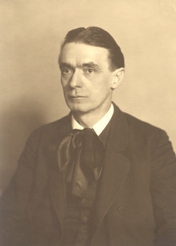
Rudolf Steiner in 1911.
There is a danger here and that is that Steiner’s teachings, taken on their own, and without any conscious connection to one’s own soul life and inner experience, can lead one to fall into anthroposophy as though it were a religion – which it emphatically is not. Anthroposophy, in fact, is a path of research and hard meditative work leading to various outcomes in consciousness, thinking, feeling and willing. This is quite a tall order for people living in a culture in which materialistic individualism reigns and there is no connection to the collective forces of the soul – but it is a necessary path to take if one wishes to understand the physical-soul-spiritual wholeness of the human being.
Filed under Anthroposophy, Carl Jung, Rudolf Steiner
Guest Post: The Bodhisattva Question, part 2 – some conclusions and further thoughts
by Hans van Willenswaard
Before I had to travel, here in South East Asia, I thought the exchanges on the Bodhisattva Question had come to an end and I intended to contribute a concluding post. On my return I found a new wave of contributions and it is not easy to catch up.
We are dealing with evaluations of the past; what the mission of the Bodhisattva of the 20thcentury might mean today in terms of evolution of humanity and our active role in it; how personal experience plays its part; how we make judgments on the viability of our own and others’ statements; and lately what our dynamic position is in the concrete socio-political constellation of today. I’ll try to react to these issues in this concluding post and then look forwards to a new Anthropopper thread to be opened by Jeremy.
One of the questions – triggered by our exchanges – that started haunting me is: Based on which experience did Rudolf Steiner initiate this vision that the Christ would re-appear in the etheric realm? How and from where did this insight arise? I found this quote:
What Paul experienced (near Damascus) as the presence of Christ in the atmosphere of the earth is what modern man may train himself to experience clairvoyantly through an esoteric schooling; this is also what single persons here and there will be able to experience through a natural clairvoyance, as I have already characterized it, beginning with the years 1930 to 1940. Then it will continue through long periods of time as something that has become entirely natural to humanity.
The Reappearance of Christ in the Etheric; Lecture I – The Event of Appearance of Christ in the Etheric World, 25 January 1910, Karlsruhe (GA 118 ).
However, is this 1910 reference to the “Damascus experience” the whole story? I started searching and found new information about the past. Recent revelations by Richard Cloud in consultation with the last remaining so called Pansophists – and confirmed by Claude Philalethes in French language – point at the possibility that Steiner learned seeing the vision of the reappearance of the Christ in the 20th century from his esoteric teacher “Master M”. Steiner identified “M” in his famous Barr Document but never revealed his identity, probably as he was bound to secrecy. Is this a secret Ottmar was curious about? The intriguing Barr document written by Steiner played a role in an earlier Anthropopper post where Jeremy Smith recalled his life-changing meeting with Sir George Trevelyan at Findhorn.
In addition to professor Karl Julius Schroer, brought to our attention by Steve Hale, and the herbalist Felix Kogutzki, who, in my understanding, guided Steiner respectively to Goethe and to the perception of life forces in Nature, it may have been, according to the, for me, unknown Richard Cloud, “Master M” who guided Steiner to the phenomenon of the reappearance of the Christ, not in a physical body but in the etheric world. Who was “Master M”?
Remarkably, first Cloud – with consent conveyed to him because 100 years have passed and thus the secret can safely be revealed – identifies “Master M” as an occult teacher with the name Alois Mailander (1844 – 1905). Mailander, according to the research of Cloud, was known in esoteric circles as “M” or brother Johannes/John. He was an illiterate mystic who lived in southern Germany and had gathered around him students. Rudolf Steiner may have been one of these students.
Later Richard Cloud even postulates, to my astonishment – in an article 24 August 2018 – that Alois Mailander may have been the incarnated Christian Rosenkreutz …
http://pansophers.com/dem-m-revealed/
http://pansophers.com/alois-mailander/
Leaving this revelation without passing on a judgment for the time being (maybe Jeremy can open a post on this) the question still arises what is “Pansophy”? Where does it originate from?
Here is what Rudolf Steiner says:
Very few people today know that Amos Comenius was the actual founder of the modern pedagogy (…). A book by Friedrich Eckstein entitled Comenius and the Bohemian Brothers was recently published. Friedrich Eckstein is one of those people who was united with me in a small theosophical group in Vienna at the end of the 1880’s. [Eckstein was a known student of Mailander – addition Hans]. Then he went his own way and I had not heard of him until this book about Amos Comenius appeared. These 150 wood cuts from the original edition are given with German and Latin texts. Here you have wood cuts beginning with God, the world, heaven, the elementals, the elements, plants, fruits, animals, the human body and its members, etc., all of which was put in such a way as to appeal to the heart. This sort of presentation still appeals very much to people. Herder and Goethe loved all this in their childhood. The whole way of writing children’s books rests upon Amos Comenius. He was connected with many secret brotherhoods all over Europe and he wanted to establish what he called his “Pan Sophia”. In the beginning of our period, in the 16th, 17th century, we have in Amos Comenius a human being who knew that now is the time for a sudden change, that one must transmute all the knowledge from earlier times into the form of external intellect. You do not simply continue it in the form of the ancient tradition. This tradition rests upon that which was the Temple architecture. Amos Comenius had as his task translating (this) in his “Pan Sophia” (…). (…). And so we want to establish a school of wisdom, a universal wisdom, a “Pan Sophia” wisdom so that one can say that that which is in Goethe’s Wilhelm Meister, which was represented in the Wander Years, is a continuation of what Amos Comenius wanted.
Things in Past and Present in the Spirit of Man, Lecture V: Comenius and the Temple of PanSofia, Dornach, 11 April 1916, GA 167
This quote not only is most intriguing in terms of giving possible credibility to the above mentioned revelations – to be checked – from the source of the remaining Pansophists; the reference to Comenius provides, in my opinion, a welcome opportunity for positioning the Waldorf school impulse of Rudolf Steiner in both an inspiring historic as well as a universalist (albeit within the Christian tradition) perspective, beyond the often repeated framework of “German idealism”.
It’s also remarkable that Comenius (1592 – 1670), a wandering Czech free-thinker and bishop of the Bohemian brotherhood, lived for many years in the Amsterdam canal house, Keizersgracht, where more recently one of the probably most important libraries of Rosicrucian and other esoteric literature is based, the Bibliotheca Philosophica Hermetica,now under the name of “Embassy of the Free Mind”. This library was built up piece by piece by businessman Joost Ritman and his family. One of the sons is chairman of the umbrella organization of Dutch Buddhist organisations, and active in the European Buddhist Union (EBU).
Also interesting from my personal perspective is that, as a coordinator I worked at the youth centre cum jazz club in the 70s exactly opposite, across the canal from the present building. In that time the library was not yet accessible by the public but I had been told about it by my meditation teacher and in a dream visited the attics of the library when it was still based at a much smaller house nearby.
Recently I bought in Amsterdam a copy of the Dutch translation of Via Lucis, the way of the Light, which Comenius wrote in London.
More information about Johann Amos Comenius and his “College of Light” can be found in an article of Rachel Ritman through this link:
https://www.ritmanlibrary.com/the-ritman-library-team/the-college-of-light/
From this point about resonances with the past, I would like to come back to Gauren’s very helpful critical observation, where I made the realization of the reappearance of the Christ in the etheric world conditional to humanity’s awareness of it. Here are some interesting quotes from Steiner to clarify the issue:
Christ will exist in the earthly sphere as an etheric being. It depends upon the human being how he establishes a relationship to Him. On the appearance of Christ Himself, therefore, no one, no initiate however mighty, has any influence. It will come. I beg that you hold firmly to this. Arrangements can be made, however, for receiving this Christ event in this way or that, for making it effective.
When we speak in this way, we feel what anthroposophy should and can mean to us, how it should prepare us to fulfill our task by seeing to it that a sublime event such as this not pass humanity by, leaving no trace behind. If it were to pass without leaving a trace, humanity would forfeit its most important possibility for evolution and would sink into darkness and gradual death. This event can bring light to human beings only if they awaken to this new perception and thereby open themselves also to the new Christ event.
Humanity will be granted a period of about 2,500 years in which to develop these faculties; 2,500 years will be at his disposal to attain etheric vision as a natural, universal human faculty, until human beings advance again to another faculty in another time of transition. During these 2,500 years, more and more human souls will be able to develop these faculties in themselves. (At other instances he speaks about 3000 years counted from 600 before Christ).
Humanity is called upon to develop ever-higher faculties, however, so that the course of evolution may be able, again and again, to make new leaps.
Christ will be there in order that He can be experienced also on these higher stages of knowledge. Christianity is in this connection not at the end but at the beginning of its influence. Humanity will continue to advance from stage to stage, and Christianity will also be there at every stage in order that it may satisfy the deepest requirements of the human soul throughout all future ages of the earth.
These and later quotes, if not mentioned otherwise, are from the first three lectures of GA 118: The Reappearance of Christ in the Etheric
Lecture I – The Event of Appearance of Christ in the Etheric World, 25 January 1910, Karlsruhe
Lecture II – Spiritual Science as Preparation for a New Etheric Vision, 27 January 1910, Karlsruhe
Lecture III – Buddhism and Pauline Christianity, 27 February, Cologne
Whereas Steiner himself taught about it for less than two decades, he said this vision would be further announced later in the 20thcentury. Now, how culturally specific is the prediction that the Maitreya Buddha would incarnate as a ‘Bodhisattva of the 20thcentury’ announcing ‘the re-appearance of the Christ in the etheric’?
This question may lead us to exploring the possibility of an evolution in the understanding of what bodhisattvas are, in particular how the bodhisattva principle increasingly is being socialized. Can we speak of a nucleus of bodhisattvas and can it include every ones’ efforts, small and big. It would release us from the obsession to find THE Bodhisattva, without becoming uncritical. What unites us is more important than what divides us. We may, in the search to find an answer, also explore acceptance of pluriformity in our assumptions of how reincarnation actually works. Does it happen with intervals of 300 years? In a 100 years rhythm – does each century has its Maitreya Bodhisattva – ? Or can re-birth be realized a few years after death, as is the case with Tibetan lamas?
For reflections on these issues it may be helpful to identify some milestones in human evolution in the 20thcentury and relevant for our dialogue.
Ultimately we will have to settle a meaningful consensus on how to share the universality of the Christ impulse – and impulses coming from other spiritual manifestations like the Buddha – in the context of a global multi-cultural, inter-religious civil society, based on free inquiry. Is the striving for “sustainability” our common goal?
Rudolf Steiner speaks of an initial consciousness leap to take place around 1930 – 1940 with a period of 2500 years to bring it to fruition. Steiner mentioned these years were not to be taken exactly. He may not have foreseen the enormous disaster of World War II which delayed the course of events. While searching for anchor points in time I come to a possible timeframe for further research. Of course the evolution of consciousness plays out at various fronts. One of the possible areas for finding such demarcation points, in a threefold worldview (which I will address later in this concluding post), is that of governance and law.
From this governance perspective, a milestone in the evolution of humanity’s consciousness certainly is the post-War formulation and adoption of the Universal Declaration of Human Rights, in the year 1948. And one can say that this human achievement to end and prevent disaster was preceded half a century earlier by the First Hague Peace conference of 1899 (the approximate year that, according to Steiner, the ‘Dark Age’ of Kali Yuga ended): a first step towards building global governance and law materialized in the construction of the Peace Palace.
A decade after 1948 – in 1957 – another milestone occurred. The Buddhist world celebrated the “2500 commemoration of the Enlightenment of the Buddha”. It was not only the year that my wife was born in Thailand (where we live now in the year 2561), it was the first time that the Dalai Lama travelled to India to join, as a 22 year old lama, the festive commemorations in New Delhi. Two years later he had to take refuge in India. Tibet had been occupied and the revolt against China failed. The Dalai Lama remained in exile in India for the rest of his life. The year 1957 marked the unique turning point from the influence of the Gautema Buddha to that of the Maitreya Buddha to be incarnated 2500 years later. The realization of (genuine) sustainability – the reappearance of the Christ in the etheric world – may need this 2500 years’ time span to come to full fruition, if I understand Steiner well.
From the 1957 celebrations in the huge Buddha Jayanti Park that was especially laid out in New Delhi for this occasion and where the still largely unknown Dalai Lama met, as a refugee, with the enormous diversity of Buddhist dignitaries he may have silently started preparing for a role as spiritual world leader. Only in 1967, at the age of 32 years, he began travelling all over the world to spread the message of Universal Responsibility – including responsibility for Nature – complementing the freshly adopted Universal Declaration of Human Rights in two ways: emphasizing responsibilities over rights and transcending anthropocentrism.
[In October 1993 the Dalai Lama inaugurated a huge Buddha statue in the park, where I was present.]
The search for universal values inevitably evokes a sharp paradox: the realisation of universality, unity, requires free, independent, individuals. Universalization does not mean (forced) surrender to one central truth. Dynamic agreement-building based on diversity and free personal consciousness goes hand in hand with simultaneous appreciation of the (spiritual) fact of absolute inter-dependence.
Can Christ be appreciated as one (for those closely connected to him: central) spiritual entity among a diversity of entities with a common mission to constitute universal responsibility? It may require collective effort of individual human beings who cultivate freedom, in order to co-create a responsible political order and a community-driven economy. The evolution of humanity towards due care for the Earth – the foundation for the community of life – is “a sacred trust”. That is how it is stipulated in the Earth Charter launched in The Hague – another milestone – 100 years after the First Hague Peace conference, and 50 years after the adoption of the Universal Declaration of Human Rights.
http://earthcharter.org/discover/the-earth-charter/
The period of these 2500 years in the evolution of consciousness starts from the initial experiencing of “the etheric”:
A conception will arise that will see the earth not in terms of purely mineral forces but in terms of plant, or what could be called etheric, forces. The plant directs its root toward the earth’s center, and its upper part stands in relation to the sun. These are the forces that make the earth what it is; gravity is only secondary. The plants preceded minerals just as coal was once plant life; this will soon be discovered. Plants give the planet its form, and they then give off the substance from which its mineral foundation originates. The beginnings of this idea were given through Goethe in his plant morphology, but he was not understood. One will gradually begin to see the etheric, because it is that which is characteristic of the plant realm.
They will behold the etheric earth from which the plant world springs up. (…). He who possesses this science in the highest degree is the Maitreya Buddha, who will come in approximately 3,000 years (if counted from what is now identified as the beginning of the anthropocene; addition Hans). (…) This will all lead human beings to know in which direction they must go. You must undertake to transform abstract ideas into concrete ideals in order to contribute to an evolution that moves forward.
Lecture III – Buddhism and Pauline Christianity, 27 February, Cologne
Experience is essential for this conception. I am grateful to Steve and Kathy that they hinted at personal accounts of how in their life they experienced the highest etheric presence, a “bodhisattva momentum” or a Damascus event. These experiences, by the way, could be less rare than we may think. Sir Alister Hardy (1896 – 1985) made a public appeal to volunteer participation in research on spontaneous “religious” experiences and was overwhelmed by the response.
So, I owe Steve and Kathy that I try to tell something of my own experiences. I have two experiences I can try to share and they come together in what I try to advocate: “engaged Buddhism”; and “engaged spirituality” where anthroposophy leads the way. One experience is about meditation. I admitted earlier to Tom Hart Shea that I am not comfortable with the First Class mantrams or other anthroposophical exercises. They are so “Rudolf Steiner”. I love the uniqueness and personality of Steiner and feel deeply inspired to act upon the second part of The philosophy of freedom. But although I find confirmation of meditative insight in the first part of the book, for the actual meditation I resort to the more “de-personalized” approach of Vipassana Bhavana.
Around my 33rd year I did my first ten-days Vipassana retreat at a small attic of what later would become the Thai temple in a bigger building. It is hard to communicate the core meditative experiences that resulted, and it is also recommended not to do so. But I found a beautiful reference in a, to my eyes, very important article to which Steve Hale linked us in his post, 22 June 2018, for which I am very grateful. I reproduce the reference here with the comment that my insights in no way did match this level of sophistication.
In “The scientific credibility of anthroposophy” Jost Schieren summarizes parts of the work of Herbert Witzenmann (1905 – 1988), an early (often criticized) leader of the Social Sciences Section.
(…) the ontological sphere of the world has to nullify itself in the human organisation. Witzenmann describes the human neuro-sensory system as an organ for the nullification of the spirit brought about by ontological evolution. It places the human being before the nothingness of sensory perception, so that in the free act of knowing he can undertake a re-constitution of reality. It is a kind of null-pointand as such a point from which human cognition can proceed unconditionally. There are – as Rudolf Steiner points out in The philosophy of freedom – two different ways of doing this: on the one hand, through the perceptsdelivered by the sensory organization; and on the other, through autonomously generated thinking. By using meditation to practice inner observation and thus developing his ability to work with these two poles of human cognition – perceptionand thinking– the human being takes hold of a new freedom-based mode of constituting both self and world.
The scientific credibility of anthroposophy, Jost Schieren, RoSE – Research on Steiner Education, Vol. 2, 2011.
Inner observation as described here, is a required exercise to lay the foundation for scientific research that in the same time can do justice to anthroposophy as well as satisfy mainstream science, according to Schieren. Sunyata, nothingness,is also a concrete, intimate – and at my age then, life defining – meditation experience in a person’s biography.
I feel that it is scientific rigour, maybe derived from the point Witzenmann describes, which distinguishes the mathematician Elisabeth Vreede from Adolf Arenson, a merchant and composer, and makes them arrive at different conclusions on the possible shared identity of the earmarked Bodhisattva and Rudolf Steiner. Later Sergei Prokofieff fortifies Arenson’s vision in a context of modern conservative anthroposophy.
My second personal experience related to the subject came at the age of 39. Location: CREAR at Rio Limpio, Dominican Republic where I did my Emerson College rural development internship. I learned more than ever in my life in that period. I did not have a good relationship with founder and leader of CREAR Mark Feedman and working in the garden (with passionate “double digging”) in the tropical climate was hardship. One day I observed from a distance how Mark, he liked to do things on his own, sprayed the land by hand with the 503 cow manure preparation. Suddenly a strong golden glance arose from the soil and I “heard”: “this is my body” … I experienced something happening which earlier had fascinated me and had explored as transubstantiation…
Given the reference Rudolf Steiner makes to the etheric, revealing itself in the “Damascus experience” of Paul in the first quote of this contribution, it is interesting to learn that modern researchers question whether the Last Supper ritual was initiated as such by Christ or later inserted by Paul.
https://en.wikipedia.org/wiki/Origin_of_the_Eucharist
Christianity evokes the narrative of God the Father becoming a human being, his Son the Christ. While in our era the Christ is reappearing as body of the Earth. This is an evolutionary need to counter extreme materialism, industrialization/digitalisation and commercialisation. In its realization the transformation loses earlier gender implications, unifies with the nearly forgotten but especially in Latin American very strong “buen vivir” movement around the vivid reality of Mother Earth. Evolving into what the Earth Charter determines as “community of life” and how it can be co-created.
Rudolf Steiner gave a series of 10 lectures, March 1913, in The Hague. Later in the same year the Peace Palace would be opened. Steiner must have walked around the nearly finished building. In May he traveled to Dornach and suddenly decided to start the construction of the First Goetheanum.
In conclusion some comments on Buddhism and Anthroposophy.
A study group was initiated on this theme by Dharmacharya (authorized teacher in the tradition of Thich Nhat Hanh) Ha Vinh Tho who studied eurythmy in Dornach for many years. The first meeting was attended by 11 persons, among whom my wife Wallapa and I, in the old emperor’s city of Hué, Vietnam, March 2001. Later we introduced Tho to our friends in Bhutan where he became a well-known teacher and programme director of the Gross National Happiness center.
The Bodhisattva is a Being who passes through all civilisations, who can manifest Himself to mankind in various ways. Such is the Spirit of the Bodhisattvas.
Now the mysteries always make appropriate preparation for the corresponding duty of mankind. Every age has its special task; and every age has to receive the truth in the particular form needed by that epoch.
The East in the Light of the West, 31st August 1909, Munich
Anthroposophy derived, with its assimilations, the concepts of Karma and Reincarnation from Buddhism. Contemporary understandings of Karma and Reincarnation guide “engaged Buddhism” in similar ways as in anthroposophy.
A man who has assimilated these ideas knows: According to what I was in life, I shall have an effect upon everything that takes place in the future, upon the whole civilisation of the future! Something that up to now has been present in a limited degree only — the feeling of responsibility — is extended beyond the bounds of birth and death by knowledge of reincarnation and karma. The feeling of responsibility is intensified, imbued with the deep moral consequences of these ideas.
Reincarnation and Karma, GA135, 5thMarch 1912, Berlin
In addition to Karma and Reincarnation, anthroposophists, like the former chair of the Anthroposophical Society in the Netherlands, Joop van Dam, have studied, practiced and published on the Eightfold Path. What has been less researched is the perceived resonance between the Tri Ratna or Three Jewels in Buddhism and the principle of threefolding as developed by Rudolf Steiner. (See my book The Wellbeing Society. A Radical Middle Path to Global Transformation.) The Tri Ratna is the most central, essential, spiritual entity in all streams of Buddhism. Buddhists take (everyday) refuge to the Buddha, the Dhamma and the Sangha.
Since my first visit to the Goetheanum in 1976 I have been intrigued by possible similarities between threefolding and the Buddhist Tri Ratna. Only by exchanges in the context of the International Network of Engaged Buddhists (INEB) with leaders of the Ambedkar movement in India, I got some external confirmation of possible resonance. Who was Dr. B. R. Ambedkar (1891 – 1956)? Born a dalit, an untouchable, low-cast, in a family with 14 children, he was given opportunities to study in India and abroad, and became a prominent law expert and political rival of M. K. Gandhi.
Ambedkar was of the opinion that Gandhi did not go far enough in the emancipation of the untouchables. After independence Ambedkar was given the task to draft the constitution of democratic India. Ultimately he found that becoming a Buddhist was the only way to positively liberate himself from the caste system. In 1956, just before he died, he took refuge in the Buddha, Dhamma and Sangha and triggered a mass conversion movement among untouchables.
Upon the question how it could be that in his draft for the preamble of the constitution the three values of the French Revolution were so clearly recognizable, he replied that these were not the values of the French Revolution but it was purely Buddhism that had guided him.
I think here is a key to fresh collaboration between Anthroposophy and Buddhism. The Buddha symbolizes personal liberation and responsible freedom; the Dhamma stands for the laws of Nature and Karma to whom we all are equal; and the Sangha, in its narrow sense, the monastic order of monks and nuns, harbours in a broader sense the value of true brother- and sisterhood, the spirit of community.
A concrete affirmative response to the growing recognition of life-forces and the etheric in Nature, as an urgently needed expression of resilience vis-à-vis materialistic destruction, can be jointly shaped – in a universal context – with the help of modern insights on threefolding.
More concretely threefolding addresses: the challenges of freedom as well as responsibility of citizens; sovereignty of nation-states; and property rights in the economic sphere. All three have to be reframed.
Christopher Weeramantry, Sri Lanka (1926 – 2017), Vice President of the International Court of Justice, The Hague, himself a Christian, said about property:
(…) concepts such as ownership are often taught and conceived in Western jurisprudence as being of absolutist nature, which is the very antithesis of the Buddhist approach to these concepts. Their stress on rights overshadows the accompanying concept of duties, and the latter is what Buddhist teaching tends to emphasize. This elevated concept of duties lies at the heart of the notion of trusteeship.
C.G. WeeramantryTread Lightly on the Earth. Religion, the Environment and the Human Nature, Stanford Lake, 2014 (second print)
And the Constitution of Bhutan (2008), the last Buddhist kingdom in the Himalayas, stipulates:
Every Bhutanese is a trustee of the Kingdom’s natural resources and environment for the benefit of the present and future generations.
Earth Trusteeship implies that all global citizens are equal trustees of the Earth. A new threefold world order will be based on Earth Trusteeship.
Regressive trends of our time, like Brexit (sorry Steve), are based on the old paradigm of sovereignty of the nation-state and accompanying nationalism.
We need to turn to the new paradigm of Earth Trusteeship.
Martin Large formulates, more concretely:
Social threefolding can also help answer the question of the conditions for organisational success. For example, community land trusts (CLT) are well grounded on threefolding principles. They secure the land as a commons or right into the trusteeship of a civil society, non-profit body, whilst leasing the right to use the land to a homeowner, who owns the actual ‘house structure’ standing on the land. The homeowner is able to sell or buy the house, but not the land, to qualified buyers. CLT thinking sees the house as a commodity and the land as a commons held in trust, so that land ‘value’ is captured for community, rather than for private benefit.
Rudolf Steiner’s Vision for our Social Future: Openings for Social Threefolding by Martin Large, New View magazine, issue 81, Autumn 2016.
Jeremy may have news about the Emerson College gathering in 2020.*
* Not yet – but I hope to have some preliminary information by Spring 2019. J.
Filed under Alois Mailander, Anthroposophy, Bodhisattva, Buddhism, Rudolf Steiner
What’s in a name?
Back in 2014, at the summer conference of the Anthroposophical Society in Great Britain (ASGB) I was heartened to hear the then recently appointed general secretary, Marjatta van Boeschoten, announce that the ASGB Council was seriously considering a name change for the society. I was even more encouraged that the members present seemed to be overwhelmingly in favour of such a change and wanted the society to play a much more active, outward-facing role in the world.
Four years on, it’s apparent that other counsels have prevailed and that changing the society’s name was felt to be more than the members (or perhaps Dornach) would stand for. But it still seems to me that, if our intention is to help other people to find out more about what it really means to be a human being, then the word “anthroposophy”, at least in the English-speaking world, is a hindrance rather than a help.
To the ear of an English speaker, “anthroposophy” and “anthroposophical” are not only difficult to pronounce but they also sound vaguely cult-like, perhaps causing the listener to bracket us alongside Scientology or the Jehovah’s Witnesses. “What’s in a name?” asked Juliet in the balcony scene of Romeo and Juliet: “A rose by any other name would smell as sweet”. This may be true, but if the rose were called Sticky Willy, Knobweed or Nipplewort, then I doubt whether today it would be the national flower of England.
So names do matter in terms of shaping perceptions, and we should ask ourselves whether “anthroposophy” is doing us any favours. From where did Steiner get the name? According to Wikipedia:
The term began to appear with some frequency in philosophical works of the mid- and late-nineteenth century. In the early part of that century, Ignaz Troxler used the term anthroposophy to refer to philosophy deepened to self-knowledge, which he suggested allows deeper knowledge of nature as well. He spoke of human nature as a mystical unity of God and world. Immanuel Hermann Fichte used the term anthroposophy to refer to “rigorous human self-knowledge,” achievable through thorough comprehension of the human spirit and of the working of God in this spirit, in his 1856 work Anthropology: The Study of the Human Soul. In 1872, the philosopher of religion Gideon Spicker used the term anthroposophy to refer to self-knowledge that would unite God and world: “the true study of the human being is the human being, and philosophy’s highest aim is self-knowledge, or Anthroposophy.” In 1882, the philosopher Robert Zimmermann published the treatise, An Outline of Anthroposophy: Proposal for a System of Idealism on a Realistic Basis,proposing that idealistic philosophy should employ logical thinking to extend empirical experience.” Steiner attended lectures by Zimmermann at the University of Vienna in the early 1880s, and it is therefore possible that this is where he came across the term.
From this it is clear that Steiner didn’t invent the name, nor did he think it so special that it should be kept for all time. In a lecture given in Dornach on April 15th1923, Steiner made the following remark: “If I had my way, I would give anthroposophy a new name every day to prevent people from hanging on to its literal meaning, from translating it from the Greek, so they can form judgments accordingly. It is immaterial what name we attach to what is being done here. The only thing that matters is that everything we do here is focused on life’s realities and that we never lose sight of them. We must never be tempted to implement sectarian ideas.”
And yet the irony is that anthroposophy has often been accused by some misguided or malicious “skeptics” as promoting sectarian or even crackpot ideas. “Life’s realities”, according to these people, include their beliefs that we have just one lifetime; that our consciousness is extinguished with death; that there is no such thing as a spiritual world existing alongside the physical world and that the only real things are those which are material.
Yet surely it is these materialistic ways of regarding the world which have in large part brought humanity and our planet to its present parlous state. Materialistic civilisation has led to environmental degradation on such a scale that the entire biosphere of the earth is now under serious threat. Nationalism, religious and racial hatreds and political confrontation are making the world a much more dangerous place than at any time since the Second World War. The powerful, prosperous industrial nations keep the majority of the Earth’s inhabitants in the Third World in economic dependence and abject poverty. In many dictatorships, human rights are routinely violated. But, even in supposedly advanced democracies, the dignity of the free human being is assaulted in many ways by the media, by commerce, by schooling systems and materialistic science dominated by economic interests.
Insights gained from anthroposophy show us what each of us can and should do – politically, economically and spiritually – to work effectively against these challenges and all their associated problems. Yet since 1925, the year of Steiner’s death, what has the Anthroposophical Society done to help turn the tide? Why have there been no attempts by the Society to engage in the general development of society by way of contributing to public discourse?
I’m not suggesting that the Society should be putting its opinions into the world. One of the outstanding features of the Society is that members are not asked to sign up to any opinions or articles of faith, or pledge themselves to carry out any obligations. A member’s opinions are her or his own, and they cannot hold heterodox views as there is no anthroposophical orthodoxy. This of course means that neither the national societies nor the General Anthroposophical Society in Dornach can make any pronouncements in the name of the members. But I am suggesting that where anthroposophy has real knowledge and insights to contribute, then the Society should be bringing them forward into the public realm. Anthroposophy is here not only for its members but is also (and I would say, primarily) an approach to life created by Rudolf Steiner for the transformation of consciousness both of individuals and society, thus leading to the increasing wellbeing and development of the world and its inhabitants.
What then should be the role of anthroposophy in today’s society? Is anthroposophy just something that is for individuals to pursue in quest of their own spiritual development, or is it also meant to make a vital difference to the way in which society is organised and how human beings live their lives? If the latter aim is accepted as legitimate, does anyone experience the Anthroposophical Society as a community in which current world problems are discussed openly and freely, dealt with from a position of real knowledge and insight and then communicated to the interested public? I’m being very unfair, of course, in order to make my point that since Steiner’s death, anthroposophy hasn’t had the impact in the world that he had envisaged. Part of the reason for this, of course, is that without the leadership of a charismatic initiate such as Steiner, the Society no longer generates the same kind of intensity of response as it did when he was alive.
The history of the Society since 1925 has, on the whole, not been a happy one. The growing disagreements between members of the Vorstand after Steiner’s death, the mass expulsion of members in 1935, and a few disgraceful accommodations with Nazism in Germany and Fascism in Italy in the period leading up to the Second World War, were indicators of a movement that had lost its way. Perhaps, after all this, the spiritual world concluded that the Anthroposophical Society was no longer a suitable vehicle within which serious work could be done. The fact that the GAS has just spent part of its 2018 AGM in rescinding the expulsion of Ita Wegman and Elisabeth Vreede 83 years after the event points to a certain frivolity in their approach to what is needed today, however justified it may be to make a belated acknowledgement of that disastrous misstep.
So to whom is the Anthroposophical Society now speaking? It seems unlikely that it can now be a significant change-maker in the world, except inasmuch as individual anthroposophists can find common cause with people and organisations of goodwill throughout the world. It is the work of Rudolf Steiner that can still connect us to other people, because so much of what he brought through speaks powerfully to the dilemmas of today. Even the most dedicated materialists and skeptics are feeling the hugely pervasive disquiet seething in the collective consciousness of humanity at this time, as the true scale of environmental vandalism, economic disparity and social injustice reaches breaking point. At these times, the wounding power of ridicule from the skeptics towards the notion that humans are in reality spiritual beings currently in physical incarnation just loses its potency; to quote Susan Raven (author of the book Nature Spirits: the Remembrance): “If you hold another human being’s eye and speak your truth with the indefinable power that infuses a human voice when it sounds out from a point of profound and undeniable experience – there will be movement. And if the listener then goes on to hear the same, or similar, information from another two sources, the shell of denial might just begin to crack – be it ever so slightly!”
To people who are now open to treading a spiritual path, to come across the work of Rudolf Steiner, a very great initiate and master seer, can be life-changing. It is Rudolf Steiner whose extraordinary life and astonishing body of work can reach out to these people, not the society with its headquarters in Switzerland and a name that is difficult to pronounce. Is it not now time to acknowledge this reality? Is now the moment, in other words, to change the name of the Society, at least in English-speaking countries, to something like the “Rudolf Steiner Association”?
Such a move would not be without its dangers. The late Rudi Lissau said that: “If we look at every statement Steiner made as a message of the spiritual world, we endow Steiner with greater authority than that assumed by the Roman Pope. It is essential to bear in mind that certain ideas of his have their root in the general climate of the time and sometimes stem from definite people. Like any other human being Steiner was, to a certain degree, shaped by his environment and, like any other human being, had certain prejudices. He had not studied everything and, as he repeatedly stated, made many of his statements to particular groups of people in unique situations never to be repeated. If we fail to remember this, we turn a real man into an idol. One can, if one is so inclined, worship an idol. A real man with all his faults and weaknesses can be loved and there are few people more worthy of love than Steiner.”
So we should remember that Steiner was a real man who also had initiate consciousness, someone who was able to bring forward huge amounts of information for us to seek to understand, to work with, to reject or accept according to our inner being, or to take forward into further research, or to apply in practical situations. Let us put no obstacle, name or otherwise, between Rudolf Steiner and those people who need to meet him.
Filed under Anthroposophy, Rudolf Steiner
What next after capitalism?
After the results of the UK election, held on 8th June, one thing became very clear: young people have started to lose faith in the way our present society runs, particularly in our current model of capitalism. The situation is even more stark in the USA; Naomi Klein has analysed it brilliantly here.
It is not hard to understand some of the economic pressures which have led young people to conclude that capitalism is not working for them. A study by the Resolution Foundation last year found that people born between 1981 and 1985 are earning £40 a week less in today’s terms than were, at the same age, people born a decade earlier – making the current under-35s the first generation since the industrial revolution to suffer such a reversal. Meanwhile, the cost of housing has gone beyond their reach. Over the past five years, according to the Nationwide Building Society, the rate of home-ownership among 30-34 year olds has plunged from 49.3 per cent to 43.1 per cent – while older people have enjoyed higher rates of home-ownership.
Moreover, high rents have prevented many young people from putting aside any kind of savings. If they cannot win a stake in the capitalist system, in spite of working hard, why should they support it? Add to that some of the many other issues that Theresa May’s government is either supporting or which are resulting from its policies, eg fracking, foodbanks, stealth privatisation of the NHS and other public services, student tuition fees, constant austerity for ordinary people but not the rich, etc., and it is no wonder that so many young people voted in such numbers for Jeremy Corbyn’s Labour Party.
For many older people, capitalism was associated with freedom. But there is little reason today for young people to feel the same way, when they are confronted on a daily basis by large, tax-dodging corporations and bankers who wrecked the economy, who escaped without punishment and yet who carried on skimming off vast bonuses. What they see instead are the failures of Conservative industrial policy, such as over-priced trains run by private companies, which have ruthlessly exploited the private monopolies granted to them, in what was surely the most flawed of all the privatisations.
It will not be possible for the Conservatives to continue to preach the benefits of the free market if it is patently not working in favour of an entire generation. By the next election the current generation of under-35s will comprise nearly half the population. If they have a sense that the economic system is rigged against them, they will revolt against it – and so they should.
But it’s even worse than just a system rigged against the young; those of you who are regular readers of this blog may be aware that from time-to-time, I’ve expressed grave doubts as to whether this planet and all the species living on it will be able to survive the consequences of our present system of economics.
Our current model of capitalism, with its emphasis on constant growth and its elevation of money to something which trumps every other argument, is leading us inevitably towards what has been called the Sixth Great Extinction in the history of our planet. The Holocene epoch, the past 12,000 years of stable climate in which agriculture, settled communities, and great civilisations first appeared, has come to an end, and a new epoch has begun. The term “Anthropocene” was coined in the 1970s to describe this new epoch, in which we are seeing significant human impact on the Earth’s geology and ecosystems.
Another and in some ways better term for the present epoch has been coined even more recently by those who want to focus attention on the role of capitalism in bringing us to this crisis in Earth’s existence, and this is the “Capitalocene”. We are living in a new and dangerous epoch in Earth history, as identified in overwhelming detail by scientists. It is characterised by the violation of critical planetary boundaries, the unprecedented disruption of our planet’s life-support systems with potentially catastrophic results, including climate chaos, mass extinctions, acidified oceans, poisoned rivers, rising sea levels, over-population and more.
Whatever one calls this new era, it’s clear that most people (with the possible exception of Donald Trump and those who share his attitudes) are prepared to accept that the Earth System as a whole is experiencing unprecedented negative changes caused by recent human action (from the time of the Industrial Revolution onwards). The concept that perpetual, constant, infinite growth without limits is leading us directly to disaster is one that is probably accepted by most sane people these days. The question is: what can be done about it? Who is going to tell voters in a democracy that there are limits to growth? Who will tell a Premier League footballer or a rock star that there should be a limit to the number of Ferraris they own? More to the point, is there any politician with the courage to say to people like me that two cars per family is quite enough?
No doubt most people can see the connection between unlimited numbers of consumer goods and ecological destruction – but which of us is prepared to accept that the limits to growth have to start with you and me?
Rudolf Steiner identified the economic, social and cultural aspects of the problem a century ago and put forward Threefolding as an alternative to our headlong pursuit of disaster. These ideas still need to be brought to the world’s attention but my assumption is that there will not be any cut-through to political and public notice by anthroposophical concepts alone, unless they are also accompanied by additional ideas and solutions propounded by other people of goodwill. Sadly, anthroposophy is too strange a word, its ideas are too remote from common attitudes today, and its historical baggage is too cumbersome to enable it to make the necessary difference on its own.
That is why I am proposing, along with a few colleagues, to organise a conference at Emerson College in 2019 to look for a new story, a new narrative about what has to pass away, and what has to come into being, if we are to survive as a species on our beautiful blue planet – and I invite you to help “crowdthink” this conference into a form that will enable it to be most useful. Here are a few ideas to get us started, and I would be most grateful for your own input, such as suggestions for speakers, themes, alternative ways forward and who should be invited to attend and participate. Please send in your thoughts and ideas via the Comment button below.
Conference working title: What next after capitalism?
Conference venue: Emerson College, Forest Row, East Sussex, UK
Proposed date: Around Easter 2019
Basic premise: The world is hurtling towards disaster because of the way we treat the planet and people and this is a direct result of our current economic systems. We are not living with love for one another and the world. Does the conference accept/agree with this? Does the conference accept/agree the concept that the problem is our present model of capitalism?
Duration: 3 days
Day 1: THEME – What’s broken?
Establishing what’s not working and why, using examples from around the world. 20-minute “Ted type” talks on identifying what is broken.
Day 2: THEME – Alternatives
Looking at alternatives from around the world – examples of success and failures
Day 3: THEME – Call to Action
Leaving with determination, purpose and a clear set of realistic actions for each of the 3 themes.
Underlying structure: 3-fold. Cross-cutting themes throughout conference, including Economic, Cultural and Rights spheres, and taking in topics such as the impact of our present model of capitalism on the environment, global economy, banking, agriculture, medicine, company structures, shareholder system, developing countries and relations between people, etc
Our ideal will be to find a backer who will fully fund the conference so that attendance can be by invitation only. Our aim will be to put together a stellar group of keynote speakers and leading thinkers, and to invite top civil servants, social entrepreneurs, pioneers who are already doing the alternatives, academics, influencers and opinion-formers to attend.
I would be very grateful to receive via the Comments below your own thoughts, ideas and suggestions to develop this proposal – please suggest speakers, topics and a structure for each day of the conference. It would be a magnificent achievement if this conference could be a result of “crowdthinking” in action!
Filed under Anthroposophy, Capitalism, Emerson College UK
 anthropopper