Tag Archives: Rudolf Steiner

Rudolf Steiner and Angels – The Potential Fall of Humans and their Angels

Part 3 of 3

Ahriman and Lucifer, the fallen angels
Interestingly, Steiner does not make a straight distinction between Good on the one hand and Evil on the other. Instead he has two poles of Evil, which he calls Lucifer and Ahriman.

Steiner saw Lucifer and Ahriman as not only forces or tendencies which affect humankind and draw us towards evil but also as actual beings. Unlike the Christ, these forces can take up their abode in our astral bodies, the seat of our desires and emotions and thus exercise a strong influence on us from within.

The head of Lucifer - a carving by Rudolf Steiner

The head of Lucifer – a carving by Rudolf Steiner

Lucifer encourages the tendency in human beings towards expansiveness, inflation, egotism, sensuality, passion, and ungrounded spirituality; Lucifer is the being who tells us that we are like the gods, knowing both good and evil, whereas Ahriman tells us that there is no God and that material reality is the only reality. Ahriman represents tendencies towards contraction, reduction, splitting, materialism, over-intellectualisation, lying, and a denial of spiritual realities; this leads to the idea that we are physical beings only. Both of these beings also play a helpful role and are in fact indispensable for human life, as the first awakens us to our freedom, while the second helps provide us with the capacity for speech and thinking. The two forces work in harmony at the present time, even though they appeal to different instincts in us. The way to deal with these two poles of Evil is to seek the balance in the middle, which is represented by Christ. However, because Ahriman can work through the seat of our desires but Christ can only work through our I or individuality, this means that the struggle is not an equal one. Our individuality has to so develop itself that it can in time learn to recognise and resist the many temptations offered by Lucifer and Ahriman. Steiner and the English sculptor Edith Maryon produced a monumental wooden carving called “Representative of Man”, which you can see in the Goetheanum at Dornach. It depicts the Christ providing the active place of balance between the opposing forces of Lucifer above and Ahriman below.

The monumental wooden statue, "Representative of Man", carved by Rudolf Steiner and Edith Maryon.

The monumental wooden statue, “Representative of Man”, carved by Rudolf Steiner and Edith Maryon.

Lucifer appeals above all to our pride and ambition, making us think that we have no limitations. Yet he is also the being who set us out on our evolutionary path to freedom. But Lucifer does not want us to be truly conscious, nor to acquire an egohood independent of himself.

In our present age, Ahriman is a greater threat to us than Lucifer. He is infinitely clever and is helping us to develop our technological civilisation. He wishes us to advance at breakneck speed, long before our individuality and moral nature are ready for such advances. He wishes to foreshorten our development so that we can never reach our true goal but only a false goal of enjoyment and endless material possessions. The scientist, the technologist and the inventor are Ahriman’s natural prey but all of us can fall victim to his temptations. Wherever there is egoism and love of power, entry is made easy for him.

While we may know of Ahriman from Persian mythology, Rudolf Steiner spoke of him as an actual, living spiritual entity. He is a being who fell behind during the Ancient Sun planetary stage. This being, he said, works to embed people firmly into physicality, encouraging dull, materialistic attitudes and a philistine, dry intellect. Steiner, in rare prophetic mode, talked about an actual incarnation of Ahriman on the earth and the potential consequences. Just as Christ incarnated in a physical body, so would Ahriman incarnate in the Western world – before ‘a part’ of the third millennium had passed. Steiner places this incarnation in the context of a ‘cosmic triad’ – Lucifer, Christ and Ahriman. Lucifer had his incarnation as the Yellow Emperor who reigned in China in the third millennium BC. Ahriman will incarnate as a counterpoint to the physical incarnation of Lucifer in the East, with the incarnation of Jesus Christ in Palestine two thousand years ago as the balancing point between the two.

The Head of Ahriman, carved in wood by Rudolf Steiner.

The Head of Ahriman, carved in wood by Rudolf Steiner.

It seems possible to me that today we are living in the time of Ahriman’s incarnation. Ahriman is the Lord of Death and his will is to materialise human thinking into dead thinking to such an extent that the soul becomes fettered to the physical body and to an ever materialised earth, effectively cutting human beings off from their spiritual home – as an Ahrimanic form of immortality. This is nothing less than a spiritual death.

His incarnation on the physical plane will intensify his influence and many of us will fall into his clutches unknowingly, because his effects work in the unconscious aspect of the human being. It will work in the human thinking through the etheric body, where the human being is not conscious.

Though it is the wish of the “good” angels that we should reach our goal, it is not pre-destined that Ahriman will be defeated, because the goal can only be reached in freedom, by us choosing to get there out of our own free will. It’s therefore clear that the possibility cannot be ruled out that humankind will succumb finally to Ahriman and other opposing forces who are gaining in strength all the time, as we see around us every day in the news and in our daily lives.

There is one even more malign aspect of Evil spoken about by Steiner and that is Sorath, the Sun Demon, who is served by both Lucifer and Ahriman. I will say nothing more about Sorath here.

Rudolf Steiner in his studio, working on the statue "Representative of Man".

Rudolf Steiner in his studio, working on the statue “Representative of Man”.

Michael
Rudolf Steiner often spoke about the great battle that occurred in the spiritual world between the spirits who are followers of Michael the Guardian of the Cosmic Intelligence, and certain ahrimanic powers. According to him the latest battle commenced around 1840 and was lost by the ahrimanic powers in the autumn of 1879. I referred in Part 1 to the Archangel Michael but strictly speaking since 1879 he should be considered as one of the archai.

We know that in 1879 these ahrimanic powers, or spirits of darkness were cast down into the physical world and a picture of this can be found in the Revelation of St John – the Angel holding the key to the bottomless pit in which he is said to imprison the dragon. Perhaps the tragic history of the 20th century is not so much the result of human folly but rather of these powers being shut out of the spiritual world and thus rampaging through the physical world, influencing the likes of Mao, Stalin, Hitler and Pol Pot and their many other human agents. On present form, the 21st century is shaping up to be even worse than the previous one.

The foremost of the archai is known to us as Michael. It was his task to go on to become the guardian or administrator, one might say, of the Cosmic Intelligence. He is known in anthroposophy as the son of the Divine Sophia who is the foremost being of the hierarchy of the Spirits of Wisdom, the Kyriotetes, and whose task it is to gather up, regulate and harmonise the Cosmic
Intelligence.

What is this Cosmic Intelligence? There are many ways of describing the Cosmic Intelligence. One such way is that it is a gathering up of all the ‘conversations’ had by the hierarchies amongst themselves; their interrelationships regarding their knowledge and understanding pertaining to the being of Christ, the second logos who descended to earth and died at Golgotha. One could also call it the essence of the Holy Spirit because the Holy Spirit is the mediating substance.

Rudolf Steiner tells us that at around the time of the Mystery of Golgotha, Michael began sacrificing his ‘rulership’ of the Cosmic Intelligence to human beings. And it is the third hierarchy, which is the closest to humanity insofar as it shares various soul and bodily sheaths with human beings, that has the task of helping us to take up the Cosmic Intelligence in the way intended by Michael.

But we humans have the unique privilege of freewill, so we have a choice. To quote Steiner: “Two things are possible for humankind and through this possibility our freedom is guaranteed: to turn to Christ consciously … or to wish to feel our severance from spirit existence and thus fall in the direction taken by the ahrimanic powers. Humanity has been in this situation since the beginning of the fifteenth century.”

Since 1879 Michael has taken over the spiritual guidance of human affairs. He does what he has to do in such a way that he does not thereby wield an influence over human beings; but humans may follow him in freedom, in order with the Christ-power to find the way out of that sphere of Ahriman which they were obliged to enter.

The classical image of Michael depicts him in battle with a dragon and shows him standing on the dragon and spearing it in the mouth. One way of interpreting this might be to say that what Michael is doing is showing us how to penetrate the dragon of materialism with spiritual vision and insight, so that the spirit coiled up in matter can be released.

Sir Jacob Epstein's bronze statue for Coventry Cathedral of Michael.

Sir Jacob Epstein’s bronze statue for Coventry Cathedral of Michael.

But Michael also sees how the danger of humanity succumbing to the ahrimanic powers grows greater and greater. He knows that as regards himself he will always have Ahriman under his feet; but will that always be the case with human beings?

Michael sees the greatest event in the Earth’s history taking place. He sees Christ’s descent to the Earth, so as to be here with us when the Cosmic Intelligence is handed over to human beings. Through Christ’s great sacrifice, He is now living in the same sphere in which Ahriman also lives. Humans are now able to choose between Christ and Ahriman. Should humans wish to, we will be able to find the Christ-way in the evolution of humanity. But Michael cannot force humans to do anything – it is because the Cosmic intelligence has come entirely into the sphere of the human individuality that compulsion from the spiritual world has ceased.

And herein lies our great danger. Ahrimanic spirits seek to smother human beings’ awareness of their own spirituality. They want to teach people that they are really only a perfectly developed animal. Ahriman, says Steiner, is in truth the great teacher of materialistic Darwinism. He also teaches all the technological and practical activity in Earth evolution where nothing is considered valid unless it can be perceived by the senses. His desire for us is that we should have widespread technology, plenty of material goods, entertainment media, all sorts of toys and gadgets, the aim being to kill and obscure any awareness we may have that we are an image of the godhead. This is the aim ahrimanic spirits are seeking to achieve by sophisticated scientific means in our age.

What if Ahriman succeeds? You may recall from Part 2 that Steiner said that the angels had particular work to do in inserting three impulses into our astral bodies. You remember these three impulses:

1. That no human being should be able to enjoy the peace of happiness himself if others around him were unhappy
2. That human beings should be able to perceive the divine principle operating in every other human being
3. That human beings should be able to gain irrefutable insight into the reality of the spiritual world.

The angels do this by working within our astral bodies when we are asleep at night. Steiner was speaking in 1918, but he said that if human beings are not willing to turn to life in the spirit before the beginning of the third millennium, ie in our present time, then the angels would need to work in a different way; that is by withdrawing all their work from the astral body and taking it into the etheric body. But then, Steiner says, the human being would have no part in it, as it would have to be done when humans are asleep, as of course when we are asleep we leave behind our physical and etheric bodies in the bed and take our astral body and individuality into the spiritual world.

And he says that, if this happens, the inevitable effect on human evolution would be threefold:
First, something would be engendered in human bodies which human beings could not discover in freedom.
Second, danger would threaten from certain instinctive perceptions connected with the mystery of birth and conception and with sexual life as a whole.
Third, humanity will get to know specific powers which enable them to unleash some degree of mental control over machines, a development that will take the whole of technology along disastrous channels, a state of affairs, however, that will serve human egotism extremely well and please many people.

Now, I don’t know about you, but that sounds to me like things that are already happening. Let’s take the second point, about the effect on our sexuality. It’s unusual for Steiner to say very much about sex but here he is clear. He says that the effect on human evolution would be that certain instincts belonging to the sexual life and to sexual nature would not come to conscious awareness in a useful way but instead would become harmful. These instincts would not be mere aberrations but would enter into the social life, configuring it. Something would enter into people’s blood as a consequence of sexual life that would above all make people go against brotherliness on Earth rather than develop brotherliness and this would be a matter of instinct.

And Steiner hints at something even worse – he says that danger will come from certain angels who themselves would undergo a change, which he says “is something I cannot speak about, for it belongs to the higher secrets of initiation which may not yet be disclosed.”

But nearly one hundred years later, I think we can say something about this, and to me what may be happening now is very frightening.

Let us go back to the War in Heaven, which started in about 1840 and was completed in 1879 with the victory of Michael over the ahrimanic beings, who were cleared out of heaven and thrust into the abyss. Now what does that mean, to be cast out of heaven and into the abyss? Where have they gone?

There is a link between our blood and the etheric body and our angels usually work in our blood and in our heart. By 1840 a number of abnormal backward angels, (these are angels with the ‘potential’ to be archangels but who have not yet reached that stage) wanted to leave the blood in order to enter into the nerves, the brain, where the normal archangels were taking up their domain. This created an obstruction, a hindrance to the flow of spiritual wisdom that was seeking to enter into the astral body. Now a battle ensued between Michael and these retarded angels, the angels of darkness. To cut a long story short, these ahrimanic angels were cast out of the nervous system into the realm of the blood again – into the abyss – by 1879. They were thrust down into the etheric body by way of the blood, which is closely connected to intellectuality and human thought. Here, in the realm of intellectual thinking, they found relief for their pain.

These beings connected to Ahriman have inspired more and more intellectualism and materialism than there has ever been before, because they thrive on it; and by way of the intellect’s relationship to the realm of Ahriman they have connected the intellect with the sub-earthly ethers, ie the realm of electricity, magnetism and atomic forces. Whether we know it or not, our etheric bodies interpenetrate these ethers all the time.

Let us recall that Michael had to surrender the Cosmic Intelligence so
that the human ego could remember it again, but this time in a free and personal way and through inner work to reconnect this intelligence with Christ.

But these spirits of darkness living in the human being and in the earth do not want this to happen: as followers of Ahriman, the antagonist of Christ, they are doing their level best to prevent us from rising up. They want to drag us down to the level of the electrical, the mechanical and atomistic – the realm of Sorath the Sun Demon – and they are making great strides forward.

As already mentioned, the angels have the task in our times of shaping images in our astral bodies at night. Our angels can only create those pictures at night, if by day we have thought, lived and spoken with integrity and morality. Only then can our angels connect us with the archangels and archai.

Steiner says: “In fact it actually depends on human beings themselves – on their attitude, on the whole way their world of feeling is disposed to the spiritual world – whether their angels accompany them when they leave their physical and etheric bodies in sleep or not…. If a person leaves his physical and etheric body in a materialistic mood, his angel would be denying his realm, his affiliation to the archangels, the archai and the exusiai if he were to accompany the human being. “

This distances us from our normal angels and draws us closer and closer to the ahrimanic angels and their offspring – the ahrimanic elemental beings. Our reproductive and sexual life is administered by the normal angels working in our blood. But for those human beings who cannot rise above materialism, not only will the dark angels take over the task of the spirits of light, but their angels, instead of rising to other tasks may, due to the influence of these dark spirits, fall even deeper than the etheric body.

What does this mean? Rudolf Steiner warns us: “We should not allow the ahrimanic powers to gain the upper hand, as it were, and we should not fall in love with them…” If this were to happen human beings would thereby, “unite spiritual progress with material progress.” This is what Rudolf Steiner called “Prostitution with Matter.”

The union of angel and man in the etheric nature of the human being, where live not only the forces of life and death, dying and becoming, but also all the unconscious desires associated with the sexual life, the life of the sensual, results in the angel ‘falling in love with matter’ through the human being, which leads to an angel’s downfall which one could call, a supra-human fall. The result
is that something thereby enters the material world that does not belong there.

Just as those human beings who today bind their egos to their physical bodies and the sub-earthly ethers, will in future times not be able to exist in a spiritualised world that has no ‘physicality’, so too do the angels of such people fall into the temptation of binding their spirit self (which sets into motion their etheric bodies), to the physical body of human beings, and not to their own etheric bodies creating not only an estrangement from spiritual worlds but also a unification of their spirit, the angel’s consciousness, with the physical world – an unlawful binding of spirit to matter by way of the human being which ultimately will prevent their future development from taking place.

When the human being falls, the right conditions are created for the human being’s angel also to fall. This corresponds to the Second Fall in the Book of Revelation, where angels fall into the realm of the physical body and ‘possess’ their human beings so that together these and the backward angels and elemental spirits that belong to them, become the hosts of Ahriman and ultimately the followers of the Sun Demon, Sorath.

So is it possible that right now the ahrimanic beings are seeking not only to reverse human evolution but also to reverse angelic evolution? If this is indeed happening, it will have huge ramifications on the future of humanity and the world.

What might this lead to? First, Rudolf Steiner warned us that, instead of a greater sense of brotherhood, the most evil sexual instincts would enter into the blood. This is surely what we are seeing today. This disconnection from the moral life signifies a separation from the angelic hierarchies and a binding to the ahrimanic mineral realm, causing an animalisation of the human being. This in turn leads to a form of unconsciousness of the feelings of others and a kind of anti-brotherhood sentiment, because the karmic ties that bind human beings are, in such cases, completely severed. Isil or the Islamic State seems to me to be a direct manifestation of this phenomenon.

Second, instead of humans having a vision of the Christ in other human beings, there will be an unconsciousness of Christ. In our time, the goal of many human beings is a sensual form of happiness without morality, and material welfare unconnected with goodness. To this end certain drugs (antidepressants, prescription drugs, alcohol, recreational drugs) have been created to dull the mind and numb the feelings and to prevent any discomfort at immoral behavior. Other drugs create the right conditions in the etheric body that will lead to an animalisation of the physical body, eg steroids, sports vitamins, food additives, mercury-based vaccines, GM foods etc. Selflessness in the etheric body is turned to its opposite – a heightened form of egoism. This estrangement from the moral world order leads us away from the Cosmic Christ and draws us closer to Sorath, his antagonist.

Is there anything we can do about this? Well, first of all, we can pray. Prayer is the most important deterrent against the forces of evil in the world today. One person working within the light is able to offset a thousand working against it. Each one of us is asked daily to send our light to the spiritual hierarchies. Due to the escalating attacks, the angelic world needs more of our light energy to help alleviate the mounting stress and to assist in the affairs of humankind. Our prayer, whether directed or in general, is the essential ingredient for the angels working on our behalf – but we have to ask for their help first. Owing to our free will, they cannot intervene until we ask. So let us determine to ask, remembering for example that Rudolf Steiner said the Lord’s Prayer every day at 3.00pm.

Second, we can try to wake up to what is going on, and to keep ourselves informed. Some of what I have been writing above has been inspired by a book called Anthroposophical Leading Thoughts or as it is sometimes known, the Michael Letters or the Michael Mystery. These leading thoughts were written by Steiner and started to appear in 1924 and continued up until his death in March 1925. I find it incredibly moving that Steiner as he was dying continued to the last to get down on paper these thoughts, which are both very profound and very clear, much clearer than he sometimes comes across in the transcripts of his lectures. It is as though he was burning himself up to the very last ounce of his physical substance, in his efforts to help us to understand the seriousness of the times we live in. And for anyone who is a member of the School of Spiritual Science, you will recall that it was Steiner’s intention that there should be three classes of the school, but he was only able to complete the lessons of the First Class before he became too ill to continue. It is my belief that the contents of the Second Class and possibly the Third Class, too, are in these Michael letters.

And third, we need to ask the angels for the gifts mentioned in the College Imagination, that is: Unity, Courage, Wisdom and the Light which is Love for one another.

27 Comments

Filed under Angels, Anthroposophy, Rudolf Steiner, School of Spiritual Science

Rudolf Steiner & Angels – The Current Work of the Angels within Human Beings

Part 2 of 3

In Part 1 of this posting, I wrote about the College Imagination and Steiner’s views on the nine orders of angels. In Part 2, we are going to look at the angelic orders that Steiner refers to in the College Imagination, that is to say the 3rd Hierarchy consisting of the Archai, Archangels and Angels of the 7th, 8th and 9th orders, who are the ones closest to us as human beings. We shall also look at some of the ways in which the angels are currently seeking to advance our evolution.

As we work together with colleagues, or in any community for that matter, it is helpful to acknowledge the presence of the angels, who are always ready to support our common work. Without their help, much that we set out to do would be too difficult, painful or disheartening to carry through to completion, or too misguided to be beneficial. With their help, true social innovation is possible. The angels support the creation of social initiatives that benefit individual societies and the continuing development of humankind.

By way of context, I hope it will be helpful here to say something as briefly as possible about Steiner’s teachings on the evolution of our solar system, and how the evolution of angels and humans has developed during this process. According to Steiner, our solar system has so far had four planetary stages, which he calls, somewhat confusingly, Ancient Saturn, Ancient Sun, Ancient Moon and Earth, this last being of course our present stage. This current stage of Earth will in time develop into three further stages or planetary embodiments, which Steiner calls Jupiter, Venus and Vulcan. In the meantime, our present Earth stage is due to continue until about the year 8000AD, when we shall start moving into the Jupiter planetary stage – so you can see that this is quite a long process! You can read more about Steiner’s views on these matters in his book, An Outline of Esoteric Science.

From Rudolf Steiner’s descriptions, it appears that humankind, in a variety of different forms, has participated in this evolution from the beginning. From the outset through to the very last stage, humans will have experienced a huge transformative process – from a human germ on Ancient Saturn to an angelic being, called the 10th order, in a future incarnation of the Earth.

Steiner also taught that each of the angelic orders has had the equivalent of a human stage in their own evolution, though of course their human stages were not like ours. Their evolutionary path is ahead of ours, with the angels of the 9th order being closest to us.

Angels (9th order)
Each of us – you, me, every one – has a guardian angel. Our very own dedicated guide in the spiritual world, it envelops us in unconditional love. Our angel gives us the safe space in which our higher selves can develop and eventually come into independent maturity. Impulses from our angel allow true ideas to stream into our consciousness. These guide us in our earthly tasks and relationships and give us strength to overcome the inevitable challenges we all meet along the way. Eventually, in the very distant future after a number of incarnations, we will take over this responsibility from the angels, rather like the way in which as we grow up we gradually find our independence from our parents. Until then, the angels’ unconditional love remains steadfast, guiding us along our way and helping to strengthen us.

Oriphiel

Oriphiel

Anael

Anael


Archangels (8th order)
Archangels unite groups of people, who have a common purpose or mission, by flowing in rhythmic motion amongst group members and their angels. They weave together mutual intentions and striving to help us form a sense of group identity, be it a community, family or nation. While angels give strength to each individual human, archangels inspire and give courage to each member of the group to work together to fulfill their common tasks. Whether forming a school, a team, a theatre company or a political movement etc., the work of the archangels helps form the group into a dynamic and viable whole. This group may well become able to receive higher spiritual intentions in order to meet challenges particular to its historical setting and time.

Zachariel

Zachariel

Raphael

Raphael


Steiner says that the archangels do not occupy themselves with the single individual, but have a wider task, which is to bring single lives into harmonious order with the life of larger human groups, as for instance with inhabitants of a particular nation.

Samael

Samael

Gabriel

Gabriel


Archai (7th order)
Archai, sometimes called Time Spirits, shine the light of intuition into the dynamic relationships or vessels that have been built with the aid of the archangels. The archai help us attune our efforts so as to be most fruitful at a particular time and place. We can see the results of their work in the rise and fall of various peoples and impulses over the course of human history.

Steiner says that the archai are even loftier beings than the archangels and they have a still higher task in the continuity of human existence. They regulate the earthly relations of whole human generations on earth. That which is called the Zeitgeist is the spiritual body of the archai. And Steiner gives an oddly intriguing idea here – he says that a strange muddle would come into the evolution of the earth if it were all left to chance, and pivotal figures such as Luther or Charlemagne were placed within any epoch, no matter which. This connection with the whole evolution of humanity over the whole earth, has to be thought out first; the right soul has to appear in harmony with the meaning of the whole earth’s development, and this process is regulated by the archai.

Michael's victory over the Devil - from St Michael's Church, Hamburg

Michael’s victory over the Devil – from St Michael’s Church, Hamburg


In the College Imagination, Steiner also refers to “the ruling spirit of our age”, by which he means Michael (whose name, Steiner insisted, is to be pronounced “Mi-cha-el” in three syllables, rather than the usual English pronunciation of that name), who from 1879 until around the year 2300, is acting as the spirit of the present age. Of the archai, Steiner mentions seven in particular who alternate as the serving spirits of the age. These seven archai are: Oriphiel (200BC – 150AD), Anael (150 – 500AD), Zachariel (500 – 850), Raphael (850 – 1190), Samael (1190 – 1510), Gabriel (1510 – 1879), Michael (1879 – 2300). This sequence should be understood as a repeating cycle, so for example Michael will be succeeded by Oriphiel in 2300.

In a lecture given in Zurich in 1918, Steiner asked the question: what are the angels doing in the astral bodies of human beings right now? A strange and rather obscure question you might think, but of course you have to bear in mind that Steiner’s view of the human being includes the idea that each of us has four bodies (the physical, etheric, and astral plus a fourth one, variously called the ego, I, self, entelechy or as I shall call it here, the individuality) which have evolved in us over aeons of time. We also have another three bodies in potential – the spirit self, the life spirit and spirit man – which are to come to full development in each of the succeeding planetary stages – the spirit self in the Jupiter stage, the life spirit in the Venus stage and finally the spirit man in the Vulcan stage, after which we shall no longer be in physical bodies.

At our present Earth stage and by comparison, the mineral kingdom has just one body, the physical; the plant kingdom has two bodies, the physical and the etheric; the animal kingdom has three bodies – physical, etheric and astral; while we humans have the same three bodies as the animals, plus the individuality.

We know about the work of the physical body but what is the role of these other bodies? The etheric body is essentially an energy body that contains and forms the physical. It is this etheric body which maintains the physical body’s form until death. The astral body provides us with awareness and self-awareness, our emotions and our feelings and intentions. The individuality is the immortal and inalienable core of a human being, which goes with us from one incarnation to the next.

When we go to sleep at night, the physical and etheric bodies remain in our bed, while the astral body and individuality go into the spiritual world for rest and inspiration and remain there until we wake up, when they re-enter the physical and etheric bodies. Have you ever experienced that sudden sensation of being jerked awake with a startle, just as you were dropping off to sleep? That is what happens when your astral body and individuality suddenly snap back into your physical body, because something has interrupted your process of falling asleep.

Anyway, Steiner asked the question – what are the angels doing in our astral bodies right now? And he answered that the angels of the 9th order are doing work on behalf of the angels of the 6th Order (Exusiai or Spirits of Form) by shaping images in us relating to the future evolution of humanity. And he says that:

“People may shy away from the notion that angels want to call forth ideals for the future in (us), but that is how it is. The process follows a specific principle, which is that in time to come no human being shall find peace in the enjoyment of happiness if others around him are unhappy. An impulse of absolute brotherliness, making all of humanity one, will govern social life…”

“There is also another impulse. The angels have specific objectives not only with regard to outer social life but also for the inner life. Here the aim they pursue with the images imprinted in the astral body is that in future every human being shall see a hidden divine principle in every other human being.”

“Mark you well, the intention underlying the work of the angels is that things shall change. In future we shall not consider human beings to be higher animals, considering their physical qualities in both theory and practice. Instead we are to meet every other human being with the full realisation that something of the divine foundations of the world is revealing itself in flesh and blood. To conceive humankind as an image revealed out of the world of the spirit, and to do so in profound seriousness, with all our strength – that is the impulse the angels lay into the images.”

“Once this is brought to realisation there will be a definite consequence. All independent religious feeling developing in humanity in time to come will depend on the individual being recognised in the image of God in real, practical terms and not mere theory. There will then be no need for religious compulsion, for every encounter between individuals will be a religious act, a sacrament, and there will be no more need for a church with physical buildings and institutions to maintain religious life. The church, if it understands itself rightly, must consider it to be its sole aim to render itself superfluous on the physical plane as the whole of life becomes an expression of the realm that lies beyond the senses. Such, at least, is the reason behind the work of the angels – to bestow complete religious freedom on humanity.”

And Steiner says there is a third objective the angels have, which is to enable human beings to reach the spirit through thinking, experiencing the reality of the spirit in their thinking.

The results of these three impulses will be, first: that each of us shall have a far deeper interest in every other human being than we are inclined to have today; second, that the Christ impulse means complete religious freedom for humanity and that the only true Christianity is one that makes absolute religious freedom possible; and third, that we shall gain irrefutable insight into the spiritual nature of the world.

Steiner emphasises, however, that these three results are subject to humankind’s free will, as well as the intervention of other spirits involved in world evolution, who have an interest in deflecting humankind from its proper course. These spirits are what Steiner calls the ahrimanic and luciferic spirits, who bring evil into the world. I shall be writing more about these “adversely commanded” angels and Steiner’s concept of evil in Part 3 of this posting.

6 Comments

Filed under Angels, Rudolf Steiner

Rudolf Steiner and Angels – Angels and Human Destiny

Part 1 of 3

A smiling Angel Gabriel from Reims Cathedral

A smiling Angel Gabriel from Reims Cathedral

Before the opening of the first Steiner Waldorf school in Stuttgart in 1919, Rudolf Steiner had less than three weeks to prepare the first twelve Waldorf teachers, who were dedicated to incorporating a living, spirit-filled view of the human being into their teaching. Steiner knew that the teachers’ continuing development into engaged, enthusiastic and open-minded human beings was central to the healthy functioning of the school and to the education they hoped to bring to the children. Therefore, from the beginning, he urged them to develop capacities within themselves to learn how to ask for and receive spiritual guidance and assistance in their work, and he warned them that were it not for this spiritual help, it was likely that they would find the task of founding the school overwhelming and be tempted to give up. On the first day of training, he offered this imaginative picture, now often called the College Imagination, of how beings of the spiritual world support our daily work, even if this collaboration is often unseen and unacknowledged by us.

“We wish to form our thoughts in such a way that we may be conscious that:

Behind each of us stands his Angel, gently laying his hands on the heads of each. This Angel gives you the strength which you need.

Above your heads there sweep the circling Archangels. They carry from one to the other what each has to give the other. They unite your souls. Thereby you are given the courage of which you stand in need.

Out of this courage the Archangels form a chalice.

The light of wisdom is given to us by the exalted beings of the Archai, who are not limited to the circling movements, but who, coming forth from primal beginnings, manifest themselves and disappear into primal distances. They reveal themselves only in the form of a drop of light in this place. Into the chalice of courage there falls a drop of light, enlightening our times, bestowed by the ruling Spirit of our Age.”

Steiner was referring to angels, archangels and archai and the one whom he considers as the ruling spirit of our age, the Archangel Michael. In this 3-part posting we’ll be looking at each of these in turn. We’ll also look at Ahriman and Lucifer, those beings called by Steiner the “adversely commanded” angels.

In the College Imagination, Steiner is saying that the angelic realm seeks to bring us unity, courage, wisdom and light (which for Steiner means the divine impulse of love). How very much we need those qualities at this time!

But today, in the age of the consciousness soul, how many of us believe in angels? Has anyone reading this ever experienced the presence of an angel? I am not clairvoyant, but once in my life, at a time of deepest despair and hopelessness, I was visited by three angels, whom I perceived not as forms but as three columns of energy (I’m sorry not to be able to be more descriptive). They were with me for about a quarter of an hour and the atmosphere in the room was extraordinary. After this experience I was able to carry on with the very difficult next stages of my life. I had been given courage, hope and reassurance and I knew with absolute certainty that I was not alone.

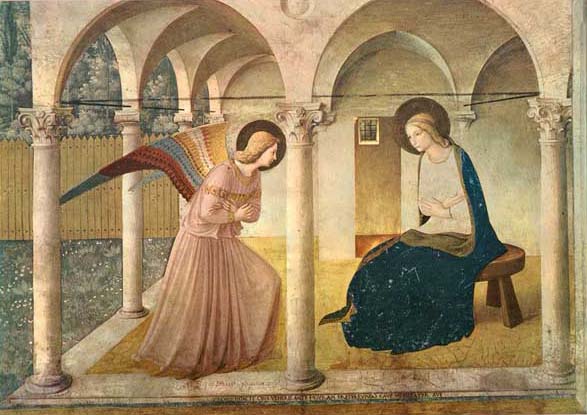
Fra Angelico's Angel of the Annunciation

Fra Angelico’s Angel of the Annunciation

In mediaeval times and up until the Renaissance, belief in the reality of angels was an absolute. You only have to look at the wonderful timber roofs of mediaeval churches, thronged with angels with their wings outspread around the roof bosses and the hammer beams; think of mediaeval art and Fra Angelico’s Angel of the Annunciation; go to a gallery of mediaeval or renaissance paintings and see how many angels are depicted there. The realm of the angels was clearly accepted as an absolute certainty and a factor of supreme importance in life, not only because angels were seen as the intermediaries between Heaven and Earth, but also because, as Steiner has described, in those times there were remnants of a kind of atavistic clairvoyance which allowed many people to have their own perceptions of the spiritual world and to report on this to others.

An angel on a hammer beam at the Church of St Agnes, Cawson, Norfolk. (Photo by Michael Rimmer)

An angel on a hammer beam at the Church of St Agnes, Cawson, Norfolk. (Photo by Michael Rimmer)

Then, in Steiner’s account of how humanity is evolving, we began to lose that ancient sense of clairvoyance and thus our awareness of the spiritual world. This was a necessary but very dangerous step in the evolution of humankind. It was necessary because as humans we have the unique privilege of developing freewill, which could only happen by entering an age in which our connection with the divine-spiritual beings and their will for our future appeared to be severed. And it was dangerous because this apparent severance from spirit existence has given the adverserial powers an opportunity they didn’t have before, which is to convince human beings through our science and technology that physical, material reality is the only reality; and thus to thwart our true destiny, which is to evolve into what Steiner called the Tenth Hierarchy. (I find Steiner’s terminology here confusing and for reasons which I go into below, will from now on refer to “order” rather than “hierarchy” for particular types of angel.) Steiner tells us that aeons from now, in a future incarnation of the Earth, humankind is destined to become the tenth order of angels – the order of Love and Freedom.

It is only humans, rather than angels, who have the potential to develop this highest form of freedom, because it is only humans who have descended this deeply into matter, where the divine and spiritual powers are no longer active. This is also why only human beings are capable of becoming atheists and denying the spirit – the angels cannot do this because they know the true reality, whereas through materialism and living in the realm of maya (illusion), we humans are free to decide what we choose to believe – and of course we will often make “wrong” choices. It is all part and parcel of our journey towards wisdom.

I’ll be writing a little bit more about this in Part 3 but for now I’ll just mention that for all of its downsides, Steiner tells us that materialism remains the vehicle for the initial development of human freedom. It was the task of materialistic science to lead us away from the overwhelming dominance of theology and theocracy in human affairs, and from the unfreedom that had for so long been associated with them. And, as Steiner repeatedly asserts, it is in our relationship as spiritual beings to the physical world that the possibility for human freedom first manifests itself. Put differently, materialism for all its faults and limitations had a very important task to perform, and it needed time to complete it – and if Steiner is correct, it’s still got another 250 years or so to run its course.

But what of the first nine orders of angels? I’ve prepared a table below to set out the thoughts of Steiner on the celestial order. Steiner seems to have adopted the scheme devised by a 6th century theological writer known rather mysteriously as pseudo-Dionysius the Areopagite. This same scheme was taken up by Thomas Aquinas, the great Dominican teacher (whom some claim to have been a previous incarnation of Steiner) and subsequently endorsed by the Catholic Church.

Now, I’m someone who finds the concept of “orders” and “hierarchy” very off-putting. It conjures up images of some kind of 19th century aristocratic or militaristic order of society, with everyone knowing their place:

“The rich man in his castle,

The poor man at his gate,

God made them high and lowly,

And ordered their estate.”

(These words come from a verse – usually omitted today – of the hymn All Things Bright and Beautiful.) Steiner encourages us not to see the orders of angels as a hierarchical, military-style ranking but more as a metaphor for some very profound truths about the unfolding of evolution. I think we should also bear in mind that these orders and hierarchies are working and co-operating together, rather than maintaining some kind of caste-like rigidity of separation.

I have to say that it is very confusing to try to follow all the different names and groupings that are given to the angels, not least by Steiner himself, who seems to use the words “order” and “hierarchy” interchangeably; plus there does seem to be some confusion among other writers about this topic. In this posting and in the table below I’m using the term “order” for one specific type of angel (eg the archangels are the 8th order); and “hierarchy” for a group of angels whose work goes together (eg the 1st Hierarchy consists of Seraphim, Cherubim and Thrones). Anyway, I hope that this table will at least give you a place to start in assembling your own thoughts on the matter.

In Part 2 of this 3-part posting, I will write about the angelic orders that Steiner mentions in the College Imagination, that is to say the angels of the 7th, 8th and 9th orders, who are the ones closest to us as human beings; and what these angels are seeking to achieve for humankind at the present time. In Part 3, I will write about Steiner’s concept of evil and the “adversely commanded” angels Lucifer and Ahriman, as well as the role of Michael, the great angel who is the spirit of our age. I will also be touching upon some huge dangers with which the adversarial powers are currently confronting humanity – and towards which we seem to be sleepwalking, ignorant and unaware of what is facing us.


THE CELESTIAL ORDER

The Holy Trinity
(Father, Son & Holy Spirit)

The Nine Orders of Angels and the Three Hierarchies

Screen Shot 2015-09-19 at 20.37.50


1 Comment

September 10, 2015 · 9:17 pm

Rudolf Steiner and the Chinese yam

It’s interesting to see how time and again during the life of Rudolf Steiner, a new body of knowledge was able to begin only once someone had asked him a significant question. Examples of this include:

1. In 1900, Marie von Sivers, a gifted young Russian (who was to become the future Frau Dr Steiner), came to Berlin in order to make the acquaintance of Rudolf Steiner. Soon after meeting him, she asked him a question which had preoccupied her. They came to call this the Chrysanthemum Tea moment, because the room in which they were having tea was full of those flowers. She asked Steiner if there wasn’t a need to call a new spiritual movement into life, one which would be appropriate for Europe and the West, since the Theosophical Society contained so much Eastern spirituality. Steiner replied that this would only be possible if it could arise from the depths of esoteric Christianity. Thus was born anthroposophy.

2. On April 23, 1919, after a lecture Steiner gave to the factory workers of the Waldorf Astoria cigarette factory in Stuttgart, Emil Molt, the company director, asked Steiner to take on the planning and leadership of a new school for the company’s workers. This led to the birth of the first ever Waldorf school.

3. In August 1923, in Penmaenmawr in Wales where Steiner was leading a summer school, Dr Ita Wegman asked him: “Would it not be possible to found a form of medicine based upon the mysteries?” This led to their collaboration in writing a book and the beginnings of anthroposophical medicine.

It seems as though an initiate can only bring something new to the world when requested to do so through an act of free will by another human being – the initiate cannot act to impose new ideas without the way being cleared by someone asking for them.

The story of the Chinese yam is another example of a significant question being asked of Steiner that led on to new research and knowledge. I’m indebted for the following account to Hannah Townsend’s review of Ralf Roessner’s book The Light Root in the Autumn 2014 issue of New View magazine (article not online).

To quote from Hannah’s review:

“Rudolf Steiner was apparently just about to depart from the gathering at Koberwitz where he had been giving the course of lectures that would lay the foundation for the development of biodynamic agriculture. This was in 1924 and the effects of humanity’s gradual slide into a one-sidedly materialistic thinking was beginning to have an effect on food. Mechanistic agricultural practices were starting to deplete produce of the cosmic forces that food should carry into the human diet if people are to be enabled to pursue their rightful spiritual development. (Food is more than solely a means of keeping our physical bodies alive, but more fundamentally a source of nourishment for human consciousness.)…

Roessner relates how, as Steiner waited for his car to arrive to take him to the train station, two of the course participants came up to him with a question. They wanted to know whether, if all the indications that he had given were followed, it would be enough to raise the quality of nutrition to give adequate spiritual nourishment for our times. The answer that Steiner gave seems to have been both surprising and direct:

‘It will not be sufficient, even in the most favourable circumstances,’ he said. ‘What should be done is to cultivate Dioscorea batatas in Europe so that it can take over from the potato as the staple diet…’ ”

Well, who could resist following up on such an intriguing story? Certainly not the anthropopper, who promptly went out and bought a copy of The Light Root by Ralf Roessner (£8.99 from Temple Lodge Publishing, ISBN 978 1 906999 63 6).

Here's what the Chinese yam (or light root) looks like when well grown.

Here’s what the Chinese yam (or light root) looks like when well grown. (Photo via Apios Institute)

It turns out that what the author calls the Light Root is a particular type of Chinese yam. The special quality of this particular yam is that it is able to incorporate within its physical substance large quantities of the light ether, of which most of our foods are nearly or completely lacking. Why does this lack of light ether matter? It matters because without the light ether it is far more difficult for us humans to become aware of ourselves in our true nature, ie as spiritual beings currently living within physical bodies. Without the light ether, materialism holds sway and people are unaware of anything other than physical, material reality. So it is possible that this plant is not only a valuable food but also something which in the future could be a decisive influence in the development of humanity. (My wife, a specialist in fertility and maternity reflexology, is convinced that the other food which contains light ether is breast milk – which, if true, is yet another reason why breast is best.)

Here of course we dive straight into controversy: what is this light ether, which most scientists, if asked, would say does not exist? Those who are familiar with Steiner’s concepts will know that he thinks in terms of a spectrum of realities, from the physical to the etheric to various gradations of the spiritual. Living organisms which have a physical body or form also have an etheric body or form, which is essentially an energy body that contains and forms the physical. It is this etheric body which maintains the physical body’s form until death.

According to Steiner, the etheric body is made up of four ethers: warmth ether, light ether, chemical/sound ether and life ether (he said that there are in fact seven ethers but only four of them are currently susceptible to investigation). Materialists won’t go along with any of this, of course. However, two researchers, Dennis Milner and Edward Smart, in their work with Kirlian-type photography, seem to have been able to detect the four ethers identified by Steiner. My friend, Dr Siegfried Trefzer, has also used Kirlian photography as a means to detect illnesses in the etheric body before they manifest in the physical body. Between them, the etheric and physical bodies contain the meridian lines and acupuncture points which create a structured and permeable web of energy that helps to maintain the health of our physical body. This level can be weakened by various factors including: electromagnetic pollution, poor diet, drug misuse, trauma, sedentary lifestyle, genetic factors etc. From all this, it is clear that the medicine of the future will have to encompass energy medicine if real progress is to be made in treating pain and disease.

I can remember staying in a boarding house at Cliftonville with my parents when I was a young boy. On the table next to ours at breakfast was a man who had an artificial leg below one knee, which was of course fascinating to me. I have never forgotten how he said that he was having pain, not where the artificial limb joined his leg, but below this – where the amputated leg had been. This phantom limb effect is another example of the etheric body. Even when the limb has been removed, sensation can be felt as if it were still there, because the etheric form of the limb is still there.

Anyway, back to Ralf Roessner’s book about the Chinese yam or, as he calls it, the “light root”, a term he has patented in Germany as “lichtwurzel”. Roessner found that he had to go to the original growing areas in China to find suitable plants, as the specimens he had got from France, Africa and America did not show anything like the expected light ether qualities. The ability to store light ether in the plant is dependent on growing the plant at a sufficient depth (the tubers need to be at least four feet deep) as tubers grown near the surface do not have the same qualities at all. In addition, it is only the male plants of the Chinese yam which have the ability to store the light ether. At harvest time, according to Roessner, these tubers have a radiance that is noticeable even to the untrained observer.

The author clearly does not expect a sympathetic hearing from materialistic science, saying at one point: “spiritual scientific research should not try to gain a place among present day natural science (on the one hand it is still in its infancy, on the other it is more the task of natural science to venture into the spiritual), it is only right to renounce any acknowledgement from natural science.”

One can see why he should be cautious – he claims that the light root was rescued from Atlantis and brought to China, that the light root is a plant which nourishes yin or what Steiner calls the Venus principle, that to describe the effect of the light root on the human being requires faculties which go beyond ordinary sense-perceptible observation. He says that the light root’s unique light ether potential is able directly to strengthen the body’s formative forces (ie the etheric body), which is thereby enabled to take up with more ‘clarity’ those cosmic formative forces which underlie all earthly growth processes. Roessner sees the light root as providing an intermediate stage between a light nutrition of the future and our current one-sidedly materialist nutrition which is becoming less and less capable of truly nourishing us.

I can see why a scientist wouldn’t want to go to Monsanto or some other large corporation to ask for a research grant to look into this. However, in a few years time, when spiritual research has done all the heavy lifting and the reality of the etheric body has been established, I can also see these same large corporations trying to patent the light root, either to suppress it or else to exploit it so that they can market food based on it as “strengthening the etheric body, lengthening your life.”

What is more, the light root does have the potential to be a popular staple food: it is apparently delicious, makes good chips, and can be used in soups, sauces, pies etc. It has the property of filling you up with a small amount, so would be good for slimmers, as well as an excellent food for people with little money. It even has a beautifying effect, bestowing smooth, silky skin and shiny, strong hair. So, yes, I can see the Monsantos or Nestles of this world spotting vast commercial opportunities further down the line.

How would you like your light root cooked? Chipped, fried, in a soup or sauce? Yam, yam!

How would you like your light root cooked? Chipped, fried, in a soup or sauce?
Yam, yam! (Photo via AliBaba.com)

In the meantime, Ralf Roessner is doing his best to promote light root products on his website (German language only). Processing the light root so as to preserve the light ether it contains has its challenges, as the magnetic field associated with electricity soaks up the light ether quality. Even the fan in a conventional oven causes damage, while microwaves completely destroy the quality of light ether. Roessner says that there is an urgent need to develop appliances such as graters, mills and mixers, where a motor can be installed away from the actual appliance. Clearly at present it is best to use the light root as a fresh food. It may be, of course that we in the West are not yet ready to swap the potato for the Chinese yam and it is therefore the role of people like Ralf Roessner and his colleagues to research and to keep the knowledge alive until that time when we begin to awaken from our deep materialistic sleep. In this, they deserve our thanks and respect for ploughing their lonely furrow on behalf of the future.

It seems significant that the light root has come out of China and that advocates of anthroposophical medicine and ancient Chinese medicine are finding more and more parallels in their approaches. Yvan Rioux, in a fascinating article in the Winter issue of New View magazine, says that: “When the Chinese tried to grasp the activity of an organ, they looked for psychic activities as well as biological processes because our internal landscape is the basis of our soul life. “ And he quotes Steiner from lectures given a century ago: “What makes consciousness possible is not the brain as a producer of consciousness but the processes of the body as a whole. These serve as a mirror reflecting the activities of the soul. The bodily organs as living body processes act as reflectors of psychic activities.1” And again: “We must know that, in spite of the fact that they are not fully penetrated by the life of consciousness, all the organs contain the source of what surges in us as our psychic life.2

How did Steiner know all this stuff? And where are the true scientists who, even if something does not fit within their current paradigm (or especially because it does not fit within the current paradigm), will say: ”We must look into these matters and if necessary, we must develop new theories, methods and techniques to enable us to do so.” Those are subjects that the anthropopper will return to in future postings.

1 Rudolf Steiner, Psychoanalysis and Spiritual Psychology

2 Rudolf Steiner, Occult Physiology

15 Comments

Filed under Anthroposophy, Rudolf Steiner

Franz Kafka meets Rudolf Steiner

Mention of Franz Kafka in my previous posting has reminded me that there was in fact a meeting between Kafka and Rudolf Steiner. It happened in Prague in March 1911. Steiner was in Prague delivering a series of lectures on the subject of An Occult Physiology. Kafka had first come across Steiner at Mrs Berta Fanta’s salon on Old Town Square, a famous meeting place for intellectuals during the two-decade period before the First World War. These gatherings were attended by professors at the German university in Prague, including Albert Einstein and Christian von Ehrenfels, as well as the up-and-coming younger generation such as Kafka and Max Brod. (Einstein also met Steiner at Mrs Fanta’s salon and attended several of Steiner’s lectures held in the Café Louvre, an Art Nouveau café on Národní třída, and was apparently impressed by Steiner’s views on non-Euclidean geometry.)

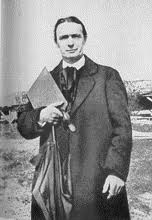
Rudolf Steiner in 1911, the year he met Franz Kafka

Rudolf Steiner in 1911, the year he met Franz Kafka

Kafka attended two of Steiner’s lectures and records his reactions in what seems to be an ironical tone (or is it perhaps just an intense observation in an attempt to understand?) in his diary entries of 26th and 28th March 1911. On 26th March he comments on Steiner’s rhetorical trick of giving full weight to the views of his opponents, so that “the listener now considers any refutation to be completely impossible and is more than satisfied with a cursory description of the possibility of a defence”; Kafka then observes: “Continual looking at the palm of the extended hand. Omission of the full stop. In general, the spoken sentence starts off from the speaker with its initial capital letter, curves in its course, as far as it can, out to the audience, and returns with the full stop to the speaker. But if the full stop is omitted then the sentence, no longer held in check, falls upon the listener immediately with full force.” Kafka was to do something similar in his own works, by writing long sentences that sometimes cover an entire page. Kafka’s sentences then deliver an unexpected impact just before the full stop, which gives a final meaning and focus to what has gone before.

On 28th March he comes back to Steiner in his diary, either referring to another or to the same lecture, which he proceeds to gently guy, interspersing this with comments about his neighbour in the audience:

“Dr Steiner is so very much taken up with his absent disciples. At the lecture the dead press so about him. Hunger for knowledge? But do they really need it? . . . Löwy Simon, soap dealer on Quai Moncey, Paris, got the best business advice from him . . . .The wife of the Hofrat therefore has in her notebook, How does One Achieve Knowledge of the Higher Worlds? At S. Löwy’s in Paris.”

Kafka would have been around 28 years old at this time. He seemed to find the tasks of daily existence very difficult, was often lonely and depressed and regarded himself as a perpetual outsider – a German speaker in Prague, a Jew among Christians. Although he had had encounters with some of the leading personalities of the age – apart from meeting Steiner, he had seen Nijinsky dance and had met Einstein, Rilke and Puccini – his experience of the wider world was limited. At university he studied law and then obtained jobs within first one, then another insurance company, work which he resented as it kept him away from his writing. He lived and worked within the same small area of Prague and its surroundings all his life. Despite a fervent longing to be independent, he spent the whole of his short life (he died at the age of 40, probably from starvation due to an inability to eat as a result of laryngeal tuberculosis) resenting that he was either living with his parents in what has been described as “an atmosphere of claustrophobic mutual surveillance” or else with one of his sisters. He had a strong sex drive but seems to have been unable to have satisfactory relationships with women, as he lacked the capacity for losing himself in loving another person. “For even the most intimate friend to set foot in my room,” he told his unfortunate fiancee, Felice Bauer, “fills me with terror.”

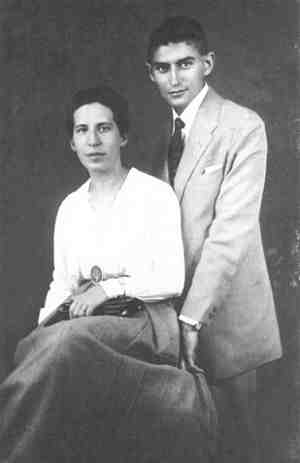
Franz Kafka with his fiancee, Felice Bauer

Franz Kafka with his fiancee, Felice Bauer

Kafka attributed his psychological difficulties to having “vigorously absorbed the negative element of the age in which I live.” He had a difficult relationship with his father, who was described by Kafka’s biographer Stanley Corngold as a “huge, selfish, overbearing businessman.” Kafka seems to have been psychic to some degree and in his diary admitted to suffering from “bouts of clairvoyance.”   A huge issue for him during this period was how to create for himself the necessary space for literature when his employment encroached upon his writing time and his family and society expected him to make a living, marry, and raise his own family. Whatever the reasons, in his writings Kafka captured like no other author before him themes such as father-son conflict, alienation, physical and psychological brutality, characters on a terrifying quest, encounters with arbitrary and unjust bureaucracy and mystical transformation.

In spite of what may have been his ironical tone in connection with Steiner’s lecture, Kafka evidently decided that Rudolf Steiner might be able to help him to find his life’s direction and made an appointment to see Steiner in his hotel room in Prague. Kafka records in his diary his impressions of this visit:

“In his room I try to show my humility, which I cannot feel, by seeking out a ridiculous place for my hat . I lay it down on a small wooden stand for lacing boots. . . Table in the middle, I sit facing the window, he on the left side of the table. . . . He begins with a few disconnected sentences. So you are Dr. Kafka? Have you been interested in theosophy long? But I push on with my prepared address: I feel that a great part of my being is striving toward theosophy, but at the same time I have the greatest fear of it. That is to say, I am afraid it will result in a new confusion which would be very bad for me, because even my present unhappiness consists only of confusion. This confusion is as follows: My happiness, my abilities, and every possibility of being useful in any way have always been in the literary field. And here I have, to be sure, experienced states (not many) which in my opinion correspond very closely to the clairvoyant states described by you, Herr Doktor, in which I completely dwelt in every idea, but also filled every idea, and in which I not only felt myself at my boundary, but at the boundary of the human in general. Only the calm of enthusiasm, which is probably characteristic of the clairvoyant, was still lacking in those states, even if not completely. I conclude this from the fact that I did not write the best of my works in those states. I cannot now devote myself completely to this literary field, as would be necessary and indeed for various reasons. Aside from my family relationships, I could not live by literature if only, to begin with, because of the slow maturing of my work and its special character; besides I am prevented also by my health and my character from devoting myself to what is, in the most favorable case, an uncertain life. I have therefore become an official in a social insurance agency. Now these two professions can never be reconciled with one another and admit a common fortune. The smallest good fortune in the one becomes a great misfortune in the other. . . . Outwardly, I fulfill my duties satisfactorily at the office, not my inner duties, however, and every unfulfilled inner duty becomes a misfortune that never leaves. And to these two never-to-be-reconciled endeavours shall I now add theosophy as a third? Will it not disturb both the others and itself be disturbed by both? . . . This is what I have come to ask you, Herr Doktor.”

It’s unfortunate for our curiosity that Kafka is so focused on himself and his problems that he doesn’t record how Steiner responded to this speech. All Kafka reports is this:

“He listened very attentively without apparently looking at me at all, entirely devoted to my words. He nodded from time to time, which he seems to consider an aid to strict concentration. At first a quiet head cold disturbed him, his nose ran, he kept working his handkerchief deep into his nose, one finger in each nostril.”

There is perhaps a little too much information in that last sentence and not enough anywhere else. There is no further mention of Steiner in the diaries, apart from one piece of advice from the same meeting: “Herr Kafka, essen Sie keine Eier.” (“Mr. Kafka, don’t eat eggs.”)

Can we make a guess at what else Steiner had said to him? It seems probable that Steiner realised that Kafka’s life would be a short one and that in his remaining time he would need to focus as much as possible on his writing. We may surmise that Steiner told Kafka to concentrate on literature above all else.

25 Comments

Filed under Anthroposophy, Franz Kafka, Rudolf Steiner

Different strokes for different folks

Following my recent post on “The issue that isn’t going away – leadership and management in Steiner Waldorf schools”, there was a minor flurry of comments from some of those who are critical of Steiner Waldorf schools. I will mention here just two of them:

Mark Hayes of the Steiner’s Mirror blog said:

“I think that the common lack of effective leadership stems from the collegiate management structure which originated with Steiner himself and the first Waldorf school, of course. I also suggest that the movement’s rigidity in this respect stems from the kind of unquestioning adulation for Steiner many share, as in your final paragraph.

Having said that, I have the impression that the mandate system used in many Steiner schools was an attempt to evolve from the fully collegiate approach, though I’ve seen little evidence that it has made much difference.

Does the SWSF still have an oversight role in the UK? Can grievances not satisfactorily resolved at school level still be taken there? If not, what role does it now have?”

Well, Mark, what I would say is that all sorts of variations have been tried in order to make the college of teachers system more responsive and effective, including the mandate system – I will be saying more about this in another posting soon, which will look in some detail at leadership and management issues.

I can’t speak for others but please do not assume that I have “unquestioning adulation” for Steiner – if I did, I would have failed as someone who seeks to work with anthroposophy. My appreciation of Steiner’s greatness has arisen over years of study, not just of anthroposophy but also of other spiritually-oriented philosophies. I have found that if you try to live and work with a new idea over a period of time, you will soon discover whether it has truth for you, because something within you will resonate with it. And if it sounds fantastical and cannot be verified, either within your own being or by some other means, then you can simply dismiss it, or say: interesting, if true. I understand that not everyone will share my assessment of Steiner, nor am I asking that they should.

Re SWSF, if I recall correctly, they no longer have a “final court of appeal “ role, which in the complaints procedures of most schools is reserved for the school’s Council of Trustees. What SWSF does do is to provide a Code of Practice, which spells out both Basic and Best Practice procedures; and in recent times, it has also introduced a Quality mark, which is awarded only to those schools which have undergone a rigorous outside assessment.

Melanie Byng has tweeted to say:

“your essential problem is that very few people agree Steiner was ‘a great initiate & one of the most remarkable human beings’ etc & most of these people don’t think it’s a good idea to base an education system on the ideas of ‘a great initiate’ or clairvoyant.”

I’m sure you’re right, Melanie, that not everyone will want such a system, but then as the marketing people say: “It’s different strokes for different folks.” Some people will want Montessori, some will want Froebel, some will want their local comprehensive, and there may even be a few who will want Steiner. What’s wrong with that?

Most parents will do their due diligence in researching the school they want for their child and there is plenty about Steiner schools on the internet, both pro- and anti-. Steiner schools are also much better these days in making statements about anthroposophy on their websites and in their prospectuses, so there should be fewer and fewer parents who are unaware of it.

If I might be excused a personal example, my wife and I were very happy to choose a Steiner school for our daughter, because we had done our due diligence and we did know fairly exactly what to expect; and it has worked very well for our daughter, both socially (like most Steiner pupils you meet, she is well-rounded, engaged with life, well-socialised, articulate and independent-minded) and academically (3 A*s at A level, a first class degree, and is now doing her MA at the Courtauld Institute). There are many others like her, both academic and non-academic types, who are able to find their way into adult life as free-thinking, creative and positive members of society. I saw it every year when I was working in a Steiner school and we said goodbye at the end of Summer term to the students leaving after their A-levels. These are fine young people that give one faith in the future of humanity – and any education system that can produce such results is doing quite a lot right.

1 Comment

Filed under Anthroposophy, Rudolf Steiner, Steiner Waldorf schools, Waldorf critics

The issue that isn’t going away – leadership and management in Steiner Waldorf schools

Two sad little messages from Steiner free school applicants have just been posted:

From North Devon:

“As you may be aware, the next round of Free School applications is in October 2014. Unfortunately all recent applications for Steiner Academies have been turned down by the Department of Education. The feeling is that they are trying to establish how the Steiner education system can progress within their guidelines.

It has therefore been decided that it would be best to wait until after the general election in 2015 before considering another application.

We know that this will leave many disappointed parents and children, not to mention the hard working support team who helped with the initial application and events, but hopefully next year will enable us to move forward. We would like to thank all of you for your kind support.”

And from Leeds:

“After a couple of very trying months, the team has decided to withdraw its application for a new Steiner School in Leeds. The main reason for this decision was our inability to recruit the kind of outstanding leader which the Department of Education and the New Schools Network wanted us to have. We were also concerned by the lack of alternative schools which have been successful in the last application round- the window for alternatives to receive state funding seems to have closed.

It is with a heavy heart over many years of hard work, effort, hopes and commitment that we’d like to say thank you for your support. We understand that this decision must be as disappointing to you as it is to us.”

I don’t know much about the background to these stories, though it is rumoured that Lord Nash, the schools minister in the Department for Education with responsibility for the free schools programme, is not keen to let through any more Steiner academies. What I do know is that Steiner Waldorf education in the UK is in a difficult phase, much of it due to our slowness to evolve our practices and professionalism.   The main reason for this is that the private schools are unable to improve themselves sufficiently because of the weaknesses of leadership and management inherent in the college of teachers system.

The message from Leeds quoted above is indicative that the independent Steiner schools’ movement in the UK is not producing sufficient numbers of people with the leadership or management experience (or perhaps the motivation) necessary to take on the role of principal in the new academy schools. The latest free school to be approved, Steiner Academy Bristol, has appointed a teacher from a non-Waldorf background as principal.

But it’s not just the new publicly-funded academies which are affected by these weaknesses – the recent closures of the Steiner schools in Aberdeen and Glasgow were ultimately caused by inadequacies in the management of those schools.

That’s not to say that there aren’t people within the independent schools who could become principals – I know some highly capable individuals, some of them leading quite unhappy and frustrated lives because of their inability to express fully their leadership talents within the college of teachers system to which they are so committed.

Nor, from what I gather, is the situation much better in the USA. A well-placed correspondent has written: “Our North American Waldorf schools, with a few notable exceptions, are not very well led. Few are even moderately successful at the institutional level. The root cause of this is cultural and it exists movement-wide. But it more or less guarantees that we will continue to alienate families by the hundreds across the country year after year, because lack of effective leadership means that real problems are not addressed effectively or in a timely manner. For all of our strengths as a movement we will have to do a lot better at managing operations if we are going to significantly reduce the number of legitimate complaints about individual schools.”

A powerful expression of such parental alienation has recently appeared in this Open Letter to Waldorf Educators.

My own feeling, which I have come to with reluctance as someone who has worked in an independent school and loves the education and its many strengths and wonderful qualities, is that the future of Steiner Waldorf education in this country will be safeguarded mainly by the state-funded academy schools, in which a principal works alongside the college. The Steiner academies are doing very good work, as is shown in the Ofsted reports for the Hereford and Frome schools; they are heavily over-subscribed and they have widespread parental support.

The roots of our present difficulties are manifold and I will be writing about them in my next posting. The independent Steiner schools struggle against great odds and yet most of them continue to achieve wonderful outcomes for their pupils and parents. What I wish to express right now is that Steiner Waldorf educators are working with the name of Rudolf Steiner, who was in my view a great initiate and one of the most remarkable human beings of the 20th or indeed any century. For us to provide anything in Steiner’s name that is less than consistently good is in a way a kind of betrayal – and this to me is unacceptable.

2 Comments

Filed under Free Schools, Rudolf Steiner, Steiner Waldorf schools

Why some atheists like anthroposophy

“The common man is a mystic. Mysticism is only a transcendent form of common sense. Mysticism and common sense alike consist in a sense of the dominance of certain truths and tendencies which cannot be formally demonstrated or even formally named. Mysticism and common sense are like appeals to realities that we all know to be real, but which have no place in argument except as postulates.” (G K Chesterton)

Chesterton, writing in the early 20th century, clearly felt that most people have a kind of natural sense that the spiritual world exists, even though many of us have no means of rationalising why we feel that way.

Others, such as Rudolf Steiner (although some people believe he had an atheistical period in his younger days), came to characterise atheism as a kind of disability or disease.  Lecturing in 1919, Steiner said : “Only those human beings…are atheists in whose organism something is organically disturbed. To be sure, this may lie in very delicate structural conditions, but it is a fact that atheism is in reality a disease…For, if our organism is completely healthy, the harmonious functioning of its various members will bring it about that we ourselves sense our origin from the Divine – ex deo nascimur (from God we are born).”

So there you are, Richard Dawkins et al – instead of having reached your view of a godless universe through the power of your intellect, you are actually just suffering from the effects of a disturbed physical organism. 🙂

Today, in the age of the consciousness soul, there are many people who have lost their natural connection with the divine. In Steiner’s view, humanity is going through a period which started in the 15th century and won’t conclude until the 35th, in which we have gradually lost an atavistic form of clairvoyance. This is a necessary but very dangerous step in the evolution of humankind. It is necessary because as humans we have the unique privilege of developing freewill, which could only happen by entering an age in which our connection with the divine-spiritual beings and their will for our future appeared to be severed. And it is dangerous because this apparent severance from spirit existence has given the oppositional powers the opportunity they didn’t have before, which is to convince human beings through our science and technology that physical, material reality is the only reality and thus to thwart our true destiny as spiritual beings. For all of the shortcomings and difficulties caused us by this present stage, Steiner tells us that materialism remains the vehicle for the initial development of human freedom. It was the task of materialistic science to lead us away from the overwhelming dominance of theology and theocracy in human affairs, and from the unfreedom that had for so long been associated with them. And, as Steiner repeatedly asserts, it is in our relationship as spiritual beings to the physical world that the possibility for human freedom first manifests itself. Put differently, materialism for all its faults and limitations had a very important task to perform, and it needed time to complete it – and it’s still got another 250 years or so to run its course.

In the meantime, we have to find ways of coping with the difficulties of our present age. In Owen Barfield’s words, “Living in the consciousness soul man experiences isolation, loneliness, materialism, loss of faith in the spiritual world, above all, uncertainty. The soul has to make up its mind and to act in a positive way on its own unsupported initiative. And it finds great difficulty in doing so. For it is too much in the dark to be able to see any clear reason why it should, and it no longer feels the old (instinctive) promptings of the spirit within.”

I rather like these concepts and find they bring a savour and a spice to life – human reality is much more exciting and inspiring than anything in science fiction! Many other people, of course, think this is all nonsense and take up the position of agnosticism or atheism. ‘Skeptics’ (as they call themselves) can be very dismissive about anthroposophical endeavours, which are of course based upon the presumption of the reality of the spiritual world. If these skeptics are also parents in Steiner schools who feel that they have had a bad experience, or if they believe that the school has not been open with them about anthroposophy, then their anger and contempt can be awesome to behold – and in this online world, they make sure as many other people as possible get to hear about it. I’m sure schools do get things wrong from time to time and I’m certainly not trying to belittle those parents who have had less than satisfactory experiences. When you have invested such hope (and hard cash) in a school for your children, it is shattering if it then all seems to go wrong. Steiner Waldorf schools, which have such high aspirations, can cause huge anger if they turn out to have feet of clay. I shall be writing in a later posting more about this unfortunate phenomenon and some possible reasons for it.

There are other sorts of skeptic parents, for example those who regard anthroposophy as a bit of a joke but still value the education Steiner schools provide for their children. I came across a good example of this latter type on an Australian blog, Good Reason. In a post entitled: “A Rational Look at Steiner Schools”, Daniel Midgley comments on an article he has read in the magazine, Australian Rationalist. After going through the various criticisms made of Steiner schools in the article, Daniel concludes:

“If there is a saving grace for Waldorf education, it’s that, in my experience, very few of the rank and file parents believe the hype. You do get a core of Steiner believers, including the teachers, but almost no one else takes Anthroposophy seriously. Many parents roll their eyes at Eurythmy and such. The kids are usually pretty down to earth about it, too. At a recent Winter Festival, some parents were trying to foster a reverent attitude during the bonfire, but the kids were chanting “More kerosene! More kerosene!” They keep it real.

I also think that the teaching of religion is handled well, as I’ve mentioned before. Many world religions are represented, and I think this has an inoculating influence on kids. They’re more likely to fall for religion in adulthood if it hasn’t been presented to them before, and the Christian myth is presented at school along with all the other myths.

If you’re a rationalist, and you’re considering Steiner education, or if (like me) you’re already in and you’re only just becoming more of a critical thinker, it’s not impossible for it to work. My kids enjoy their school, and it’s been pretty positive. …The greatest danger from Steiner schooling is to the rationalist parent, not the child; you may go insane from exposure to crackpottery, or you may eventually bite through your tongue.”

In the Steiner school I know best, I certainly came across atheist parents who nevertheless valued the education, even if they thought some aspects of it were screwy – so I’m sure Daniel is on to something in his article.

But although it is quite easy for atheists to be dismissive of Steiner schools (even if some of them like the results), it’s not quite so easy to dismiss something as nonsense when the evidence of your own senses is telling you the exact opposite. It’s indeed an irony, given many anthropops’ ambivalent attitudes to alcohol, that biodynamically produced wine is leading the way in changing attitudes to biodynamic agriculture. Take for example this post by Cory Cartwright: “An Atheist’s Defence of Biodynamics”:

“…I do believe some biodynamic vignerons are amongst the very best in the world. I’ve drank hundreds of these wines, from wines that tout a Demeter certification on their label to wines that I didn’t know were biodynamic for years. In fact many of the producers consider marketing the wine as “bio” to be just that, marketing, so they let the wine do the talking. Despite my skepticism around some of the principal tenets and practices of Steiner’s agricultural followers, I simply don’t care if they are being used.

The resurgence in biodynamics, like modern organics, the Slow Food movement, fukuoka farming, locavores, and natural winemaking was a conscious rejection of the big industrial food supply chain that twisted our view of food, wrecked economies, and wrecked our health. The tenets of modernization, control, simplification, mass production, “big solutions.” When people saw what we had done to one of our most basic of needs they were aghast, and set out to find alternatives that would stop the pollution of both of the soil and of our bodies.

The scientific based winemaking at UC Davis and elsewhere is one that sees a straightforward path between the beginning and the end of winemaking, and deviation is dealt with as harshly as possible. Shouldn’t plant vines there? Irrigation will fix that. Weeds? Monsanto has you covered (which heavily funds UC Davis. Go Aggies!). Vines not doing so well? Chemical fertilizers. Mildew? Bring on the helicopters. Of course this is all very scientific so skepticism about the ultimate problems should be shelved for now while we continue spraying. Aren’t these the questions we should be asking when it comes to winemaking? What price are we paying for this wine when everything is tallied?

I am beginning to work with a young couple in the south of France who have 14 acres of vineyards and olives that are all farmed biodynamically. We toured their vineyards, and they showed us several planting techniques they were experimenting with, from planting density to different cover crops and mixed use vineyards. As we walked through we were struck by the difference between their vineyards and others. They had some bio-culture in their vineyards, the vines looked good, their old growth was healthy. The nearby neighbors had created a moonscape vineyard, dead, except for the vines, and even then the old growth was mostly gone despite being planted at the same time.

When we asked them about the biodynamic treatments they treated us to skeptical laughs. They said it was working, with a wave of a hand towards the vines, and even if the treatments were doing nothing, so what? Practicing biodynamics was getting them out and into the vineyards, with the plants and rocks, getting their hands dirty and teaching them to recognize things that they would never get if they were in a tractor all day, or if they simply killed off all the life.”

The whole article is well worth reading and the photos contrasting the biodynamic vineyard with the conventionally-farmed vineyard are very telling.

The anthropopper can live with being ridiculed by skeptics, as long as others are beginning to see that in applied anthroposophy there really is something rather special that works, and which holds hope for the future – and in such a mad, bad and dangerous world, we all need to believe that humanity can find ways to pull through its present crises. Anyway, as human evolution continues, and once we’re all through the age of the consciousness soul (unfortunately there’s about another 1500 years to go), I like to think that we will be discovering new and much more objective clairvoyant abilities in ourselves; and the reality of the spiritual world will be glaringly obvious to all of us, skeptics, anthropops and the common man and woman alike.

5 Comments

Filed under Anthroposophy, Atheists & Atheism, Biodynamics, Rudolf Steiner, Steiner Waldorf schools

Marilyn Monroe and Rudolf Steiner

Hard on the heels of the Daily Mail’s re-hashing of a salacious story about Marilyn Monroe from sixty years ago as if it were the latest sensation, the anthropopper will not be outdone in recycling old news and is proud to reveal that … Marilyn Monroe was an anthroposophist!

images

Photo courtesy of Harpers Bazaar

Intriguingly, this does appear to be a true story. The following quotation is taken from a biography of Marilyn Monroe called “Norma Jean: the Life of Marilyn Monroe” by Fred Lawrence Guiles, published by McGraw-Hill Book Company, New York in 1969. It appears on pages 331-332 of the 333-page book.

 “Some years before her death (in Dec. ’64), Dame Edith (Sitwell) had spent a winter in Hollywood. A meeting between the poet and Marilyn was arranged by a monthly magazine. It was thought their ‘opposite’ personalities would throw off some journalistic sparks. No one could have foreseen that they would become immediate friends, nor could anyone have known that their deaths would be marked in an almost identical way — while their legends were growing in their lifetimes, they had been taken seriously by too few, too late.

“By the time she met Dame Edith, Marilyn had come a long way. If she had not been moving in an atmosphere — much of it self-created — so removed from her beginning, they might have had nothing in common. But when the introductions were over, these new and unlikely friends were left alone and began talking of Rudolf Steiner, whose personal history, “The Course of My Life”, Marilyn was reading at the time. Dame Edith was to remark later on Marilyn’s ‘extreme intelligence'”

In Dame Edith Sitwell’s autobiography Taken Care Of, she tells of her meeting with ‘Miss Marilyn Monroe’, who she describes as quiet, with great natural dignity and extremely intelligent. She was also, she said, extremely sensitive. Dame Edith tells of a magazine article that she was commissioned to write about her visit to Hollywood and this included a face-to-face encounter with Miss Monroe, who she suspected the magazine moguls thought would hate one another on sight. They were mistaken.

‘On the occasion of our meeting she wore a green dress and, with her yellow hair, looked like a daffodil. We talked mainly, as far as I remember, about Rudolf Steiner, whose works she had just been reading. In repose her face was at moments strangely, prophetically tragic, like the face of a beautiful ghost – a little spring-ghost, an innocent fertility daemon, the vegetation spirit that was Ophelia.’

(Source: http://www.webcitation.org/5wozS1ofx)

Monroe and Sitwell

Edith Sitwell and Marilyn Monroe, 1953 Photograph by George Silk/LIFE © Time Inc.

Tom Mellett, a former Steiner teacher in the USA, has added the following comments:

“While living in Spring Valley in 1980, I had the good fortune of meeting the person who had sent Marilyn that copy of Steiner’s autobiography as well as a number of other Steiner books and lecture cycles that Marilyn requested over a ten year period from the Anthroposophical Library, then located at 211 Madison Avenue in New York City. I speak of the late Agnes Macbeth, wife of the late Norman Macbeth (author of “Darwin Retried”). Agnes worked for the library during the 1950’s, handling book requests and she vividly remembers the letters Marilyn posted asking for various lecture cycles. And although Marilyn had a reputation for tardiness and irresponsibility on her movie sets, Agnes assured me that Marilyn was very conscientious and punctual with her returns of the books.

Marilyn Monroe was introduced to Steiner’s writings and lectures by her favou rite drama teacher, Michael Chekhov (1890-1955), nephew of the playwright Anton, and fellow director with Stanislavsky in the Moscow Art Theatre early in the 20th century. Marilyn was introduced to Chekhov in 1951 by one of his devoted students, the American character actor Jack Palance. Marilyn opened herself like a sponge to water to Chekhov’s approach to theatre, which was so deeply influenced by Steiner that Chekhov left Stanislavsky’s method behind. And Marilyn opened herself very deeply to anthroposophy, not because she felt it would please her teacher, but Chekhov felt that it was one of the only times in her life that Marilyn did something out of her own free inner being.

The tragedy of Marilyn Monroe is that she opened herself up too much and became a slave, not only of the studio bosses, but also the expectations of a world that focused on her as such a fantasy object. Yet deep inside her inner being, which no one in the media and our popular culture even believed she possessed, she spent the last 10 or 11 years of her tortured life cultivating the delicate plant of anthroposophy.”

29 Comments

Filed under Marilyn Monroe, Rudolf Steiner

Am I Reasonable or Unreasonable?

One of the things that impresses me about anthroposophy is the effect it can have on certain people when they seek to apply it in practical activities. It’s as though once these individuals get a glimpse of the true nature of what it is to be a human and an understanding of the role of human beings in the larger scheme of things, it somehow frees them to go out into the world without fear and to get on with their life’s work.

Look at the people who work on biodynamic farms, for example. There they are, toiling away for often just the minimum wage, producing wonderful food bursting with flavour and full of life-force, for those of us privileged enough to be near an outlet that sells it.

Why do they do it? What motivates them to forsake the normal aspirations of society, such as being able to afford to buy their own home, have a good car and get their share of the other consumer benefits most of us take for granted? Are they being reasonable?

Perhaps it’s because they simply can’t bear what is going on in conventional agriculture right now. They want the rest of us to wake up to what is happening in mainstream farming. These are individuals who feel that they have to do right by the land, by the animals and by the plants within their care because not to do so would crush them as human beings.

Or what about co-workers in Camphill village communities, who have chosen to live and work with people who have intellectual and developmental disabilities? Could it be that they feel impelled to live and work in an environment in which each person and every aspect of the natural world is valued and respected, because not to do so would be unbearable?

Or take the group of Arab and Jewish parents who founded the Ein Bustan (literally “Spring in the Garden”) kindergarten, the first Jewish/Arab Waldorf kindergarten in Israel. These founders share a vision of a society in which Jews and Arabs live peacefully together in equality and understanding. The children (half of them Arab and half Jewish) learn and speak each other’s language and discover each other’s culture and inner world. In the midst of all the hatred and horrors of Jewish/Arab conflict, these people are doing what is the obvious and necessary thing to do, that is building bridges of understanding between the children who will grow up to become the next generation of decision-makers and opinion-formers in Israel. They are reviled and derided by many on both sides for what they do.

Compare and contrast individuals like this with, say, political activists or media commentators. Such people can talk up a storm about what needs to be done to meet this crisis or that problem. They are well known, they are wheeled out as pundits on TV and radio and online, they make a good living out of what they do, and they are above all reasonable men and women. However, their tally of contributing to actual change or improvement for their fellow human beings may be less than impressive.

Reasonable people are adaptable, sensible, can tack with the prevailing winds. The Vicar of Bray was undoubtedly a reasonable man. Unreasonable people can at times be a pain to deal with and are often seen as their own worst enemies.

Was Karl Konig, who founded Camphill, a reasonable man?

Are the Ein Bustan founders reasonable to carry on in the face of all the opposition coming their way?

Was Rudolf Steiner, as someone who has had a huge impact in fields as diverse as agriculture, architecture, the arts, economics, education, medicine, a reasonable man?

Here is a favourite quotation of mine, from George Bernard Shaw’s Man and Superman:

“The reasonable man adapts himself to the world: the unreasonable one persists in trying to adapt the world to himself. Therefore all progress depends on the unreasonable man.”

Exactly so.

5 Comments

Filed under Anthroposophy