
Mention of Franz Kafka in my previous posting has reminded me that there was in fact a meeting between Kafka and Rudolf Steiner. It happened in Prague in March 1911. Steiner was in Prague delivering a series of lectures on the subject of An Occult Physiology. Kafka had first come across Steiner at Mrs Berta Fanta’s salon on Old Town Square, a famous meeting place for intellectuals during the two-decade period before the First World War. These gatherings were attended by professors at the German university in Prague, including Albert Einstein and Christian von Ehrenfels, as well as the up-and-coming younger generation such as Kafka and Max Brod. (Einstein also met Steiner at Mrs Fanta’s salon and attended several of Steiner’s lectures held in the Café Louvre, an Art Nouveau café on Národní třída, and was apparently impressed by Steiner’s views on non-Euclidean geometry.)
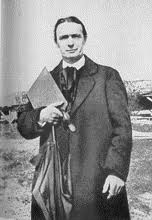
Rudolf Steiner in 1911, the year he met Franz Kafka
Kafka attended two of Steiner’s lectures and records his reactions in what seems to be an ironical tone (or is it perhaps just an intense observation in an attempt to understand?) in his diary entries of 26th and 28th March 1911. On 26th March he comments on Steiner’s rhetorical trick of giving full weight to the views of his opponents, so that “the listener now considers any refutation to be completely impossible and is more than satisfied with a cursory description of the possibility of a defence”; Kafka then observes: “Continual looking at the palm of the extended hand. Omission of the full stop. In general, the spoken sentence starts off from the speaker with its initial capital letter, curves in its course, as far as it can, out to the audience, and returns with the full stop to the speaker. But if the full stop is omitted then the sentence, no longer held in check, falls upon the listener immediately with full force.” Kafka was to do something similar in his own works, by writing long sentences that sometimes cover an entire page. Kafka’s sentences then deliver an unexpected impact just before the full stop, which gives a final meaning and focus to what has gone before.
On 28th March he comes back to Steiner in his diary, either referring to another or to the same lecture, which he proceeds to gently guy, interspersing this with comments about his neighbour in the audience:
“Dr Steiner is so very much taken up with his absent disciples. At the lecture the dead press so about him. Hunger for knowledge? But do they really need it? . . . Löwy Simon, soap dealer on Quai Moncey, Paris, got the best business advice from him . . . .The wife of the Hofrat therefore has in her notebook, How does One Achieve Knowledge of the Higher Worlds? At S. Löwy’s in Paris.”
Kafka would have been around 28 years old at this time. He seemed to find the tasks of daily existence very difficult, was often lonely and depressed and regarded himself as a perpetual outsider – a German speaker in Prague, a Jew among Christians. Although he had had encounters with some of the leading personalities of the age – apart from meeting Steiner, he had seen Nijinsky dance and had met Einstein, Rilke and Puccini – his experience of the wider world was limited. At university he studied law and then obtained jobs within first one, then another insurance company, work which he resented as it kept him away from his writing. He lived and worked within the same small area of Prague and its surroundings all his life. Despite a fervent longing to be independent, he spent the whole of his short life (he died at the age of 40, probably from starvation due to an inability to eat as a result of laryngeal tuberculosis) resenting that he was either living with his parents in what has been described as “an atmosphere of claustrophobic mutual surveillance” or else with one of his sisters. He had a strong sex drive but seems to have been unable to have satisfactory relationships with women, as he lacked the capacity for losing himself in loving another person. “For even the most intimate friend to set foot in my room,” he told his unfortunate fiancee, Felice Bauer, “fills me with terror.”
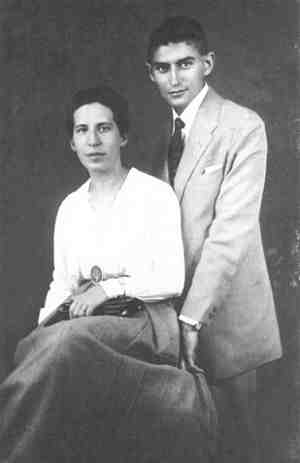
Franz Kafka with his fiancee, Felice Bauer
Kafka attributed his psychological difficulties to having “vigorously absorbed the negative element of the age in which I live.” He had a difficult relationship with his father, who was described by Kafka’s biographer Stanley Corngold as a “huge, selfish, overbearing businessman.” Kafka seems to have been psychic to some degree and in his diary admitted to suffering from “bouts of clairvoyance.” A huge issue for him during this period was how to create for himself the necessary space for literature when his employment encroached upon his writing time and his family and society expected him to make a living, marry, and raise his own family. Whatever the reasons, in his writings Kafka captured like no other author before him themes such as father-son conflict, alienation, physical and psychological brutality, characters on a terrifying quest, encounters with arbitrary and unjust bureaucracy and mystical transformation.
In spite of what may have been his ironical tone in connection with Steiner’s lecture, Kafka evidently decided that Rudolf Steiner might be able to help him to find his life’s direction and made an appointment to see Steiner in his hotel room in Prague. Kafka records in his diary his impressions of this visit:
“In his room I try to show my humility, which I cannot feel, by seeking out a ridiculous place for my hat . I lay it down on a small wooden stand for lacing boots. . . Table in the middle, I sit facing the window, he on the left side of the table. . . . He begins with a few disconnected sentences. So you are Dr. Kafka? Have you been interested in theosophy long? But I push on with my prepared address: I feel that a great part of my being is striving toward theosophy, but at the same time I have the greatest fear of it. That is to say, I am afraid it will result in a new confusion which would be very bad for me, because even my present unhappiness consists only of confusion. This confusion is as follows: My happiness, my abilities, and every possibility of being useful in any way have always been in the literary field. And here I have, to be sure, experienced states (not many) which in my opinion correspond very closely to the clairvoyant states described by you, Herr Doktor, in which I completely dwelt in every idea, but also filled every idea, and in which I not only felt myself at my boundary, but at the boundary of the human in general. Only the calm of enthusiasm, which is probably characteristic of the clairvoyant, was still lacking in those states, even if not completely. I conclude this from the fact that I did not write the best of my works in those states. I cannot now devote myself completely to this literary field, as would be necessary and indeed for various reasons. Aside from my family relationships, I could not live by literature if only, to begin with, because of the slow maturing of my work and its special character; besides I am prevented also by my health and my character from devoting myself to what is, in the most favorable case, an uncertain life. I have therefore become an official in a social insurance agency. Now these two professions can never be reconciled with one another and admit a common fortune. The smallest good fortune in the one becomes a great misfortune in the other. . . . Outwardly, I fulfill my duties satisfactorily at the office, not my inner duties, however, and every unfulfilled inner duty becomes a misfortune that never leaves. And to these two never-to-be-reconciled endeavours shall I now add theosophy as a third? Will it not disturb both the others and itself be disturbed by both? . . . This is what I have come to ask you, Herr Doktor.”
It’s unfortunate for our curiosity that Kafka is so focused on himself and his problems that he doesn’t record how Steiner responded to this speech. All Kafka reports is this:
“He listened very attentively without apparently looking at me at all, entirely devoted to my words. He nodded from time to time, which he seems to consider an aid to strict concentration. At first a quiet head cold disturbed him, his nose ran, he kept working his handkerchief deep into his nose, one finger in each nostril.”
There is perhaps a little too much information in that last sentence and not enough anywhere else. There is no further mention of Steiner in the diaries, apart from one piece of advice from the same meeting: “Herr Kafka, essen Sie keine Eier.” (“Mr. Kafka, don’t eat eggs.”)
Can we make a guess at what else Steiner had said to him? It seems probable that Steiner realised that Kafka’s life would be a short one and that in his remaining time he would need to focus as much as possible on his writing. We may surmise that Steiner told Kafka to concentrate on literature above all else.
 anthropopper