Tag Archives: Anthroposophy

Franz Kafka meets Rudolf Steiner

Mention of Franz Kafka in my previous posting has reminded me that there was in fact a meeting between Kafka and Rudolf Steiner. It happened in Prague in March 1911. Steiner was in Prague delivering a series of lectures on the subject of An Occult Physiology. Kafka had first come across Steiner at Mrs Berta Fanta’s salon on Old Town Square, a famous meeting place for intellectuals during the two-decade period before the First World War. These gatherings were attended by professors at the German university in Prague, including Albert Einstein and Christian von Ehrenfels, as well as the up-and-coming younger generation such as Kafka and Max Brod. (Einstein also met Steiner at Mrs Fanta’s salon and attended several of Steiner’s lectures held in the Café Louvre, an Art Nouveau café on Národní třída, and was apparently impressed by Steiner’s views on non-Euclidean geometry.)
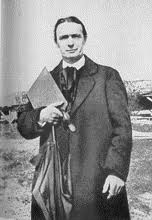
Rudolf Steiner in 1911, the year he met Franz Kafka

Rudolf Steiner in 1911, the year he met Franz Kafka

Kafka attended two of Steiner’s lectures and records his reactions in what seems to be an ironical tone (or is it perhaps just an intense observation in an attempt to understand?) in his diary entries of 26th and 28th March 1911. On 26th March he comments on Steiner’s rhetorical trick of giving full weight to the views of his opponents, so that “the listener now considers any refutation to be completely impossible and is more than satisfied with a cursory description of the possibility of a defence”; Kafka then observes: “Continual looking at the palm of the extended hand. Omission of the full stop. In general, the spoken sentence starts off from the speaker with its initial capital letter, curves in its course, as far as it can, out to the audience, and returns with the full stop to the speaker. But if the full stop is omitted then the sentence, no longer held in check, falls upon the listener immediately with full force.” Kafka was to do something similar in his own works, by writing long sentences that sometimes cover an entire page. Kafka’s sentences then deliver an unexpected impact just before the full stop, which gives a final meaning and focus to what has gone before.

On 28th March he comes back to Steiner in his diary, either referring to another or to the same lecture, which he proceeds to gently guy, interspersing this with comments about his neighbour in the audience:

“Dr Steiner is so very much taken up with his absent disciples. At the lecture the dead press so about him. Hunger for knowledge? But do they really need it? . . . Löwy Simon, soap dealer on Quai Moncey, Paris, got the best business advice from him . . . .The wife of the Hofrat therefore has in her notebook, How does One Achieve Knowledge of the Higher Worlds? At S. Löwy’s in Paris.”

Kafka would have been around 28 years old at this time. He seemed to find the tasks of daily existence very difficult, was often lonely and depressed and regarded himself as a perpetual outsider – a German speaker in Prague, a Jew among Christians. Although he had had encounters with some of the leading personalities of the age – apart from meeting Steiner, he had seen Nijinsky dance and had met Einstein, Rilke and Puccini – his experience of the wider world was limited. At university he studied law and then obtained jobs within first one, then another insurance company, work which he resented as it kept him away from his writing. He lived and worked within the same small area of Prague and its surroundings all his life. Despite a fervent longing to be independent, he spent the whole of his short life (he died at the age of 40, probably from starvation due to an inability to eat as a result of laryngeal tuberculosis) resenting that he was either living with his parents in what has been described as “an atmosphere of claustrophobic mutual surveillance” or else with one of his sisters. He had a strong sex drive but seems to have been unable to have satisfactory relationships with women, as he lacked the capacity for losing himself in loving another person. “For even the most intimate friend to set foot in my room,” he told his unfortunate fiancee, Felice Bauer, “fills me with terror.”
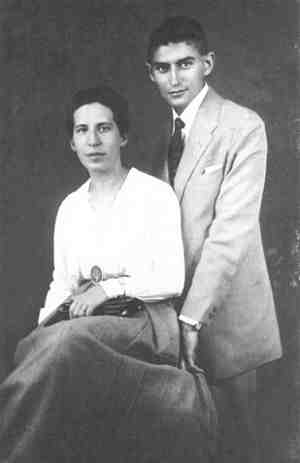
Franz Kafka with his fiancee, Felice Bauer

Franz Kafka with his fiancee, Felice Bauer

Kafka attributed his psychological difficulties to having “vigorously absorbed the negative element of the age in which I live.” He had a difficult relationship with his father, who was described by Kafka’s biographer Stanley Corngold as a “huge, selfish, overbearing businessman.” Kafka seems to have been psychic to some degree and in his diary admitted to suffering from “bouts of clairvoyance.”   A huge issue for him during this period was how to create for himself the necessary space for literature when his employment encroached upon his writing time and his family and society expected him to make a living, marry, and raise his own family. Whatever the reasons, in his writings Kafka captured like no other author before him themes such as father-son conflict, alienation, physical and psychological brutality, characters on a terrifying quest, encounters with arbitrary and unjust bureaucracy and mystical transformation.

In spite of what may have been his ironical tone in connection with Steiner’s lecture, Kafka evidently decided that Rudolf Steiner might be able to help him to find his life’s direction and made an appointment to see Steiner in his hotel room in Prague. Kafka records in his diary his impressions of this visit:

“In his room I try to show my humility, which I cannot feel, by seeking out a ridiculous place for my hat . I lay it down on a small wooden stand for lacing boots. . . Table in the middle, I sit facing the window, he on the left side of the table. . . . He begins with a few disconnected sentences. So you are Dr. Kafka? Have you been interested in theosophy long? But I push on with my prepared address: I feel that a great part of my being is striving toward theosophy, but at the same time I have the greatest fear of it. That is to say, I am afraid it will result in a new confusion which would be very bad for me, because even my present unhappiness consists only of confusion. This confusion is as follows: My happiness, my abilities, and every possibility of being useful in any way have always been in the literary field. And here I have, to be sure, experienced states (not many) which in my opinion correspond very closely to the clairvoyant states described by you, Herr Doktor, in which I completely dwelt in every idea, but also filled every idea, and in which I not only felt myself at my boundary, but at the boundary of the human in general. Only the calm of enthusiasm, which is probably characteristic of the clairvoyant, was still lacking in those states, even if not completely. I conclude this from the fact that I did not write the best of my works in those states. I cannot now devote myself completely to this literary field, as would be necessary and indeed for various reasons. Aside from my family relationships, I could not live by literature if only, to begin with, because of the slow maturing of my work and its special character; besides I am prevented also by my health and my character from devoting myself to what is, in the most favorable case, an uncertain life. I have therefore become an official in a social insurance agency. Now these two professions can never be reconciled with one another and admit a common fortune. The smallest good fortune in the one becomes a great misfortune in the other. . . . Outwardly, I fulfill my duties satisfactorily at the office, not my inner duties, however, and every unfulfilled inner duty becomes a misfortune that never leaves. And to these two never-to-be-reconciled endeavours shall I now add theosophy as a third? Will it not disturb both the others and itself be disturbed by both? . . . This is what I have come to ask you, Herr Doktor.”

It’s unfortunate for our curiosity that Kafka is so focused on himself and his problems that he doesn’t record how Steiner responded to this speech. All Kafka reports is this:

“He listened very attentively without apparently looking at me at all, entirely devoted to my words. He nodded from time to time, which he seems to consider an aid to strict concentration. At first a quiet head cold disturbed him, his nose ran, he kept working his handkerchief deep into his nose, one finger in each nostril.”

There is perhaps a little too much information in that last sentence and not enough anywhere else. There is no further mention of Steiner in the diaries, apart from one piece of advice from the same meeting: “Herr Kafka, essen Sie keine Eier.” (“Mr. Kafka, don’t eat eggs.”)

Can we make a guess at what else Steiner had said to him? It seems probable that Steiner realised that Kafka’s life would be a short one and that in his remaining time he would need to focus as much as possible on his writing. We may surmise that Steiner told Kafka to concentrate on literature above all else.

25 Comments

Filed under Anthroposophy, Franz Kafka, Rudolf Steiner

A few thoughts on leadership and management issues in Steiner Waldorf schools

Some years ago I ran a vision-building workshop for a Steiner school. To help me, I invited a very experienced businessman and friend, Mick Crews, not only because of his track record in similar workshops for big companies but also because he liked what he had already heard of Steiner Waldorf schools. As part of our preparations, I explained to Mick the ways in which the school sought to manage itself through the college of teachers system.   He listened very carefully and then he said: “It strikes me that, for your system to work, it requires a degree of personal integrity in the staff that you don’t find in any other walk of life”.

Steiner schools are trying to work with a model of self-governance as laid down by Rudolf Steiner in the 1920s, in which there was no head teacher and in which each teacher took a measure of responsibility for the running of the school, above and beyond their normal teaching duties. Why did Steiner advocate this system, which the schools have tried to implement ever since?

Those of us who have struggled with the challenges of running the school in the college of teachers system have always told ourselves that Steiner gave this daunting task to the schools as a kind of necessary preparation for working in a way that will increasingly come to the fore as humanity develops, that is in a non-hierarchical, consensual system that gets away from top-down, centrally-driven thinking and decision making. There’s no denying that it does have some real advantages:

  • The sense that teachers have (or are more likely to have) of professional autonomy and of shared collective responsibility for the children and the school
  • The willingness that teachers have (or should have) to take a larger view of their role beyond their immediate job description
  • The opportunity that teachers have not only to meet and discuss anything related to teaching, curriculum and the pupils but also to share their experiences, take initiatives and learn from one another

Out of these conditions arise several benefits for the school and the pupils, which would otherwise be far less likely to exist. They include:

  • Better relationships between teachers and pupils than seems to be the case in many other schools
  • Pupils, who because of the Waldorf curriculum running alongside the examination courses, tend to be well-rounded and “interesting” individuals
  • A tangible quality of warmth about the education that makes for a supportive and encouraging atmosphere within the school
  • Teachers able to work as true professionals rather than classroom managers

However, if not handled well by all concerned, the college of teachers system can also display some more difficult aspects:

  • a management approach in which everybody has nominal responsibility but only a few take active responsibility
  • lack of time, and lack of expertise in complex areas such as employment law
  • lack of individual accountability
  • lack of clarity in the role of College (is it the spiritual heart-organ of the school, a permanent teacher training academy, a school management body, or all of these and more?)

The effect of these difficulties can sometimes lead to:

  • slowness in coming to decisions
  • poor communications with other parts of the school community, eg lack of clarity for parents about whom they should approach when faced with a problem
  • poor communications with teachers who are not on College
  • weakness in overall pedagogical management and inadequate self-management by some teachers
  • inherent risk of conflict of interest when teachers set their own standards
  • slowness in responding to difficult situations which then become crises
  • slow and sometimes inappropriate or inadequate responses to the outside world’s demands;
  • occasional failures to deal effectively and quickly with under-performance of teachers or difficulties within classes
  • problems in keeping up to date with advances in teaching practice, with legislation and with what is going on in other parts of the educational world
  • inadequate pastoral care for staff

There are additional complexities in running a Steiner school which do not apply to other schooling systems, and these are to do with the way in which Steiner’s teaching encompassed not only his method of education but also its spiritual basis in anthroposophy and its socio-economic basis in “threefolding”. For reasons of concision, these complexities are not dealt with here, although perhaps I will return to them in a future posting.

In a system so dependent on the astonishing insights of one man who died in 1925, the schools movement is now, to use a phrase originated by Steve Sagarin of Great Barrington Waldorf School, like a restaurant without a chef. Sagarin asks: “How can Waldorf schools address this absence? There is no single right or appropriate model. Democratic or aristocratic, consensus decision-making or mandates, it doesn’t matter. Each school community must solve this conundrum for itself.”

A former mentor and a good friend of mine, Helen Weatherhead, a very experienced Steiner class teacher, has said to me: “It doesn’t matter which system you have in place – what really decides whether a school works well or not is the constellation of people within the staff of that school”. And of course, that’s absolutely right – well-motivated people of good will, aligned around a single purpose, will make the best of any system of school management. Here we come back to the point Mick Crews made about the required degree of personal integrity, which in my experience is only sometimes higher in Steiner schools than that found in other walks of life. But perhaps it’s because Steiner schools aspire to such high ideals, and because parents invest so much belief and hope in the education, that when things go wrong or are badly handled by the school, the disillusion and anger expressed by these parents can be overwhelming.

If one reads the Conferenzen, (the record of the teachers’ meetings with Steiner at the first Waldorf school in Stuttgart), it is clear that up until he became seriously ill in late 1924, Steiner and the teachers continued to evolve the management system in the light of difficulties that were experienced. At no point did they arrive at a definitive system and, indeed, it is ironic that up until his final illness, Steiner continued to act as a kind of visiting headmaster to whose views every one deferred.

Nearly a century after Steiner’s death we have vastly different educational and political circumstances to deal with. To mention only the most obvious, teachers’ workloads have increased, external regulations and inspections have multiplied, employment law, health and safety regulations and child protection legislation have made running a school a truly complex operation; and everyone working in a school wants to maintain a healthy work/life balance rather than spend many evenings and weekends in teachers’ meetings.

Despite all of this, most Steiner schools have persisted with the college of teachers system or variants, although it doesn’t work well in terms of managing the school in today’s circumstances. The independent Steiner schools, which have so many excellent qualities, are usually not at their best either in customer care or quality control and they are perhaps twenty or thirty years behind in their attitudes to these concepts when compared with what is happening in the other parts of the schools’ sector in the UK.

I except from this the newly founded Steiner academies, which are publicly funded and required to maintain more stringent governance than is usually the case in the independent schools. The UK government has made it a condition that there should be a principal in each of these schools who is personally accountable to them for the running of the school. It will be interesting to see in the coming years what sort of modus vivendi will evolve between the principal and the college of teachers (where there is one) in these Steiner academy schools.

The leadership and management roles of the council of trustees should also not be forgotten. Indeed, the idea that Steiner schools are run by the faculty through the college of teachers is only partially correct. It would be more accurate to say that, under current charity law, the council of trustees is responsible for everything that happens within the school and that they devolve certain of their responsibilities to the college of teachers. At the school with which I am most familiar, the trustees reserve to themselves decisions about financial, legal and regulatory matters, while devolving responsibility for all pedagogical matters to College.

I have myself been a trustee at a much smaller Steiner school of more recent creation, and it has very different problems and issues from the larger and longer-established schools. For a time, its trustees, who were mainly parents at the school, had to micro-manage everything and there was no college of teachers, although there were regular faculty meetings. The school is now moving towards a system in which the school management team (on which faculty, trustees and administration are represented) assumes more and more functions devolved from the trustees. Another Steiner school of which I’m aware has done away completely with its college of teachers and replaced it by a system of mandates and teacher-meetings. Several schools have appointed education facilitators (full-time educational administrators) whose role it is to deal with those many aspects of running a school that the teachers do not have time for in their College meetings. The Steiner Academy Hereford, the first of the new publicly-funded Steiner schools, appointed a principal and deputy principal to work alongside the college of teachers, and this is a pattern that may be repeated in schools that are currently seeking to become academies under the government’s “free schools” initiative. All of these examples serve to illustrate Sagarin’s point that each school must work out its own solutions according to its own unique situation.

This ‘unique situation’ or the exceptional autonomy of each Steiner school is also both a strength and a weakness. It’s a strength inasmuch as autonomy allows each school to develop its own character and culture to the maximum. It’s also a weakness because a wide range of autonomous individual schools makes coordinated responses to movement-wide problems very difficult. This lack of centralised authority makes it almost impossible to fix problems that individual schools have been unable to solve for themselves.

A recent conversation with Christopher Clouder has led me to question whether we might not in any case have misunderstood how Steiner’s indications for school management came about. Christopher said that he had been looking through some of the books in Steiner’s library, which is stored at the Goetheanum in Dornach. While turning the pages of a book on educational reform written by someone called Kirschlager, Christopher noticed some passages which had been heavily underscored by Steiner. They contained the same thoughts with which we are familiar in any discussion of leadership in Steiner schools: there should be no head master, the school should not be dictated to by the state, the school should be a republican academy. If these ideas were current in educational circles in Germany in the 1920s, is it possible that Steiner, rather than bringing a vital concept for the development of humanity in the future from his vast spiritual insight, was simply aligning himself with the advanced educational thinking of his time? If this really is the case, then we can surely now free ourselves from the letter of what was done in Stuttgart all those years ago and concentrate instead on translating the essence of Steiner’s intentions into the very different circumstances of today.

How easy it would be if Steiner was still around to tell us how to do things in the very changed circumstances of the 21st century! What wouldn’t we give to be able to ask Steiner for more information, for greater detail, on a whole host of issues? But we can’t – and so it is necessary for the movement to have the courage to adapt and move on in response to the needs of our times. As Steiner said to Margarita Woloschin: “One is never ready for a task, one evolves into it.”

10 Comments

Filed under Anthroposophy, Free Schools, Rudolf Steiner, Steiner Waldorf schools, Threefolding

Different strokes for different folks

Following my recent post on “The issue that isn’t going away – leadership and management in Steiner Waldorf schools”, there was a minor flurry of comments from some of those who are critical of Steiner Waldorf schools. I will mention here just two of them:

Mark Hayes of the Steiner’s Mirror blog said:

“I think that the common lack of effective leadership stems from the collegiate management structure which originated with Steiner himself and the first Waldorf school, of course. I also suggest that the movement’s rigidity in this respect stems from the kind of unquestioning adulation for Steiner many share, as in your final paragraph.

Having said that, I have the impression that the mandate system used in many Steiner schools was an attempt to evolve from the fully collegiate approach, though I’ve seen little evidence that it has made much difference.

Does the SWSF still have an oversight role in the UK? Can grievances not satisfactorily resolved at school level still be taken there? If not, what role does it now have?”

Well, Mark, what I would say is that all sorts of variations have been tried in order to make the college of teachers system more responsive and effective, including the mandate system – I will be saying more about this in another posting soon, which will look in some detail at leadership and management issues.

I can’t speak for others but please do not assume that I have “unquestioning adulation” for Steiner – if I did, I would have failed as someone who seeks to work with anthroposophy. My appreciation of Steiner’s greatness has arisen over years of study, not just of anthroposophy but also of other spiritually-oriented philosophies. I have found that if you try to live and work with a new idea over a period of time, you will soon discover whether it has truth for you, because something within you will resonate with it. And if it sounds fantastical and cannot be verified, either within your own being or by some other means, then you can simply dismiss it, or say: interesting, if true. I understand that not everyone will share my assessment of Steiner, nor am I asking that they should.

Re SWSF, if I recall correctly, they no longer have a “final court of appeal “ role, which in the complaints procedures of most schools is reserved for the school’s Council of Trustees. What SWSF does do is to provide a Code of Practice, which spells out both Basic and Best Practice procedures; and in recent times, it has also introduced a Quality mark, which is awarded only to those schools which have undergone a rigorous outside assessment.

Melanie Byng has tweeted to say:

“your essential problem is that very few people agree Steiner was ‘a great initiate & one of the most remarkable human beings’ etc & most of these people don’t think it’s a good idea to base an education system on the ideas of ‘a great initiate’ or clairvoyant.”

I’m sure you’re right, Melanie, that not everyone will want such a system, but then as the marketing people say: “It’s different strokes for different folks.” Some people will want Montessori, some will want Froebel, some will want their local comprehensive, and there may even be a few who will want Steiner. What’s wrong with that?

Most parents will do their due diligence in researching the school they want for their child and there is plenty about Steiner schools on the internet, both pro- and anti-. Steiner schools are also much better these days in making statements about anthroposophy on their websites and in their prospectuses, so there should be fewer and fewer parents who are unaware of it.

If I might be excused a personal example, my wife and I were very happy to choose a Steiner school for our daughter, because we had done our due diligence and we did know fairly exactly what to expect; and it has worked very well for our daughter, both socially (like most Steiner pupils you meet, she is well-rounded, engaged with life, well-socialised, articulate and independent-minded) and academically (3 A*s at A level, a first class degree, and is now doing her MA at the Courtauld Institute). There are many others like her, both academic and non-academic types, who are able to find their way into adult life as free-thinking, creative and positive members of society. I saw it every year when I was working in a Steiner school and we said goodbye at the end of Summer term to the students leaving after their A-levels. These are fine young people that give one faith in the future of humanity – and any education system that can produce such results is doing quite a lot right.

1 Comment

Filed under Anthroposophy, Rudolf Steiner, Steiner Waldorf schools, Waldorf critics

The issue that isn’t going away – leadership and management in Steiner Waldorf schools

Two sad little messages from Steiner free school applicants have just been posted:

From North Devon:

“As you may be aware, the next round of Free School applications is in October 2014. Unfortunately all recent applications for Steiner Academies have been turned down by the Department of Education. The feeling is that they are trying to establish how the Steiner education system can progress within their guidelines.

It has therefore been decided that it would be best to wait until after the general election in 2015 before considering another application.

We know that this will leave many disappointed parents and children, not to mention the hard working support team who helped with the initial application and events, but hopefully next year will enable us to move forward. We would like to thank all of you for your kind support.”

And from Leeds:

“After a couple of very trying months, the team has decided to withdraw its application for a new Steiner School in Leeds. The main reason for this decision was our inability to recruit the kind of outstanding leader which the Department of Education and the New Schools Network wanted us to have. We were also concerned by the lack of alternative schools which have been successful in the last application round- the window for alternatives to receive state funding seems to have closed.

It is with a heavy heart over many years of hard work, effort, hopes and commitment that we’d like to say thank you for your support. We understand that this decision must be as disappointing to you as it is to us.”

I don’t know much about the background to these stories, though it is rumoured that Lord Nash, the schools minister in the Department for Education with responsibility for the free schools programme, is not keen to let through any more Steiner academies. What I do know is that Steiner Waldorf education in the UK is in a difficult phase, much of it due to our slowness to evolve our practices and professionalism.   The main reason for this is that the private schools are unable to improve themselves sufficiently because of the weaknesses of leadership and management inherent in the college of teachers system.

The message from Leeds quoted above is indicative that the independent Steiner schools’ movement in the UK is not producing sufficient numbers of people with the leadership or management experience (or perhaps the motivation) necessary to take on the role of principal in the new academy schools. The latest free school to be approved, Steiner Academy Bristol, has appointed a teacher from a non-Waldorf background as principal.

But it’s not just the new publicly-funded academies which are affected by these weaknesses – the recent closures of the Steiner schools in Aberdeen and Glasgow were ultimately caused by inadequacies in the management of those schools.

That’s not to say that there aren’t people within the independent schools who could become principals – I know some highly capable individuals, some of them leading quite unhappy and frustrated lives because of their inability to express fully their leadership talents within the college of teachers system to which they are so committed.

Nor, from what I gather, is the situation much better in the USA. A well-placed correspondent has written: “Our North American Waldorf schools, with a few notable exceptions, are not very well led. Few are even moderately successful at the institutional level. The root cause of this is cultural and it exists movement-wide. But it more or less guarantees that we will continue to alienate families by the hundreds across the country year after year, because lack of effective leadership means that real problems are not addressed effectively or in a timely manner. For all of our strengths as a movement we will have to do a lot better at managing operations if we are going to significantly reduce the number of legitimate complaints about individual schools.”

A powerful expression of such parental alienation has recently appeared in this Open Letter to Waldorf Educators.

My own feeling, which I have come to with reluctance as someone who has worked in an independent school and loves the education and its many strengths and wonderful qualities, is that the future of Steiner Waldorf education in this country will be safeguarded mainly by the state-funded academy schools, in which a principal works alongside the college. The Steiner academies are doing very good work, as is shown in the Ofsted reports for the Hereford and Frome schools; they are heavily over-subscribed and they have widespread parental support.

The roots of our present difficulties are manifold and I will be writing about them in my next posting. The independent Steiner schools struggle against great odds and yet most of them continue to achieve wonderful outcomes for their pupils and parents. What I wish to express right now is that Steiner Waldorf educators are working with the name of Rudolf Steiner, who was in my view a great initiate and one of the most remarkable human beings of the 20th or indeed any century. For us to provide anything in Steiner’s name that is less than consistently good is in a way a kind of betrayal – and this to me is unacceptable.

2 Comments

Filed under Free Schools, Rudolf Steiner, Steiner Waldorf schools

Why some atheists like anthroposophy

“The common man is a mystic. Mysticism is only a transcendent form of common sense. Mysticism and common sense alike consist in a sense of the dominance of certain truths and tendencies which cannot be formally demonstrated or even formally named. Mysticism and common sense are like appeals to realities that we all know to be real, but which have no place in argument except as postulates.” (G K Chesterton)

Chesterton, writing in the early 20th century, clearly felt that most people have a kind of natural sense that the spiritual world exists, even though many of us have no means of rationalising why we feel that way.

Others, such as Rudolf Steiner (although some people believe he had an atheistical period in his younger days), came to characterise atheism as a kind of disability or disease.  Lecturing in 1919, Steiner said : “Only those human beings…are atheists in whose organism something is organically disturbed. To be sure, this may lie in very delicate structural conditions, but it is a fact that atheism is in reality a disease…For, if our organism is completely healthy, the harmonious functioning of its various members will bring it about that we ourselves sense our origin from the Divine – ex deo nascimur (from God we are born).”

So there you are, Richard Dawkins et al – instead of having reached your view of a godless universe through the power of your intellect, you are actually just suffering from the effects of a disturbed physical organism. 🙂

Today, in the age of the consciousness soul, there are many people who have lost their natural connection with the divine. In Steiner’s view, humanity is going through a period which started in the 15th century and won’t conclude until the 35th, in which we have gradually lost an atavistic form of clairvoyance. This is a necessary but very dangerous step in the evolution of humankind. It is necessary because as humans we have the unique privilege of developing freewill, which could only happen by entering an age in which our connection with the divine-spiritual beings and their will for our future appeared to be severed. And it is dangerous because this apparent severance from spirit existence has given the oppositional powers the opportunity they didn’t have before, which is to convince human beings through our science and technology that physical, material reality is the only reality and thus to thwart our true destiny as spiritual beings. For all of the shortcomings and difficulties caused us by this present stage, Steiner tells us that materialism remains the vehicle for the initial development of human freedom. It was the task of materialistic science to lead us away from the overwhelming dominance of theology and theocracy in human affairs, and from the unfreedom that had for so long been associated with them. And, as Steiner repeatedly asserts, it is in our relationship as spiritual beings to the physical world that the possibility for human freedom first manifests itself. Put differently, materialism for all its faults and limitations had a very important task to perform, and it needed time to complete it – and it’s still got another 250 years or so to run its course.

In the meantime, we have to find ways of coping with the difficulties of our present age. In Owen Barfield’s words, “Living in the consciousness soul man experiences isolation, loneliness, materialism, loss of faith in the spiritual world, above all, uncertainty. The soul has to make up its mind and to act in a positive way on its own unsupported initiative. And it finds great difficulty in doing so. For it is too much in the dark to be able to see any clear reason why it should, and it no longer feels the old (instinctive) promptings of the spirit within.”

I rather like these concepts and find they bring a savour and a spice to life – human reality is much more exciting and inspiring than anything in science fiction! Many other people, of course, think this is all nonsense and take up the position of agnosticism or atheism. ‘Skeptics’ (as they call themselves) can be very dismissive about anthroposophical endeavours, which are of course based upon the presumption of the reality of the spiritual world. If these skeptics are also parents in Steiner schools who feel that they have had a bad experience, or if they believe that the school has not been open with them about anthroposophy, then their anger and contempt can be awesome to behold – and in this online world, they make sure as many other people as possible get to hear about it. I’m sure schools do get things wrong from time to time and I’m certainly not trying to belittle those parents who have had less than satisfactory experiences. When you have invested such hope (and hard cash) in a school for your children, it is shattering if it then all seems to go wrong. Steiner Waldorf schools, which have such high aspirations, can cause huge anger if they turn out to have feet of clay. I shall be writing in a later posting more about this unfortunate phenomenon and some possible reasons for it.

There are other sorts of skeptic parents, for example those who regard anthroposophy as a bit of a joke but still value the education Steiner schools provide for their children. I came across a good example of this latter type on an Australian blog, Good Reason. In a post entitled: “A Rational Look at Steiner Schools”, Daniel Midgley comments on an article he has read in the magazine, Australian Rationalist. After going through the various criticisms made of Steiner schools in the article, Daniel concludes:

“If there is a saving grace for Waldorf education, it’s that, in my experience, very few of the rank and file parents believe the hype. You do get a core of Steiner believers, including the teachers, but almost no one else takes Anthroposophy seriously. Many parents roll their eyes at Eurythmy and such. The kids are usually pretty down to earth about it, too. At a recent Winter Festival, some parents were trying to foster a reverent attitude during the bonfire, but the kids were chanting “More kerosene! More kerosene!” They keep it real.

I also think that the teaching of religion is handled well, as I’ve mentioned before. Many world religions are represented, and I think this has an inoculating influence on kids. They’re more likely to fall for religion in adulthood if it hasn’t been presented to them before, and the Christian myth is presented at school along with all the other myths.

If you’re a rationalist, and you’re considering Steiner education, or if (like me) you’re already in and you’re only just becoming more of a critical thinker, it’s not impossible for it to work. My kids enjoy their school, and it’s been pretty positive. …The greatest danger from Steiner schooling is to the rationalist parent, not the child; you may go insane from exposure to crackpottery, or you may eventually bite through your tongue.”

In the Steiner school I know best, I certainly came across atheist parents who nevertheless valued the education, even if they thought some aspects of it were screwy – so I’m sure Daniel is on to something in his article.

But although it is quite easy for atheists to be dismissive of Steiner schools (even if some of them like the results), it’s not quite so easy to dismiss something as nonsense when the evidence of your own senses is telling you the exact opposite. It’s indeed an irony, given many anthropops’ ambivalent attitudes to alcohol, that biodynamically produced wine is leading the way in changing attitudes to biodynamic agriculture. Take for example this post by Cory Cartwright: “An Atheist’s Defence of Biodynamics”:

“…I do believe some biodynamic vignerons are amongst the very best in the world. I’ve drank hundreds of these wines, from wines that tout a Demeter certification on their label to wines that I didn’t know were biodynamic for years. In fact many of the producers consider marketing the wine as “bio” to be just that, marketing, so they let the wine do the talking. Despite my skepticism around some of the principal tenets and practices of Steiner’s agricultural followers, I simply don’t care if they are being used.

The resurgence in biodynamics, like modern organics, the Slow Food movement, fukuoka farming, locavores, and natural winemaking was a conscious rejection of the big industrial food supply chain that twisted our view of food, wrecked economies, and wrecked our health. The tenets of modernization, control, simplification, mass production, “big solutions.” When people saw what we had done to one of our most basic of needs they were aghast, and set out to find alternatives that would stop the pollution of both of the soil and of our bodies.

The scientific based winemaking at UC Davis and elsewhere is one that sees a straightforward path between the beginning and the end of winemaking, and deviation is dealt with as harshly as possible. Shouldn’t plant vines there? Irrigation will fix that. Weeds? Monsanto has you covered (which heavily funds UC Davis. Go Aggies!). Vines not doing so well? Chemical fertilizers. Mildew? Bring on the helicopters. Of course this is all very scientific so skepticism about the ultimate problems should be shelved for now while we continue spraying. Aren’t these the questions we should be asking when it comes to winemaking? What price are we paying for this wine when everything is tallied?

I am beginning to work with a young couple in the south of France who have 14 acres of vineyards and olives that are all farmed biodynamically. We toured their vineyards, and they showed us several planting techniques they were experimenting with, from planting density to different cover crops and mixed use vineyards. As we walked through we were struck by the difference between their vineyards and others. They had some bio-culture in their vineyards, the vines looked good, their old growth was healthy. The nearby neighbors had created a moonscape vineyard, dead, except for the vines, and even then the old growth was mostly gone despite being planted at the same time.

When we asked them about the biodynamic treatments they treated us to skeptical laughs. They said it was working, with a wave of a hand towards the vines, and even if the treatments were doing nothing, so what? Practicing biodynamics was getting them out and into the vineyards, with the plants and rocks, getting their hands dirty and teaching them to recognize things that they would never get if they were in a tractor all day, or if they simply killed off all the life.”

The whole article is well worth reading and the photos contrasting the biodynamic vineyard with the conventionally-farmed vineyard are very telling.

The anthropopper can live with being ridiculed by skeptics, as long as others are beginning to see that in applied anthroposophy there really is something rather special that works, and which holds hope for the future – and in such a mad, bad and dangerous world, we all need to believe that humanity can find ways to pull through its present crises. Anyway, as human evolution continues, and once we’re all through the age of the consciousness soul (unfortunately there’s about another 1500 years to go), I like to think that we will be discovering new and much more objective clairvoyant abilities in ourselves; and the reality of the spiritual world will be glaringly obvious to all of us, skeptics, anthropops and the common man and woman alike.

5 Comments

Filed under Anthroposophy, Atheists & Atheism, Biodynamics, Rudolf Steiner, Steiner Waldorf schools

Marilyn Monroe and Rudolf Steiner

Hard on the heels of the Daily Mail’s re-hashing of a salacious story about Marilyn Monroe from sixty years ago as if it were the latest sensation, the anthropopper will not be outdone in recycling old news and is proud to reveal that … Marilyn Monroe was an anthroposophist!

images

Photo courtesy of Harpers Bazaar

Intriguingly, this does appear to be a true story. The following quotation is taken from a biography of Marilyn Monroe called “Norma Jean: the Life of Marilyn Monroe” by Fred Lawrence Guiles, published by McGraw-Hill Book Company, New York in 1969. It appears on pages 331-332 of the 333-page book.

 “Some years before her death (in Dec. ’64), Dame Edith (Sitwell) had spent a winter in Hollywood. A meeting between the poet and Marilyn was arranged by a monthly magazine. It was thought their ‘opposite’ personalities would throw off some journalistic sparks. No one could have foreseen that they would become immediate friends, nor could anyone have known that their deaths would be marked in an almost identical way — while their legends were growing in their lifetimes, they had been taken seriously by too few, too late.

“By the time she met Dame Edith, Marilyn had come a long way. If she had not been moving in an atmosphere — much of it self-created — so removed from her beginning, they might have had nothing in common. But when the introductions were over, these new and unlikely friends were left alone and began talking of Rudolf Steiner, whose personal history, “The Course of My Life”, Marilyn was reading at the time. Dame Edith was to remark later on Marilyn’s ‘extreme intelligence'”

In Dame Edith Sitwell’s autobiography Taken Care Of, she tells of her meeting with ‘Miss Marilyn Monroe’, who she describes as quiet, with great natural dignity and extremely intelligent. She was also, she said, extremely sensitive. Dame Edith tells of a magazine article that she was commissioned to write about her visit to Hollywood and this included a face-to-face encounter with Miss Monroe, who she suspected the magazine moguls thought would hate one another on sight. They were mistaken.

‘On the occasion of our meeting she wore a green dress and, with her yellow hair, looked like a daffodil. We talked mainly, as far as I remember, about Rudolf Steiner, whose works she had just been reading. In repose her face was at moments strangely, prophetically tragic, like the face of a beautiful ghost – a little spring-ghost, an innocent fertility daemon, the vegetation spirit that was Ophelia.’

(Source: http://www.webcitation.org/5wozS1ofx)

Monroe and Sitwell

Edith Sitwell and Marilyn Monroe, 1953 Photograph by George Silk/LIFE © Time Inc.

Tom Mellett, a former Steiner teacher in the USA, has added the following comments:

“While living in Spring Valley in 1980, I had the good fortune of meeting the person who had sent Marilyn that copy of Steiner’s autobiography as well as a number of other Steiner books and lecture cycles that Marilyn requested over a ten year period from the Anthroposophical Library, then located at 211 Madison Avenue in New York City. I speak of the late Agnes Macbeth, wife of the late Norman Macbeth (author of “Darwin Retried”). Agnes worked for the library during the 1950’s, handling book requests and she vividly remembers the letters Marilyn posted asking for various lecture cycles. And although Marilyn had a reputation for tardiness and irresponsibility on her movie sets, Agnes assured me that Marilyn was very conscientious and punctual with her returns of the books.

Marilyn Monroe was introduced to Steiner’s writings and lectures by her favou rite drama teacher, Michael Chekhov (1890-1955), nephew of the playwright Anton, and fellow director with Stanislavsky in the Moscow Art Theatre early in the 20th century. Marilyn was introduced to Chekhov in 1951 by one of his devoted students, the American character actor Jack Palance. Marilyn opened herself like a sponge to water to Chekhov’s approach to theatre, which was so deeply influenced by Steiner that Chekhov left Stanislavsky’s method behind. And Marilyn opened herself very deeply to anthroposophy, not because she felt it would please her teacher, but Chekhov felt that it was one of the only times in her life that Marilyn did something out of her own free inner being.

The tragedy of Marilyn Monroe is that she opened herself up too much and became a slave, not only of the studio bosses, but also the expectations of a world that focused on her as such a fantasy object. Yet deep inside her inner being, which no one in the media and our popular culture even believed she possessed, she spent the last 10 or 11 years of her tortured life cultivating the delicate plant of anthroposophy.”

29 Comments

Filed under Marilyn Monroe, Rudolf Steiner

The Monstering of Glenn Hoddle

In an excellent talk given to the ASGB 2014 Summer Conference by Alan Swindell (principal of the Steiner Academy Exeter), he reminded us of what had happened to Glenn Hoddle when he expressed in an interview some thoughts on karma and reincarnation.

Those of you who are football fans (and even many who are not) will undoubtedly remember the sad fate of Glenn Hoddle. Hoddle had had a distinguished playing career at Tottenham, AS Monaco and as an England international and he followed this with considerable success as a manager at Swindon Town, as a player-manager at Chelsea and finally as the England manager from 1996 to 1999.

Glenn Hoddle with the faith healer Eileen Drewery. (Photo courtesy of The Sun.)

Glenn Hoddle with the faith healer Eileen Drewery. (Photo courtesy of The Sun.)

Hoddle, like all England managers, had his critics. One of the areas for criticism was his employment of a faith healer, Eileen Drewery, as part of the England coaching staff, something which led the tabloids to dub the England team “the Hod Squad”. On 30th January 1999, with England preparing for Euro 2000, Hoddle gave an interview to Matt Dickinson of The Times newspaper, in which he attempted to defend himself and his beliefs. He said:

 “My beliefs have evolved in the last eight or nine years, that the spirit has to come back again, that is nothing new, that has been around for thousands of years. You have to come back to learn and face some of the things you have done, good and bad. There are too many injustices around.”

“You and I have been physically given two hands and two legs and half-decent brains. Some people have not been born like that for a reason. The karma is working from another lifetime. I have nothing to hide about that. It is not only people with disabilities. What you sow, you have to reap.”

“You have to look at things that happened in your life and ask why. It comes around.”

This was of course a gift not only to rent-a-mouth politicians such as the sports minister Tony Banks, head of the Football Task Force David Mellor and prime minister Tony Blair, who immediately criticised his remarks but also to journalists who sensing an opportunity for a media witchhunt, called for Hoddle’s dismissal as England manager. The Football Association sacked Hoddle just three days later and this was welcomed by representatives of disabled groups, despite the work Hoddle had been doing on behalf of organisations helping disabled people. The BBC reported the sacking as ”More Bad Karma for Glenn Hoddle”.

So the lesson for anyone in public life was clear. The materialists have the monopoly on spiritual truth. It’s best not to have any beliefs other than atheism but if you must have, confine them to the conventional religions. Even with those, don’t embarrass yourself or others by speaking about them in public. And whatever you do, don’t mention karma or reincarnation – or your career will be over and you will face monstering by media.

In such a climate of opinion, those of us who think that anthroposophy has something to offer could be forgiven for keeping our heads below the parapet. Our views are seen as heretical in the prevailing orthodoxy.

However, I think that Glenn Hoddle was articulating something, however clumsily, that many people know instinctively and have a great need to express. At the same ASGB conference at which Alan Swindell spoke, I was leading a workshop on the theme: “Anthroposophy – Never An Ideology”, during the course of which I quoted from something Tarjei Straume had posted on his website:

 “Anthroposophy…is not really comparable to religious doctrines but more to scientific doctrines, say like the doctrine of heliocentrism that was introduced by Copernicus and Galileo in the 16th and 17th centuries – a theory that was officially prohibited by the Church in 1616 but is now so absorbed and widespread that anything that contradicts it is heresy. Thus it may be argued that the anthroposophical worldview is a relatively new heretical theory that may replace Copernicanism, Newtonianism, Darwinism and Einsteinism in the future.”

Leave a comment

Filed under Glenn Hoddle, Karma