Category Archives: Anthroposophy

Rudolf Steiner’s last illness and last verse

As far as I’m aware, the exact nature of Rudolf Steiner’s last illness has never been established. He took to his sick bed on September 28th 1924, straight after having had to cut short a lecture in Dornach because of exhaustion and physical weakness. Rather than go to his apartment in Haus Hansi, Steiner opted to be cared for in the primitively equipped studio – not much more than a wooden barracks – where he had worked with Edith Maryon on carving the statue of the Representative of Man. It was here that he had all his working papers, and his library was close at hand; but there was not much else to recommend it as a sick room. The studio had no windows, only a skylight; there was no kitchen and the boards of the wooden walls were thin and the cold of winter came through them – and he was often disturbed by the construction noise from the work on the second Goetheanum nearby. Here he was attended, mainly by Dr. Ita Wegman who stayed in a small side-room off the studio, and on occasions by Dr Ludwig Noll and others.
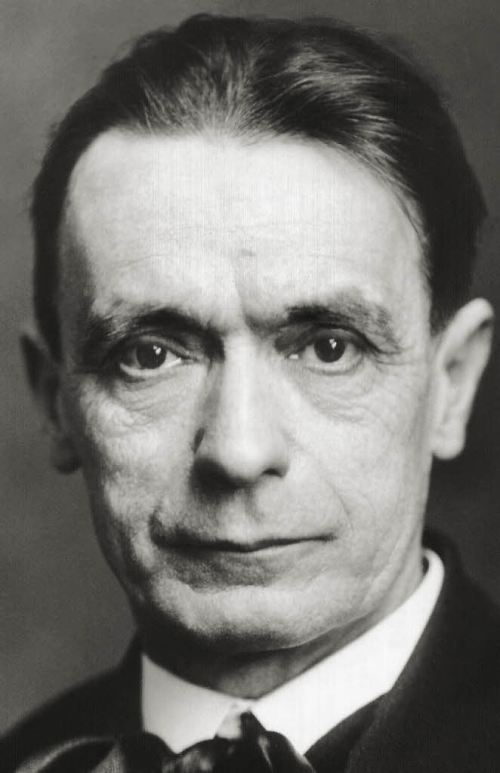
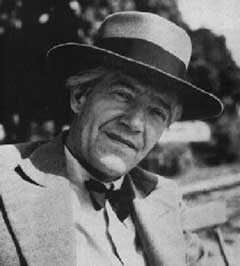
Steiner 1924

Dr Rudolf Steiner in 1920.

We know that his digestion was extremely delicate and had been so for some years before this. In the last months of his life, he seems to have been unable to take in anything except the smallest quantities of food. I think we can safely discount the rumour that he had been poisoned at a tea party on January 1st 1924, not least because Steiner himself tried to quash this on three occasions and the physicians attending him all said that this was not the case. I’m also inclined to discount the idea, which Marie Steiner put forward and Sergei Prokofieff subsequently developed, that Steiner had taken on the karma of the members of the Anthroposophical Society but that they had failed to respond to the opportunity given them at the Christmas Foundation Conference and had therefore somehow through the operation of an occult law brought Steiner to a premature end.

Edith Maryon, who had stood with Steiner and watched the burning of the first Goetheanum on New Year’s Eve 1922, died in 1924 after a long and painful illness. Speaking in May 1924 after her death, Steiner said this:

The seed of Miss Maryon’s illness was planted in her during the night in which the Goetheanum burned down. And from what was started with that seed during the night when the Goetheanum burned she could not be healed, not even with the most attentive and skilled care.
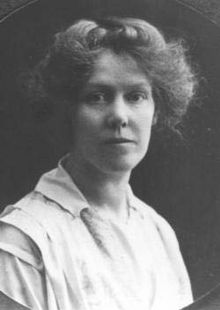
220px-Edith_Maryon

Edith Maryon, the English sculptor and close colleague of Rudolf Steiner

Did this also apply to Steiner himself? It seems likely. The signs of his illness had appeared some years previously and were seen by those who worked closely with him but weren’t noticed by more casual observers until the beginning of 1924, that annus mirabilis in which he achieved superhuman feats of work, despite being so ill. Many eye-witnesses attested to the phenomenon of Steiner, who looked ill and exhausted before a lecture, gaining strength and vitality as soon as he began to speak, so much so that people thought he had recovered from whatever was ailing him. Actors who have been ill before a performance often experience this phenomenon of suddenly gaining new life and energy when they go on stage – they call it “Dr Theatre”.
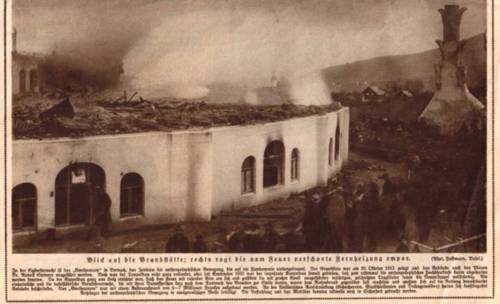
burning goetheanum

The smoking ruins of the first Goetheanum, thought to have been destroyed by an arsonist.

What we do know is that by the last six months of his life, Steiner had lost a lot of weight, did not have the least appetite, his physical strength was so reduced that he had to be supported when he stood up and he suffered from very painful haemorrhoids. An enlarged prostate had caused a urinary tract blockage, which must also have been very painful – particularly as I suspect he did not allow Dr Wegman to catheterise him, and so this had to wait until Dr Noll was able to visit.

But even after he had taken to his sickbed, Steiner worked incessantly. He was writing his biography, The Course of My Life, writing the Letters to Members and the Leading Thoughts, reading the daily newspapers, studying the latest scientific and literary articles, and speed-reading piles of books which his secretary, Guenther Wachsmuth, brought in for him every day. He also dealt with masses of correspondence and all the details of the construction of the second Goetheanum, as well as holding regular conferences with Albert Steffen about editorial matters for two weekly periodicals.

In the draft she prepared for a lecture about Steiner in 1931, Dr Ita Wegman, Steiner’s main physician, said the following:

Through the burning of the Goetheanum, which shattered his physical body – there was a powerful loosening of the etheric body, even a separation of the etheric from the physical – his health became ever more delicate. “In comparison to other people, I have really already died on earth,” was something he often said. “My ego and astral body direct the physical body and supplement the etheric.…”

The question that arises again and again: what are we to understand by illness of an initiate, why speak of an illness in the case of Rudolf Steiner? That is what I want to try to answer here.

Well, why did he get sick? The delicate physical body was left behind too much and for too long by the soul-spiritual which was working in its very own homeland. The physical body was left to its own weight and physical laws, so that it became weaker and the digestion failed.
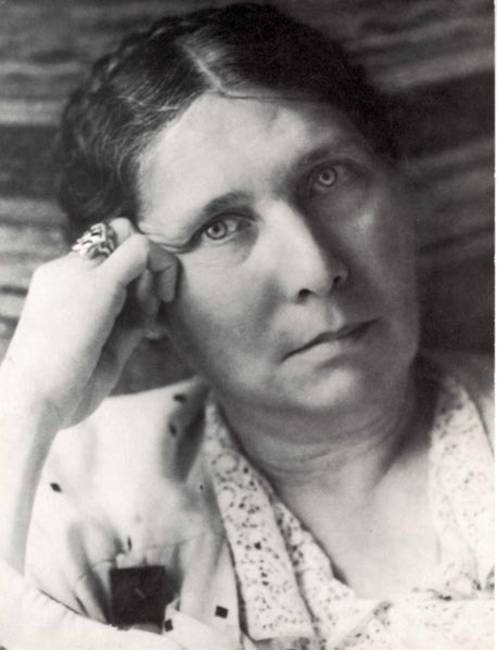
wegman

Dr Ita Wegman, Steiner’s close colleague and main physician during his last illness.

Steiner seems to have believed (or at least told others) up until very close to the end, that he would prevail over the illness. He died on the morning of March 30th 1925 without having been able to resume any of the lectures or overseas visits he had planned. Two weeks or so before his death, he wrote the following verse:

 I want with cosmic spirit

To enthuse each human being

That a flame they may become

And fiery will unfold

The essence of their being.


The other ones, they strive

To take from cosmic waters

What will extinguish flames

And pour paralysis

Into all inner being.


O joy, when human being’s flame

Is blazing, even when at rest.

O bitter pain, when the human thing

Is put in bonds, when it wants to stir.


(Ich möchte jeden Menschen

Aus des Kosmos Geist entzünden

Daß er Flamme werde

Und feurig seines Wesens Wesen

Entfalte.


Die Anderen, sie möchten

Aus des Kosmos Wasser nehmen

Was die Flammen verlöscht,

Und wässrig alles Wesen

Im Innern lähmt.


O Freude, wenn die Menschenflamme

Lodert, auch da wo sie ruht.

O Bitternis, wenn das Menschending

Gebunden wird, da wo es regsam sein möchte.)


I find it intensely moving that Steiner’s last year of life was spent in working harder and harder, despite all his physical ailments, to get across to people the magnificence of what it is to be a human being and to help each person to find that spiritual flame of the true self. For those of us who love Steiner, one way we can express that is to try to help others to see the choice they have between unfolding the essence of their true being or becoming the “human thing” chained down by materialistic illusions.

Christian Morgenstern expressed it beautifully:

I have seen THE HUMAN BEING in his deepest aspect,

I know the world, down to its foundation stones.


Its meaning, I have learned is love alone,

And I am here to love, and ever love again.


I spread out my arms, as HE spread HIS,

To embrace the whole wide world as HE has done.
63 Comments

Filed under Anthroposophy, Rudolf Steiner, Rudolf Steiner poisoning

No, Mr Dugan, Steiner Waldorf schools are not cult schools.

Following the anthropopper’s last post, my attention was drawn to comments on the Waldorf Critics’ forum alleging cult-like behaviour in Steiner Waldorf schools. Such criticisms have been around for some time, of course. Several long-standing allegations of cult-like behaviour have come from Dan Dugan of the organisation PLANS (People for Legal and Non-Sectarian Schools) in the USA. Dan listed nine “cult-like characteristics of anthroposophy” on the Waldorf Critics’ website on February 9th 1999.

Just a year or so before that, my wife and I decided that we wanted to send our daughter to a Steiner Waldorf school. Our daughter had had a happy first year of school in the Reception class of our local state primary school. I remember her skipping down the road on her journey to school, eager to get there to meet her friends and enjoy the day. This changed, unfortunately, when she moved into Year 1 and the National Curriculum kicked in. We began to notice some distinct and disturbing changes in our daughter. She started to become clumsy and was often falling and bruising herself. This happy, outgoing child started to become pale and withdrawn. Most alarming of all, the spontaneous dancing and painting and drawing she had previously done just stopped.

At this point we decided we had to act. We went to visit various Steiner schools with our daughter where she met the teachers and the pupils in her age group and took part in sample lessons. Eventually she decided that she wanted to go to the Kings Langley school. Things moved fast from that point; our house went on the market in July and sold within one week for our asking price; we went on a frantic house search process and eventually found a house we liked and could just about afford. We moved in at the beginning of September 1998 and our daughter started at the Kings Langley school three days later.

Why did we want to send our daughter to a Steiner school, even though any rational assessment would show that we couldn’t afford the fees and that we faced the prospect of years of scrimping and saving and few, if any, holidays? There are so many reasons but here are just a few:

  • A truly child-centred curriculum that allows children to develop at their own pace and to have a proper childhood
  • A method that uses art and creativity to teach every subject
  • The main lesson system which allows subjects to be studied with both depth and breadth
  • A noticeable quality of warmth in the schools and friendly relations between staff and pupils but also mutual respect

I would like a school with such qualities to be available for every child who might benefit from it, especially for those whose parents can’t afford the fees of the independent schools. That is why I am so pleased for those parents who live within the catchment areas of the new publicly-funded Bristol, Exeter, Frome and Hereford Steiner Academy schools. I wish there were many more, throughout the country, to supplement the good work of the independent schools.

Dan Dugan’s own history with Waldorf schools is interesting and has been set out in some detail here. Dan describes himself as a “secular humanist” but his humanist values do not seem to prevent him from engaging in campaigns of misinformation, defamation and myth-making. In the USA, of course, with the separation of church and state, schools have a delicate balancing act to perform, which PLANS has sought to exploit by bringing legal cases against Waldorf schools – which PLANS have subsequently lost. In seeking to make his case that Steiner Waldorf schools are religious schools, Dan has listed what he calls their cult-like characteristics.

These alleged cult-like characteristics, as identified by Dan, are shown below in bold while my comments on these are shown in italics.

Cult-like characteristics of Anthroposophy include:

1. It clings to rejected knowledge. 
(The heart is not a pump, etc.)

Here’s an extract from an article on the AnthroMed Library website which deals with this question:

 “To any doctor trained in today’s medical schools, the idea that the heart may not be a pump would, at first sight, appear to be about as logical as suggesting that the sun rises in the West or that water flows uphill. So strongly is the pump concept ingrained in the collective psyche that even trying to think otherwise is more than most people can manage. Yet Rudolf Steiner, a man not given to unscientific or slipshod thinking, was quite clear on the matter and reiterated time and again that the heart is not a pump. “The blood drives the heart, not the heart the blood.”

This topic requires more space than is available here, but anyone wishing to find out more might wish to start with this article from the Journal of Anthroposophical Medicine. There is also a useful description of what is taught about the heart in Steiner Waldorf schools here.

A further interesting fact, which medical science is unable to explain, is that in embryological development, the blood starts circulating in the embryo before the heart organ has been created. In other words, blood circulation in the embryo pre-dates the heart.

2. It requires teachers to commit to the world-view for advancement in status. 
(college of teachers).

Many Steiner Waldorf schools do not have a head teacher or principal but are instead organised by a body of staff (mainly teachers but often including administrators) called the College of Teachers. The criteria for becoming a College member usually include a commitment to working meditatively on oneself, thus seeking an active connection between oneself and the spiritual worlds; on being on a continuous path of personal and professional development; and on taking an active part in the running of the school beyond one’s normal teaching or administrative duties. Becoming a member of College does not lead to any increase in status, nor to any increase in pay. What it does lead to is a deeper commitment to the work of the school and a fuller realisation of the seriousness and responsibility of the task of the educator.

3. Its core doctrines are not published. 
(First Class).

It is true that what are called the class lessons of the First Class of the School of Spiritual Science have not been published – although these can now be found online, published without support from the society. During the refounding of the Anthroposophical Society at Christmas 1923/24 as the General Anthroposophical Society, Rudolf Steiner also introduced the School of Spiritual Science, which was intended to have three classes, leading from one to the next. Owing to Steiner’s death in 1925, he was only able to provide lessons for the First Class. His intention was that there should not be any published texts of these lessons released for personal reading but that the content of the lessons should be passed on by word of mouth. It was also his intention that anyone who wished to belong to the school should be “a worthy representative of anthroposophy before the world.” The reason for this is that the lessons are steeped in esoteric knowledge and require much background preparation from the student. They are not to be read or talked about like stories from a newspaper, or thought about with our everyday kind of thinking. “One can accomplish nothing whatever in esoteric life if one does not know that in esoteric life truth – absolute truth – must prevail, and that we cannot merely speak of truth and still persist in taking these things in the way one would in the profane, external life.” So these texts are not for intellectual or casual reading, but require a certain cast of mind, as well as preparation and commitment, before engaging with them.

4. It is exclusive. 
(Only Anthroposophical knowledge of man leads to right education.)

It’s not obvious what Dan has in mind here – Steiner Waldorf schools of course teach all kinds of knowledge from many different sources, as does any school. Anthroposophy, on the other hand, is not taught to the children, nor is it necessary to be an anthroposophist before teaching in a Steiner Waldorf school. Clearly, the schools hope that anyone who comes to teach in a Waldorf setting will have an interest in anthroposophy and will want to find out more; but it is not a requirement and teachers do not have to sign up to any particular set of beliefs.

5. It guards revelation of “difficult” knowledge. 
(Prospective parents won’t be told about the role of Lucifer.)

When Dan Dugan wrote this list of cult-like characteristics in the late 1990s, it was probably a fair criticism to say that prospective parents were not told much about anthroposophy in many school prospectuses. I don’t believe this was for any sinister reason, but simply because it would be difficult to know where to begin with such a complex and extensive body of knowledge. However, in the light of criticisms from organisations like PLANS, school websites and prospectuses are nowadays much more likely to be more forthcoming about anthroposophy, and this is very much to be welcomed. Parents should of course do their own online research and reading about educational systems, as well as pay visits to the school and talk to other parents before committing their child to any particular school.

6. It is a closed system. 
(Almost all publications referenced are from Anthroposophical presses and periodicals, all writers refer to Steiner.)

Inasmuch as it applies to anthroposophy, this is probably a fair criticism. I think such a criticism might also apply to other specialist areas originated by a towering figure, eg Jungian psychology, in which new territory was being opened up by the founder. The passage of time will change this, as is already being seen within anthroposophy, where the contributions of people such Bernard Lievegoed, Otto Scharmer, Arthur Zajonc and other highly respected thinkers are building on Steiner’s foundations.

Inasmuch as it applies to Steiner Waldorf schools, the same situation applies, with Steiner’s educational ideas gradually being added to by other experienced educationalists. Steiner Waldorf schools have been to a certain extent insular in their relations with the wider educational world. There are reasons for this, of course, in that the Waldorf system deplores much of what it regards as the excessive pressures and unreasonable demands put upon children and schools by modern politicians; and does not see many of its own ideas understood or referred to in mainstream educational publications. Clearly, however, it is not ideal for the schools to be isolated from the educational culture of their countries and Steiner would undoubtedly have wished there to have been much more interaction between Waldorf and other school systems. I have written more about this here. In those countries (now including England) where Steiner Waldorf schools are able to receive public funding, there is much more of a sense that the schools are part of a pluralistic educational culture.

7. It uses Jargon that redefines common terms. 
(Child development)

When Steiner Waldorf schools talk about child development and age-appropriate education, they have in mind the importance of not bringing any form of knowledge to a child before he or she is developmentally ready to receive and benefit from it. Rudolf Steiner has given the schools a model of child development which has been tried and tested now for over 90 years, and on the whole it works very well, because it accords completely with the actual nature of most children.

8. It maintains separation from the world by generating fear and loathing. 
(Denigrating public schools, “us vs them” attitude, paranoia)

I’ve not heard any reports of this from schools in the UK but there are certainly allegations of this nature made in the USA. If this has ever happened in any Steiner Waldorf school, it would certainly be deplorable and would be completely contrary to the intentions of Rudolf Steiner.

9. It suppresses critical dialogue, resulting in elaboration but no development of theory. 
(Consensus government, “like it or leave,” Shunning)

It is, of course, very difficult in any school if a parent or group of parents starts to create serious unrest in the parent body with vociferous complaints. In such cases, if the parents do not respond to offers of dialogue and discussion but continue to spread disharmony, then they may be asked to leave. The challenge for schools is to be as open as possible about anthroposophy before parents enrol their children; and then to provide plenty of opportunities through parents’ evenings, study groups and orientation days for any issues to be discussed before they become contentious and divisive. If the school attended by Dan’s son had been more open all those years ago, perhaps Dan would have realised in advance that it was not somewhere he would choose for his son’s education.

Conclusion

I am not an uncritical defender of Steiner Waldorf schools and I do recognise that on occasion, things can go wrong. Some schools seem to have an unfortunate knack for upsetting parents and then failing to deal properly with the consequences. The reasons for this can be many and complex and in my post on leadership & management issues in Steiner Waldorf schools, I’ve listed some of these. Improved teacher training, school management and customer care are required before these problems will start to disappear. But I also think that when Steiner Waldorf education works well, as it does for many thousands of children (including my own daughter), it’s one of the best, and most human, systems of education you can find.

I hope it is clear from what has been written above, and in my previous post on anthroposophy, that Steiner Waldorf schools cannot legitimately be described as being part of a cult, or cult-like. But it is also clear that Steiner Waldorf schools need to be as open and transparent as possible with parents about anthroposophy and the part it plays in the approach that teachers take to their teaching. I believe that most Steiner Waldorf schools today are more aware of these issues and that school brochures and websites are far less reticent about anthroposophy than used to be the case. It is not in the best interests of any school to have parents who do not support the Waldorf system or who feel that somehow the school has been less than straightforward with them about what lies behind the education. Well-informed and supportive parents, who understand what the teachers are trying to achieve and who are prepared to work with the school for the best outcomes for their children, are the bedrock of any school system, Steiner Waldorf or mainstream.

Further reading

There are several posts on this blog about Steiner Waldorf education, or which touch on aspects of it. For ease of reference, here are the links:

September 4th 2014 – Rudolf Steiner visits Margaret McMillan

September 11th 2014 – The internet, the critics and Steiner Waldorf schools

September 16th 2014 – Karma and the Steiner Waldorf teacher

September 27th 2014 – Why some atheists like anthroposophy

October 2nd 2014 – The issue that isn’t going away – leadership and management in Steiner Waldorf schools

October 4th 2014 – Different strokes for different folks

October 9th 2014 – A few thoughts on leadership and management issues in Steiner Waldorf schools

February 15th 2015 – “Every school could use these methods…”

December 1st 2015 – “A right good evening, the best of cheer…”

December 13th 2015 – Guest Post: Leadership & Organisational Structure in Steiner Waldorf schools

49 Comments

Filed under Anthroposophy, Dan Dugan/PLANS, Leadership in Steiner Waldorf Schools, Rudolf Steiner, Steiner Waldorf schools, Waldorf critics

No, anthroposophy is not a cult – and here’s why.

People who are critical of anthroposophy sometimes accuse it of being a cult, or a cult-like religious sect. To determine whether there is any validity in this accusation, we need first of all to understand what these critics are likely to mean by the word “cult.”

According to Wikipedia, the word “cult” was originally used, not to describe a group of religionists, but the act of worship or religious ceremony. It was first used in the early 17th century, borrowed via the French culte, from Latin cultus (worship).

Today, however – at least in English – the word “cult” is understood as a derogatory term. Wikipedia goes on to say that: “In the mass media, and among average citizens, “cult” gained an increasingly negative connotation, becoming associated with things like kidnapping, brainwashing, psychological abuse, sexual abuse and other criminal activity, and mass suicide. While most of these negative qualities usually have real documented precedents in the activities of a very small minority of new religious groups, mass culture often extends them to any religious group viewed as culturally deviant, however peaceful or law abiding it may be.”

In such a context, to accuse anthroposophy of being a cult is to make a serious and potentially damaging allegation. So what is the reality – is anthroposophy “a cult-like religious sect following the teachings of Rudolf Steiner (1861-1925)”, as alleged by Dan Dugan (founder of PLANS and the Waldorf Critics’ website)? Or is it neither a cult nor a religion but a path of knowledge to guide the spiritual in the human being to the spiritual in the universe, as described by its founder, Rudolf Steiner?

Let us see if we can find a further definition of what constitutes a cult. There is a very useful organisation called the International Cultic Studies Association (ICSA), which provides information on cults, cultic groups, psychological manipulation, etc, and practical suggestions for those affected by or interested in these subjects. I presume that Dan Dugan approves of the work of ICSA, because he has published an article about anthroposophy on its website.

The ICSA says that cults usually display some or all of fifteen typical characteristics. These fifteen characteristics identified by the ICSA are shown below in bold while my comments on how anthroposophy compares with these are in italics.

 1. “The group displays excessively zealous and unquestioning commitment to its leader and (whether he is alive or dead) regards his belief system, ideology, and practices as the Truth, as law. “

 Rudolf Steiner, the founder of anthroposophy, was undoubtedly a charismatic leader and his teachings, as set out in his lectures and books, are usually taken with great seriousness and respect by anthroposophists; but Steiner himself always insisted that no-one should take his statements as true unless they had first checked within themselves as to how they feel about such statements, eg our innate and “infallible feeling for truth must be the active principle in the verification of knowledge.” Anthroposophists who are given to quoting Steiner on all subjects rather than speaking from their own experience and knowledge are not doing what Steiner asked of them – and such behaviour does not make anthroposophy a cult, even if a few anthroposophists sometimes can give that impression.

There is an additional difficulty for anthroposophy, however, and this has been well described by Ha Vinh Tho: “On one hand everybody emphasises that it is NOT a religion but a spiritual science, but on the other hand most of the contents of anthroposophy are completely beyond any ones cognitive grasp and have to be accepted in good faith. The method presented by Steiner is indeed accessible to all, but the contents he researched are mostly far beyond anyone’s grasp who is not an initiate or a fully realised being. And there seems to be a confusion between advocating a scientific methodology of contemplative research and inquiry that includes the spiritual dimension of the human being and of the world; and upholding contents that can only be perceived by non-anthroposophists as a revelation given by an enlightened master. I have no problem with the latter, but there is no way one can present these revelations as scientific results that everyone can acknowledge.”

This is surely true. Anthroposophists (like me, for example), regard Steiner as an initiate who was able to access knowledge not available to most of us. We are willing to live with some very advanced concepts that we can’t prove, because of our sense of Steiner’s total integrity and extraordinary insight. Nevertheless, by their fruits shall ye know them; and the results of what I call “applied anthroposophy” continue to demonstrate the potential for practical solutions to current world problems that arise from the work of Steiner and many other anthroposophists in the fields of agriculture, banking, health, education and in many other areas.

2. “Questioning, doubt, and dissent are discouraged or even punished.”

Question, doubt and dissent have always been part of anthroposophy since its foundation. But since there is no set of beliefs or doctrines that members are required to adhere to, there is no possibility for any member to transgress. There are of course areas of controversy and disagreement but people are in no way prevented or discouraged from discussing their views or adopting particular positions. The word “must” does not exist in the anthroposophical vocabulary, since freedom is at the core of anthroposophy.

3. “Mind-altering practices (such as meditation, chanting, speaking in tongues, denunciation sessions, and debilitating work routines) are used in excess and serve to suppress doubts about the group and its leader(s).”

Meditation and the meditative path are certainly encouraged in anthroposophy, but are seen as private, individual initiatives and have nothing to do with the society. None of the other practices listed has ever had any place in anthroposophy.

4. “The leadership dictates, sometimes in great detail, how members should think, act, and feel (for example, members must get permission to date, change jobs, marry—or leaders prescribe what types of clothes to wear, where to live, whether or not to have children, how to discipline children, and so forth.“

There is absolutely no dictation to members on what to wear, how to think, feel or act, who to marry etc. The concept of freedom is central to anthroposophy.

5. “The group is elitist, claiming a special, exalted status for itself, its leader(s) and members (for example, the leader is considered the Messiah, a special being, an avatar—or the group and/or the leader is on a special mission to save humanity.”

As mentioned under (1) above, anthroposophists often regard Steiner as an initiate and anthroposophy certainly sees itself as having much to contribute towards current world problems – but there is no sense in which anthroposophists regard themselves as an elite separate from the rest of society. On the contrary, Steiner frequently made it clear how important it is for anthroposophists to be involved in the wider world, eg “Our anthroposophical movement should not be a vaguely mystical, nebulous theory-movement sought by people wishing to withdraw from life, but must be a movement by which a man {sic} introduces the spiritual with practical effect into life’s every sphere.”

6. “The group has a polarised us-versus-them mentality, which may cause conflict with the wider society.”

Anthroposophists are encouraged to ‘do’ anthroposophy, ie to be engaged and active within the world – there is no sense of us versus them.

7. “The leader is not accountable to any authorities (unlike, for example, teachers, military commanders or ministers, priests, monks, and rabbis of mainstream religious denominations).”

Since Steiner’s death in 1925, there has been no ‘leader’ of anthroposophy. Each national society has a general secretary and Council who are accountable to their members and chosen by election.

8. “The group teaches or implies that its supposedly exalted ends justify whatever means it deems necessary. This may result in members participating in behaviours or activities they would have considered reprehensible or unethical before joining the group (for example, lying to family or friends, or collecting money for bogus charities).”

Steiner was known as a man of unimpeachable moral integrity – not even his most vehement critics have ever accused him of any dishonourable behaviour. Steiner himself said that to take one step in spiritual development required three steps in moral development. To call oneself an anthroposophist while engaging in reprehensible or unethical behaviour would be simply to fail to understand anthroposophy, let alone live it. That is not to deny that some anthroposophists have failed to understand it and have fallen grievously short of what one would expect from them – one thinks for example of some individuals who were close to the Nazis in Germany or the fascists in Italy in the 1930s and 40s – but these people were notable exceptions.

 9. “The leadership induces feelings of shame and/or guilt in order to influence and/or control members. Often, this is done through peer pressure and subtle forms of persuasion.”

This does not happen in anthroposophy – there is no peer pressure to conform and no forms of persuasion, subtle or otherwise.

 10. “Subservience to the leader or group requires members to cut ties with family and friends, and radically alter the personal goals and activities they had before joining the group.”

None of these things is required or expected of anthroposophists, nor is there any kind of leader to whom one could be subservient.

11. “The group is preoccupied with bringing in new members.”

 This is certainly not the case with anthroposophy.

12. “The group is preoccupied with making money. “

This is even less the case with anthroposophy, as the difficult financial state of many anthroposophical organisations can bear witness.

13. “Members are expected to devote inordinate amounts of time to the group and group-related activities.”

There are absolutely no requirements or expectations of this kind for anthroposophists.

14. “Members are encouraged or required to live and/or socialise only with other group members.”

This is absolutely not the case in anthroposophy.

15. “The most loyal members (the “true believers”) feel there can be no life outside the context of the group. They believe there is no other way to be, and often fear reprisals to themselves or others if they leave (or even consider leaving) the group.”

People who are devoted anthroposophists naturally value their membership of the society and are loyal to it – but no anthroposophist has ever feared reprisals from other members and people are entirely free to leave membership, without any fear of reprisals, whenever they wish.

I think it is clear from the ICSA list above that anthroposophy displays none of the characteristics of a typical cult. To be fair to Dan Dugan, he has himself admitted, in an exchange with Tarjei Straume, that “I agree that as cults go, Anthroposphy is a sissy; in almost all aspects not dangerous, just a huge waste of time.” That’s about as good as we’re going to get from a Waldorf critic – and if Dan Dugan goes on record to say that anthroposophy is not much of a cult, then I think the rest of us can probably agree that it is not a cult at all.

92 Comments

Filed under Anthroposophy, Cult, Rudolf Steiner, Waldorf critics

Cryonics and the Fear of Death

A really interesting article by Courtney Weaver in a recent edition of the Financial Times Weekend magazine caught the anthropopper’s attention, not only because of the sheer weirdness of the subject – it’s about cryonics, a technique of freezing dead bodies in the hope that science in the future may find a way to bring the corpses back to life – but because of the astonishing beliefs about life and death processes that lie behind the concept.

As with the arms race and the space race, it is the USA and Russia which are slugging it out in a new and literally very Cold War to establish supremacy in the business of making money from individuals seeking the prospect of future immortality. People who believe in cryonics think that, if a human is cooled to -196C at the time of clinical death, it could be possible to resuscitate them later at a time when science has advanced sufficiently to cure them of old age or illness.

To accommodate people with this belief, the Russians have one of the biggest cryonics companies in the world (KrioRus), which will charge $36,000 to freeze and store a full body or, even more bizarrely, only $12,000 for a head. This has given them a huge price advantage over the leading American company (Alcor), which charges $200,000 for a full body and $80,000 for a head. Needless to say, you get what you pay for and in the cheaper Russian version, its 45 cryopreserved ‘patients’ are stored together in two containers, hanging by their ankles from individual pulleys in liquid nitrogen; while the heads and brains of those cheapskates who have chosen what is called a neuropreservation (head only) are stored on the floor of the same containers. KrioRus also stores more than a dozen deceased pet animals in these containers, which gives you a clue that this may not be the most upmarket kind of operation.

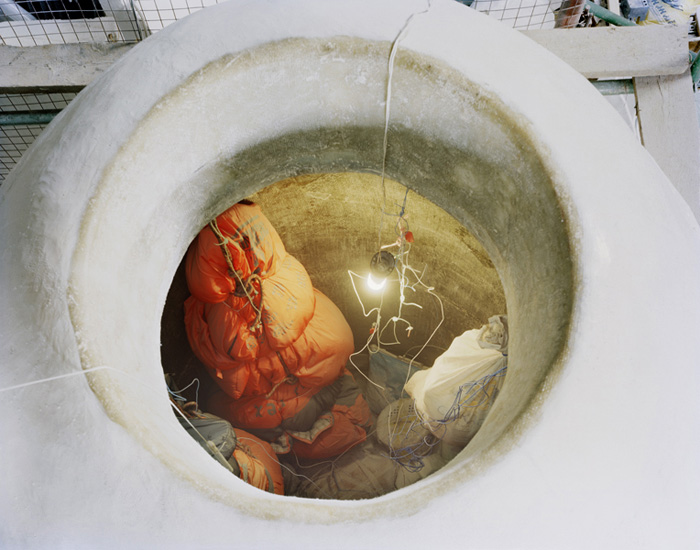
Cryostat interior at KrioRus facility near Moscow. Photo courtesy of Murray Ballard.

Cryostat interior at KrioRus facility near Moscow. Photo courtesy of Murray Ballard.


Alcor in the USA, on the other hand, keeps its 141 frozen patients in individual shiny steel capsules in a room with a bullet-proof viewing window and seems to be altogether a more classy kind of set-up that has attracted some famous clients. The head of US baseball star Ted Williams is stored at -196C in a steel flask in Arizona, while PayPal founder Peter Thiel and computer scientist Ray Kurzweil are booked in to be preserved when they shuffle off this mortal coil. News anchor Larry Page is also said to be about to sign up in preparation for when he signs off.

In both countries, though, the process is broadly the same: get to the patient as soon as possible after clinical death has been pronounced and then cool the body over the next few days to bring it down to -196C using nitrogen gas. To quote from Wikipedia, “the stated rationale for cryonics is that people who are considered dead by current legal or medical definitions may not necessarily be dead according to the more stringent information-theoretic definition of death. It is proposed that cryopreserved people might someday be recovered by using highly advanced technology.”

Cryonically-preserved bodies at Alcor in Arizona, USA. Photo courtesy of i09.com.

Cryonically-preserved bodies at Alcor in Arizona, USA. Photo courtesy of i09.com.

According to Ms. Weaver, people who choose to sign up fall into two categories. “The first consists of people who consider themselves pioneers and would be quite content to come back in the future, knowing no-one and nothing of the current culture. The second is of people scared both by the prospect of death and by the finality that comes of saying goodbye to a loved one for ever, a feeling most skeptics would find it hard not to empathise with.”

View from Alcor's conference room into the cryonics holding bay. Photo courtesy of i09.com

View from Alcor’s conference room into the cryonics holding bay. Photo courtesy of i09.com

Apart from the obvious weirdness, what is really odd is the mindset and belief system that lies behind cryonics. The article quotes two cryonics pioneers, a husband and wife, Maria and Gary from Los Angeles: “If you wait 100 years or 1,000 years or however much time it takes for the technology to develop, it doesn’t matter. I’m sure it’s a split second for your experience. It may be a one in one thousand chance. But the alternative is a 100 per cent guarantee annihilation of your existence. And if you don’t like it in the future, you can always die again if you want to. You can take a peek and say ‘I like it’ or ‘I don’t. I’d rather be dead’. People think cryonics is freaky but lying in the ground and decomposing isn’t? What’s the difference?“

Evelyn Waugh! thou shouldst be living at this hour – the world hath need of an updated version of The Loved One, your short satirical novel about the American Way of Death.

But perhaps Maria and Gary and all the other people contemplating cryonic preservation for themselves or their loved ones would do even better to read Rudolf Steiner about death and what happens after death. Other cultures, eg the Tibetans in their Book of the Dead, or the Ancient Egyptians in their Book of the Dead have prepared their peoples in the knowledge of how to die and what will happen after death; but in the West, the only person I know who has done this in a really comprehensive way is Rudolf Steiner.

Have a look at Steiner’s Theosophy or his lecture series on Life Between Death and Rebirth. There’s also a useful video on Death & Reincarnation, presented on YouTube by Brian Gray of Rudolf Steiner College.

Maria and Gary and other cryonics fans, save your money and stop worrying – did you but know it, you are in fact already immortal!

32 Comments

Filed under Anthroposophy, Cryonics, Rudolf Steiner

Of Magi and Moral Imbeciles – the Three Kings’ Play at Epiphany

I recently wrote of the three Oberufer Christmas plays and said that at Epiphany I would also be writing something more about the third of those, the Three Kings’ Play, which is traditionally performed at Epiphany on 6th January.

Epiphany comes from a Greek word meaning “manifestation” or “vision of God” and in the Christian tradition it refers to the visit to the newborn Jesus child in the stable at Bethlehem by the Three Kings; or in other words, the revelation of God the Son as a human being to the Three Kings or Magi. Epiphany is sometimes called the Festival of the Three Kings for this reason, and Rudolf Steiner had some interesting things to say about it. He said that in our present time less importance is attached to Epiphany than to the Christmas festival itself but in the future, Epiphany will assume greater and greater significance as we begin to understand its symbolism.

The Oberufer Christmas plays tell us of two proclamations of the birth of Jesus: the Shepherds’ Play shows us that one proclamation is made to the shepherds in the fields, while the Three Kings’ Play shows us the proclamation made to the three Magi from the East, who follow a star leading them to the Jesus child. This is the Nativity as related in the Gospel According to St Matthew.

So the plays are showing us two ways in which higher knowledge came to exceptional individuals in earlier times. Individuals such as the simple shepherds in the fields who with their great purity and kindness of heart still possessed a certain power of clairvoyance that came over them like a dream.

And the Three Kings’ Play shows us that there were individuals who had reached the heights of learning, like the three Magi from the East, in whom the ancient faculty of gazing into the how and why of cosmic happenings had been preserved.

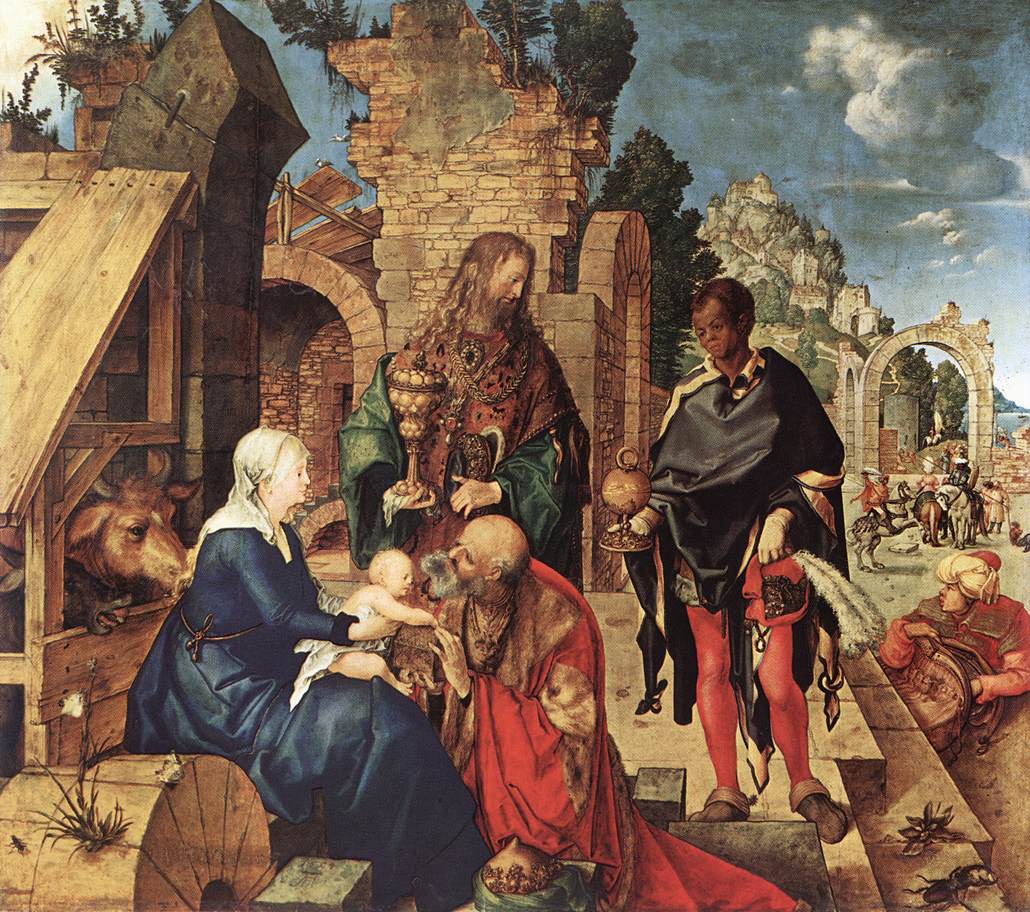
The Adoration of the Magi by Albrecht Durer

The Adoration of the Magi by Albrecht Durer

The plays therefore point the way to two definite but quite distinct forms of knowledge:

  • To the Shepherds – revelation through the last echoes of the old instinctive clairvoyance
  • To the Magi – revelation through heart-filled scientific knowledge

Since we are contemplating the Three Kings’ Festival of Epiphany, let’s take a closer look at the knowledge possessed by the three Magi. It’s clearly indicated in the Three Kings’ Play that these Magi (another word for spiritual masters or initiates), were able to read the secrets of the movements of the stars. This ancient knowledge of the secrets of the stars also contained the secrets of happenings in the world of human beings.

Steiner posed the question: “What has become of the wisdom possessed by the Magi?” And his answer was that it has become the mathematical astronomy of today. Unlike today’s astronomers, the Magi were able to gaze at the world of the stars, not only with their eyes but also with their inner vision and their esoteric knowledge and thus they were able to see the secrets of the universe and of humankind. In a way we can scarcely understand today, the Magi could also perceive the stars talking to them. However in our age of the consciousness soul, today’s mathematics has become pure abstraction, says Steiner, but he also says that the same forces that are unfolded in mathematical thinking can again be filled with life, enriched and intensified in imaginative perception. Then, from our own inner forces, we can once again behold the heavens through inner perception, inner vision, as the Magi discerned the secrets of the Christ child.

Perhaps it is thoughts like these that prompted Steiner to give the following meditative verse at Christmas 1923:

The stars once spoke to Man.

It is world destiny that they are silent now.

To be aware of this silence

Can become pain for Earthly Man.

But in the deepening silence

There grows and ripens

What Man speaks to the stars.

To be aware of this speaking

Can become strength for Spirit Man.

In our present age of the consciousness soul, the verse seems to suggest, we need to recognise that the spiritual world has withdrawn from us so as to advance the next step of our own evolutionary journey. We are not alone, however; help is all around us. We must find the courage and imagination to speak to the stars and re-establish our links with the spiritual world; but this time in full consciousness.

Turning to the Magi themselves, one of them is portrayed as a Moor, an African; the second as a white man, a European; and the third as an Asian from India. And about this Steiner says something which I find very moving (and which gives the lie to those people who accuse him of racism):

“What must never be forgotten is that the proclamations to the Shepherds and to the Kings contained a message for all mankind – for the earth is common to all. In that the revelation to the shepherds was from the earth, it was a revelation that may not be differentiated according to nationality. And in that the Magi received the proclamation of the sun and heavens, this too was a revelation destined for all mankind. For when the sun has shone upon the territory of one people, it shines upon the territory of another. The heavens are common to all; the earth is common to all. The impulse of the ‘human universal’ is in very truth quickened by Christianity. Such is the aspect of Christmas revealed by the twofold proclamation.”

But there is another king in the Kings’ Play – King Herod. Unlike the three Magi, who are working out of love, or more precisely, who are applying the intelligence of their hearts to their knowledge of the stars, Herod is working out of the opposite of love.

What is the opposite of love? Not hate. No, the true opposite of love is fear. Herod is afraid. He is afraid of losing his throne to this new-born king, whom he assumes will be a temporal rather than a spiritual ruler. And out of Herod’s fear, and his ignorance of spiritual laws, he is willing to commit the most terrible atrocity imaginable: the mass slaughter of all boy-children in his kingdom under the age of two.

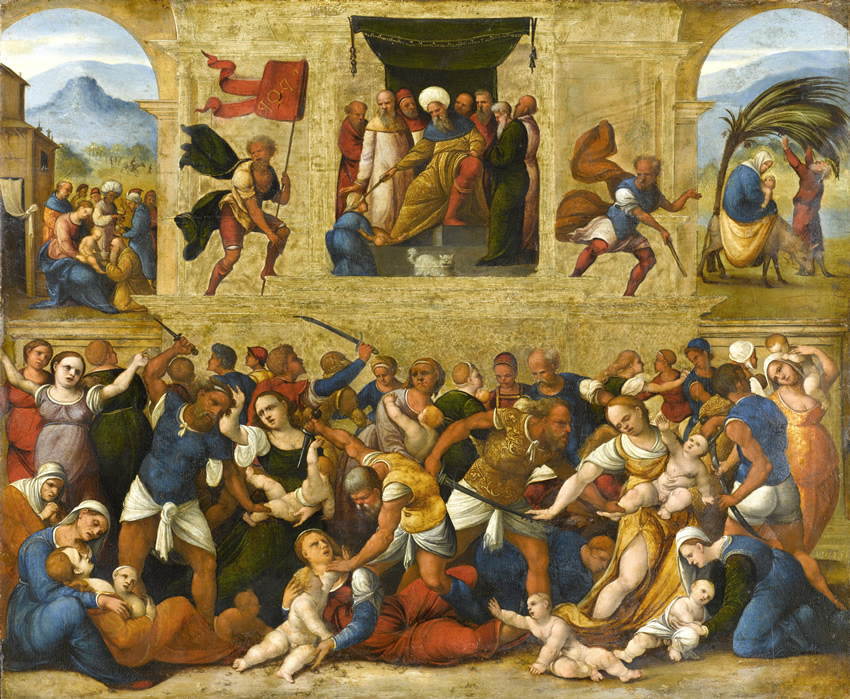
The Massacre of the Innocents by Lodovico Mazzolin

Massacre of the Innocents by Lodovico Mazzolino

Actually, one feels almost sorry for Herod, who in his fear and ignorance is preparing a truly appalling karma for his future lives. In the play, Mary appears to Herod in a vision and tries to warn him about what he is doing to himself:

“Great King, to Mercy mend your mind

Lest grief come suddenly behind;

If so much guiltless blood you shed

What call you, King, on your own head?”

But Herod is not to be dissuaded from his terrible crime and orders his servants to kill all the children, “to make the children’s blood gush out.”

And at this point, I can’t help but ask myself what has changed in the last 2000 years? Still today we have rulers who are acting out of fear and ignorance rather than a heart-filled wisdom. A prime example is president Assad in Syria, where the death toll of Syrian citizens killed by their own government forces is now estimated to be over 133,000 and where well over four million people have been forced into exile to escape the violence.

President Assad of Syria

President Assad of Syria (photo-montage courtesy of Vine of Life)

Why is this, I wonder? Why is it that so many politicians and leaders today still lack “the light that gives warmth to simple shepherds’ hearts, the light that enlightens the wise heads of kings?” Why are so many of them, to use a 19th century term that deserves to be revived, such moral imbeciles?

Whatever the answers to those questions, each of us can help to improve matters. None of us is powerless – our thoughts, our example, our daily interactions with other people can all help to create a better future, even if the numbers of those working consciously for good seem like an impossibly diluted homeopathic dose within the great mass of humankind.

To quote the closing lines from T.S. Eliot’s Choruses from the Rock:

“And when we have built an altar to the

invisible Light, we may set thereon the little

lights for which our bodily vision is made.

And we thank Thee that darkness reminds us of light.

O Light Invisible, we give Thee thanks for Thy great glory.”


7 Comments

Filed under Anthroposophy, Rudolf Steiner

A Happy Number-Crunching New Year!

WordPress, the company which hosts this blog as well as many thousands of others, has recently sent out data about activity on anthropopper during 2015.It began like this:

“The concert hall at the Sydney Opera House holds 2,700 people. This blog was viewed about 20,000 times in 2015. If it were a concert at Sydney Opera House, it would take about 7 sold-out performances for that many people to see it….The busiest day of the year was August 8th, with 1,541 views. The most popular post that day was Marilyn Monroe and Rudolf Steiner.”

Ah yes, Marilyn and Rudi. That has certainly been the most popular post, not only in 2015 but in 2014 as well. Checking the stats for that post, on one day in September 2014 it received 2,001 views. I reckon that since it was first put up in September 15th 2014, it has received more than 16,000 views from around the world.

Clearly the key to blogging success for those of us with recherché subject matter is to find a way to link our topic with another one of much vaster public interest. (Now, how can I follow on from Marilyn and Rudi? Rudi and Princess Di? Rudi and Elvis? There must be some sort of link I can find!  Rudolf Steiner and cats doing funny things, perhaps?)

What was truly astonishing, though, was the information about where these visitors came from. They came from 109 countries in all! And there are only around 190 countries in the whole world. Most visitors of course came from the USA, UK and Australia, but there were also surprisingly sizeable visitor numbers from Scandinavia, Europe, the Indian sub-continent, China, Russia, South America, and South Africa.

Now for many bloggers I’ve no doubt that these numbers will seem miniscule by comparison with their own sites; but nevertheless I thought all of this was quite impressive and encouraging for a blog which is dealing with subjects that are decidedly of esoteric rather than mainstream interest. If I had set out to write a book on anthroposophy, I doubt if 1,000 people would have seen it. But in this age of the internet, a blog about aspects of anthroposophy has received over 33,000 views from 20,000 visitors in just eighteen months. Many thanks, dear readers and followers, for your interest so far and very best wishes for 2016!

By the way, here is a link to a blog post by Ha Vinh Tho, who summarises neatly some of the dilemmas facing anthroposophy at the present time. I’m sure that these themes will be featuring on the anthropopper blog as well during 2016.

9 Comments

Filed under Anthroposophy, Rudolf Steiner

Epiphany on the Farm with the Three Kings

On New Year’s Eve, the anthropopper will be joining colleagues at Plaw Hatch Community Farm in Sussex to prepare a very special biodynamic preparation. The Three Kings Preparation is one of a whole group of preparations created by Hugo Erbe (1885-1965) as a result of his lifelong work as a biodynamic farmer in Germany. He experienced a very close connection to the elemental world and sought ways of encouraging their beneficial influences.

Erbe considera.org

Hugo Erbe, who devised the Three Kings biodynamic preparation (photo courtesy of Considera.org)

Following the nuclear bombing of Hiroshima and Nagasaki in 1945, Hugo Erbe observed a massive disruption and flight of beneficial elemental beings from his farmland. He experienced this deep wound to the living sheath of the earth as a process whereby the elementals were being demonised. To help heal the damage done to the earth’s organism and bring the elementals back into equilibrium he developed a preparation made from the gifts of the Three Kings, or Magi.

The Three Kings brought offerings of Gold, Frankincense and Myrrh to the Jesus child. These three offerings are full of meaning, as you might expect of gifts chosen by initiates. Gold is the symbol of wisdom and of intelligence. Frankincense is a universal symbol for spiritual intuition and sacramental offering. And Myrrh is the symbol of dying, of death, the sacrifice of the earthly in order that the higher may come to life.

Avena Botanicals

Myrrh, gold and frankincense, the three active ingredients of the Three Kings preparation (photo courtesy of Avena Botanicals)

Rudolf Steiner gave significant insights about these substances from his own spiritual research. He pointed out that the gifts of the three Magi were meant to strengthen the development of the Jesus child in three ways. The first help was from gold for the growth of the physical body, connected to the sun forces. The second, frankincense, was for the development of a harmonious soul life. For this, the incense form was supposed to be paramount. Thirdly, myrrh was to enhance the spiritual development. Myrrh oil was used by the Egyptians, for example, for embalming and for those processes that have to do directly with the passage of consciousness into a higher spiritual world.

Pestle Avena Botanicals

The three ingredients have to be pounded with mortar and pestle before being mixed and stirred with warm rainwater (photo courtesy of Avena Botanicals)

Most significantly, Rudolf Steiner pointed out that the resin of the frankincense tree not only protects the plant, but also enables the plant to reconnect itself to the world of the stars from which its growing impulses come. When introduced into the human body, it strengthens milk production in the mother and when passing from the mother’s milk into the infant, it then helps to optimise the development of the young brain. In adults it optimises mental functioning.

The three kings might be said to represent the three higher forces of man: Wisdom, Beauty and Strength. As long as man lives in his lower nature, these three forces are in him disordered and chaotic. But when man has so purified himself that the three forces work together in perfect harmony, and he can freely use them, then the way into the realm of the spiritual lies open before him.

3 Kings Ravenna telegraph

Balthasar, Melchior and Caspar (the Three Kings or Magi) from a Roman mosaic in Ravenna (photo courtesy of the Daily Telegraph)

Ancient mystery wisdom has always held these three substances as symbols of awareness for the spiritual events taking place behind the outer physical phenomena. When prepared in the right way these three holy substances can also serve as gifts to the earth and to the elemental world. The preparation is always prepared on New Year’s Eve and then spread on 6th January, the Festival of the Three Kings.

I will join the Plaw Hatch farm team on 6th January to spread the preparation around the boundaries of the farm. The idea is to walk the boundaries with a bucket in one hand and a brush in the other, dipping the brush and every few steps flicking the preparation in an outward direction, away from the farm boundary, where it falls in a fine spray. This is done so as to invite elemental life forces to manifest within the farm for the coming year and to help and guide us for the coming growing season. It is a kind of offering to the earth and the elemental kingdom and a way of giving thanks for what the universe provides.  Some may scoff and call it nonsensical. All I can say is that it seems to me a natural extension of the old farming adage that believed: “the best fertiliser is the farmer’s boot”. I have always understood this to mean that, by walking the land with consciousness and intent, the farmer is somehow aligning himself with all the forces that work together to ensure good outcomes for the farm, the crops and the animals.

Finally, there’s a quotation from Rudolf Steiner that I would like to share with you, because during dark times, when it is so easy to despair, we should remind ourselves of what people of good will working together can achieve:

“Human communities are the mysterious locations that higher spiritual entities move and sink into so as to work through individual human beings, just as the human soul works by means of the limbs in the body…This is the secret of the advancement of future humanity – to work out of communities.”

(GA 54, Berlin, 23rd November 1905 – Brotherhood and the Fight for Survival)

4 Comments

Filed under Anthroposophy, Biodynamic farming, Biodynamics, Rudolf Steiner

Guest Post:Leadership & Organisational Structure in Steiner Waldorf Schools

This is the first guest post to appear on the anthropopper’s blog!

It’s from Bernard Thomson in Australia, who is particularly interested in the question of leadership and management in Steiner Waldorf schools.  The anthropopper is also interested in this issue and has previously written on the topic, here and here.  It was these posts that prompted Bernard to visit me when he came to England recently and, although we have differing views, I invited him to write a post setting out his thoughts. We both hope that this will start a discussion on an issue of vital importance to the development of Steiner Waldorf education.

But first, here is Bernard writing about himself:

“I grew up in the Midlands and attended Elmfield Rudolf Steiner School. In 1973 I went to Germany to complete my education returning to the UK in 1978.  I studied philosophy of science and economics at the LSE followed by a year at the Centre for Social Development at Emerson. In 1987 I moved to New Zealand and in 2003 arrived in Australia where I became a business manager at a Steiner school south of Adelaide. After 12 years I began to work as a freelance consultant initially specialising in leadership and governance in Steiner schools. My career and work experience has been predominantly in social welfare organisations, both Steiner based and ‘mainstream,’ with an ongoing interest in social and organisational development.”


Leadership & Organisational Structure  in Steiner Waldorf Schools

by Bernard Thomson

The issue of leadership and organisational structure in Waldorf schools is not new. Indeed one could argue that it began in the early years of the first school in Stuttgart and in one way or another has continued ever since. And this should be no surprise since organisations are living systems which defy any permanent structural solutions.

However this topic is pressing and engages many of us concerned with Waldorf education and its capacity to survive and thrive in an ever changing social, political and economic environment. To date the argument has often been between assertions as to what Steiner said or meant about school leadership and the pragmatic response to perceived and, indeed, evident failures in organisational governance and leadership. Steiner did say there shall be no headmaster and he did say that every teacher was to act in full personal responsibility without recourse to the comfort of receiving directions from an overarching authority*

In this contribution I will not debate the pros and cons of College versus Principal structure as I believe this misses the real question.

I take as my starting point that a school organism, like any other social organisation, needs a structure together with process leadership to guide its performance. And it requires such a structure and leadership that best supports its purpose and function. Unlike a production industry where the purpose is an efficient process to deliver goods to willing customers, a school is in the people business; its product is what goes on between human beings namely teachers, students and parents. The human relationships are the fabric which supports the pedagogical practice. The latter cannot exist without the former and the efficacy of educational practice is directly related to the health of the human relationships.

In the production industry, which can be considered as a system of inputs, process and outputs, we might conclude that it can be optimised through specifications which precisely control as many factors as possible. Frederick W. Taylor gave his name to the first so-called scientific management system which sought to do just that. Centralised control from the top appears to be the logical answer to co-ordinating a diversity of inputs and processes. However this authoritarian structure is being challenged because it fails to take account of human (f)actors whose motivation and hence productivity is directly affected by the workplace environment and culture. Indeed there is an increasing number of organisations which are being reimagined as living entities in which ecological systems thinking replaces the mechanistic logic of direct and control, cause and effect. The human subsystem (according to Lievegoed’s phases of organisational development) is, I believe, what is here being developed as part of a move towards the third phase of integration. This accords with my understanding of consciousness soul activity where we do not seek nor expect answers to the challenges we face to be available in a model or formula. Instead the ongoing engagement with other thinking human beings forms the basis for our decision-making processes. And this is the same for both production industry and human services.

This means abandoning certainty (or the illusion of it!) and becoming comfortable with the unknown, the ambiguous, in other words, the creative process. A recent book by Fredric Laloux, “Reinventing organisations” describes various approaches to this challenge, in a range of diverse industries. What they share in common is the removal of central control in favour of distributed authority in which accountability is achieved through clearly defined processes, a system for effectively disseminating information for maximum transparency.

The widespread shift in Waldorf schools across the globe to a more top down or principal leadership structure is mostly justified by the failure of a collective approach to school management. There are many examples of this failure, with which I am also personally familiar. The apparent solution, however, is also producing many failures if these are to be determined on the basis of school performance as judged by staff and parents. Indeed, in Australia at least, there has been a continual turnover of school leaders (variously called administrators, heads of school, directors, principals, etc.) where the common denominator is an authority structure in which the school board or council appoints the school leader with full authority to manage the day-to-day operations of the school. Accountability is one way, and that is up.

Now there are also good examples of leadership performance that build collective strength and support a strong collegial culture within the school. Thus we invariably conclude that it is not the structure but the people that make the difference, and this is true. So are we faced with either a collective approach which may work if there is a high level of individual and social competence, or a single authority which may also work if the “right” person is in charge? Is there nothing more to it than to simply hope or pray that we can get the right people in the right places? And who chooses the right people?

As I mentioned above we are in the people business in which human relationships are key. We are also in the human development business in which role modelling has a powerful influence and we don’t need Steiner to tell us that the character of the teacher, or indeed of all adults, is central in supporting healthy development in young people. So we can confirm Steiner’s vision that the school must be led by a culture of learning and human development, which he called a republican teachers’ academy.

I believe in the notion that you start working in a way that is congruent with the aim. If it is true that for the students, “Our highest endeavour must be to develop individuals who are able out of their own initiative to impart purpose and direction to their lives”(1), then we found teacher practice on personal initiative and self-responsibility. The supporting school organism supports and strengthens this by creating a culture of personal initiative and self-responsibility. The leadership culture embodies this.

In his 1990 book “The Fifth Discipline” Peter Senge introduced the concept of the Learning Organisation which has 5 key features which include personal mastery, building a shared vision and team learning. I suggest that in the Learning Organisation we find a close similarity with Steiner’s vision of how a College of Teachers and Waldorf School management is to be understood.

Steiner’s vision for school leadership and governance recognised the fact that the cultural/ social mission of Waldorf education requires a new form for human learning and collaboration. This insight is now finding resonance in a growing understanding of organisations as social organisms. The “Newtonian” mechanistic model is being replaced by a living systems approach (see “Leadership and the New Science” by Margaret Wheatley).

Organisms have an ecology which connects all the elements together in a living dynamic. They are not run or managed in the conventional sense, but may be said to operate and self-regulate according to a guiding motif. The guiding motif acts as a point of self-reference. In an animal organism we speak of the unique animal instinct which guides behaviour; in the human social organism we must speak of the mission or spiritual ideal. It is just this that Steiner said must replace the headmaster by becoming the focus for the College work. As self-responsible adults participating in a self-regulating school organism we move with our experiences from the periphery to the centre and take out to the periphery our newfound intentions. The task of leadership is to facilitate the collective learning which informs the mission and to guide the processes which transform the mission into individual resolve.

Social understanding and discernment is of course necessary for leadership. Leader-guides must be selected who have the maturity and social skill to advance leadership throughout the school. The school processes must be transparent and accountable and include practical methods for review and evaluation. But the old form where adults make themselves subservient to an “outside” authority which “knows best” has to be left behind.

This process requires a new understanding of leadership as something akin to an alchemical process in which everyone participates. The idea of an “external” reference point or standard against which to guide practice will be seen as always provisional and temporary and must ultimately be abandoned in favour of self-referencing also known as self-governance.

* Address by Rudolf Steiner 20 August 1919 on the evening prior to the lecture course translated as “Study of Man” (also known as “The Foundations of Human Experience”)

(1)Marie Steiner

7 Comments

Filed under Anthroposophy, Leadership in Steiner Waldorf Schools, Rudolf Steiner, Steiner Waldorf schools

Ahriman versus the Archbishop of Canterbury

When the anthropopper was a boy at school in the 1950s, each day we had what was called an “assembly” in the school hall. It was in fact a short, non-denominational Christian religious service in which we sang a hymn, said a prayer and listened to an address by the head master or another teacher, and then went on to routine announcements about what was happening in the school. There were always a few children of other faiths, who stayed outside the hall for the religious part of the assembly.

School assemblies in the UK were provided for in the 1944 Education Act. Schools in England, Wales, and Northern Ireland were required (and still are to this day) to provide daily acts of collective worship. In Scotland, some form of religious observance is required. If the school is a faith school, these acts must be in line with the specific religion. In non-religious schools, the acts need to be broadly Christian in character without favouring any particular Christian denomination.

However, a recent report by the University of Leicester says that the duty of British schools to arrange daily acts of collective worship should be scrapped. The study, for the Arts and Humanities Research Council, says such acts, which must be Christian in nature, could discriminate against other religions. It adds there is no clear rationale for the duty, and that parents are often unaware they can withdraw their children from religious assemblies. The report also highlights how in 2004, the Chief Inspector of Schools for England drew Parliament’s attention to the fact that 76% of secondary schools were breaking the law by failing to provide daily acts of worship.

The statutory duty to provide an act of collective worship or religious observance in schools has been controversial for decades. Atheists and secular humanist have never liked it and there is disagreement about the appropriateness of such acts in an increasingly multicultural UK.

The Department for Education said the daily act of collective worship encourages children to reflect on belief, and helps shape fundamental British values of tolerance, respect and understanding for others. A spokesman said: “It is for schools to tailor their provision to suit the needs of their pupils, and parents can withdraw their children from all or any part of collective worship.”

The situation in the UK in 2015 is clearly very different from how it was seventy years ago and there are children of many other faiths and none in our schools whose needs should be respected and represented in school assemblies. But the fact remains that the culture in the UK has been formed over many hundreds of years on the basis of Christian values and traditions and in the anthropopper’s view, it is useful for children of any faith or none to have some idea about where this culture came from. It gives each of us a context in which we can frame our own views and decide what we choose to believe.

Fewer and fewer people today seem to share this view, however, and it is clear that to express any form of interest in, let alone belief, in spiritual values is to commit some kind of social faux pas. I was talking to a priest the other day and she told me that during a conversation while she was having her hair cut, she was asked what her work was. When she said “minister of religion”, everyone in the hairdresser’s shop went quiet, in some kind of embarrassed silence. “It was,” she said, “as though people thought I was going to judge them, when that is the very last thing on my mind.”

And now it appears that we have reached a point where even a sixty-second advert from the Church of England, based on the Lord’s Prayer, is deemed too embarrassing and divisive to be shown in cinemas. This is due to a decision by the Digital Cinema Media agency (DCM), which handles advertising for cinemas in the major chains.

DCM won’t accept ads with religious content in cinemas lest they offend “those of differing faiths and of no faith”. So it seems that, unlike a feature film which may contain scenes of rape, torture, sadism, massacre and all kinds of horrors, it’s too upsetting for cinemagoers to view one minute of the Archbishop of Canterbury and others saying the Lord’s Prayer.

Despite its potentially shocking nature, the church’s advert was passed uncut by the British Board of Film Classification and given a “U” certificate, as well as receiving clearance from the Cinema Advertising Authority.

You can watch the advert on YouTube and decide for yourself. I looked at it and thought it was rather good; the words of the Lord’s Prayer are said and sung by people at work in factories and fields, by schoolchildren, body builders, police officers and a black gospel choir. I imagine that atheists, rationalists, skeptics and those of other faiths are robust enough not to be too traumatised by it.

The decision by DCM should perhaps not be unexpected in the Age of the Consciousness Soul, during which according to Owen Barfield, “…man experiences isolation, loneliness, materialism, loss of faith in the spiritual world, above all, uncertainty. The soul has to make up its mind and to act in a positive way on its own unsupported initiative. And it finds great difficulty in doing so. For it is too much in the dark to be able to see any clear reason why it should, and it no longer feels the old (instinctive) promptings of the spirit within”.

But this may also be the age of the incarnation of Ahriman, which Rudolf Steiner said was likely to happen at the beginning of the 21st century. Whether Ahriman is in bodily form or not, he is clearly working well and confusing us in the West with moral relativism. I can’t help but think, however, that his followers in the East would also have found the advert offensive but, unlike DCM, would have no truck with any such namby-pamby protection of cinemagoers’ sensitivities. Instead, the representatives of IS, Isil, Islamic State, Daesh or whatever name we are currently supposed to use, would go straight to the cinema to spray with bullets anyone who was decadent enough to watch the advert or the feature film. No doubt DCM was trying to avoid provoking them.

9 Comments

Filed under Ahriman, Anthroposophy, Archbishop of Canterbury, Moral Relativism

Staudi: or The Curate’s Egg

The anthropopper notes with interest that in his recent posts on this blog, he seems to have inadvertently adopted a Threefold Posting Order. The first three posts were on the topic of Angels and then the next two were about Demons. Well, here is one last post about Peter Staudenmaier to complete the threefolding aspect; after which I hope to be able to concentrate on more wholesome topics.

Bishop:

Bishop: “I’m afraid you’ve got a bad egg, Mr Jones”; The curate replies, desperate not to offend his eminent host and ultimate employer: “Oh no, my Lord, I assure you! Parts of it are excellent!”

Gerald du Maurier’s celebrated cartoon, which appeared in Punch in November 1895, gave rise to the phrase ‘a curate’s egg’, meaning something that is mostly or partly bad, but partly good. A modern-day version of this cartoon might have the caption:

Staudenmaier: “I’m afraid I’m a bad egg, Mr Mellett.” Mellett wipes a brown substance off his nose and replies, desperate not to offend his lord and master: “Oh no, my Lord, I assure you! Parts of you are excellent!”

According to Wikipedia, “in its original context, the term ‘a curate’s egg’refers to something that is obviously and essentially bad, but is euphemistically described as nonetheless having good features credited with undue redeeming power. Its modern usage varies. Some authorities define it as something that is an indeterminate mix of good and bad and others say it implies a preponderance of bad qualities.”

Isn’t that last sentence a perfect description of Peter Staudenmaier, self-appointed scourge of Steiner and anthroposophy and intellectual guru to the Waldorf Critics’ Yahoo group?

Staudenmaier, for those who have not yet made his online acquaintance, is the professor of modern German history at Marquette University in Milwaukee. His research explores the work of Rudolf Steiner; his dissertation was “Between Occultism and Fascism: Anthroposophy and the Politics of Race and Nation in Germany and Italy, 1900-1945.”

Like a polecat, which despite its stink and habit of biting all and sundry indiscriminately, can nevertheless occasionally be useful for chasing rabbits out of their burrows, the egregious Staudi sometimes has a use; and even the anthropopper has expressed gratitude to him for revealing a slice of history about which the Society has, rather disgracefully in my view, kept quiet. Here, for example, is a link to a review by Staudi of a book by Ansgar Martins. This shadow side of anthroposophy really should be known by all anthroposophists. As “Wooffles” commented on my last but one post, “In the last decade or so, anthroposophists, or at least some anthroposophists, have gotten much better at engaging with historical context, and it is doubtful that this would have taken place without the persistence of not-particularly-sympathetic scholars like Staudenmaier and Zander.”  That’s quite a fair point, although the phrase “not particularly sympathetic scholar” when applied to Staudi’s attitude to Steiner must qualify as understatement of the year.

But, to return to my original metaphor, a bad egg is hard to like and Staudi’s overweening arrogance and contempt for others does nothing to endear him to any readers other than the fawning sycophants and melletts on the WC Yahoo list. It’s an interesting question why, unlike say with Martins or Zander, Staudi arouses such animosity in so many people. Is it for the reason Staudi himself gives?

“Any outside scholar who studies anthroposophy encounters strong opposition from parts of the anthroposophist movement. A large part of the reason why I continued researching anthroposophy’s history had to do with this sort of opposition; I initially thought the article I was asked to write back in 1999 would be a one-time piece, and then I’d return to other topics. But the article provoked such an indignant response among anthroposophists that I went back to the sources to see if I had missed something, and the further I dug into this history the more I found. Anthroposophists routinely claim that scholars who examine their movement have distorted Steiner’s ideas and misrepresented his teachings and falsified his true message and so forth; this is a common reaction among esoteric groups, who often believe they have special access to higher forms of knowledge and react strongly against scholarly standards of critical inquiry. The same sort of opposition I face is even more intense in the case of my German colleague Helmut Zander, the foremost historian of anthroposophy. Many of Steiner’s followers simply don’t like seeing their movement and worldview subjected to external scrutiny.”

Well, that sounds reasonable enough, doesn’t it? The picture he conjures up is not implausible: anthroposophists, who may be well-meaning but unaware of some significant episodes in the history of their movement,  react angrily to information which doesn’t correspond to how they feel about anthroposophy.

But unfortunately for the good professor’s chances of constructive dialogue with such anthroposophists, he doesn’t leave matters there and cannot resist being condescending, dismissive and supercilious with anyone who questions him.

Staudi was brought irresistibly to mind when I read the following passage in John Stewart Collis’ wonderful account of farming life during the 1940s, The Worm Forgives the Plough:

“There is an interesting remark which I have often heard here and elsewhere, not uncommon anywhere when some boss or foreman is mentioned. ‘The trouble is,’ they say, ‘ ‘e’s so ignorant.’ By this they do not mean that he lacks knowledge. They mean that he lacks manners. It is a significant remark. For what is manners? Manners is psychology. It is the understanding of the simple psychological needs of other people. It is homage to the strikingly simple fact that people like you to address them amiably; to show appreciation, and to say thank you at intervals. If a man does not know this and act upon it he is called ignorant by labourers under him. That is their philosophy of education.”

By this definition, Staudi is remarkably ignorant. One wouldn’t really have expected this in someone who has been an active participant in the anarchist, green and cooperative movements in the United States and Germany for many years. One would have thought that a person of those sympathies might have acquired some emotional intelligence during that time. Not so, it seems.

But Staudi is not only ignorant in the sense of being unable to resist insulting and abusing people who in other circumstances would be perfectly willing to have a civilised exchange of views with him; he is actually ignorant in an even more fundamental sense, and this is in his complete lack of understanding of Rudolf Steiner. To understand Rudolf Steiner it is not enough to have a good brain; you need to have a good heart, too, and to be able to apply the intelligence of the heart to initiatic language that is often difficult to comprehend with our everyday understanding. Where Steiner is concerned, poor Staudi has a tin ear; he is to the elucidation of Rudolf Steiner what Florence Foster Jenkins was to operatic recitals.

Someone whose scholarly work in the same subject area demonstrates understanding on every page (in shining contrast to Staudi’s effusions) is Dr Adrian Anderson of Melbourne, Australia. I thoroughly recommend Anderson’s e-booklet, Opponents and Critics: Criticisms of Steiner and anthroposophy, to anthroposophists and critics alike. It will take you about half an hour to read but it is well worth the time and effort. Dr Anderson addresses Staudi’s criticisms of Steiner and does not shrink away from the darker episodes of anthroposophical history. Some of what he writes will no doubt be difficult reading for anthroposophists, as well as for members of the Christian Community; but unlike Staudi’s tone-deaf tin ear, Dr Anderson has perfect pitch when evaluating Steiner’s use of language, and the problems that Steiner’s language can pose for anthroposophy and modern readers today.

Staudi is having none of this, of course, and gets his rebuttal in first, alerted by one of his toadies on the WC Yahoo group:

“Thanks to Eric for pointing this out… The new booklet is a standard anthroposophist apologia for Steiner’s racial teachings. It features the usual elements, including some entertaining misunderstandings of Steiner’s texts. One of the more striking examples is the booklet’s defense of Steiner’s 1923 complaint against the presence of black people in Europe, in particular his denunciation of the stationing of French colonial troops on German soil in the aftermath of World War One. Anderson thinks Steiner was actually referring to the African slave trade! It is hard to imagine a more thoroughgoing incomprehension of the passage in question.

The sections on Nazism are a good deal worse. Anderson believes that historians have recently “discovered” that “some German anthroposophists from the early 20th century were involved in Nazism” (golly, imagine that). The notion that this is some sort of discovery — or even especially remarkable — speaks volumes about the level of naivete and historical ignorance among all too many anthroposophists today.”

This is such an inadequate, not to say shameless, response to what is a substantial and considered piece of work that it almost beggars belief that Staudi can write in such misleading terms. Here we have all the standard Staudi tactics of scattering mud and abuse, misrepresentation of arguments, condescension and contemptful dismissal, which he employs to avoid engaging with the actual substance of the text written by Dr Anderson. Anderson demonstrates real understanding and insight in his essay and yet Staudi can’t bring himself to address any of it.

Why is this? Why is it that Staudi is so full of unremitting malevolence towards Steiner? And here I’ve recently come across an intriguing possibility: could it be that Staudi has never forgiven Steiner for criticising another Staudenmaier?

On 22nd September 1923, Steiner gave a lecture in Dornach on “The Logic and Illogic of Dreams” (GA225) and in it he referred at some length to a book called Magic as an Experimental Science by one Ludwig Staudenmaier, in which the author recounts his experiences of mediumship through channeled writing, his denial of the spirit as the source of his writing and his belief that the unconscious was responsible for it but was always lying to him. Steiner is quite amusing about what he considers to be the errors in Staudenmaier’s understanding of his experiences and the cumulative effect of these comments must have been somewhat devastating for Ludwig.

Can this have affected our present day Staudi’s attitude to Steiner? Was Ludwig related to Peter? Perhaps Turncoat Tom Mellett, Staudi’s devoted gofer, could ask on our behalf when he’s next kneeling before the Apprentice Demon.

42 Comments

Filed under Anthroposophy, Staudenmaier, Waldorf critics