Category Archives: Anthroposophy

Daisy Aldan, Anaïs Nin and Rudolf Steiner

I have to confess that, until quite recently, I had not heard of the Pulitzer-nominated poet and highly regarded translator and teacher, Daisy Aldan (1923 -2001). But when I first came across her poetry and then learned that she was an anthroposophist who had also taught at Emerson College in the UK (where I now work) I was sufficiently intrigued to want to find out more.

Paul Matthews, who teaches creative writing at Emerson College, told me that he “never met Daisy Aldan, but I did correspond with her briefly. I understand that in the late Sixties, perhaps, or early Seventies, she gave (through Francis Edmund’s invitation) a Creative Writing contribution at Emerson College. She gave me the impression that if I had not appeared on the scene in 1972 she might well have been offered a more permanent role at the College. I hope that she has forgiven me by now! I did include a poem by her in the anthology that I edited for Rudolf Steiner Press.”

daisy-aldan

Daisy Aldan in a pose from eurythmy.

It seems that Aldan’s earliest book of poems was published in 1946. This was followed by The Destruction of Cathedrals and Other Poems in 1963, with a preface by Anaïs Nin, and Seven: Seven (Poems and Photographs) in 1965. During the 1970s, Aldan published seven books of experimental and lyrical poetry. Her non-fiction and prose works are focused on the topic of poetry and consciousness. In 1979 she published the novella, A Golden Story.

Aldan edited several important poetry magazines, including Folder Magazine of Literature and Art (1953-1959) and Two Cities (co-edited with Anaïs Nin and so called because it was based in both New York and Paris), from 1961 to 1962. She also published in 1959 a book-length anthology of poetry and drawings, A New Folder: Americans- Poems and Drawings, that she considered a continuation of Folder Magazine. She also edited and published translations of works by Stephane Mallarmé, Anaïs Nin, Albert Steffen, and Rudolf Steiner. Aldan also founded Tiber Press in 1953, publishing her own work and that of poets and artists who are today household names, such as Ginsberg, Kerouac and Jackson Pollock.

Poetry has rarely made anyone rich, however, and so to support herself, Aldan worked as a teacher at New York’s High School of Art and Design, where her presence became an institution. She retired from there in 1973 to devote herself to her writing. To this day, her former students remember her in glowing terms. One of these students, Renée Magriel Roberts, wrote that:

“Having Miss Aldan as a teacher, was like having a combination of the European continent and the Greenwich Village literary scene brought into the classroom. We were fascinated, but largely unaware of the importance of the writing and the people to whom we were introduced. For example, one day she brought Anaïs Nin to our class to talk about Cities of the Interior. We were constantly exposed to the work of European and American poets, especially those of the Beat Generation whom Miss Aldan knew well, for she was not only a poet and a teacher, but also the editor of a publication called “Folders”, which included original and reproduction art works and poetry. By combining translation work (she was a gifted translator of Mallarmé, Anaïs Nin, Rudolf Steiner, and Albert Steffen), writing, teaching, and editing and promoting the work of others, Miss Aldan created a viable living for herself, and also afforded herself the luxury of not only writing luminous poetry, but of having the time to encourage others to write as well. Our classes were filled with music, experimental writing, and rich mythological studies.… The idea of the “artist-in-residence” was integrated throughout the school structure, as opposed to being like an alien from another planet surrounded by traditional classroom goings-on.

What this meant, for us students, was that we were literally surrounded by excited, working artists. It was a school that nobody ever wanted to leave, overflowing with incredible work, music, literature, an excitement that also translated into the “core” subject areas. It was a very happy school. “


Another student, Marc Widershien, has left this account:

 “I first heard of Daisy Aldan in 1978.  Howard Gottlieb, Curator of the then Special Collections at Boston University, had asked me to find some poets whose work would be worthy of having a home at the Twentieth Century Archives. I must have discovered her through her celebrated Folder Editions which began publication in the early 1950s. Much of her tabloid is collected by the New York Public Library, and most of her papers are housed at the Beinecke Library at Yale. Daisy published mostly avant garde writers and artists, many of whom are still known. She was one of the first publishers of Ginsberg, Frank O’Hara, John Ashbery, Rexroth, Kerouac, Jasper Johns, and de Kooning.  They were all there and none of them were known.

At the time I made her acquaintance she was a proponent of Anthroposophy, an offshoot of Theosophy, founded by the Austrian Rudolph (sic) Steiner who was also the founder of the Waldorf schools.  The school originated with classes for employees at the Waldorf Astoria cigarette factory in Stuttgart, Germany. The schools are headquartered in Dornach, Switzerland, but have satellites all over Europe; but, there are many in America such as Pine Hill and High Moving in Wilton, New Hampshire.

Daisy loved Eurythmy which is a form of dance where speech is made visible through dance, a discipline developed by Jacques Dalcroze at the turn of the 20th Century; but of course, the Anthroposophists would never admit their debt to Jacques Dalcroze and the American-born dancer Isadora Duncan.  Steiner was an occultist. It was exciting material for a poet with spiritual aspirations, and that is what I find characteristic about Daisy Aldan’s work—along with her mastery of modern diction. She explored a super reality not only through her work but through her own personal development. But she was thoroughly grounded as well, and highly practical. Her poems, though, reflect her taste not only in Anthroposophy, but French Surrealism.  She was very interested, for example, in the secret society of the Cathars, who were Gnostics of the 12th Century, later persecuted by the Catholic Church, and finally exterminated through the machinations of the Spanish Inquisition. They were an affront to political power just as Aldan was through her free thinking which manifested very early in her relationships with people such as Anaïs Nin.

Daisy also was an innovator in the translating of French poetry. Her translations of Mallarme are outstanding, and only her version of Un Coup de Des is truly successful. Mallarme’s poem was symphonic in nature. She said that “Mallarme wanted it done on music sheets because it was structured like a symphony.” She tackled a number of writers, including Albert Steffen, the Swiss poet, Edith Sodegran and others. She knew many of the French surrealists. She was an actress, a poet, short story writer, critic, and a constant innovator.

For nearly 14 years, she was my friend and sometime confidante. I have reviewed some her books such as Day of the Wounded Eagle, A Golden Story, Climb Mount Parnassus and Behold, Between High Tides and others. She was unlike any American poet I had read. There was a European tradition in her work, but also the secret traditions of Gnosticism and the Jewish Kabbalah which abounded in her work. She would often write to me from Dornach, and describe her need to do Eurythmy as a way of getting in touch with her adytum.”


In 1959, Aldan had become friends with Anaïs Nin, who at that time was a struggling novelist with a small but dedicated following. Nin noted in her diary, “Daisy is a magnificent poet, of the highest quality, yet she has to publish her poetry herself. Her teacher’s salary goes into that.”

anais_nin

Anais Nin in the 1970s

Daisy Aldan and Anaïs Nin worked together on several projects, including a 1960 reading of “Un Coup De Dés” at the Maison Française in New York, where Nin read the poem in French, and Aldan read her translation into English. This reading was recorded and subsequently broadcast on radio. Aldan was also one of Nin’s New York friends who helped her keep her “trapeze life” (her bicoastal relationships with Rupert Pole and Hugh Guiler) from being discovered by her two lovers. She would take calls from Rupert Pole (whom Nin had told she was staying with Aldan) and explained that Anaïs “had just stepped out” and would have her return the call. She then referred to a card index upon which Nin’s schedule was written, call her with Rupert’s message, and Nin would then call him back, never missing a beat. According to Aldan, she was just one of many who helped Nin in this very complicated process.

Anaïs Nin seems to have regretted Steiner’s influence on Aldan:

“Daisy Aldan’s interest in Rudolf Steiner alienated us. She sees everything through his eyes. God is back again in her poetry – an abstraction. It has removed her from human life and psychology. I feel as if in the presence of a Catholic dogmatist: every thought controlled by a theory. She translates a bad (Swiss) poet, Albert Steffen”

From The Diaries of Anaïs Nin, Vol. 7 (1966-1974)


And, according to an entry in the Encyclopedia of New York School Poets, M L Rosenthal, in an article in the New York Times Book Review, “compared Aldan to e.e. cummings for ‘combining daring technique with sentimental conception’. The latter quality evolved into a spiritualism (sic) informed by Aldan’s study of Rudolf Steiner, with the consequence that her later work failed to engage the avant-garde audience that she had originally attracted.”

Is it the case that an interest in metaphysics necessarily leads to a diminution of one’s poetical abilities? Or is it perhaps that those who know you, but who cannot follow the evolution of your spiritual development, rather than engaging with or trying to understand your new direction, resort instead to deploring this apparent softening of your brain?

Stanley Kunitz, when he was Poet Laureate of the United States, said of Aldan: “The world that engages her imagination lies beyond the ‘merely temporal and physical.’ Like Mallarmé, to whom she has devoted much of her primary and influential work as a translator, her poems evoke an interior landscape of dream and reverie, from which she ‘wakes to the miraculous.’”

I will finish with a poem Daisy Aldan wrote about Rudolf Steiner:

Y o u   r a d i a n c e…

For Rudolf Steiner

You radiance in wind,

concentrically weaving in and out of window frames

in concrete and steel skeleton structures, whirl


toward my ruined orbit.

Help me to sprout coral branches of light

antennae of the Eternal, through the prison


of my skull. Lead my

resurrected INsight toward that mercurial

Sun-abyss where Archangels are holding council;


let me know those plans they’re

concocting for us down here. Let the eyes in your

photograph pasted to my wall, transmute to mine,


balance between Here and There.

Sweep, golden-angel-winged, into my monotonous

opacity, and spark that luminous


region near my heart

which, you say, moves to understand the stars,

that I may perceive Man’s spidery ties


to constellations:

And let my footsteps glide in tranquil three-time

pace, during the earthly sun-period of my brain;


for they are restless

as a broken radiator; and I am angry,

and gossip about my friends, and write popular songs.


Let the squealing tones

of my voice deepen, and my tongue learn the folly

of useless chatter. Make me wise to choose


to shun the Trap of Fame

whose prize is a great hunk of putrefacted cheese:

For I sniff at the plastic lures of the senses


and forget it is enough

for God to mouthe my name. Let Promethean fire

fill me, though chained to a rock; symmetry not entice,


nor the rectangles of Albers*.

Beholding, let me face the blind of back alleys:

And guide the words I write to join your beacon to the Gods!


(*a reference to the work of German-American artist-educator Josef Albers.)

44 Comments

Filed under Anais Nin, Anthroposophy, Daisy Aldan, Rudolf Steiner

Thoughts from Nice

The anthropopper is enjoying a few days off in France right now, house-sitting for his in-laws. They live in a hill village between Nice and Vence, with views over the Baie des Anges. Sitting here besides the pool, under the shade of an old olive tree, in the warmth of what the poet Apollinaire called “la paix solaire”, I watch a solitary eagle rising and circling on the thermal currents in the cloudless azure sky. The only sounds are the endless chirping of the cicadas and the chime of the clock on the church bell tower marking the hours. Occasionally, a gentle breeze sends a subtle waft of scent in my direction from the climbing jasmine at the corner of the house. An idyllic scene indeed, an earthly paradise.

And yet if I walk to the other end of the pool and look out towards the south-east, just beyond the valley of the Var river, I can see in the distance the artificial promontory into the sea on which sits the runway of Nice Airport, where our plane had landed three days before. Outside the airport, the palm tree and flower-lined Promenade des Anglais runs alongside the sea into the centre of Nice; and it was there, just a fortnight before we arrived, that a hired truck came to a halt outside the Hotel Negresco, unable to proceed further in its murderous rampage because of the quantity of mashed and mangled human bodies choking its running gear.

My wife met someone who knew one of the victims; all that had been found of her, the sole identifying feature, was one of her hands. Apart from the 84 people who were murdered, there are many others who have lost limbs and who will bear the physical and mental scars for the remainder of their lives. Some of the members of the emergency services who had had to deal with the aftermath are themselves suffering post-traumatic stress disorder, after seeing sights that no-one should ever have to witness. After the attacks in Paris, Nice and the even more recent murder in Normandy of an elderly priest celebrating Mass, France itself is in a state of shock and disbelief. La belle France, la douce France, how can it have come to this?

To try to gain some small insight into what is really going on right now, those of us who are anthroposophists will turn to what Rudolf Steiner had to say about the nature of evil. From his spiritual perception, Steiner was able to describe the various forces of evil in our time, as well as their main opponent, the Archangel Michael. In our materialistic and sceptical times, many people will find it difficult to take seriously the concept of spirits of darkness and beings of light; and yet for some of us, it is only when we take these concepts as worthy of serious consideration that we can begin to make some sort of sense of this battle of cosmic dimensions in which we are all involved.

Those of you who are familiar with anthroposophy or who have been reading this blog for some time, will be aware of Steiner’s concept of the two poles of evil, which he calls Lucifer and Ahriman, and which I have written about here. But there are other hierarchies of evil I have previously hesitated to mention because I find them too horrifying and disturbing; yet since it seems to me that what is happening now bears the unmistakeable stamp of these hierarchies, I shall have to face my own fears and go into the area of what St John in the Book of Revelation called “the two-horned Beast.” This two-horned Beast is the antithesis of the Being of Christ, and is designated by the mystical number 666. Rudolf Steiner interprets this number as signifying the name of the Sun Demon, Sorat, the adversary of Christ. It is Sorat’s goal to destroy both the human ‘I’ (the Self or ego) and the earth. 666 is also the number of those human beings who “out of their own cunning free-will have become black magicians by placing spiritual forces in the service of their own egotism.” (GA 104a, 21/05/09)

I am convinced that what we are seeing in the phenomenon of Isis, Daesh, Islamic State or whatever one calls it, is inextricably tied up with the workings of black magic. It is only when what Steiner calls the ABC of black magic is being practiced that humans actually set out along that route which will bring them to Sorat:

“The ABC consists in the pupil of a black magician being taught to destroy life quite consciously, and in doing so to cause as much pain as possible and to feel a certain satisfaction in it…The beginning in black magic is to cut and stab into living flesh … This draws the pupil closer and closer to the being described as the two-horned Beast.” (GA 104, 29/06/08) Steiner also says that: “in certain schools of black magic the followers are taught the horrible and diabolical practice of gashing living animals with a knife at the precise part of the body which will generate this or that force in the wielder of the knife.” (GA 94, 02/06/06).

My suspicion is that IS followers no longer bother to practice on animals but instead go straight to work on their human victims. They are even getting children to learn how to behead their hostages.

Steiner continues: “In no way can one so readily assimilate destructive astral forces as by killing. Every killing of a being possessing an astral body evokes an intensification of the most brutal egotism. It signifies a growing increase of power. In schools of black magic, therefore, instruction is first given as to how one cuts into animals.” (ibid.)

So murder, sex and the infliction of pain (we should note that these are also major preoccupations of our Western entertainment culture) are the essential prerequisites for black magic to unfold. The black magician gains sensual pleasure in cruelty; the urge to kill creates a void around themselves in the astral world in which their egotistic desires can unfold. This void in the astral world is created by acquiring power through seizing the life force of another living being, by deliberately killing or destroying it. The first rule of black magic is: Life must be conquered. (GA 94, 02/06/06)

It is in this context that we should look at the actions of the adherents of Islamic State. We should note first of all that many of the people who get caught up in it are very far from the ideal of the good Muslim. The driver of the Nice truck, a 31-year old Tunisian man, was known to police because of allegations of threats, violence and thefts over the last six years, and he had been given a suspended six-month prison sentence earlier this year after being convicted of violence with a weapon. The man’s father, who lives in Tunisia, has revealed that his son showed signs of mental health issues — having had multiple nervous breakdowns and volatile behavior. The man was also said to have had sex with both men and women, beaten his wife, taken alcohol and used drugs. Similarly, at least two of the men involved in the Paris attack at Le Bataclan music venue were people who smoked drugs, drank alcohol and had convictions for petty crime. So these were people who one could say did not have much of a stake in society and were vulnerable to manipulation by more powerfully-minded individuals.

Hitherto-suppressed reports are now starting to emerge from police who were involved in the aftermath of the attack on Le Bataclan in Paris. These police reports found evidence of torture on the bodies of some of the 89 victims. This includes the gouging-out of eyes, the cutting-off of testicles and stuffing them in the mouth of the victim, and the stabbing of female genitals. If these reports are true, they indicate that black magical practices of inflicting maximum pain, horror and humiliation while killing were being used.

While the Islamic State group is losing territory in its self-styled caliphate, it is tightening its grip on the estimated 3,000 Yazidi women and girls held as sex slaves. These women were captured in August 2014 after IS overran Sinjar in northwestern Iraq. In a fusion of ancient barbaric practices and modern technology, IS sells the women like packaged goods on smart phone apps and shares databases that contain their photographs and the names of their “owners” to prevent their escape through IS checkpoints. In June this year, 19 Yazidi women who refused to have sex with IS fighters were burnt to death in iron cages in Mosul. For those that remain, multiple rape and beatings are the reality, these being techniques of black magical practice through which the oppressors can assimilate their victims’ astral energies. IS has actually issued a “rape handbook” to its fighters, with fifteen rules of how rapes may or may not be carried out on “infidel women”.

Steiner says that: “The black magician draws the most powerful forces out of the morass of sensuality. The purpose of sexual rites is to introduce such magic into these circles.” (GA 93a, 17/10/05)

The favoured IS method of beheading its victims (as seen in the UK with the attempted beheading of Fusilier Lee Rigby) or throat-slitting (as done with Fr Jacques Hamel in Normandy) are also standard black magical practices. Fr Hamel is reported to have said: “Va-t-en, Satan!” (Begone, Satan!) to his attacker. This is an exact naming of the force that was possessing his attacker, and by making it clear that he recognised what it was he was facing, the priest was helping to defuse the worst of the effects.

Those people who would seek to turn opinion against Muslims in the wake of such Islamic State atrocities should recall Steiner’s statement that after Christ’s crucifixion in what he calls the “Mystery of Golgotha” which blunted Sorat’s aim 2000 years ago, a second wave of attack came from Soratian forces in the 7th century AD through the Persian academy of Gondi-Shapur but this attack was largely thwarted by the creation of another counterforce – the religion of Islam. According to Steiner:

“Through the appearance of Mohammed and his visionary religious teaching, there was a deadening of the influence that was meant to go out from Gondi-Shapur. Above all, in those regions where it was wished to spread the Gnostic wisdom of Gondi-Shapur, Mohammed took the ground from under its feet…Here you can see the wisdom in world history; we come to know the truth about Mohammedanism only when, in addition to other things, we know that Mohammedanism was destined to deaden the Gnostic wisdom of Gondi-Shapur, to take from it the strong ahrimanically seductive force which would otherwise have been exercised upon mankind.” (GA 184, 12/10/18)

Furthermore, it was only though the convergence of Christianity and Islam during the period from the mid-sixth century to the thirteenth century that it was possible for our modern culture to come into being. In the monasteries of mediaeval Western Europe, Arabian concepts of philosophy and science started to influence Christian clerics.

So for us to turn against Muslims in the wake of IS atrocities is not only unjust and counter-productive, it also fails to recognise how the advent of Islam saved our own societies in the West all those centuries ago. To get through our present crises, fear and hatred are precisely the wrong answers. Instead, France, Germany, Britain and the rest will have to learn how to cherish and better integrate our Muslim citizens.

That is not to deny, however, that some current Islamic beliefs are in serious and urgent need of overhaul, particularly notions regarding paradise. A recent opinion piece by Kamel Daoud in the International New York Times contended that some Muslims, including those drawn to Islamic State, are giving up on any idea of improving life on Earth through independence, egalitarianism, development, wealth creation or justice. Their dreams have been destroyed by the authoritarian regimes, corruption and political failures in the Arab world, and the marginalisation of Muslims within Western societies. In their place, paradise is the new country dreamed of by the poor, the unemployed and the jihadists. Its main selling point is women, who are promised in vast numbers as a reward for the righteous. The women of paradise, the houris, are beautiful, submissive, languorous virgins.

This rather begs the question of what the Islamic paradise offers to women. If men can have dozens of virgins, what do the women get? It seems that the woman’s heavenly reward is to be her husband’s happy wife throughout eternity, the two of them destined to enjoy perpetual conjugal felicity (though presumably the husband is still taking full advantage of the houris).

But it cannot be ignored that this fantasy of eternal bliss requires that, before you can get to heaven, you first have to die. If you don’t have much else going for you here on earth, or if you are angry with the manifold injustices you see around you, then the prospect of a glorious death and entry into paradise may be tempting.

It does, however, take much more than a desire for paradise to turn a human being into the kind of creature that can force children into becoming soldiers who kill and behead hostages; that can throw homosexuals from rooftops; that can enslave and rape Yazidi women and girls in the belief that they are less than human; that can torture and behead its victims, bury them alive or burn them to death inside cages. For this, it takes black magicians who are able to create powerful egregora or thought forms, which can then take over the consciousness of those whose souls have become susceptible. Let us recognise what we are truly dealing with here: Rudolf Steiner speaks of human beings possessed by Sorat to such a degree that one could have every reason to doubt whether they are really members of the human race.

It was only in the twentieth century that humankind was first subjected to the Soratian attacks without the luciferic and ahrimanic masks that were previously used to lead human beings astray in preparation. We saw this with the decisions of politicans and generals in the First World War that led to 17 million deaths and 20 million wounded; we saw it in the rise to power of Adolf Hitler in 1933 (the year when Steiner said more and more individuals would start to become aware of Christ in the etheric body of the earth), and whose racial extermination policies would lead to the death of 6 million Jews and an overall death toll during the Second World War of between 50 to 80 million; we saw it in the rulership of Joseph Stalin in the Soviet Union, who was responsible for the deaths of 20 million of his fellow citizens; or of Mao-Tse-Tung, who between 1958 and 1962 was responsible for the deaths of 45 million people, who were worked, starved or beaten to death; or of Pol Pot whose Khmer Rouge were said to be responsible for the deaths of 2 million Cambodians. We saw it again in the massacre of up to 1 million Tutsis in Rwanda by Hutus in 1994, and in the war in Bosnia-Herzegovina and the ethnic cleansing and genocide that took place there. These examples from the last century could be multiplied and the present century is shaping up to be just as bad.

Whereas Ahriman’s aim is to lead us into an ever-intensifying form of brain-bound, earth-bound materialistic thinking, and Lucifer’s is to tempt us into believing that we are gods, the aim of Sorat the Antichrist, the Sun Demon, is to destroy the human ‘I” (the Self, the bearer of the Christ principle or the indwelling divinity in the human being) and to destroy the earth itself, which the ‘I’ needs for the future development of the human soul. Climate change, war, the sixth great extinction, genocide, materialism, racism, and human degradation – these are all facets of attacks from the same enemy. This is the true scale of the battle with which we are now engaged.

About this, Rudolf Steiner said: “What people in our epoch must learn is the need to wage a fully conscious fight against the evil that is making its way into human evolution.” In my next post, I will try to look at this in more detail.

162 Comments

Filed under Ahriman, Anthroposophy, Black Magic, Evil, Islam, Islamic State, Lucifer, Mohammed, Rudolf Steiner, Sorat

Brexit, new wine and old bottles – what is really going on?

Since 23rd June, when a majority of the British people voted to leave the European Union, it has seemed as though the entire country is in a kind of prolonged post-referendum stew. Many of those who voted Remain are feeling angry – angry towards those who voted Leave, angry towards David Cameron for making such a thorough miscalculation of such an important issue for grubby short-term political ends, angry that a continent united peacefully after the Second World War now looks set to unravel, and angry about the possibility that the United Kingdom may cease to exist if the Scottish people (who voted to Remain) now vote for independence. London has been in a state of shock – how dare a few million provincials in a “foreign” country called England do this to them? There have been calls for a second referendum, with millions signing a petition to that effect, in a vain bid to persuade parliament somehow to overrule the referendum result.

As an anthroposophist, I know that being on the losing side can be painful. After all, as Hermann Poppelbaum once said, “If one is to pursue a life spent in the promotion of anthroposophy, it is necessary to develop an entirely new relationship to failure.” But even so, the reaction of those who were unhappy with the result of the British referendum has been extraordinary: there have been splits in settled communities and dissension between old and young, rich and poor, metropolitan types and country dwellers, and even within families. A friend spoke about a married couple she knows: the husband voted Leave, the wife voted Remain. After the result, they didn’t speak to one another for three days and things are still decidedly frosty between them.

My own family has not been immune from this. My French in-laws emailed to say in Asterix-speak: “Ils sonts fous, ces Anglais”, and made it politely but decidedly clear that in their view I was naïve, idealistic and quite mistaken in my reasons for voting Leave. My son expressed the same view, but in angrier, more indignant language and accused my generation of having betrayed younger people. Why it is seen as unworldly to have ideals while trying to take a view beyond the immediate, I’m not quite sure; but I try to reassure myself about these idealistic tendencies of mine with the following quotation from Rudolf Steiner’s Renewal of the Social Organism:

“It is too easy to dismiss as impractical idealism any attempt to proceed from bread-and-butter issues to ideas. People do not see how impractical their accustomed way of life is, how it is based on unviable thoughts. Such thoughts are deeply rooted within present-day social life. If we try to get at the root of the ‘social question’, we are bound to see that at present even the most material demands of life can be mastered only by proceeding to the thoughts that underlie the co-operation of people in a community.”

For it is clear from the referendum result that co-operation between the people in the various British communities is breaking down. To quote from an article by Brendan O’Neill in The Spectator:

 “The most striking thing about Britain’s break with the EU is this: it’s the poor wot done it. Council-estate dwellers, Sun readers, people who didn’t get good GCSE results (which is primarily an indicator of class, not stupidity): they rose up, they tramped to the polling station, and they said no to the EU.

It was like a second peasants’ revolt, though no pitchforks this time. The statistics are extraordinary. The well-to-do voted Remain, the down-at-heel demanded to Leave. The Brexiteer/Remainer divide splits almost perfectly, and beautifully, along class lines. Of local authorities that have a high number of manufacturing jobs, a whopping 86 per cent voted Leave. Of those bits of Britain with low manufacturing, only 42 per cent did so. Of local authorities with average house prices of less than £282,000, 79 per cent voted Leave; where house prices are above that figure, just 28 per cent did so. Of the 240 local authorities that have low education levels — i.e. more than a quarter of adults do not have five A to Cs at GCSE — 83 per cent voted Leave. Then there’s pay, the basic gauge of one’s place in the pecking order: 77 per cent of local authorities in which lots of people earn a low wage (of less than £23,000) voted Leave, compared with only 35 per cent of areas with decent pay packets.

It’s this stark: if you do physical labour, live in a modest home and have never darkened the door of a university, you’re far more likely to have said ‘screw you’ to the EU than the bloke in the leafier neighbouring borough who has a nicer existence. Of course there are discrepancies. The 16 local authorities in Scotland that have high manufacturing levels voted Remain rather than Leave. But for the most part, class was the deciding factor in the vote. This, for me, is the most breathtaking fact: of the 50 areas of Britain that have the highest number of people in social classes D and E — semi-skilled and unskilled workers and unemployed people — only three voted Remain. Three. That means 47 very poor areas, in unison, said no to the thing the establishment insisted they should say yes to.”

As for the mainstream political parties, they seem to have gone through a collective nervous breakdown. The Tories have demonstrated yet again their capacity for ruthlessness and backstabbing amongst colleagues; while Theresa May has outgamed them all and clawed and fought her way to the top of the greasy pole. One Tory MP was quoted as saying: “The thing about Theresa is that she knifes you in the front”. It seems this was meant as a compliment. The Labour Party is currently in meltdown, with the Parliamentary Labour Party divorced from its voters, its members and from its leader, Jeremy Corbyn, who is facing a leadership challenge from two former members of his shadow cabinet. The referendum has revealed just how incompatible the various sections of the Labour electorate have become and it is not inconceivable that the Labour Party will split into two or more new parties.

Many young people are upset about the result, despite the fact that according to Sky Data only 36 per cent of 18-24 year olds bothered to vote in the referendum, compared with 75 per cent of 45 year olds and 83 per cent of people over 65. This first became obvious when a young woman went viral on YouTube describing her bewilderment that her vote had actually had a real grown-up effect on the life of the nation. “I didn’t realise,” she kept saying, and, “I thought I might get another chance to vote again.” She is of course a product of the re-sit generation, which grew up facing only exams which could be re-taken until a favourable result was gained. So the attitude that a democratic vote can be taken again if you don’t like the result is not perhaps surprising; indeed, we saw the EU adopt that approach with the Nice Treaty and then again with the Lisbon Treaty when voters in Ireland did not vote in the approved way.

What most of these young people don’t seem to have realised is that reports of the enormity of the change that emerged on June 24th are misplaced. It may not be as seismic as people have assumed. The truth is that the world is controlled by the corporate sector, especially the banking sector, and will continue to be so whether the UK is part of the EU or not. It’s a strange paradox that all these radical young people who voted Remain were on the same side as the major neoliberal institutions – from the Bank of England, the Conservative government and the Corporation of London to the EBRD, OECD, World Bank and the US government.

It’s also worth noting that in this age of social media we are increasingly living in what has been called a “filter bubble”, in which our information sources are becoming ever more filtered and self-socialised, because we are only associating with people who live and think like us. Here’s what internet guru Tom Steinberg said about this on his Facebook page just after the result:

“I am actively searching through Facebook for people celebrating the Brexit leave victory, but the filter bubble is SO strong, and extends SO far into things like Facebook’s custom search that I can’t find anyone who is happy despite the fact that over half the country is clearly jubilant today and despite the fact that I’m *actively* looking to hear what they are saying.

This echo-chamber problem is now SO severe and SO chronic that I can only only beg any friends I have who actually work for Facebook and other major social media and technology to urgently tell their leaders that to not act on this problem now is tantamount to actively supporting and funding the tearing apart of the fabric of our societies. Just because they aren’t like anarchists or terrorists – they’re not doing the tearing apart on purpose – is no excuse – the effect is the same, we’re getting countries where one half just doesn’t know anything at all about the other.”

As I mentioned in my last post, I thought it was foolish of the EU to treat David Cameron’s call for meaningful reform with such contempt and to send him back to the UK with barely a fig leaf to cover his embarrassment. The EU is now reaping the consequences, and it is surely time, as Angela Merkel seems to have realised, to get shot of Jean-Claude Juncker as head of the European Commission. Interestingly, the Dutch prime minister, Mark Rutte, has come up with some useful suggestions for reform of the EU. He’d like to introduce some new rules: the EU would only act in areas where other member states could not. It would agree that any of its directives could be vetoed if a third of national parliaments rejected them. Such changes could have provided a blueprint for precisely the kind of far-reaching reform that Cameron was seeking and had promised to the British people. If he had got a deal like that, I might even have voted Remain myself, despite all my other concerns about the EU. Rutte’s overall point is that sovereignty – and democracy – matters. But this was not to be, and Cameron had to fall on his sword.

If, as the referendum result seems to show, a social and political cleavage is deepening in our country, what can be done? What is really going on? We are in truly turbulent times. Since the Brexit vote, we have had the publication of the Chilcot Report into the Iraq War, the conclusions of which will surely mean that Tony Blair spends the remainder of his life fighting lawsuits from bereaved families as well as moves to impeach him from people such as Alex Salmond of the Scottish National Party. Nor are these convulsions confined to the UK; in recent days, we have had the murder of more than eighty people in Nice by what is assumed to be an Islamist terrorist, an event which seems certain to strengthen the appeal to French voters of Marine Le Pen and her Front National party, who are also arguing for a Frexit referendum; we have had an attempted military coup in Turkey; and we have the prospect of Donald Trump in the USA presidency from November.

To turn from the ridiculous to the sublime, I have found this passage from a lecture that Steiner gave in November 1919 to be meaningful:

 “…Now we live in the age of the Michael Revelation. It exists like the other revelations. But it does not force itself upon the human being because man has entered his evolution of freedom. We must go out to meet the revelation of Michael, we must prepare ourselves so that he sends into us the strongest forces and we become conscious of the super-sensible in the immediate surroundings of the earth. Do not fail to recognise what this Michael revelation would signify for men of the present and the future if men were to approach it in freedom. Do not fail to recognise that men of today strive for a solution of the social question out of the remnants of ancient states of consciousness.

All the problems that could be solved out of the ancient states of human consciousness have been solved. The earth is on the descending stage of its evolution. The demands which arise today cannot be solved with the thinking of the past. They can only be solved by a mankind with a new soul constitution. It is our task so to direct our activity that it may assist the rise of this new soul constitution in mankind.”

What did Steiner mean by the Michael revelation? He was referring to the Archangel Michael, the Time Spirit for our age, and Steiner saw the Michael Impulse as the theme needed to transform modern human consciousness. Stated very simply, this Michael impulse is to help us all to receive the inflow of the spiritual world into our material, physical world.

I daresay that quite a few people will be scornful of moving from a sober discussion of the political and social realities around Brexit to mention of the non-material influences on these matters; but to my mind, at a time when all our established systems are breaking down, when our leaders are discredited and clearly at a loss as how to proceed, and all the hidden dark secrets of our society are coming to the light of day, it is impossible to understand what is going on without a larger view of human consciousness than is provided by the materialist outlook. Right now we are surely seeing some of the effects of the Michaelic impulse on our “ancient states of human consciousness”. As always, the poets and artists get there before us, and W B Yeats described what is now happening, in a poem written in 1919, the same year in which Steiner delivered the lecture quoted here.

THE SECOND COMING

Turning and turning in the widening gyre

The falcon cannot hear the falconer;

Things fall apart; the centre cannot hold;

Mere anarchy is loosed upon the world,

The blood-dimmed tide is loosed, and everywhere

The ceremony of innocence is drowned;

The best lack all conviction, while the worst

Are full of passionate intensity.


Surely some revelation is at hand;

Surely the Second Coming is at hand.

The Second Coming! Hardly are those words out

When a vast image out of Spiritus Mundi

Troubles my sight: a waste of desert sand;

A shape with lion body and the head of a man,

A gaze blank and pitiless as the sun,

Is moving its slow thighs, while all about it

Wind shadows of the indignant desert birds.


The darkness drops again but now I know

That twenty centuries of stony sleep

Were vexed to nightmare by a rocking cradle,

And what rough beast, its hour come round at last,

Slouches towards Bethlehem to be born?


Steiner ended the lecture quoted above with this warning:

“Externally, humankind approaches today serious battles. In regard to these serious battles which are only at their beginning … and which will lead the old impulses of Earth evolution ad absurdum, there are no political, economical, or spiritual remedies to be taken from the pharmacy of past historical evolution. For from these past times come the elements of fermentation which first, have brought Europe to the brink of the abyss, which will array Asia and America against each other, and which are preparing a battle over the whole earth. This leading ad absurdum of human evolution can be counteracted alone by that which leads men on the path toward the spiritual: the Michael path which finds its continuation in the Christ Path.”

Jesus Christ put it this way: “And no man putteth new wine into old bottles: else the new wine doth burst the bottles, and the wine is spilled, and the bottles will be marred: but new wine must be put into new bottles.”

In the UK, Europe and America we are seeing that the politicians are unable to keep the old machinery working. They pull the old levers, more and more frantically, but the effect is less and less. We see the old social orders are breaking down, and new cultures are rising up. For some reason, the politicians and the media people are usually the last to realise what is going on, while everywhere around them people are starting to resist the old certainties and a tendency to disorder begins to emerge. Our western civilisation is changing in the age of the consciousness soul and under the influence of the Michael impulse; and a certain amount of chaos is inevitable as we move to a different kind of order. The new wine needs new bottles.


112 Comments

Filed under Anthroposophy, Brexit, European Union, Jesus Christ, Rudolf Steiner

Operation Redemption

In 1984, when I was in my 33rd year, I was at a point of crisis in most areas of my life, including work, marriage and other relationships. It was at this very low ebb of my life that I took a decision that was to change my future direction. I went to spend two weeks in the Findhorn Foundation in the north of Scotland.

I suspect if I had known more about Findhorn at that time I wouldn’t have gone, as I would have dismissed it as a nest of dippy hippies with weird ideas. But for whatever reason, I felt a pull towards Findhorn which in retrospect I think was coming from my higher self. So I enrolled myself in an Experience Week (the orientation programme that all newcomers to Findhorn have to do before they can take part in workshops or courses) and also signed up for the following week, which was Findhorn’s Spring Arts Festival.

During the Experience Week, participants spend the mornings in group work and the afternoons with one of the work departments such as Kitchen, Dining Room, Gardening, Housecare etc. When you arrive, you are asked to attune to which work department is the right one for you. I’m a keen gardener and of course had heard about the wonders of the Findhorn garden with its giant vegetables grown in little more than sand; and so I had thought that I would ask to go to the garden department. But no, try as I might to change it, an inner voice told me that I needed to join the housecare department. So I did, and was put to work cleaning bathrooms and windows. Now I hate housework at the best of times (which is perhaps why I had to do it) but strange to relate, I began to find a certain satisfaction in taking care of bathrooms and making them clean and shiny. At Findhorn, each of the bathrooms has a name and even a kind of personality, which seems to be brought out through the care and attention that it receives and the little touches, such as houseplants or other simple enhancements.

findhorn-gardens

The Findhorn garden

While cleaning bathrooms, I learnt the truth of Peter Caddy’s advice that to make the best of any situation you should love where you are, love who you’re with, and love what you do. This actually works, as it changes your consciousness towards any task, however mundane or tedious. Resentment at having to do menial jobs can be transformed by starting to care about what you’re doing and seeking to do it as well as you can. It helps you to feel better about yourself and your situation and also brings a certain sparkle to those objects with which you are interacting!

The mornings spent in group work with around twenty people from around the world and led by two facilitators from the Findhorn community, were sometimes exhilarating and sometimes challenging, as you are brought up (very gently) against your own areas where further growth or development is needed. The American author Paul Hawken, who in the 1970s wrote a book called The Magic of Findhorn, has described Findhorn as being like a greenhouse that accelerates the growth of people, which in my experience is quite true. There were times when I was thrilled and uplifted to be there and other times when for two pins I would have packed my bags and left. It was at one of these dark times when I went into the woods behind Cluny and leant against a tree, wondering why I had come and asking myself whether I should leave. Suddenly a voice came into my mind, which I knew was not from my own thoughts – it was somehow quite distinct and authoritative. There were two sentences, answers to the questions I had been asking: “This (ie Findhorn) is not for you, though it is good for you to see it.” And then: “The yeast is in the dough, let it work in its own time.” These two sentences gave me the courage and resolution to stay with the process and see it through, which I was able to do – and I stayed on for the second week, the Spring Arts Festival.

universal hall via findhorn.org

The Universal Hall at Findhorn (photo via the Findhorn Foundation)

The main venue for concerts, talks and performances during the arts festival was the Universal Hall, an extraordinary building which was constructed by community members. I read somewhere that, after it had been completed, an expert in sacred geometry asked the community whether they had worked consciously with the principles of sacred geometry as it was a perfect demonstration of how such a building should be made. The answer was that none of them had any knowledge or experience in this area but had simply done what seemed to them was needed.

It was in the Universal Hall that I found myself listening to a talk by Sir George Trevelyan, who during his lifetime was often called by journalists “the Father of the New Age.” Sir George was a craftsman furniture maker and adult educationalist who had been born into an aristocratic family with a penchant for radical thought and public service. His uncle was the historian and Master of Trinity College, Cambridge, G. M. Trevelyan, a friend and contemporary of Bertrand Russell, another radical and outspoken aristocrat and grandson of the Victorian Prime Minister Lord John Russell. Sir George himself had had to relinquish hopes of inheriting the family property of Wallington in Northumberland when his father, who had been a Labour MP and minister in Ramsay Macdonald’s government, left it to the National Trust.

sir george via galacommunications.co.uk

Sir George Trevelyan – photo via gala communications.co.uk

I can’t from this distance recall the subject of Sir George’s talk but in a sense it doesn’t matter because his subject was always the same whenever he spoke: he was advocating spiritual renewal, which was not a religious revival, but an awakening that is available to those of all religions and those of none. What I do remember very well, though, is that during his talk I found myself thinking: “This man is mad, mad – and what’s more you’re mad for sitting here and listening to him.” At the same time, however, another part of me was saying: “Yes, yes, yes…” I date my own spiritual awakening to this talk. It’s interesting to me also that I’m writing this account 33 years afterwards.

I discovered subsequently that there was a strange parallel here with Sir George’s own spiritual awakening. In 1942, he attended a lecture given by Walter Johannes Stein, who was one of Rudolf Steiner’s pupils. He said later that, as Stein introduced the ideas of Steiner one by one: “Everything in me said yes, yes, yes.”

As Ruth Nesfield-Cookson observed: “Although the work of Rudolf Steiner was what led George into an interest in the spiritual he searched for the truth far and wide, in the work of Shakespeare, Goethe, Blake, Hopkins, the romantic poets etc., and also in the works of more modern thinkers including Teilhard de Chardin, Wellesley Tudor Pole, Grace Cook and the White Eagle teachings etc. And from his close link with Pir Vilayat Inayat Khan, the leader of the Sufi movement in this country, he saw that the fruits of Eastern as well as Western thinking had to be considered and represented. He knew there were many routes up the mountain and no one route was right for everybody. However he never doubted that, to quote his own words ‘It is Cosmic Christianity we are about’ “.

caddys maclean via rejteyekszigete.com

Eileen and Peter Caddy with Dorothy Maclean (photo via rejteyekszigete.com)

In later years, I got to know Sir George a little better; his talks had the same awakening effect on thousands of people that I had experienced in 1984 and his book Operation Redemption is still well worth reading. I also met Peter Caddy, who with his wife Eileen and their friend Dorothy Maclean, were the three founders of Findhorn. In my view, both Findhorn and anthroposophy are deeply Rosicrucian impulses and both in their own way are interlinked with positive forces of change in the world. They have set into world consciousness, albeit in homeopathic doses, what will one day lead us away from disaster.

Anthroposophy, in what I call applied anthroposophy, offers many young tendrils of growth for a different and kinder future for us all, while Findhorn continues to offer a new story or narrative of how the world could be. Whether we as human beings will have the courage or imagination to make the necessary changes is not easy to foresee. I suspect that we are going to be brought right up to the brink of chaos and catastrophe before meaningful change can happen.

130 Comments

Filed under Anthroposophy, Findhorn Foundation, Rosicrucianism

Britain and the European Union – should we stay or should we go?

europe-flag via Reuters:Stefan Wermuth

Photo: Reuters/Stefan Wermuth via the Daily Telegraph

On 23rd June 2016 the British people will vote in a referendum to decide whether the United Kingdom should remain or withdraw as a member of the European Union.

This will be the second occasion on which the British people have voted in a referendum on their relationship with Europe (the first was in 1975) and it will be a highly significant moment in the history of the UK. I’ve been wondering about which way I shall vote, and whether anthroposophy can give any pointers to help me in my decision-making. This blog post is the result and is longer than usual, reflecting as it does just a few of the complexities involved in coming to a view on such a historically-charged issue.

The 1975 referendum

I’m old enough to have voted in the 1975 referendum on whether Britain should stay in what was then called the European Economic Community. At that time I voted Out, persuaded by the argument that the EEC was created in the interest of bankers and big business and was fundamentally undemocratic.

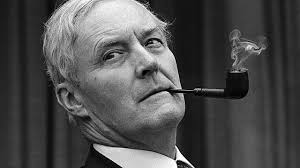
As Tony Benn of the Out campaign put it: “My view (of the EEC) has always been not that I am hostile to foreigners but I am in favour of democracy. I think they are building an empire and want us to be part of that empire, and I don’t want that.”
tony benn via the colossus.co

Tony Benn – photo via the colossus.co

However, most Britons came to different conclusions and the 1975 result was a landslide for the pro-Europeans. On a 65% turnout, more than two-thirds of voters backed British membership. Every part of the UK voted to stay in, except for the Shetlands and the Western Isles. It was the most emphatic endorsement of the European project the British have ever given.

The 2016 referendum

Forty years after that first British referendum, Prime Minister David Cameron has called a second referendum on 23rd June to try to quell a rising tide of anti-EU sentiment within the UK. By now, Mr Cameron is probably regretting his decision to hold a referendum, as far from shooting the UK Independence Party’s fox, its main effect to date has been to split his governing Conservative party apart.

cameron via uk.businessinsider

Prime Minister David Cameron – photo via uk.businessinsider

Angus Jenkinson, an anthroposophist and business consultant has written an interesting piece for LinkedIn, called The Fallacy of Brexit, in which en passant he looks at Cameron’s motives for holding the referendum:

“…In the first case, why are we having a referendum at all. Was a majority of the people of Britain calling for a referendum?  We are told not.  There are many people who would like to leave, the polls put it at 39%, but the betting houses are predicting we will vote to stay.  The real reason for the referendum is to deal with the politics of the Conservative Party. Approaching the last election, David Cameron needed to stop the haemorrhage of his fellow conservatives to UKIP.  He promised them a referendum after an election he did not think he would win. To his and the embarrassment of many Conservatives, others now wish to take the opportunity of a mass refugee migration to convince the public at large that it is time to leave. I do not see this as democracy but as the imposition of the internal politics of a party on the nation. It is nasty bureaucracy”.

Angus is firmly in the “Remain” camp and other friends and colleagues to whom I’ve spoken take the same view. We know that Rudolf Steiner felt that it was time for the age of nationalism and nation states to draw to a gradual close, and that would seem to accord with voting to stay within the EU. Probably most people in the circles I move in are also thinking of voting to stay in, on the grounds that we’re all European now and the EU is much better at environmental protection, human rights and general fair-minded decency than a British Conservative government is ever going to be. But is that the main or most important consideration?

What is the real issue?

To my mind, the issue is not Europe, with its great history, incomparable culture and diverse peoples – we shouldn’t confuse Europe with the EU. Nor is it that we in Britain need some European protection from the excesses of an unfettered and reactionary Conservative government. No, the issue is the European Union and the ultimate goal for the EU to become a superstate – the United States of Europe. Anglo-American elitists have been working hard behind the scenes to bring this about for more than a century now, because they see the United States of Europe not only as a bulwark of support for the USA in future struggles with Asia but also as the first phase in the formation of a system of world governance.

Here we come up against something that Rudolf Steiner warned about, which is the agenda of those behind what the first President Bush called in 1990 the “New World Order.” After Germany’s defeat in the First World War, Steiner made the following observation:

“… the actual victor is the being of  the Anglo-American peoples, and…this being…is destined to dominate the world in the future…It will be easy to win external dominion, for this will be done with the help of forces for which the winners can claim no credit. The transfer of external dominion will take place with the relentlessness of a force of nature…Will there be a sufficient number among those impelled to assume external dominion…who feel a responsibility for inserting into this entirely external materialistic dominion…an impetus for spiritual life? What is more, there is not much time in which this can be done. The middle of this century is a very important moment….the dominion of materialism bears within it the seed of destruction. To shoulder external dominion means to take on, and to live within, the forces of destruction, the forces of sickness in the world. Out of the new seed of the spirit will come something that can bear mankind onwards into the future. This seed will have to be nurtured, and those to whom dominion has fallen will be especially responsible for this.”

Rudolf Steiner, Ideas for a New Europe, lecture series in Dornach Dec 1919 to Feb 1920

Steiner is here saying that the elites of the Anglophone countries will be exerting a dominion in economic, cultural and political life in entirely materialistic terms and that this will lead inevitably to cultural disintegration and disaster. What is really interesting is that he is also saying that it is the people in these English-speaking countries who will have to find a way to counteract these forces by planting the new seed of the spirit that can bear humankind towards a better future.

The European Union and its part in the New World Order

The ultimate goal of these elites is world government, the first phase being the creation of the United States of Europe. This phase started in 1951 with the European Coal and Steel Community, which then became the European Economic Community, and which is currently the European Union. The second phase of the drive to world government is the creation of a Pan-American Union. Preparations for this have already been put in place with NAFTA, the North American Free Trade Agreement signed by Canada, Mexico and the USA. The third phase, the one which will be most difficult of all to achieve due to the disparity of cultures involved, is to convert the Asia Pacific Economic Cooperation forum into an Asian Union.

This New World Order and the move to world government has been planned by the current elites such as the Bilderberg Group, the World Economic Forum at Davos and their forerunners such as the Pilgrims, the Skull and Bones Club, the Cecil Rhodes/Alfred Milner group for many, many years and has involved many well-known statesmen. Here, for example, is Winston Churchill in a speech at the Albert Hall given on 14th May 1947:

“The creation of an authoritative, all-powerful world order is the ultimate aim towards which we must strive. Unless some effective World-Super-Government can be set up and brought quickly into action, the prospects for peace and human progress are dark and doubtful. But let there be no mistake upon the main issue.  Without a United Europe there is no sure prospect of world government. It is the urgent and indispensable step towards the realisation of that ideal”.

Ironically, Churchill who was an old-fashioned imperialist, never envisaged Britain as part of what became the EU. He felt that the British Empire should endure and, as someone born to an American mother and a British father, saw Britain and America working together to spread Anglo-American values throughout the world. He must have felt betrayed when it became clear after the Second World War that, through the Marshall Plan, the American government was bent upon depriving Britain of its colonies and taking for itself much of the trade with those countries.

Winston Churchil AP Photo

Winston Churchill – photo via AP Photos

Back in 1947, Churchill saw himself as a patrician doing his best for the decent people in the lower orders:

“What is it that all these wage-earners, skilled artisans, soldiers and tillers of the soil require, deserve, and may be led to demand? Is it not a fair chance to make a home, to reap the fruits of their toil, to cherish their wives, to bring up their children in a decent manner and to dwell in peace and safety, without fear or bullying or monstrous burdens or exploitation, however this may be imposed upon them? That is their heart’s desire. That is what we mean to win for them.”

Churchill’s heart was in the right place and those things he listed may well be what millions yearned for; but the ordinary people were not to be allowed to seek for them in their own way, democratically. They were not to be told the ultimate goal but were to be led by a series of little lies and evasions along the path which the international elite had already determined would best satisfy the yearnings of the many – a United States of Europe that would be ‘little sister’ to the USA’s ‘Big Brother’.

The United States of Europe and the road to world government

An example of how this worked in practice was the way in which British citizens were lied to from the 1960s onwards, when the British government first began to try to persuade the British people that joining the EEC would be in our interests because it would make Britain richer and more prosperous; it was presented as merely a kind of economic club, the purpose of which was to increase trade. Had we been told from the beginning that the goal of the EEC was to do away with Britain’s national sovereignty and to incorporate Britain as just one member state of a centralised federal union, we would never have voted for it. But that goal of a United States of Europe – for Winston Churchill, for Jean Monnet (founding father of the EU), for US statesman Dean Acheson, for President John F. Kennedy, for former Prime Minister Edward Heath (who took Britain into the EEC) and many other prominent transatlantic figures – was in fact always the destination, on the long road to a world government.

World government, after all, sounds quite benign – until you look at the words of those who are planning for it. Here’s Brook Chisholm, former director of the UN World Health Organisation, in 1991:

“To achieve world government, it is necessary to remove from the minds of men their individualism, loyalty to family traditions, national patriotism and religious dogmas.”

And here is the famous French naturalist Jacques Cousteau, also in 1991, quoted in the UNESCO Courier:

“It’s terrible to have to say this. World population must be stabilised and to do that we must eliminate 350,000 people per year. “

UNESCO has previous form here. In 1948, for instance, Julian Huxley, the British scientist and first head of UNESCO (and brother of Aldous Huxley), wrote:

“Even though…any radical eugenic policy will be for many years politically and psychologically impossible, it will be important for UNESCO to see that the eugenic problem is handled with the greatest care, and that the public mind is informed of the issues at stake so that much that is now unthinkable may at least become thinkable.”
rockefeller image via beforeitsnews.com

Image via beforeitsnews.com

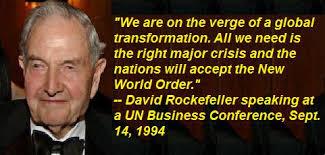
And in a meeting of the Bilderberg Group in 1991, David Rockefeller, President of the Council of Foreign Relations and of Chase Manhattan Bank said:

“We are grateful to the Washington Post, the New York Times, Time magazine, and other great publications whose directors have attended our meetings and respected their promise of discretion for almost 40 years…It would have been impossible for us to develop our plan for the world if we had been subject to the bright lights of publicity during those years. But the world is now more sophisticated and prepared to march towards world government. The supernational sovereignty of an intellectual elite and world bankers is surely preferable to the national auto-determination practised in past centuries.”

Yes, surely we would all be much happier with an intellectual elite and world bankers deciding everything for us – except that following the financial crisis of 2008 we now know where that leads. We are all still paying for it, while our public services are slashed to pieces or privatised, and by contrast the bankers are unpunished and continue to take huge risks within a financial system that is still largely unreformed.

Rudolf Steiner’s warning about a world dominion based solely on economic advantage

“A fundamental concept for the western areas which are so mired in platitudes must be to see the social organism as something living. And one sees it as living only when it is considered in its threefold nature. It is just those whose favorable economic position allows them to spread an [economic] imperialism over practically the whole world who have the terrible responsibility of recognizing that the cultivation of a true spiritual life must be poured into this imperialism. It is ironic that an economic empire which spread over the whole world was founded on the British Isles and then when they were seeking mystical spirituality turned to those whom they had economically conquered and exploited. [India — Tr.] The obligation exists to allow one’s own spiritual substance to flow into the social organism. That is the awareness which our British friends should take with them, that now, in this worldwide important historic moment, in all the world’s economic institutions where English is spoken, the responsibility exists to introduce true spirituality into the exterior economic empire. It’s an either/or situation: Either efforts remain exclusively oriented towards the economy — in which case the fall of earthly civilization is the inevitable result — or spirit will be poured into this economic empire, in which case what was intended for earthly evolution will be achieved. I would like to say: Every morning we should bear this in mind very seriously and all activities should be organized according to this impulse. The bell tolls with extreme urgency at present — with terrible urgency.”

Rudolf Steiner in Dornach, Feb 22 1920 Lecture 3, The History and Actuality of Imperialism

Britain is told to step back in line

cameron obama via metro.co.uk

President Barack Obama and Britain’s Prime Minister David Cameron wave from the steps of 10 Downing Street, London before a meeting Friday, April, 22, 2016. (AP Photo/Kirsty Wigglesworth)

If we needed any further convincing that the USA is angry with Britain about the referendum, all it will have taken was the recent visit of President Obama to London and his extraordinary threat that Britain would be at the back of a 10-year long queue to negotiate a trade deal should we be foolish enough to vote Leave. Let us put aside for the moment the irony that the leader of a country that was founded after fighting for independence from a foreign empire is now seeking to convince the British that they don’t need their own independence from a latter-day empire. Let us also discount the warnings of no less than eight former US Treasury secretaries of the dangers ahead if Britain leaves the EU. All I will say is that we don’t have a trade deal with the USA at the moment (neither does the EU, although it’s currently negotiating one in secret) and yet we seem to be trading perfectly satisfactorily without one.

The threat of TTIP

And why is the USA so insistent that we shouldn’t leave the EU? Could it be anything to do with the TTIP, the Transatlantic Trade and Investment Partnership currently being negotiated in secret between the EU and the USA? There is concern that TTIP will enable companies to sue governments where state measures harm profits.  It will also open up Europe to rapacious US corporations, keen to find new profitable areas to exploit through the privatisation of our health and education services.

Richard House in an excellent article for News Network Anthroposophy has described what is likely to happen to our education system once forced academisation (preparing the ground for TTIP) comes in. However, TTIP is much more about power than about trade, and if national governments are faced with the possibility of very expensive lawsuits from very wealthy corporations should these governments have the temerity to introduce policies that hinder the corporate sector’s pursuit of profit so as to protect the environment or workers’ rights (which is what will be possible through TTIP) then these governments are far less likely to introduce those policies. This will be even more the case in poorer countries.

Iain Dale via LBC

Iain Dale -photo via LBC Radio

The Conservative media commentator, Iain Dale, has just woken up to the dangers of TTIP, and has written in his blog:

“Until this week, we only suspected what its contents are. Its drafting was so secret that the European Commission banned any knowledge of the negotiations. Anyone who revealed the contents were threatened with criminal proceedings. This week, a draft of the agreement was leaked to Greenpeace and it makes for pretty horrifying reading.

One of the main aims of TTIP is the introduction of Investor-State Dispute Settlements (ISDS), which allow companies to sue governments if those governments’ policies cause a loss of profits. In effect, it means that unelected transnational corporations can dictate the policies of democratically-elected governments.

For example, if the Government introduces an environmental tax on fracking which affects the profit of a US mining company, they can sue for loss of profits. Totally outrageous. It also forces public sector organisations such as the NHS to effectively open up all their services to privatisation. Now that may be a good idea, but it is our Government that should decide to do this – not TTIP.

US-manufactured GM food products will be forced on EU countries who currently ban them. I could go on. It’s an issue which even many Remain supporters are uncomfortable with. In essence it’s an affront to democracy. There is some debate about whether national governments have a veto over its final draft. Some say it is subject to Qualified Majority Voting. In my opinion, it’s so important that there should be a referendum on it in each of the 28 countries.”

The European multinationals want us to stay in

The European corporate sector, as represented by the CEOs of Philips, Volvo, Shell, Fiat, Nestle, BP etc, is also very keen that Britain should stay in the EU. They all belong to an organisation based in Brussels called the European Round Table of Industrialists (ERT). It’s a private club whose only members are the CEOs of the biggest European multinational corporations.

The ERT was instrumental in forming the single market in the first place, in 1985. The aim of the ERT (and of the single market) is to promote growth and to orient the European economy towards exports, in order to obtain greater global market share for European corporations. ERT members are on very close terms with European Commissioners – they dine at each other’s homes, they meet regularly during work hours and they provide commissioners with places on the boards of their corporations in a classic example of the “revolving door” between government and the multinationals.

Many reports originating from the ERT end up as Commission policy almost word-for-word. For example, the ERT decided that we need to expand the motorway network in Europe, to facilitate growth and exports, and almost exactly the same map that they produced was used by the Commission and adopted by the European Parliament.

The Global Redesign Initiative

But the best-laid plans of these elites can still go awry, partly through increased access by ordinary people to hitherto confidential information via the internet (viz Edward Snowden), and partly by unforeseen world events which are having a massive impact on people’s lives. Recently we can see that at least one of the wheels has fallen off the New World Order project bandwagon. In particular, the prospect of creating a United States of Europe is receding into the distance as the monetary union fiasco and migration disasters have demonstrated the inability of the EU to operate effectively in the interests of its members.   And so the global elites and the corporations have come up with their best – and most scary – idea yet: the Global Redesign Initiative.

Their argument is that when it comes to tackling global problems, nation-states and their public politics are not up to the job. They must therefore be replaced by a much more efficient new system in which ‘stakeholders’ –- that is transnational corporations, a few powerful governments, selected intellectuals and invited members of ‘civil society’ – will henceforth manage the world’s affairs together. Governments will become merely one actor among several running global affairs.
Dr Harris Gleckman via YouTube

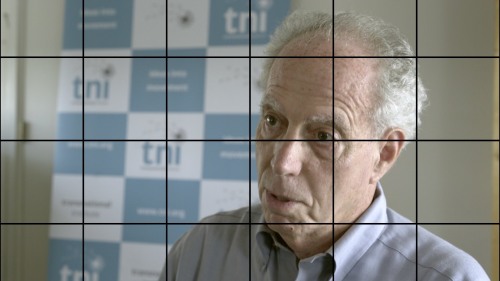
Dr Harris Gleckman of the Transnational Institute – photo via YouTube

National governments can no longer control transnational corporations, and can no longer govern their own countries. If they try, in ways that inconvenience multinational corporations and their investors, those investors will remove their money from that country and force it to change direction. There is an excellent video entitled “How do corporations want to run the world in future?” featuring Dr Harris Gleckman of the Transnational Institute, who explains what the Global Redesign Initiative is all about.

The economic arguments for staying in

What about the economic arguments for staying in? The British Chancellor of the Exchequer, George Osborne, has been trying to scare us with some truly absurd future scenarios. But what does seem to be the case is that Britain’s annual EU subscription of some £10 billion each year actually gives us nothing in return – yes, nothing, for the figure is calculated after netting off everything British farmers and scientists and others at present receive from the EU.

I’m no economist and I can be pulled this way or that by convincing-sounding arguments put forward by either side. But I’ve recently read a very good and evenly-balanced post on the “Notes on the Next Bust” blog, which comments on the UK Treasury’s report detailing the costs to Britain of leaving the EU. To my mind, it makes it clear that no-one actually knows what would happen and that it is far from certain that leaving the EU would be detrimental to Britain.

Can the EU reform itself?

This has been a longer-than-usual posting and I’ve not even touched upon some other important issues such as: the lack of democracy in the EU structures, the lack of effective measures to deal with security and defence, terrorism, money laundering and tax evasion, immigration, etc. One European response is to say that it just proves how we need “more Europe”: if only the EU had more overall power and less internal squabbling then for example it could maintain its own borders. In theory, perhaps, this is true, but experience is telling us that the EU is, by its constitution and because of its sprawling size, a system of bureaucratic regulation, but not a system of democratic, decision-making government whose citizens can believe in it.

We should always remember that changes in the EU to make it less corporate-centred and less signed up to the neo-liberal agenda are more or less impossible, because they would require changes to the Treaties; and these treaties can only be changed by the unanimous vote of 28 countries.

Rudolf Steiner’s ideas for a new Europe

Rudolf Steiner via Adoc photos - Corbis

Rudolf Steiner – photo via Adoc Photos/Corbis

What did Steiner want for Europe? Steiner hoped for a threefold association of European nations that would themselves be threefold societies in which the cultural, legal-political and economic spheres would be clearly separated yet inter-related, his diagnosis being that Europe’s ills were caused by the interference of the three spheres with one another: business seeking to dominate the political state and the state seeking to dominate the cultural life (e.g. education). For the European level, Steiner looked forward to a common European economic life, a common supranational European cultural life but to the maintenance of national values and traditions in the sphere of rights and law.

That’s what I’d like, too. It can still be worked for, when the moment is right.

We British are not going to be able to reject our corporate-controlled national government quite yet, but on 23rd June we have an opportunity to reject the European version. With luck and a fair wind, that will then provide some encouragement for us to join other people around the world to start creating the new and different story we all need so desperately.


88 Comments

Filed under Anthroposophy, Brexit, European Union, New World Order, United States of Europe

The surpassing strangeness of Rudolf Steiner

What a hornets’ nest one brings about one’s ears when trying to write honestly and rationally about Rudolf Steiner and some of the more difficult issues of interpretation concerning his speeches and writings.

When in my last posting on this blog I suggested that Steiner was not seen at his best in the comments he made on French language and culture during his meetings with the teachers at the first Waldorf school, this provoked reactions all round among both pro- and anti-Steiner factions. Some of the pro-Steiner people adopted a tone of regret that I had been so naïve as to go into such troubled territory. One commenter said: “He (Steiner) gives his usual thorough attention to the concern of switching from French to Russian.  The remark in question, concerning the transplanting of the black race into Europe, is being misunderstood.  Unfortunately, it is Jeremy that is instigating it as an indication of Steiner’s racial prejudice”.

Of the anti-Steiner people, Tom Mellett was gleeful to see that there were one or two anthroposophists who were prepared to acknowledge that Rudolf Steiner was a fallible human being as well as a high initiate, while struggling to conceal his relish that there was dissension in the Steiner camp. The real attitude of the antis, however, was displayed by their intellectual guru, Peter Staudenmaier, who commented: “When the denizens of the more clueless corners of the English-speaking anthroposophical world profess themselves shocked, shocked! at discovering some rebarbative passage by Steiner, they have no idea how much else they are missing. Until they learn more about what their founder actually taught, it will be hard for them to make basic sense of their own ideological inheritance”.

Well, mote and beam, Staudi, mote and beam. Though I have in the past expressed gratitude to him for his genuinely useful work in bringing little-known (to me, at least) information about the history of anthroposophy and anthroposophists, Staudi’s weakness is that he does not seem able to move beyond his antipathy towards Steiner so as to see the man as a rounded whole, in his greatness, his strangeness and his humanness.

Add to this Staudi’s unfortunate habit of treating anthroposophists with contempt and scorn when they do not know or agree with everything he knows or thinks he knows, and we end up with very little chance of a reasonable dialogue – which is quite a missed opportunity.

I wonder why it is so difficult for people to take on board the fact that Steiner was not only a remarkable phenomenon, a truly great man with a huge range of achievements but also a human being, which by definition implies fallibility? Human beings are dualities, as Steiner himself taught; that is to say, each one of us has a light side and a dark side. Why is there such a need, among both pro- and anti-factions, for Steiner to have been a perfect human being, incapable of error? Is it an impossible paradox that someone, whose formative years were in the latter part of the 19th century in Central Europe and whose main work was in the early years of the 20th century, should be at one and the same time not only a high initiate with access to extraordinary knowledge and wisdom but also a man of his time, with some of the attitudes of his age and nation?

steiner-marie-rudolf

Marie and Rudolf Steiner

I don’t agree with those anthroposophists who engage in all sorts of casuistry to demonstrate that Steiner didn’t have any racism in his outlook. I do agree with Dr Adrian Anderson, who in his paper Opponents and Critics: Criticism of Steiner and Anthroposophy, says the following:

“… Anyone who can discern the spiritual integrity of Steiner, as evidenced in his teachings on ethics and spirituality, is aware that he was certainly not a person who harbours dislike, and encourages hostility of, people based on their racial characteristics. Those who study Steiner carefully, encounter ideas which have a profoundly spiritual nature. But this argument is of little weight with those who cannot, or do not want to, see the integrity of Steiner.

For example Steiner mentioned, in what amounts to a direct and total breach of modern anti-racism criteria, that the colour of the skin itself is an expression of various etheric and astral energies, and that these give a specific tone to the way the human mind manifests. It is true that when he was talking about this, he emphasised that the worthiness of the human being itself, of any racial origin, is not the theme, and is not being assessed in his lecture. But despite these words, any person today in assessing Steiner’s works against the modern definition of racism, has no option other than to conclude that they are to be defined today as racist; for logically viewed, this is simply the fact of the matter. And students of Steiner need to note this fact well”.

As I said in the previous posting, readers today need to come to their own conclusions about which Steiner they are meeting when they read any of the forty volumes of his writings or the thousands of lecture transcripts. Are they reading Steiner the initiate, or Steiner the man of his time, or Steiner the fallible human being? For myself, there are many times when I feel exalted, inspired and humbled by what Steiner has written or spoken and those passages are the ones that I take to have come from Steiner the high initiate. There are other times, but only a few, when I find passages by Steiner to be simply bizarre, plain wrong or even offensive. On occasion, when one looks more deeply into the matter, it’s possible to see that Steiner is unfolding some really interesting and difficult ideas that challenge our present-day attitudes and opinions; and sometimes one thinks he is just way off-beam and the sheer strangeness of his thought seems very remote from our life and times. But my overriding impression is of Steiner’s great love for all humanity, his vision of our future, his genius and his wisdom.

There are some people, of course, who for whatever reason, can never begin to approach the surpassing strangeness and visionary genius of Rudolf Steiner with anything other than antipathy or hatred. Marie Steiner wrote about this after his death:

“… On 30th March, 1925 Rudolf Steiner passed away.

His life, consecrated wholly to the sacrificial service of humanity, was requited with unspeakable hostility; his way of knowledge was transformed into a path of thorns. But he walked the whole way, and mastered it for all humanity. He broke through the limits of knowledge; they are no longer there. Before us lies this road of knowledge in the crystal clarity of thoughts …. He raised human understanding up to the spirit; permeated this understanding and united it with the spiritual being of the cosmos. In this he achieved the greatest human deed. The greatest deed of the Gods he taught us to understand; the greatest human deed he achieved. How could he escape being hated with all the demonic power of which Hell is capable?

But he repaid with love the misunderstanding brought against him”.

190 Comments

Filed under Anthroposophy, Marie Steiner, Rudolf Steiner, Staudenmaier

Jeremy Paxman and Rudolf Steiner on French language and culture

Jeremy Paxman, the BBC broadcaster who hosts University Challenge and was formerly the anchorman on the Newsnight programme, has upset French speakers by attacking their language as “useless” and saying that the French nation’s achievements are “long past”. According to Mr Paxman, learning French instead of English, especially in Francophone countries such as Tunisia, Algeria and Morocco, sets people back in the modern world. Paxman went on to say:

“No one is going to deny that, historically, France has enhanced civilisation. European culture would be a thin thing without Montaigne, Descartes, Debussy and Cézanne, to say nothing of the dictator’s dictator, Napoleon Bonaparte.

The problem is that it is all long past and the new world is anglophone. In the centuries-long struggle between English and French there is one victor, and to pretend otherwise is like suggesting that Johnny Hallyday is the future of pop.

The outcome of the struggle is clear: English is the language of science, technology, travel, entertainment and sport. To be a citizen of the world it is the one language that you must have.”

Jeremy Paxman

Jeremy Paxman – photo via The Guardian


Needless to say, Paxman’s attack has riled a great many people, not all of them French. It also reminded me of something I had read in the Conferenzen (the record of Steiner’s meetings with the teachers at the first Waldorf school in Stuttgart) so I went to look it up. Sure enough, in the meeting which took place on Wednesday 14th February 1923, one of the participants, Dr Karutz, brought a proposal to replace the teaching of French with another language such as Russian. Rudolf Steiner responded at some length to this proposal. What he had to say would have been music to the ears of Jeremy Paxman:

“…The fact is that what France is doing today is like the last throes or the last frantic outburst of a declining nation, a nation that is fading out of earth evolution, only in history these last throes last a long time. A spiritual view of European history shows this aspect very clearly, of course. The French character is the first vanguard of decadent Rome, the declining Romanic nations of Europe…

Now this whole phenomenon of decadence in French national culture is not least visible in their language. The French language is one of those languages one can learn in Europe at present which, if I may put it like this, drives man’s soul to the very surface of his being. It would be the one in which, to put it paradoxically, it is easiest to tell lies honestly. It lends itself most easily to telling lies candidly and honestly, because it is no longer connected with man’s inner nature. It is spoken entirely on the human being’s surface.

This determines the soul attitude of both the French language and the French character. The soul bearing is such that the French language takes command of the soul. Whilst with a German person the inner configuration of the language puts the soul under the domination of the will element, the moment you speak French it has a numbing effect and takes over command. It is a language that violates the soul and therefore makes it hollow, and thus under the influence of the language, French culture hollows one out. Anyone who has a feeling for these things can always sense that in fact no soul is forthcoming in the French character, only a culture which has grown formal and rigid. The difference is this, that in French you are dependent on the language taking command over you. In French you have not got that endless freedom that you have in German, and which we ought to make use of, the freedom to put the subject in any position we like, all according to its inner significance.

It is not for pedagogical reasons that French is included in children’s education….The aim was to give French the status which Latin had had at the grammar school. They pretended that French had the same educational value as Latin. But this is not true. Latin always contains an inner logic. If you learn Latin you imbibe logic instinctively. This is not the case with French. The French language is no longer based on logic but has become mere phraseology… – and French no doubt does have a fundamentally alienating effect on the children, so that we would certainly like to see the teaching of it gradually disappearing for reasons of its innate quality. It is also quite obvious that in the future it will go.”

One can imagine Jeremy Paxman nodding his head vigorously in agreement, were he ever to read these things. To me, however, these passages show Steiner in a pretty poor light. One has to enter a caveat here about the Conferenzen transcripts, relying as they do on shorthand records, which may have been of a fragmentary nature. But whenever there was an extensive address by Steiner, as in this case, the transcripts can usually be considered as reasonably authentic. So it seems likely that these were indeed Steiner’s views on the French language and culture.

Here we encounter a difficulty which modern-day readers will come across from time to time, where they will need to decide which Steiner they are meeting. By this I mean:

Is it Steiner the great initiate?

Is it Steiner the man of his time and nation?

Is it Steiner the fallible human being who can make mistakes?

In the passages above, we are not seeing anything of Steiner the initiate, but rather Steiner as a man of his time and nation. We should remember that he was speaking less than five years after the end of the First World War, a war which Germany had lost decisively. Could it be that behind his remarks there lies a kind of anger that the Central European culture of which he himself was such an ornament, had been so overthrown and shattered; whereas the French, on the coat-tails of the British and Americans, had found themselves on the winning side. This is surely Steiner speaking from the “normal” level of consciousness rather than the sublime; it could also be Steiner the man, who sees clearly the same shortcomings in French language and culture that have been identified by Jeremy Paxman, but is expressing himself with a chauvinistic bias that undermines any objectivity that might otherwise be there.

Steiner goes on to express his view that the school will have to teach French for the time being because it is necessary for the pupils to reach examination levels in languages in a sound pedagogical way by the time they are eighteen. He says: “Taking it for granted that it is justified that our pupils have this opportunity of attaining certain educational levels, it is necessary that we plan our language lessons the way we have to. We must swallow the pill until something different arises”.

Steiner, Marie Steiner, Wegman

Rudolf Steiner, flanked on his right by Ita Wegman and Marie Steiner on his left.


Steiner then returns to what I can only describe as his prejudiced views:

“As a language French is deader than Latin was in the Middle Ages when it was already a dead language. In the case of Latin there was more spirit alive in it when it was ecclesiastical and dog Latin than there is in French today. It is the French temperament, their blood, that keeps their language going. The language is actually dead, and the spoken language is a corpse. This appears most strongly of all in the French poetry of the nineteenth century. No doubt about it, the soul becomes corrupted through using the French language. It gives one nothing except the possibility of a certain phraseology. And people who speak French with enthusiasm proceed to transfer this to other languages. It is also possible at the present time that the French will even ruin their own blood, the very element which has kept their language going as a corpse. That is a terrible thing the French people are doing to other people, the frightful cultural brutality of transplanting black people to Europe. It affects France itself worst of all. This has an incredibly strong effect on the blood, the race. This will substantially add to French decadence. The French nation will be weakened as a race”.

This is quite shocking stuff from Steiner and of course it is nonsense. Steiner was clearly speaking here as an Austrian of his times and as a fallible human being who makes mistakes. To describe French poetry of the nineteenth century as a corpse, which presumably includes the poetry of Baudelaire, Verlaine and Mallarme, is simply to be absurd; one suspects that Steiner’s real problem was with the sensual and sexual elements of these poems. He would no doubt have regarded Baudelaire and Verlaine as decadent and depraved, which is rather to miss the point made by St Julian of Norwich that “sin is behovely” (useful or necessary) in our development as human beings, and that ultimately “all shall be well and all manner of things shall be well” – while in the meantime, the work of these French poets is part of the patrimony of human culture in the West.

The comment on black people is grossly offensive and typical of the prejudices of his times. The man who was speaking here was not the same Steiner who could speak the following out of his higher self: “What must never be forgotten is that the proclamations to the Shepherds and to the Kings contained a message for all mankind – for the earth is common to all. In that the revelation to the shepherds was from the earth, it was a revelation that may not be differentiated according to nationality. And in that the Magi received the proclamation of the sun and heavens, this too was a revelation destined for all mankind. For when the sun has shone upon the territory of one people, it shines upon the territory of another. The heavens are common to all; the earth is common to all. The impulse of the ‘human universal’ is in very truth quickened by Christianity.”

To return to the teacher-meeting: after all this, a teacher says that French has been abolished in Bavarian state schools and Steiner comments: “If it suggests itself here (i.e. were the Bavarian decision to be repeated in Wurttemburg), we shall shed no tears over the French language. Perhaps the French teachers will say something?” One can imagine the poor French language teachers who had had to listen to this demolition of their subject and who must have felt as though they had been absolutely flattened, both in terms of self-worth and in the eyes of their colleagues, just recovering themselves sufficiently to stammer out a feeble response: “We could not do it just on the spur of the moment”.

What do French teachers in today’s Steiner Waldorf schools make of all this, I wonder? In the meantime, I note that one of the new publicly funded schools, the Steiner Academy Frome, does not teach French, nor even German, but only Spanish and Mandarin. Jeremy Paxman would no doubt approve.

80 Comments

Filed under Anthroposophy, France, French language and culture, Rudolf Steiner

Thoughts on Easter

Tablehurst sheep and lamb

Proud mother and 10-minute old lamb at Tablehurst Community Farm


After a hectic but very enjoyable Lambing Day on March 19th, with hundreds of visitors at Tablehurst Farm, we went in the evening to Lewes, the county town of East Sussex, for an inspiring performance of Bach’s St John Passion. To go from little lambs to the Lamb of God is a wonderful way to get into the Easter mood; and it also got me reflecting on Easter as the festival of death and resurrection, the death of Jesus Christ and his subsequent rebirth into a new life.

When I was a child and indeed for many years afterwards, I could never understand what was meant when teachers and priests said things like “Christ died to save our sins” and “Christ died that we may live”. And actually, I’m not sure that those teachers and priests knew what they meant, either. How could someone dying a horrible death 2000 years ago have had any practical effect on our lives today? And how did that death redeem my small sins or help me to live? There is a mystery here and I didn’t receive any explanation that made sense to me while I was growing up.

As I got older and particularly as I began to enquire more widely into esoteric matters, I started to get a glimmer of understanding into these questions. Rudolf Steiner’s works have been particularly helpful in this respect.

From his youth, Steiner possessed complete clairvoyance so that the spiritual worlds were as open to him as the material world is to us. Having developed this power of exploring higher worlds he set about his investigations and was able to research back to the dim past of human and planetary evolution. To his astonishment, he discovered that the descent of the Christ into physical existence was the absolutely central event of evolution, what he sometimes called “the turning point of time”. Of this period in his life Steiner writes in his autobiography: “I stood before the Mystery of Golgotha in a most profound inward festival of knowledge” and it is a fact that from about 1910 onwards Steiner’s entire teaching is Christo-centric.

Naturally this teaching does not always conform to church dogma, for Steiner’s spiritual research enabled him to arrive at esoteric truths and then express them without the need to pay lip service to what was taught by the churches. Some of you may remember David Jenkins, who was Bishop of Durham from 1984 to 1994. He enraged newspapers like the Daily Mail and the more thick-headed rent-a-quote type of MP by saying that the resurrection was not of a physical body, an idea which he described as “conjuring tricks with bones.” The poor bishop was trying to give out information from esoteric Christianity rather than the fairy story that the Church hitherto had thought was all we could understand – but clearly there were still some people who didn’t want to take off their baby shoes.

It’s also disappointing to have to spell out the following but if I don’t do so, there are people who will try to drive sectarian wedges between Steiner and others. So let it be understood that behind everything Steiner says is the concept that life is a divine oneness and that humankind is one great family. The Christ impulse illumines every race, creed and nation, and there is nothing sectarian about it – Truth and Love are there for every human being, of whatever race and whether atheist or believer.

Esoteric Christianity sees the man Jesus as the human vehicle for the cosmic being of the Christ. What do we mean by the Christ and why did this cosmic being need a human vehicle? The name “Christ” comes from the Greek “Christos” and it refers to an exalted being of the spiritual Sun. We need to re-think materialistic science’s view that the celestial bodies are just balls of gas or types of nuclear reactor in the skies – the solar system as seen with Steiner’s spiritual knowledge is a huge living organism filled with living thought. Here we have to try to encompass the concept of a solar system filled with spirit and being. This is not the time to go into Steiner’s picture of the evolution of the solar system and the way in which the celestial bodies became related to each other but those who are interested can read more in Steiner’s book, An Outline of Esoteric Science. If we can nevertheless hold on to this picture of the celestial bodies as spheres of activity for spiritual beings, then we might also see that evolution has both a spiritual and a physical aspect.

Steiner says that the overlighting of Jesus of Nazareth by the Cosmic Christ took place at the time when the 30-year old Jesus was baptised in the River Jordan by John the Baptist. This was when the Christ incarnated into the body of Jesus. In the Gospel of St Matthew we read: “and lo, the heavens were opened unto him and he saw the Spirit of God descending like a dove and lighting upon him.” For three years after the Baptism, the Christ lived in this body of Jesus until his death on the cross.

Turning now to Steiner’s comments on Easter, he says here something about the true significance of the Festival for us:

“When a mighty individuality like that of the Christ Jesus comes to the aid of entire humanity, it is his sacrifice in death which permeates the karma of mankind. He helped to carry the karma of the whole of humanity, and we may be quite sure that redemption through Christ Jesus was absorbed and assimilated by the totality of human karma.”

An amazing thought, and one which to me helps to make sense of the saying that Christ died to save us from our sins. What Steiner is conveying here is that when Christ died on the cross he took on a huge part of the karma of humanity, which had it not been redeemed in this way, would have led us into more and more darkness and materiality. Instead, Christ’s deed began the slow but sure upward ascent away from materialism in which we are now engaged. Now, this materialism still has a long way to run, apparently for another 2,500 years or so, and indeed it has not yet reached the peak of its intensity – but we are all now on an upward path.

Unusual and startling as some may find Steiner’s insights, personally I find them very helpful in understanding the true meaning of Easter. Steiner goes on to talk about the enormous significance of Easter for human evolution:

“Christ Jesus experiences death, as commemorated by Good Friday. He remains in the grave for the period of three days, this representing His coalescence with earthly existence. This period between Good Friday and Easter Sunday is celebrated in Christendom as a festival of mourning. Finally, Easter Sunday is the day on which the central being of Christianity arises from the grave. It is the memorial day of this event. That is the essential substance of Easter: the death, the interval in the grave, and the Resurrection of Christ Jesus.”

“The essential point is that in the thirtieth year of His life… the primal Being of the Sun, the Christ Himself…took up His abode in the body of Jesus of Nazareth. That is what underlies the Mystery of Golgotha as the primal fruit of the whole life of the Earth.”

“It is, however, characteristic of the modern evolution of Christianity that the thought of Good Friday (i.e. the Crucifixion)…has come ever more to the fore, and the thought of the Resurrection — the true Easter thought — has gradually retired. Thoughts on Easter must point especially to a time in which man must experience the resurrection of his being through the Spirit. We have need of Easter thoughts, and of a full understanding of such thoughts…It is the Christ we have need of, however, the Christ Whom we can seek in our own inner beings, and Who at once appears when we do seek Him…We have need of the vivid consciousness of the eternity of the Spirit.”

Notice there that Steiner has said that the true thought of Easter is Resurrection and not the concentration on the Crucifixion. In other words, the more important aspect of Easter is not death and mourning but the possibility of new life and the return of awareness of the spirit to human consciousness. He says:

“We will never be able to grasp the true thought of Easter unless we realise that in speaking of the Christ we must look upwards from what is merely earthly to what is cosmic….Christ came down among men in order to unite the souls of men with the Cosmic Spirit. Only a true expounder of the Gospel of Christ points out that what we see in the physical sun is the outward expression of the Spirit of our universe — the resurrecting Spirit of our universe.”

And in fact Steiner gives us the most tremendous thought, one which I find changes my conception of what it is to walk this Earth. He says that since Christ’s descent into hell and resurrection, Christ has lived in the etheric body of the Earth and can be experienced by those who have developed the necessary supersensible perception. Steiner says that there will be no Second Coming of Christ in a physical body. There is no need for the Christ to incarnate again and live through a physical body and so pass through death. That was done once and for all and will not be repeated.

So if the Christ really is in the etheric body of the Earth, what does that mean for us? Well, it certainly can make a difference to how you walk on the earth itself. If the Christ is there, then you are literally treading on holy ground every time you take a step, wherever you may be. And if He is indeed present invisibly throughout the whole etheric field of the Earth, then He is truly within the etheric body of every form, every tree and plant, every animal. Christ came for the benefit of all creation, not just human beings. But with our normal intellectual processes we cannot consciously experience this. If we can raise our thinking and awareness, however, there we shall find Him.

Now, here’s another thought – what would it mean for the world if instead of dashing about heedlessly, we walked with the awareness that we are treading on the etheric body of Christ, and that by doing this with loving consciousness, we are helping to release the spiritual substance locked up in matter and thereby transforming it – what might that do to the world? What might that do to our selves?

Happy Easter!

Easter languages

18 Comments

Filed under Anthroposophy, Cosmic Christ, Easter, Jesus Christ, Rudolf Steiner

But will you wake, for pity’s sake?

At a time of life when most people might expect to have retired and be putting their feet up, the anthropopper (who doesn’t think that retirement is good for people), counts himself fortunate to have not one, but two part-time jobs. Despite a colleague’s cynical observation that there is no such thing as a part-time job, only part-time wages, I love both these jobs and after a long and sometimes frustrating working life, I’m delighted to have work where I feel I’m making a worthwhile contribution, in organisations that are offering hope and practical solutions for some of the world’s problems.

The first of these jobs is at Tablehurst Community Farm in Forest Row, East Sussex. While I was there the other day, I found myself having a sudden flashback to an emotion I recognised – it was how I had sometimes felt when I was a small boy at primary school in the 1950s. It came and went in seconds but I was intrigued as to why I had had this sudden recall of something from my early schooldays, now well over half a century ago. What had made me remember this feeling from so long ago, seemingly out of the blue? Trying to analyse my state of mind at that moment, I realised that I had a feeling of wellbeing, knowing I was in the right place for me and glad to be working on a community-owned farm in which the land, plants and animals are cared-for and where the people are friendly, supportive and look out for one another. I was, in fact, in a situation that I suspect is hardly ever experienced in most workplaces these days. This then led me to the further realisation that, if how I was feeling that day was reminiscent of how I had felt during my early schooldays, then there must have been something warm and secure and nurturing about my primary school and the way in which the teachers and pupils treated one another back then. This was not a Steiner school, it was an ordinary state primary school in the 1950s, long before the days of Ofsted, SATS, league tables etc. Somehow I grew up with the notion that the world was on the whole a safe and welcoming place, that adults and policemen were mainly benign, there was joy and beauty in nature – and I also had a sense of how to behave and how not to behave. This gave me something to rebel against when I was a teenager in the 60s. My generation was lucky to have had these positive experiences, as recent alarming reports indicate that many schoolchildren today have quite a different experience of school.

An international study by the Children’s Society in 2015 found that English children are among the unhappiest in the world. Matthew Reed, chief executive of the Children’s Society, said: “It is deeply worrying that children in this country are so unhappy at school compared to other countries, and it is truly shocking that thousands of children are being physically and emotionally bullied, damaging their happiness. School should be a safe haven, not a battleground.”

And now in a report dated 9th March 2016, the online Spectator magazine’s Health section has said that: “There has been a large increase in the number of British children prescribed anti-depressants, according to research published in the journal European Neuropsychopharmacology. The research, led by Dr Christian Bachmann of Berlin’s Charité University Hospital, found that prescription rates increased by 54 per cent between 2005 and 2012. In Denmark the figure is higher still, at 60 per cent.”

What on earth is going on? Clearly, something very disturbing is happening with our young people. Rudolf Steiner, in a lecture given in Berlin in 1919, said:

“What the individual human being experiences consciously when he (sic) strives to attain clairvoyance in the spiritual world, namely, the crossing of the threshold, must be experienced unconsciously by the whole of mankind, during our fifth post-Atlantean epoch. Humanity has no choice in regard to this; it must experience this unconsciously — not the individual human being, but HUMANITY, and the individual human being together with humanity.”

So are our young people starting to experience this crossing of the threshold between the physical and spiritual worlds, but unconsciously, without preparation? And if so, what part of the spiritual world are they accessing?

My second part-time job is with Emerson College in Forest Row, East Sussex, where I organise a programme of public talks and workshops by leading thinkers. On 9th March 2016, we were privileged to hear a talk by Lisa Romero, an adult educator, complementary health practitioner and teacher of meditation from Australia.

Lisa’s theme was: Developing the Self – Meditations and Exercise for our Inner Growth. During the course of her talk, she had some interesting things to say about the difficulties and challenges that teenagers are experiencing today. She suggested that teenagers are crossing the threshold into the elemental part of the spiritual world. Lisa enlarged on this in her book, The Inner Work Path:

“Humanity has begun to break through this threshold, the boundary between the physical and elemental world. If those who cross over are unprepared, we will see more mental disorders in our community. As fascination with the occult, psychic powers, and the supernatural continue to grow, all sorts of false paths of ‘inner development’ will become more and more popular. Consciousness-altering substances that exploit a form of gate-crashing to enter the other dimensions will increase. Using these substances to enter different states of consciousness will be seen as an acceptable and inevitable path for our young people.”

Some schools are now teaching their pupils meditation and calling it “mindfulness” so as to avoid any association with the spiritual; but Lisa thinks that this “will lead ultimately to a weakened relationship to the spiritual world, and thereby leave them open to all sorts of potentially harmful influences by stepping backward, not forward, in their incarnating process. All those who truly know the path of inner development know that a healthy relationship to the spiritual world is acquired by completing all the necessary developmental stages of childhood first. These various occurrences that we already see are signs that humanity is crossing the threshold unprepared. Rudolf Steiner describes this unprepared entry into the elemental world, likening it to putting your head into an ant’s nest.”

Where is anthroposophy, and where are anthroposophists, in all of this? One of the things which teenagers need to know at this time is that not all spiritual beings are divine beings. Some of these beings are working to divert humanity from the path of evolution, by encouraging us in our materialism, reinforcing our egotism and selfishness, magnifying our false self and deepening our lower ego – while at the same time supporting our premature access into the spiritual world. Anthroposophists ought to be helping young people to understand that the right path for humanity and each one of us is to align freely with the beings of progression, the beings of the divine spiritual world – but for that to be possible, we must find the progressive being, the divine being within ourselves. Are we, should we be, finding ways of telling that to young people? Are we making sufficient efforts to communicate with teenagers in ways that they can access? I don’t think so. In the meantime, anthroposophy as we have known it is dying. Lisa told me that there are now only 130 society members in the whole of New York City.

The situation appears to be no better in the UK. As Marjatta van Boeschoten, general secretary of the Anthroposophical Society in Great Britain, says in the Spring 2016 Newsletter of the society: “This question (of how anthroposophy can best fulfil its given task) occupied me greatly during the Holy Nights, especially when a range of initiatives in the ‘daughter’ movements in Great Britain are either closing, struggling, in conflict or in financial crisis.” To add to Marjatta’s worries, the ASinGB has revealed that 55% of members pay nothing at all towards their annual membership. What is the future of the society if more than half of its members, out of their own free choice, are making no financial contribution whatsoever?

Surely these symptoms are telling us that the present form of anthroposophy is in serious decline. What are anthroposophists doing about this crisis? My own sense is that another form of anthroposophy is seeking to be born, but it is having an extended labour and a difficult birth. It won’t come from trying to persuade people to read difficult lectures or books, it won’t come from attending the same old meetings with a rapidly diminishing number of elderly anthroposophists (not that I have anything against elderly anthroposophists – far from it – I hope to be one myself before too long) and it certainly won’t come from spending too much time online arguing with the critics.

On the other hand, it may emerge from people who become inspired by one or more of the practical applications of anthroposophy, such as biodynamics or education. I’m struck, for example, by the number of young people who are coming to work at Tablehurst Farm, which now employs nearly 30 people, some of whom are starting families there – this in marked contrast to what is happening on conventional farms, where the average age of a British farmworker is 59 years and where a farm of 300 hectares will be run by one or two men with machines and lots of chemicals. It may emerge if we can find practical, clear and sensible ways of speaking about the spiritual realities behind what is happening in the world, as Lisa Romero is doing. Lisa is part of the Goetheanum Meditation Initiative, which is involving young people from many countries. (Incidentally, Lisa Romero will be returning to Emerson in June for a talk and weekend workshop.)

The times are serious and demand people and organisations of initiative. Places like Tablehurst Farm and Emerson College are seeking to play their parts.  Finding ways in which to meet the very real human needs of today’s young people can offer hope and practical solutions not only to them but to anthroposophy as well. Christopher Fry expressed our opportunity in his play, A Sleep of Prisoners:

Thank God our time is now when wrong

Comes up to meet us everywhere,

Never to leave us till we take

The longest stride man ever took.

Affairs are now soul size.

The enterprise

Is Exploration into God.

Where are you making for? It takes

So many thousand years to wake

But will you wake, for pity’s sake?

61 Comments

Filed under Anthroposophy, Biodynamic farming, Biodynamics, Emerson College UK, Rudolf Steiner, Steiner Waldorf schools, Waldorf critics

Turning the human being into the human thing

When the anthropopper was a small boy of 3 or 4 years of age, I lived with my family just a few doors down from the house of my Uncle Perce and Auntie Joan. I can still remember how one day Uncle Perce took me to see the chickens in his back garden and offered to shut me up in the hen-coop with the birds. My reply has gone down in family history. Apparently what I said was: “You can’t put me in there, I’m a human bean.”

Evidently, even at that young age, I had a sense that there were certain indignities to which human beings should not be subjected. Perhaps this is why to this day I still have strong feelings about how humans should and should not be treated.

human bean red bubble.com

Photo via redbubble.com

But why are we humans special and worthy of respect? One of the attributes that marks us out is that we are divided beings, carrying the potential for both good and evil within ourselves. In reminding us of this, Rudolf Steiner said: “one does not usually notice that a human being is a duality.”1 And yet it is so; our dual nature symbolises our connection with the dualistic universe we inhabit: spirit and matter, night and day, life and death, hot and cold, young and old etc. Each one of us carries both a light side and a shadow side within us, which reveal themselves in all kinds of ways.

In this, we are different from the angelic realms. Angels are beings with a unified state of consciousness (whether for good or, like the fallen angels, for evil), but they cannot hold both good and evil thoughts within themselves at the same time, as can humans, who are able to live with many different and contrary thoughts and emotions jumbled up together. In this difference lies the reason for all our struggles between the promptings of our higher and lower natures. “Freedom and evil have the same original source”, says Steiner2. This source was the “adversely commanded” angel, Lucifer, who at the event known in the Bible as the Fall, provided for our astral bodies to be permeated by selfishness and egotism. Paradoxically, this also gave us the potential, over many incarnations, to become free through learning to choose wisely between our highest and lowest urges. (For those who are unfamiliar with Steiner’s use of the terms ‘Lucifer’ and ‘Ahriman’ as names for the polarities of evil, please see my earlier posting here.)

Although we are currently at the beck and call of our own lower selves and to the karmic knots we have tied ourselves in as a result, this division between our lower and higher natures allows us countless opportunities (slowly, over many lifetimes), to evolve from our dualistic state into a more unified plane of consciousness that is motivated and permeated by love. This is the goal of human evolution, a transformation that will be achieved through the slow accumulation of wisdom learnt during our many incarnations. It is this that Ahriman is seeking to prevent, by putting us in blinkers so that we cannot see who we really are or where we should be headed.

In all his work, by making us aware of our true nature and destiny as human beings, Steiner was trying to prepare us to withstand the onslaught that the world is currently experiencing as the incarnation of Ahriman comes closer and closer. Steiner’s last verse, which I quoted in my previous post to this one, contains the following:

O joy, when human being’s flame

Is blazing, even when at rest.

O bitter pain, when the human thing

Is put in bonds, when it wants to stir.

Evidence of this onslaught, the attempt to reduce us all to “the human thing”, is all around us. I try to observe as many examples of these attacks as I can, because the more of us who can see and acknowledge what the oppositional forces are up to, the less likely it is that they will be effective. What are they trying to achieve? In a lecture given in 1919, Steiner has told us the following:

“Just as there was an incarnation of Lucifer in the flesh and an incarnation of Christ in the flesh, so, before only a part of the third millennium of the post-Christian era has elapsed, there will be, in the West, an actual incarnation of Ahriman: Ahriman in the flesh. Humanity on earth cannot escape this incarnation of Ahriman. It will come inevitably. But what matters is that people shall find the right vantage point from which to confront it.

Whenever preparation is being made for incarnations of this character, we must be alert to certain indicative trends in evolution. A being like Ahriman, who will incarnate in the West in time to come, prepares for this incarnation in advance. With a view to his incarnation on the earth, Ahriman guides certain forces in evolution in such a way that they may be of the greatest possible advantage to him. And evil would result were people to live on in a state of drowsy unawareness, unable to recognise certain phenomena in life as preparations for Ahriman’s incarnation in the flesh. The right stand can be taken only by recognising in one or another series of events the preparation that is being made by Ahriman for his earthly existence. And the time has now come for individual human beings to know what tendencies and events around them are machinations of Ahriman, helping him to prepare for his approaching incarnation.

It would undoubtedly be of the greatest benefit to Ahriman if he could succeed in preventing the vast majority of people from perceiving what would make for their true well-being, if the vast majority of people were to regard these preparations for the Ahriman incarnation as progressive and good for evolution. If Ahriman were able to slink into a humanity unaware of his coming, that would gladden him most of all. It is for this reason that the occurrences and trends in which Ahriman is working for his future incarnation must be brought to light.”

Of course, it’s quite easy for Ahriman. Money, power, lust and violence enthrall human beings. Perhaps I’m just a Grumpy Old Man but I can’t be the only one who’s noticed that what was culturally unacceptable thirty or forty years ago has now become the new normal. But alongside this ratchet effect of continuing cultural and social degradation, Ahriman is also slowly but surely working to make us forget what it is that makes us truly human. Here are a few of the more egregious examples of ahrimanic phenomena that I’ve recently noticed:

Virtual Reality

In 1965, computer scientist Ivan Sutherland wrote a paper suggesting that a computer-generated visual “display” might one day become so believable it could “literally be the Wonderland into which Alice walked”. Half a century on, virtual reality (VR) devices are entering the mass market. Goldman Sachs analysts predict that gaming will be the most lucrative kind of VR software over the next decade, generating $11.6bn in annual revenues by 2025. Facebook has recently bought VR company Oculus and FB founder Mark Zuckerberg has made it clear that his ambitions for VR go far beyond games, calling it “a new communication platform.” Quite how VR can be a social enabler when the technology completely isolates users from the people around them, by covering their eyes and ears to replace the real world with a digital one, at the moment escapes me – but Zuckerberg is the one with the money, not me, so I’m sure he knows what he is doing. Nevertheless, I found the photo below utterly chilling.

zuckerberg-vr phonearena.com

Mark Zuckerberg and some VR zombies (photo via phonearena.com)


Microchip implants

If you’ve got a dog, it’s possible that it already has a microchip embedded between its shoulders, as a kind of invisible key to owner identity verification. From April 2016, this becomes a legal requirement in England and Wales – yes, that’s right – it will be illegal to keep a dog without having it microchipped. Human microchip implants are not yet widely available but they’re coming – a chip, encased in borosilicate biocompatible glass, will be pushed through your skin near your wrist and will sit there, waiting to engage in all sorts of transactions between you and all sorts of computers and smart devices. The chip will enable you to be located anywhere in the world through a tiny electronic system known as RFID or Radio Frequency Identification. It could contain information such as who you are, how much credit you have, your work ID, whether you’re a criminal out on licence or a migrant who needs to be tracked. I’ve no doubt that Transport for London will already be drawing up plans to replace their Oyster card (which enables you to make journeys by public transport around London) with chip implants (so much more efficient and user-friendly and will never get lost) and at some point they will become compulsory rather than voluntary. Before long, passports and ID cards will be replaced by these chip implants, and you won’t be able to use an airport without having one. It will, of course, be sold to us on the basis that it will improve security, will speed up queues, will make our lives easier, and if we’ve done nothing wrong, we’ll have nothing to fear.


Microchipping a West Highland terrier

Injecting a microchip into a white West Highland terrier (photo via RSPCA)


Security checks at airports

Talking of airports, if there is one situation designed to humiliate and strip you of your dignity as a human being, it is the modern experience of air travel. In the words of Frances Stonor Saunders: “At the airport, we advance with the miniature steps of geisha girls, towards the apparatus that sees, sees into, scans and filters us. We yield to verbal instructions issued in what Auden described as the ‘peremptory tone reserved for … children one cannot trust/Who might be tempted by ponds or learn some disgusting/Trick from a ragamuffin’. We remove our jacket, shoes, belt, and hold aloft our cosmetic secrets in a see-through plastic bag. Without protest, we shuffle in our socks towards the pat-down, or into the machine that sees through our clothes without us having to take them off (they’re known as ‘porno scanners’ in the security industry).”


airportQueue griffinmediagroupcompanies.com

Airport security checks in Denver (photo via globalmediacompanies.com)

Advanced Western democracy

To observe the progress of plutocratic dynasts such as Donald Trump and Hillary Clinton through the American electoral system is to realise that the days when it was theoretically possible for an ordinary citizen to make the journey from log cabin to White House are long gone. Today’s political system, run for the benefit of corporates and financed by them through kickbacks and lobbying, relies on the compliance of a people lobotomised by an ahrimanic media through a focus on bread and circuses and celebrity tittle-tattle. It makes one realise that Clinton and Trump are no better than the arse-cheeks of Ahriman, operating out of lust for power and utter indifference to the real needs of the American people or the wider world. Of course, although the forms of corruption and deceit may vary, it’s a similar story in the UK and in most other countries today.


GTY_hillary_clinton_donald_trump_split_jt_150912_16x9_992

Could these two be the arse-cheeks of Ahriman?


TTIP – the Transatlantic Trade & Investment Partnership

The mention of how corporate interests always come first reminds me of TTIP. Under this new deal between the US and the EU, multinational corporations will be able to sue elected governments that introduce any policies that can be shown to reduce their profits – even if those policies are to protect public health or the environment. I haven’t got room here to say any more but there’s a beginner’s guide to TTIP here:


ttip-lobby-groups_0


Each of these examples of what is happening, and many, many more, are designed to turn us into the “human thing” and more forgetful of the true dignity and worth of human beings. For me, Rudolf Steiner’s work is an invaluable corrective to Ahriman’s apparently unstoppable progress, because he has identified what will happen and what we need to do to avert the worst effects of it. “Know thyself “or perhaps better, “Know thy Self”, should be our watchword, because as long as we lack self-knowledge, we are prey to the delusions of our lower nature – and hence easy meat for Ahriman. In the same lecture I’ve quoted above, Steiner said:

“To the extent to which people can be roused into conducting their affairs not for material ends alone and into regarding a free and independent spiritual life, equally with economic life, as an integral part of the social organism — to that same extent Ahriman’s incarnation will be awaited with an attitude worthy of humanity.”

So in that spirit of preparation for what is to come, how many other indications of ahrimanic phenomena in modern life have you noticed? Please list them in the Comments and by doing so, let’s see if we can avoid that state of drowsy unawareness of which Steiner warned.

1 In the 4th lecture of the first Course for Doctors.

2 Lecture November 22nd 1906 – The Origin of Suffering: the Origin of Evil, Illness and Death

22 Comments

Filed under Ahriman, Anthroposophy, Rudolf Steiner