Category Archives: Anthroposophy

The UK’s Brexit and anti-globalisation general election

Apart from his efforts to bring about the Threefold Social Order after the First World War, Rudolf Steiner stayed away from involvement with politics. Indeed, he went so far as to say: “The Anthroposophical Society is averse to any kind of sectarian tendency. Politics it does not consider to be among its tasks.”  This is a line that many anthroposophists also take, for understandable reasons.

Despite this, I am going to write here about politics, because the forthcoming “snap” British general election, called by the British prime minister Theresa May to be held on June 8th 2017, is of such a momentous nature, with implications not just for the UK but also for many other countries around the world, that it surely deserves a wider anthroposophical perspective.

We have also just had the result of the presidential election in France, which was won decisively by Emmanuel Macron, leader of a new political party, En Marche! (On the Move!), whose name by a strange coincidence bears the same initials as his own. His defeated opponent, Marine Le Pen of the far-right Front National party, had one of the most devastating lines in their televised debate, when she said: “France is going to be led by a woman, either me or Frau Merkel” but her aggressive, hectoring style led most observers to conclude that she had lost the arguments.

(As an interesting aside, a respected clairvoyant suggested to me that Emmanuel Macron is an aspect of Napoleon Bonaparte, who has reincarnated to do what he can to compensate for all the death and destruction he caused during his life as Emperor of France. A fanciful notion, perhaps, but put pictures of Macron and Bonaparte side by side and there is a distinct resemblance. I shall watch with great interest how Macron approaches his task of seeking to unite a very divided nation.)

Macron Bonaparte

Macron Bonaparte (image via the blog Conseil dans l’Espérance du Roi)

The Eurozone economic crisis, combined with the cultural and social impact of its open borders policy, has led to the rise of far-right parties not just in France but in many EU nations: the very thing which defenders of the EU say it exists to counter. But discontent with the EU is only one factor; another important one, which applies much more widely than just within Europe, is that the bankers and money-men collectively bankrupted us a decade ago – and got away with it. The resulting surge of rage across the Western world unleashed the Brexit vote in the UK; it smashed the established French party system, so that neither of the main parties there was any longer even in contention for the presidency; and in the USA it carried Donald Trump all the way to the White House. The tide in favour of national self-determination and anti-globalisation appears to be running high in many countries right now.

As regular readers of this blog will know, I voted to leave the European Union during the referendum held on June 23rd 2016, and I gave my reasons here and here. Most anthroposophists I know took a different line, and voted to remain. There has been a lively discussion about all of this in recent issues of the Anthroposophical Society in Great Britain’s Newsletter. I don’t intend to repeat the arguments I made last year, but will add here a few further observations.

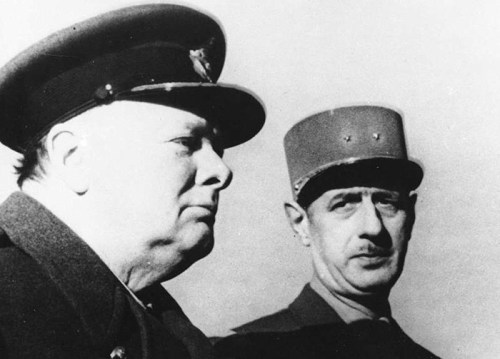
First of all, a glance back at the history of Britain and the European project, together with a question: why was it that Conservative and Labour statesmen such as Winston Churchill, Clement Attlee and Ernest Bevin, as well as the great European Charles de Gaulle, were all against the idea of Britain joining what was to become the European Union? Was it because they all understood what the European project was about and realised that Britain was not a natural part of it?
Churchill de Gaulle

Winston Churchill and Charles de Gaulle

The case made by those in favour of joining the European Economic Community (such as Harold Macmillan, prime minister from 1957 to 1963) was that Britain’s relative economic and actual geopolitical decline after the Second World War left joining the rest of Europe as the only viable alternative. However, after the war and in the early 1950s, most British politicians were unable to see just how difficult Britain’s position had become; or perhaps some of them could see it, but weren’t prepared to tell the British people that our imperial pretensions could no longer be sustained. It was the Suez War of 1956 that revealed just how far Britain’s economy had weakened, and how dependent it had become on the USA.

Britain after the Second World War and into the 1950s resisted the idea of joining in any moves towards European integration. True, Churchill had publicly supported the idea of a United States of Europe, notably when he made the keynote speech at the Hague Congress that created the Council of Europe in 1948; though whether he ever envisaged Britain being part of any such union is very doubtful. Certainly, he was far less sympathetic to the idea of union by the time he had returned to power in 1951. Nor was the post-war Labour government in favour of any moves towards union that might cede sovereignty in any form. In May 1950 foreign secretary Bevin said that because of links with the USA and the Commonwealth, Britain was “different in character from other European nations and fundamentally incapable of wholehearted integration with them.” In any case, measures towards political union of any kind aroused him to vigorous rejection. ‘I don’t like it. I don’t like it,’ he famously said of the idea of the Council of Europe: ‘When you open that Pandora’s Box you’ll find it’s full of Trojan horses.’

Bevin and Attlee

Ernest Bevin and Clement Attlee

Most Conservative politicians agreed with him. So Britain failed to engage in the creation of the EEC in the Treaty of Rome of 1957, and then later tried but failed to remedy what had come to be seen as a mistake. For Charles de Gaulle had never forgotten that Churchill had once told him that “if we had to choose between France and the US, Britain would always choose the latter.” So when Britain finally tried to join the EEC, first in 1963 and then again in 1967, de Gaulle vetoed our applications. Giving his reasons in 1963 for saying “Non”, he commented: “England in effect is insular, she is maritime, she is linked through her interactions, her markets and her supply lines to the most diverse and often the most distant countries; she pursues essentially industrial and commercial activities, and only slight agricultural ones. She has, in all her doings, very marked and very original habits and traditions.”

De Gaulle also believed that Britain would represent American interests: it would be the US’s Trojan horse in the EEC. He had concluded that Britain was not committed to the goals of the EEC because, having withdrawn in 1955 from the original talks that led to the creation of the EEC, Britain had then proceeded to establish its own rival customs union (EFTA – the European Free Trade Association). In addition, he found the British both arrogant and self-important. Was de Gaulle wrong about any of this? I don’t think so.

This is all ancient and unfortunate history, some might say. Eventually, in 1973, Britain managed to join the EEC – but only after de Gaulle had left office. Nearly half a century later, we’re all Europeans and global citizens now, drinking our fairtrade coffee while we wait for our flight to some agreeable holiday destination. We like the idea of being able to move to any EU country for work, and in any case, without all those helpful Eastern Europeans coming to the UK, who will look after the elderly in our care homes or serve us our skinny latte?

Despite such compelling arguments, I voted to leave on June 23rd 2016, and thus opened myself up to accusations of racism, fascism, betraying young people etc from furious Remainers. Even so, I was somewhat bemused to find myself characterised by Michael Eggert, a German blogger, as someone who was siding with “neo-nationalist reactionaries” and “reflecting the internal arguments of the UKIP supporters.” He tells his readers that if they go to the anthropopper blog they will know what to expect if they are “familiar with today’s neo-right and open-fascist conspiracy theories. The ingredients for anti-Americanism and anti-Semitism are the same, albeit with the pseudo-occult bluff arguments which so many believing Steiner supporters derive from his statements of 100 years ago.”

Actually, Michael, if I were pushed to define my political position, I would say that I lean towards anarcho-syndicalism with a deep green tinge. I thought I had taken great care in my Brexit essay to set out quite a distinct and principled position from a progressive standpoint – but perhaps the argument was too nuanced to pierce the hard shell of your cultural infallibility.

Leaving the uncomprehending Egoisten aside, I still remain baffled by the poor reasoning exhibited by so many Remainers; why is it, for example, that pro-EU people on the left or Green sides of the argument are so in favour of the European Union? What are they doing, these radicals who like to think of themselves as being in the forefront of the fight against globalisation, by fighting instead for an undemocratic, unaccountable trading bloc which is backed by the world’s banks, multinational corporations, financiers, and heads of governments? To listen to these Remainers, it’s clear that the decision to leave is being treated not as an opportunity to engage more fully with the wider world, nor a throwing-off of economic handcuffs or even simply as a change that must be accommodated after due democratic process, but rather as some kind of a national disaster.

Caroline Lucas

Caroline Lucas, the Green Party’s only MP and one half of the party leadership

And what is the Green Party thinking of, when it supports the EU? The EU cannot by any stretch of the imagination be described as green. Has Caroline Lucas forgotten the continent-wide destruction created by the EU’s Common Agricultural Policy – the wiping out of hedgerows, forests and wildlife, landscape features, small and family farms, and the promotion of industrial farming and agricultural free trade – which has arguably done more damage to the rural landscapes of Europe in 50 years than any other single instrument in the previous 500? This of course is now being extended to Romania, Poland, Hungary and the other newer members of the EU, where we will once again see the destruction of the peasantry, wildlife and diverse landscapes and the introduction of monocultures and the triumph of agri-business.

As for the Labour Party, I confess I don’t know what their attitude to the EU is today, nor do I understand what their position is on Brexit. What I do know is that they have failed to provide any kind of leadership, or to show that they have any clue about what caused the vote to leave. It seems that they have already given up on any prospect of winning this general election and are now manoeuvring behind the scenes for the leadership election that seems likely to follow a heavy general election defeat for their party.

The weakness of the left and the Greens means that this general election campaign will be more or less entirely about Brexit – and if I am right about most people’s motivations for voting to leave the EU, then in some ways it is also a manifestation of anti-globalisation, as we have seen elsewhere around the world.

The ruthlessness and will to power of the Conservatives have been much in evidence ever since the country voted to leave. We saw this first of all in the leadership contest to succeed David Cameron and then in everything Theresa May has done since becoming prime minister, especially in the way she has called this general election after denying on at least six occasions that there would be any election before 2020. The chances are that we are in for an extended period of Conservative rule. This has huge consequences, most obviously for Brexit and the UK’s future relations with Europe, but also for the futures of Labour’s leadership, public services, and the constitutional outlook for Scotland, Northern Ireland and Gibraltar.

may juncker

Theresa May and Jean-Claude Juncker (photo via the Daily Telegraph)

Mrs May has of course been fortunate in her enemies; nothing is better calculated to bring voters over to her side than leaked vindictive accounts from the aides of Jean-Claude Juncker of private dinners at Downing Street, or the threat of charging British taxpayers £100 billion because we were foolish enough to want to resign from the club. This is perhaps one reason why the Liberal Democrats were not able to make any kind of a breakthrough in the British local elections held on 4th May – as the one British political party which is unequivocally for Remain, they are now seen as supporting the vindictive and venal elite of the European project.

For the European Union has always been an elite project. Since it took shape in 1992, its architects have always been reticent about putting their project to the people. Referenda were rare, and if people voted the wrong way, as they did in Ireland or in Portugal, they were told to vote again until they gave the ‘right’ answer. The unspoken but clear aim has been to diminish, if not abolish, the democratic sovereignty of European nations, and to ‘pool’ that sovereignty in the interests of creating a giant, borderless free-trade zone. Of course, it was dressed up with talk of peace, equality and brotherhood, but it was primarily an economic project, as well as an attempt to keep Germany from becoming too dominant. (I wonder what happened to that?) People were not asked to vote on any of this, for a simple reason: it was clear they would say no. People remain stubbornly attached to their national identities, as we have seen in Britain, and as we see across the continent. This has been the EU’s fatal and quite deliberate flaw: it has never carried the people with it.

Were Rudolf Steiner alive today, he would not be giving his backing to the European Union as it has evolved. Why so many anthroposophists are unable to see this escapes me, because Steiner was quite clear about what should happen. He hoped for a threefold association of European nations that would themselves be threefold societies in which the cultural, legal-political and economic spheres would be clearly separated yet inter-related, his diagnosis being that Europe’s ills were caused by the interference of the three spheres with one another: business seeking to dominate the political state and the state seeking to dominate the cultural life (e.g. education). For the European level, Steiner looked forward to a common European economic life (which the EEC had started to provide), a common supranational European cultural life (which over the last fifty years has started to emerge in many ways) but to the maintenance of national values and traditions in the sphere of rights and law. It is this last point that the European Union, in its inept attempts to become a superstate, has completely failed to understand, and this is why Brexit became a necessity.

If Macron and others could begin to help the EU to reform itself along the lines indicated by Steiner, I would not hesitate to seek to rejoin such a community – and I think this would apply to many other people as well, not just in Britain but throughout Europe.

80 Comments

Filed under Anthroposophy, Brexit, European Union, Rudolf Steiner

The supersensible powers of Rudolf Steiner

Long before writing this blog post, I recall reading an account by Walter Johannes Stein of a car journey he had taken with Steiner. They were going through a town when Steiner suddenly asked the driver to stop the car outside a bookshop they had just passed. Steiner went into the bookshop and re-emerged shortly with a book, which he showed to Stein with great satisfaction, saying that he had been wanting to obtain a copy of it for some time. “But how did you know it was in that bookshop?” asked Stein. “Oh, I saw it in the window,” said Steiner. Stein knew that this was quite impossible by any normal means, because it was just before dusk and the light was poor, and the car had in any case been moving too fast for anyone to have been able to pick out a title in the bookshop window. Unfortunately, I can’t now recall where I read about this and despite googling extensively, have not been able to re-locate it. Should any reader discover it, I would be grateful to know. But what this anecdote shows is that Rudolf Steiner had some amazing abilities that are not available to most of us in our present stages of development. What were these abilities, and what use did Steiner make of them?

steiner in spiritual world

Rudolf Steiner, photographed when in supersensible contact with the non-physical realm

Édouard Schuré (1841 – 1929) was a French philosopher, poet, playwright, novelist and music critic who had known Marie von Sivers (the future Frau Dr Steiner) since the year 1900, when she had contacted him with a request to translate some of his works into German. It was Marie von Sivers who introduced Schuré to Rudolf Steiner in 1906. According to the Wikipedia article on Schuré, “he was deeply impressed and thought of Steiner as an authentic ‘initiate’ in line with his The Great Initiates. After hearing Steiner lecture in Paris for the first time in 1906, Schuré in an ecstatic state ran home and wrote down the entirety of the lecture from memory. This first lecture, and the other lectures in the series (which Schuré wrote down) were published as Esoteric Cosmology. Subsequently, Steiner and von Sivers staged Schuré’s esoteric dramas at the Theosophical Congresses in Berlin and Munich. Schuré’s The Children of Lucifer, served as a precursor of Rudolf Steiner’s own esoteric dramas.”

220px-Edouard_Schuré_01

Edouard Schure

So Schuré was someone who knew Steiner well and had a very high regard for him. In 1910, he wrote some biographical notes on Steiner, which describe Steiner as an adept, a higher initiate, combining the powers of both mystic and occultist:

“The mystic…is one who seeks for truth, and the divine directly within himself, by a gradual detachment and a veritable birth of his higher soul. If he attains it after prolonged effort, he plunges into his own glowing centre. Then he immerses himself, and identifies himself with that ocean of life which is the primordial Force.

The occultist, on the other hand, discovers, studies, and contemplates this same Divine outpouring, given forth in diverse portions, endowed, with force, and multiplied to infinity in Nature and in Humanity. According to the profound saying of Paracelsus: he sees in all beings the letters of an alphabet, which, united in man, form the complete and conscious Word of life

The weapons of the mystic are concentration and inner vision; the weapons of the occultist are intuition and synthesis. Each corresponds to the other; they complete and presuppose each other.

These two human types are blended in the Adept, in the higher Initiate… Rudolf Steiner is both a mystic and an occultist. These two natures appear in him in perfect harmony. One could not say which of the two predominates over the other. In intermingling and blending, they have become one homogeneous force.”

There are numerous accounts, from people who knew him well, of Steiner’s supersensible abilities. From these accounts, it is clear that Steiner always waited for the conscious co-operation of the people with whom he worked; and that he never used his powers in an egotistical or selfish way, or to bring about a particular end. The freedom of other human beings was a fundamental and absolute principle underlying everything he did and said. I have chosen here a few examples, which have particularly appealed to me, to illustrate some of Steiner’s supersensible abilities but there are many others available.

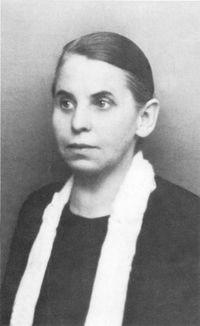
The first example comes from Eleanor Merry (1873 – 1956), an English anthroposophist and artist who studied in Vienna and met Rudolf Steiner in 1922 after becoming interested in his teachings. Eleanor Merry was one of the organisers of Steiner’s 1924 summer school in Torquay, and this account comes from a meeting she had with Steiner in Paris in May of that year to discuss some of the details of the forthcoming conference.

Eleanor Merry

Eleanor Merry

“I told Dr Steiner about my efforts at painting according to his methods, and as I meant to exhibit some of my work at Torquay, I wished so much he had seen them beforehand. He replied: ‘I have seen your paintings’, and I said ‘No, Herr Doktor. You haven’t seen them; they are all in London.’

He said again: ‘I have seen them.’

I contradicted him, and for the third time he repeated that he had seen them, looking at me with his intense dark gaze.

Then for the first time I realised that he had indeed seen them, but not with earthly sight.

This incident gave me still greater confidence, because his ‘seeing’ had obviously not been the usual type of clairvoyance, but something entirely different. And there was something else. I told him that one day in London I had had great anxiety about my conduct of life, and my son and daughter, and had been nearly at my wits’ end and extremely unhappy. I was walking in the Park, thinking these anxious thoughts, when I heard distinctly a voice saying to me ‘Alles Licht kommt aus der Finsternis heraus.’ (All light comes out of the darkness.) It was so clear that I was startled, and I told him I had thought he was himself speaking. He looked kindly at me and said the simple words: ‘Warum nicht?’ (Why not?)

Never again could I doubt that in spirit he could be at any moment present with his pupils, no matter where they were.”

Anna Samweber (1884 – 1969) was an active co-worker in Berlin with Rudolf Steiner and Marie Steiner-von Sivers for several years. Her anecdotes and recollections were recorded by Jacob Streit during an intensive two days shortly before Anna’s death. They contribute a warm and intimate picture of Rudolf Steiner, the man, and his work.

csm_Samweber_Anna_dfb76cd481

Anna Samweber

“Frau Dr Steiner owned a lovely diamond watch with her initials inscribed on the lid. It was broken, and I had to take it to a well-known watchmaker who lived a long way from the Motzstrasse (the house at 17 Motzstrasse in Berlin was where Rudolf and Marie Steiner lived from 1903 – 1913, and where the work of the Anthroposophical Society was carried on). It was late on a cold and foggy November evening when I made my way in the direction of Nollendorfplatz, where the building site for a subway was situated. I was walking along a long, wooden blank wall when suddenly two human shapes appeared from the dark and attacked me. I remembered that once Rudolf Steiner had told me that if ever I was in need I could call on him. So when these two attackers went for me, the one holding me from behind so that the other could rob me, I called inwardly and spontaneously: ‘Doctor, help me!’ At the same moment both fellows fell back like lightning and were gone.

When Rudolf Steiner came for breakfast the next morning he greeted me with the words ‘Good morning, Sam. What was the matter that you cried so loud last night?’ When I told him about my experience and he had listened quietly, he said simply: ‘But I did help you, didn’t I?’ “

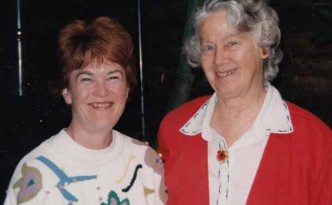
Now here is an intriguing little story that will no doubt invite derision from some, but to my mind is highly significant. There is a book, Summer with the Leprechauns, by a Canadian author, Tanis Helliwell. In it, Helliwell describes how she went to Ireland and lived in a cottage with leprechauns (the race of elemental beings to which elves, leprechauns and fairies belong), one of whom became her particular friend and teacher about these beings. It’s an entertaining book to read and has been praised by Dorothy MacLean (one of the three founders of the Findhorn Community, well known for her work with the elemental kingdom).

Tanis-Dorothy-McLean-smaller-332x205

Tanis Helliwell (L) with Dorothy MacLean

In an interview, Helliwell was asked: What is the intention of elementals, what is their role, what do they mean for us in these ecologically very sensitive times and how do you see the writings of Rudolf Steiner on elementals?” Tanis Helliwell replied:

“In my book Summer with Leprechauns: The Authorized Edition I describe a new caste of elementals. About 100 years ago Rudolf Steiner (founder of anthroposophy) met with my leprechaun friend. He asked him and other elementals coming from all different castes: leprechauns, elves, goblins, gnomes, trolls and fairies to work in partnership with the humans to help create a healthier Earth and also to learn how to use free will and learn to be co-creators. My work assists him in the process. I travel around the world to speak to interest groups to work with elementals. Wherever I go be it the Maori of New Zealand, the Haida in Canada, the Mayan in Central America or people in Germany or Ireland the traditions of these people, all of them, believe in elementals. It is in their stories, in their legends and it is also in their present because so many people have encounters with elementals in their lives.”

I’m going to finish with a lengthy extract from an article, ‘The Initiate and the Teacher’, published in 1959 in The Golden Blade by the English artist, Gladys Mayer (1888 – 1980). She first came across Steiner’s work in 1915, when she read The Way of Initiation. In April 1922 she attended Steiner’s series of lectures on education at Stratford-on-Avon, then went to the Vienna Congress in June. The following year she visited Steiner in Dornach and decided to become a painter and art teacher at the Goetheanum.

“Mine was a strange, perhaps unique, experience of him. It is of the Initiate I must write, for I came to him late in his earthly mission, and I was not permitted to speak with him in outer life, until I had recognised him, supersensibly, as my Teacher.

Shattering events in life brought me to Rudolf Steiner. I came, not for myself, but on behalf of others. I came with doubt in my heart concerning him, yet the events which made me seek his help were beyond the competence of any but an Initiate to understand. I needed the advice which I knew he could give…”

Gladys Mayer 2

Gladys Mayer

Mayer then describes how she experienced what she called “the great karmic crisis of my life”:

“On not only one occasion but three times in the space of about six weeks, I had to face madness and impending tragedy in my own immediate environment. Twice in this period, on distinct occasions and amongst unrelated people, I had to intervene when a murder seemed imminent, and once to check an intended suicide. I began to ask myself: ‘Is the world about me going mad?’

But The Way of Initiation had already begun to bear fruits in spiritual experiences which guided me through events of terrifying responsibility, from day to day, and sometimes from moment to moment. I knew the spiritual worlds as reality, and Spiritual Beings as my aid. I received pictured instruction, through which healing was brought to the madness of one friend, and through which I was able to save the life of another. At length, I received the instruction to go to Rudolf Steiner for further advice…I met him frequently for something over two weeks: each time I met him he greeted me with a smile and a warm hand-clasp. Each time I asked him, ‘May I come and speak with you?’ he put me off with the reply: ‘Frage mir nochmal (Not just yet).’ Friends in Dornach told me this did happen sometimes, and of course it had a reason…Meanwhile, my spiritual instruction was going on, but it had developed a new phase.

Every night I awoke about two hours after midnight, and was aware of a continuous experience. At first it was a Star, very distant, that was shining on me: then it was gradually coming nearer, and at length it was a man with a lamp who stood by my bed. By the light of the lamp I was aware of another, greater figure, and from this other one, though I could not see him clearly, came words instructing me in the spiritual understanding of what was going on around me. I was shown, unexpectedly, the concealed suffering in the heart of a nearby friend: it was as though I were lifted up by the unseen Teacher to learn to know, through the Light of the Lamp, what was happening behind the veils of sense appearances.

At length, after about 14 days, I became anxious to know from whom I was receiving such teaching. I had become accustomed earlier to receiving instructions from an unseen Spiritual World. I had been made aware of the reality of spiritual discarnate Beings. But this Teacher was more concrete. I could see him unclearly towering above me, too great, it seemed, to be in any way connected with a human form. I could see the great form, but not yet the face of this Being.

At last, I could bear it no longer: I felt I must know more. I seized hold of him, as it were, with all my soul forces, and challenged him, saying: ‘Who are you?’ Then, as there came no answer, I asked wonderingly: ‘Are you the Christ?’ ‘Nicht so’ (Not so). Then, because these were German words, a further thought came to me. ‘Are you, can you be, he whom we know on earth as Rudolf Steiner?’

There was an instant stillness, and then the answer came softly, ‘Eben so’ (Even so).

I was still not satisfied. It seemed impossible for anyone so spiritually great to be also a human being. So I pressed further. ‘Then show me your face,’ I asked.

Immediately away to my left, where was situated the studio in which Rudolf Steiner lived and worked, I saw a tiny distant picture of his face and form resting with eyes closed, as it seemed to me, not in sleep, but in deep meditation.

I understood now why I had been kept waiting. I had doubted, and doubt came in through a false spiritual perception. It could be put right only by my seeing and recognising him in truth, in supersensible experience, as my Teacher. I came to him joyfully the next day, and asked confidently: ‘Now can I come to see you?’

I knew what the answer would be, and was not mistaken. When we talked together, I felt that I had known him for all time. I told him of all the terrible and wonderful experiences I had gone through, where earthly disasters had been averted through spiritual enlightenment, yet had eventually left me with responsibilities I felt were too great for me to bear alone; and how these responsibilities had eventually brought me to him. He listened quietly, and one had the impression he made his whole being receptive, soul to soul. Then he explained my experiences with the simple words: ‘Dies ist eine karmische Sache (This is a karmic matter).’ I felt enormous relief. Here, at last, is someone who understands, who takes all these astounding events calmly, and is competent to give advice. This is a matter of karma.”

Gladys Mayer’s account continues with her decision to sell up all she possessed so as to move from England to Dornach to be a painter at the Goetheanum, conscious that because of Steiner’s failing health there might not be much time left. As one of his many pupils, she continued to receive answers in meditation to her questions, particularly in relation to her painting and use of colour. She received these answers at night, when she would see a painting she had done during the day as muddy and grey. When she asked how the picture should have been, she saw it transformed into radiant transparent colour.

After Steiner’s death in 1925, Gladys Mayer was one of those people who was very upset by the dissensions and splits that occurred between factions in the Vorstand and in the wider General Anthroposophical Society: “Once in those first years, I heard his voice again, in a kind of despairing wonder: ‘Aber, mein lieben Freunde, was tun si alle?’ (‘But, my dear friends, what are you all doing?’)

Steinertot

Rudolf Steiner on his deathbed

She concludes with an assessment of what Rudolf Steiner has brought to us all:

“As it seems to me, he has given certainty of the Spirit, guidance to the awakening faculties of spiritual seeing, and example of strength, courage and love to attempt the tasks of the New Age…But are we awake enough? The Teacher is there working with us, and through us, but he waits always for our conscious co-operation…Because humans are so very hungry for the certainty, the wisdom and the good, which this teaching, entrusted to Rudolf Steiner out of the divine worlds, can bring to our suffering Earth.”

24 Comments

Filed under Anthroposophy, Rudolf Steiner

What was it like to hear Rudolf Steiner give a lecture?

I’ve sometimes wondered what it must have been like to have been a member of the audience at one of Rudolf Steiner’s lectures. “Sculpting in snow” is how Heinrich von Kleist described the art of acting in the theatre, and there is a similarly short term of life for the lecture; both the actor and the lecturer have the happiness of communication with the audience in moments of inspiration; but the lecture and the performance only exist as long as the creator is there, when he is present and speaking, when he is physically and spiritually alive.

If Steiner had lived another ten or twenty years, perhaps we would have had a recording or even some brief filmed glimpses of him – but he died in 1925, before the age of routine sound recordings, filmed newsreels etc.; so all we have are a few photographs, stenographic records of his words (“from shorthand reports unrevised by the lecturer”, as we are always told) and some recollections by people who heard him lecture.

It is from these written recollections of those who heard Steiner speak that we can gain some idea of the effect he had on his audiences. I’ve selected a few representative samples of these. Here, for instance, is Frederick William Zeylmans van Emmichoven (1893 – 1961), a Dutch psychiatrist and anthroposophist, who from 1923 until his death was chairman of the Dutch Anthroposophical Society. He recalls herehis first experience of hearing Steiner lecture; this was in Dornach in December 1920.

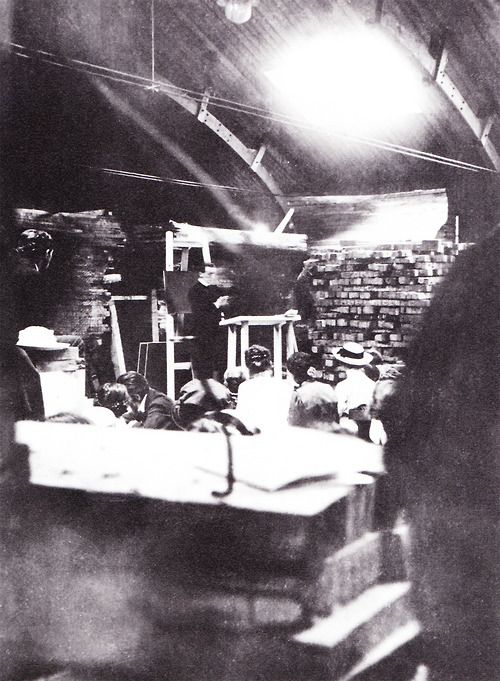
Steiner in schreinerei

A rare photo of Rudolf Steiner lecturing in the Schreinerei.

“On December 17, in the evening, I was sitting in the Schreinerei (the carpentry workshop adjacent to the Goetheanum, often used for lectures and performances) with my fiancée, who was studying eurythmy in Dornach. Happy at being together again, we were waiting for Rudolf Steiner’s lecture. Outside it was bitterly cold; Dornach lay covered in snow. Suddenly the blue curtain by the side of the stage lifted, and Rudolf Steiner went to the lecture-desk. At that moment I had the direct experience of recognition. The impression was so strong that a whole series of pictures simultaneously arose before me, pointing indeterminately to earlier situations – as if I were seeing him as my teacher through ages of time. It was the most memorable experience I have ever had in all my life. For some time I sat as though carried away and did not realise until later that his lecture had already begun. It was the first of the three lectures subsequently published under the title: The Bridge between the Spirituality of the Cosmos and Physical Man….

When I came to myself again and saw Rudolf Steiner standing at the lecture-desk, I had the strange feeling that for the first time I was looking at a Man! It is not at all easy to describe this impression. I had met many well-known and famous people, among them scholars and noted artists, and had always moved in circles where a great deal was going on – it had by no means been a humdrum existence. But now I realised: this is what Man is meant to be. I began to question myself: what is the explanation for this? You have encountered many human beings – what is it that is so significant here? I said to myself first of all that it was his whole bearing, the bearing of one who is like a tree that grows freely between earth and sky. This impression was connected not only with his straight, erect figure, but above all with the poise of the head – it seemed to hover between heaven and earth. The second feeling was profoundly moving: from this beautiful, powerful voice came forth words which lived on even after they had been spoken. And thirdly, there were the thoughts. I was obliged to confess to myself that I could not always understand them, but I realised that they were not there merely to be understood intellectually, but they had another, quite different, significance as well. Listening to professors, what always mattered was whether one understood everything they said. What mattered here was not whether I actually understood – it was something different. Today I could speak of ‘ideas’, of seed-bearing impulses and the like, but at that time I could not. I knew only that different impulses were at work here.”

zeylmans

F.W.Zeylmans van Emmichoven (photo via the Ita Wegman Institut)

A different account comes from Assya Turgeniev (1890 – 1966), a Russian artist who was in close contact with Rudolf Steiner from 1912 until his death in 1925. She was married to the Russian writer, Andrei Belyi. When she and Belyi first came across the writings of Steiner in 1912, they were struggling with questions arising from some disturbing recent mystical experiences. The two books by Steiner they had read (Christianity as Mystical Fact and How to Attain Knowledge of Higher Worlds) had given them the sense that they could trust Steiner to provide answers to their questions. As soon as they had come to this conclusion, they rushed to catch a train from Brussels, where they had been staying, to Cologne, where Rudolf Steiner was lecturing. They first of all tried to meet Steiner but were rebuffed by a fierce lady, whom they came to know later as Marie von Sivers (the future Frau Dr Steiner). Instead, she invited them to attend a “members only” lecture later that day. They decided to attend this lecture, with very mixed feelings after their stern reception, particularly as neither of them spoke German. Turgeniev’s account2 continues:

“A remarkable audience assembled in a longish room decorated in blue. The majority were ladies, most of them not very young. Many were wearing peculiar shirtlike dresses with straight stoles over them, and others wore necklaces or chains with strange pendants. Even among those with some pretensions one could not discern any real style. The absence of make-up was very noticeable…

Half-bored, I watched the assembling audience. But what was that? Far off on the platform, partly covered by other people, something like a gleam of light showed. Then it disappeared and returned once more. Finally the outline of a head emerged. Dr Steiner! I knew that it was he, even though I could scarcely see him. Now he steps up onto the platform…an immense seriousness, a power which is beyond words spoke through those features…we sat there, gazed into the countenance of this person and listened to his words. That was the greatest and most important thing that had ever happened to me up till then, and something which went so deep into my very being that I could no more separate myself from it. One was immersed with such intensity into the voice with its resonance and rhythms, into the gestures and the expression of the face, that one accepted it all without question; one only knew that that in which one now lived and breathed was the original source of one’s being. Only when the lecture had come to an end did one ask oneself in amazement: “What has happened here? I did not understand one word of what was said and yet, in listening to it, I had such a deep experience, as though I had understood each word.”

Asya-184x300

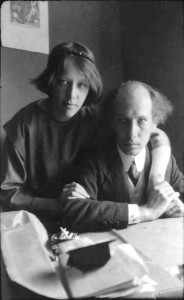
Assya Turgeniev and Andrei Belyi (photo via The Swetlana Geier Collection)

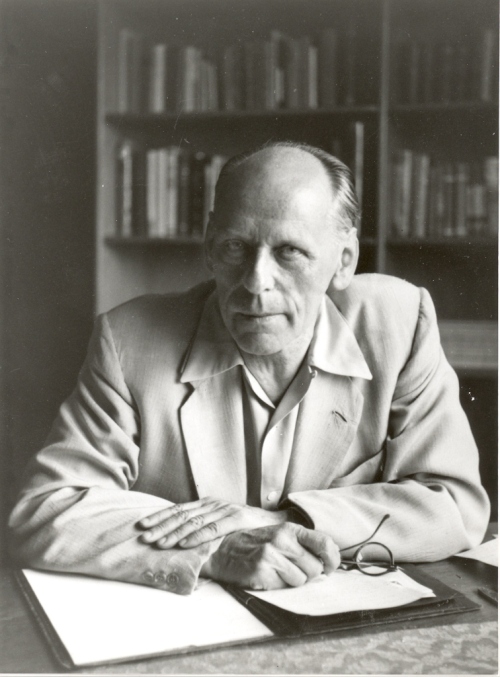
Friedrich Hiebel (1903-1989) was a personal student of Rudolf Steiner and a teacher at the first Waldorf school in Stuttgart. Later in life he became a professor of German Literature and in 1963, he became a member of the Vorstand in Dornach. He attended seventy of Rudolf Steiner’s lectures. The following account3 is a description of the first lecture he ever heard, at the congress in Stuttgart in 1921, on the topic of Agnosticism – the Destroyer of Genuine Human Nature (not available online):

“…all eyes turned to the tall figure of the man in black tails who slowly walked from backstage to the centre and then let his eyes wander over the audience.

Slowly, Rudolf Steiner walked over to the lectern. The way he walked revealed something of the balance between a soaring freedom from the body and the permeation of earth substance with will. Indeed, Rudolf Steiner’s gait was like that of a young man. His face was framed by black hair, which still showed no trace of gray at the age of sixty. Lines on the forehead and furrows around the chin and the corners of the mouth bore witness to the spiritual battles of the quest for knowledge, and in their dignity contrasted strangely with the youthful agility of his limbs…

None of the many carefully taken photographs…can fully convey the essence of his stature. For even the best pictures remain silent, and it was only in his word that the essence of his being was revealed…

Rudolf Steiner’s word now resounded in the great hall, speaking to the almost two thousand listeners. The contrast between the delicate features of his spiritualised physique and the deep resonance of his speech, resulting from breathing deeply with the diaphragm, was surprising. The deep tone of his speech rested in the larynx, vibrated in the chest, and was permeated with the warmth of the heart…

During the introductory sentences of his lecture, he seemed to keep his eyes almost completely closed, and his glance directed downwards. His posture was that of a man listening inwardly. He remained in this inwardly listening stance, gathering himself with all his will forces, for the duration of several long sentences. Then came a clearly discernible breakthrough: he opened his eyes, looked directly at the listeners, and began to reinforce his talk with a forceful and diverse language of gestures…

Here, a man stood before me who taught first how to comprehend consciously and in freedom with the head, then knew how to reach people from heart to heart, and finally was able to enter into the depths of the will…Those who were gripped by these lectures were lifted out of themselves, as it were. They received an inkling of the future image of the human being that was exemplified and fought for by the founder of anthroposophy.”

hiebel_friedrich_5139

Friedrich Hiebel (photo via Verlag Freies Geistesleben)

But what about those people who heard Steiner but did not have that sudden shock of recognition or the sense that something very important had just happened to them? Here is one such example4, this time from England. In 1922, Steiner visited England to lecture at a conference on ‘Drama and Education’, which was taking place in Stratford-on–Avon. The Times Educational Supplement carried a front-page article ‘from a correspondent’, headed ‘Anthroposophy’.

This unnamed correspondent, who refers to himself in the third person throughout the following extract, first of all described in a semi-ironical way the development of anthroposophy out of theosophy and its vast ambitions in all areas of knowledge, its philosophical approach to the occult and the building of the Goetheanum. He then described his responses after listening to Steiner’s lectures:

“It is interesting to note the effect of all this on a typical English public school and old university man who spent a strenuous fortnight in listening to lectures and demonstrations on education. His impression of the man Steiner is noteworthy. It appears that the philosopher has an imposing presence, and exercises a remarkable effect upon his audience. Our English schoolmaster found this personal influence exhausting. At first he sat immediately in front, under the speaker’s eye. But after a day or two he found the strain more than he could bear, and retreated to a seat in the background. With quite a laudable mixture of scepticism and fair-mindedness the schoolmaster gave the lecturer every chance, but remained unconvinced. He says that the lectures appeared to him to be nearly nonsense, but delivered in a fascinating way and marked by all the appearance of sturdy common sense. From any other person the hearer said he would not for an instant have tolerated the startling things set forth by the lecturer, but from him they seemed somehow or other to be at the same time entirely plausible, not to say reasonable.”

There you have a good example of solid, stolid British middle-class common sense and conservatism in the face of something strange and disturbing – yet almost in spite of himself, the correspondent noted the fascinating way in which the lecture was delivered and “the appearance of sturdy common sense”, which rendered the startling content somehow or other to be “entirely plausible, not to say reasonable.”

I will finish with some recollectionsby George Adams. He was a most remarkable man – an anthroposophist, mathematician, scientist and translator – who translated over one hundred of Steiner’s lectures, and translated for Steiner whenever he came to England. The arrangements he describes for these translations sound absolutely hair-raising: the lecture was divided into three parts by Steiner, who then spoke for 20-25 minutes, during which time Adams scribbled furiously, using his own system (he never learned shorthand) of invented signs, symbolic logic, abbreviations and capital letters. Steiner would then sit down, while Adams gave his translation. Then Steiner would give part 2 of the lecture, speaking for another 20 minutes, and so on. To the very end of his life, Steiner was unable to lecture in any language other than German.

George Adams

George Adams (photo via Forschungsstelle Kulturimpuls)

In a 1957 essay, Rudolf Steiner in England, George Adams recalled his impressions of Steiner:

“My impression … was, so to speak, of many Rudolf Steiners. There was the simple, friendly gentleman…Then there was Dr Steiner lecturing – deeply impressive and stern, vivid in characterisation, then often moving into anecdote, good-natured satire, rollicking fun and humour… there was Dr Steiner speaking in a more esoteric meeting … the initiate from timeless realms. Moreover, there was Dr Steiner as you might see him during a personal interview, when you told him of your life’s difficulties and ideals and he answered your questions – the deep, silent look in his eyes, the warm kindness and encouragement at some moments, and at others the absolute quiet, so that it was left entirely to you to come out with what you had to say, with seemingly no help from him, but silent waiting. And then again there was Dr Steiner as I saw him at the large public gatherings in Germany in 1921-22, often with audiences of two or three thousand, partly indifferent or merely curious or even hostile – the way he held them, the firmness and buoyancy of his carriage, the utter lack of compromise or any attempt to influence them. He rather put them through the mill, building up the ground of spiritual science or the stages of higher cognition with closely knit trains of thought, speaking for two hours or more and yet holding his audience completely.”

1 From ‘Rudolf Steiner in Holland’, an essay included in Rudolf Steiner, Recollections by some of his pupils. Translated from the German and published in a special issue of The Golden Blade edited by Arnold Freeman and Charles Waterman, in London, November 1957.

2 From Reminiscences of Rudolf Steiner and Work on the First Goetheanum by Assya Turgeniev. Translated from German by John and Margaret Wood. Published by Temple Lodge, 2003.

3 From Time of Decision with Rudolf Steiner by Friedrich Hiebel. Translated from the German by Maria St. Goar. Published by Anthroposophic Press, 1989.

4 Quoted on page 704 of Volume II (1922 – 1925) of Rudolf Steiner in Britain by Crispian Villeneuve. Published by Temple Lodge, 2004

5 From ‘Rudolf Steiner in England’, an essay included in Rudolf Steiner, Recollections by some of his pupils. Published in a special issue of The Golden Blade edited by Arnold Freeman and Charles Waterman, in London, November 1957.

68 Comments

Filed under Anthroposophy, Lectures by Steiner, Rudolf Steiner

Enjoy yourself, it’s later than you think…

Looking back at the postings on this blog, the anthropopper must ruefully admit that he takes life a little too seriously at times. This po-faced quality is one of the things I would most like to change about Me. Lighten up, I tell myself, but my default personality position seems to be set at Earnest & Responsible and this is what keeps the Inner Scintillating Me from coming to the fore. I spot my Earnest & Responsible side coming out in all sorts of circumstances and situations. As an example, a song by the late Prince Buster came on the radio and, listening to the lyrics, I found myself feeling just a tad disapproving of the sentiments expressed:

Enjoy yourself, it’s later than you think

Enjoy yourself, while you’re still in the pink

The years go by as quickly as you wink

Enjoy yourself, enjoy yourself, it’s later than you think!

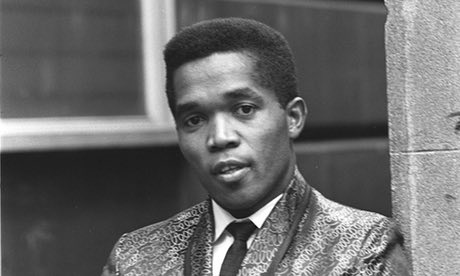
prince-buster

Prince Buster, pioneer of ska music. (Photo via The Guardian)

Life is not about enjoyment, I thought, although joy can be part of the story. Nor is the implication that we have just the one life a sound concept on which to base one’s actions. No, life is about discovering and fulfilling as far as possible your purpose for this lifetime. It’s about opportunities to burn off some of your bad karma and wherever you can, helping to build up some good karma for future lifetimes through behaving with kindness and unselfishness to those whose karmic paths cross with yours. Hedonism and living for the moment, I told myself, are not compatible with Taking Responsibility for One’s Soul Development.

Well, I’m sure you can tell from this that I’m hopelessly inept at letting my hair down and having a good time; but then I started to wonder whether my default personality position has been reinforced by my interest in anthroposophy. Rudolf Steiner, after all, frequently tells his followers to become aware of the seriousness of our age – “serious” and “earnest” are two words that I always associate with him.

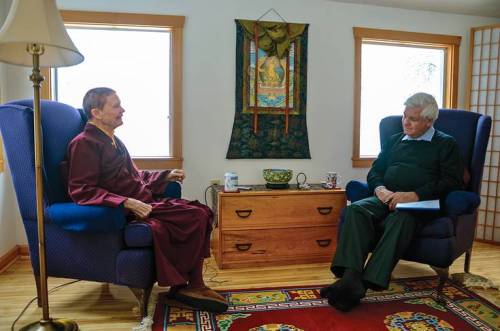
There’s no doubt, of course, that more than ever we do indeed live in serious and challenging times – so is it frivolous and trivial actively to seek enjoyment in life? “Eat, drink and be merry, for tomorrow we die” sort of thing? I’ve just seen an interview with the Buddhist Pema Chödrön, who was interviewed at her home, Gampo Abbey, in Nova Scotia:

pema-melvin-liza-matthews

Pema Chodron being interviewed by Melvin McLeod (photo by Liza Matthews)

Melvin McLeod: I notice there’s a sign in the entrance to Gampo Abbey that says “Enjoy Your Life.” We don’t usually think of that as a spiritual teaching, but as we noted in a recent issue of Lion’s Roar, enjoying your life is really a transformative practice. But it’s hard for many of us to do.

Pema Chödrön: It’s a great sign to have in a Buddhist monastery. Right away, it presents a paradox: Aren’t you here to escape all that hedonism? Aren’t you here not to seek enjoyment from outer things?

The answer is yes, that is why you’re here. So in that case, what does “enjoy your life” mean, if it doesn’t mean getting your pleasure and sense of wellbeing from external things, including people and relationships as well as material goods?

You know who said it best? Leonard Cohen. He meditated all those years at Mt. Baldy Zen Center, often for twelve hours at a time. In an interview, he said his storyline just wore itself out. He got so bored with his dramatic storyline. And then he made the comment, “The less there was of me, the happier I got.”

That’s the answer to how to enjoy your life. It’s to show up and have a sense of curiosity about whatever might appear that day, including it all in your sense of appreciation of this precious human birth, which is so short. I don’t want to call it delight, although it can feel like that. It’s more curiosity. Some people say, I know what’s going to show up today—the same old thing. But it’s never really the same old thing. Even in Groundhog Day, every day was a different experience for Phil, until finally he learned that caring about people was the answer.

This is actually a big point, because the less there is of you, the more you’re interested in and curious about other people. Who you live with and who you rub up against and who you share this world with is a very important part of enjoying your life.

Sartre said, “Hell is other people,” but this is the other view of that. When people irritate you, when they get your goat, when they slander you, whatever it might be, you still have a relationship with them. It’s interesting that of all the billions of people on the earth, they’re the particular ones who came into your world. There’s respect for whatever happens, and this is only really possible if you’re not rejecting whole parts of your experience.”

Well, I can go along with that. Caring about people is the answer for anyone who has a problem in enjoying life. Rudolf Steiner, of course knew all of this and in ways far more profound than I will ever know, but I can’t help thinking a disrespectful thought: that he might have enjoyed life more (and lived longer) if he hadn’t taken life quite so seriously. Our karma determines the way our life unfolds, and enjoyment of it is usually not the point. But was it really essential for Steiner to work himself into the ground and wreck his health for the sake of his mission – which in any case it seems all too likely he didn’t manage to complete. Is there a lesson there for me? After all, each one of us has got more than just this present incarnation to get things right – or is that a cop-out?

14 Comments

Filed under Anthroposophy, Enjoyment of Life, Rudolf Steiner

Anthroposophy, the First Class and the Dharma Protectors

Some of the comments on the recent thread “An Open Letter to Frank Thomas Smith,” about the online publication of the lessons of the First Class of the School of Spiritual Science, have caused me to think quite hard about my own position on making the lessons and mantrams available to any who seek them. Is there today still a justification for keeping them only for Blue Card members (ie members who have applied and been accepted into membership of the School of Spiritual Science)?

I was struck by the contribution from Daniel Perez, who said:

“Rudolf Steiner expressed to Marie Steiner that if the society became sectarian, or the Class Lessons were a source of personal power, that the Lessons would have to be made public. I recently was dismayed as my local class reader expressed both traits. The individual wondered if a recently departed soul could participate in the earthly reading of the Class Lessons without a blue card! I was surprised at the conception that a spiritual being needed a ticket for entry. I wished to give my card to this poor soul at the moment I heard this. My aunt, Baptist fundamentalist, would say the same about the gates of heaven. Only Baptists had the ticket to the gates of heaven. I never understood such thinking, but I know now why the Lessons are public.”

Some other people said that they, too, had experienced sectarian attitudes within the Society, while Tom Mellett sought to draw us off-topic by revealing the existence of a secretive body within the Society called The Circle, Youth Circle or JugendKreis, which he alleges to wield unseen and unspoken power in a number of anthroposophical institutions. I had never heard of the Kreis before, so was intrigued to learn something about it. It does appear to exist, and a number of anthroposophists said that they had been disturbed by its hidden influence in their local Steiner Waldorf school or among First Class readers.

Anthroposophy, of course, has a long and often tragic history of human frailty. I’m inclined to feel that, at least since 1935 and the mass expulsions of members, the spiritual world may have simply stopped regarding the Anthroposophical Society as a vehicle for progress of any kind. And yet the Society has continued to regard itself as the earthly body of the School of Michael, and believes that it is only through anthroposophy that one can continue this connection between Michael and his human disciples.

I was reflecting on all of this when a Buddhist friend came to visit, and I told her something of what I was thinking. She in turn told me about Bön , which is Tibet’s oldest spiritual tradition. Followers of Bön receive oral teachings and transmissions from teachers in a lineage unbroken from ancient times until the present day. In addition, most of the scriptural texts also have been preserved. While much in modern Bön is similar to Tibetan Buddhism, Bön retains the richness and flavour of its pre-Buddhist roots.

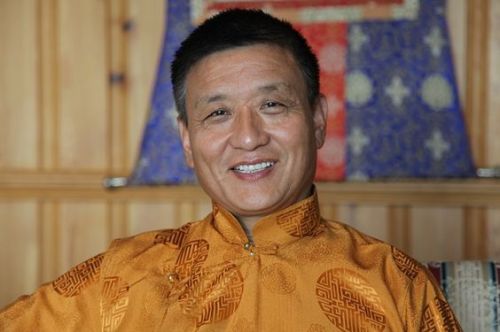
Until very recently, the ancient teachings of Bön were offered to very few students of any generation. But now it seems that its lamas are reaching out to teach Western students about the rich Bön spiritual tradition and its practices. In particular, my friend told me about a teacher called Tenzin Wangyal Rinpoche, who is making these teachings very widely available to many thousands of students via books, YouTube and the internet. Here is what Tenzin has to say about making the teachings accessible:

“Some Tibetan masters might find it strange that I teach these practices to Westerners who have not done certain preliminary practices or who do not have certain understandings. The teachings were traditionally maintained as secret teachings, both as a sign of respect and as a protection against dilution through the misunderstanding of unprepared practitioners. They were never taught publicly nor given lightly, but were reserved for individuals who had prepared to receive them. The practices are no less efficacious and valuable than they ever were, but conditions in the world have changed, and so I am trying something different. I hope that by teaching what is effective, openly and simply, the tradition will be better preserved and more people will be able to benefit from it. But it is important to respect the teachings, both to protect them and to further our own practice.”

Rinpoche, Tenzin Wangyal. The Tibetan Yogas of Dream and Sleep (p. 15). Shambhala. Kindle Edition.

tenzin-wangyal-rinpoche

Tenzin Wangyal Rinpoche

And in this passage, Tenzin enlarges on his reasons for stopping the secrecy, and his belief that the teachings in some way contain their own protection:

“Some of the teachings in this book, particularly those related to dzogchen and tantra, were until recently held in strict secrecy both as a sign of respect and as a protection against their being diluted through the misunderstanding of unprepared practitioners. They were never taught publicly or given lightly but were reserved for individuals who had prepared to receive them. In times past, suitable vessels were willing to travel far on foot and endure other great hardships to access these teachings. But this is seldom the case now; and to preserve the teachings we are challenged to bring them to a new, global audience. My teacher Lopön Sangyé Tenzin Rinpoche advised me that it is time to teach openly. I believe there are some people who simply will not understand, no matter how clearly you teach, and that the goddess is keeping the teachings secret from them. We must trust that the teachings will inevitably reach the right vessels and that what is meant to be kept secret will remain so.”

Wangyal Rinpoche, Tenzin. Tibetan Yogas of Body, Speech, and Mind . Shambhala Publications. Kindle Edition.

I was intrigued by this, since one of the reasons I had given for opposing the online publication of the lessons of the First Class was that the lessons are steeped in esoteric knowledge and require much background preparation from the student – and yet here was Tenzin, from a similarly secretive spiritual tradition, saying that, after centuries of secrecy, it is now time to teach openly.  I was also struck by the last two sentences of the quotation above: “I believe there are some people who simply will not understand, no matter how clearly you teach, and that the goddess is keeping the teachings secret from them. We must trust that the teachings will inevitably reach the right vessels and that what is meant to be kept secret will remain so.”

My friend then introduced me to the concept of the ‘Dharma Protector’.

Dharma is a Sanskrit term to denote law or doctrine. Dharma also means the teachings, code of conduct and philosophies that belong to a certain religion or belief system. Therefore, we can have Hindu Dharma, Christian Dharma and so forth. However Dharma is usually used in the Buddhist context, which is Buddhadharma or just Dharma in short.

The word ‘Protector’ literally means one who stands guard to protect. Therefore, ‘Dharma Protector’ refers to the one who protects the Dharma in you. This is a being who acts as a guardian angel to safeguard our spiritual path and our general wellbeing.

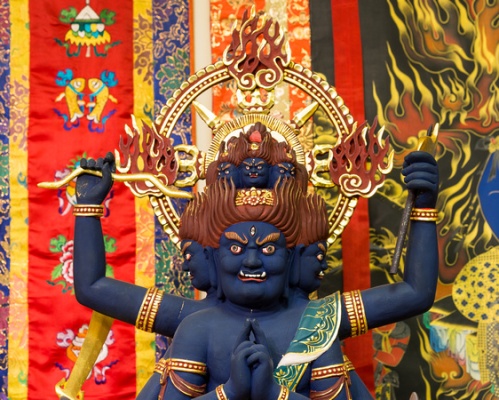
dharma-protector-glenn-nagel-photography

A Dharma Protector (photo via Glenn Nagel Photography)

A defining feature of a Dharma Protector is his or her wrathful appearance. In Buddhism, wrath reflects the innate quality of extreme compassion. Dharma Protectors often have blue, black or red skin, and a fierce expression with protruding fangs. Though they have a terrifying appearance and countenance, they are all bodhisattvas or buddhas, meaning that they are embodiments of compassion that act in a wrathful way for the benefit of sentient beings. Perhaps it is these Dharma Protectors who are keeping the Bön teachings safe and away from those who are unable to understand or become “right vessels,” while allowing thousands upon thousands of genuine seekers worldwide to find their way to Bön.

Why, I ask myself, is this not happening with anthroposophy and the School of Spiritual Science? What is it about the Society and its ways of being that hinder Steiner’s teachings from going around the world to all those who are hungering for spiritual sustenance? Why do we not have teachers like Tenzin, able to speak to the needs of thousands of ordinary people?

Whatever the reasons, I have now changed my mind about the necessity of keeping secret the lessons and mantrams of the School of Spiritual Science. That particular horse bolted long ago and shutting the stable door now is worse than useless. The situation has changed utterly since 1924 and it is possible that we are now in a post-anthroposophical world. At a time of such huge turmoil for humanity, it almost seems frivolous to fret about these matters.

Yet that which has been experienced in the School of Spiritual Science and transformed within the student’s own inner life can never be taken away. The lessons and mantrams retain their power for those who wish to work seriously and sincerely with them. Let us now stop this futile pretence of secrecy and fling open the doors that have been hiding the teachings. I’ve no doubt that the First Class has its own dharma protectors, who, should the need arise, will wheel into action to protect it from the “misunderstanding of unprepared practitioners.” What is meant to be kept secret will remain so. What is meant to reach many thousands should be allowed free passage into the world.

42 Comments

Filed under Anthroposophy, First Class, School of Spiritual Science

The Threefold Social Order – has it been forgotten? (Part 3)

Guest Post by MICHAEL SPENCE

Part 3 of 3

The Importance of the Threefold Social Order

Rudolf Steiner points to the necessity in our age of separating what is at present unified within the State. The pyramidical form of the present State is something derived from the old theocratic social structure that was right for the earlier state of human consciousness. That was correct for the time when humanity was guided by the spiritual world working from above through inspired teachers and leaders. But now the spiritual world holds back and human beings must themselves find their way back to the spiritual world. A quite different social structure must now come into being for the awakening ego of the consciousness soul. What is still looked upon as one must now become three distinct and separate sectors of human society, that is, the economic sector, the rights sector and the cultural life must each become independent and free. The State as we know it must disappear, it is a dead relic from the past.

Even people who have been thinking through what Steiner said of the threefold social order for many years have great difficulty grasping what this would actually mean in practical effect. Most people think of it as something like our present elected government with three distinct departments, or three separate democratically elected administrations. But clearly Steiner did not mean this, nor does it make sense. It is only when one has come to a reasonably clear idea of each sector, of the nature of the very different forms of leadership and the areas of activity and responsibility of each, that it begins to become clear how only as three separate and independent sectors does the three become one. Just as the human body is formed of a threefold system of the head and nervous system, the rhythmic system of heart and lungs and the metabolic and limb system, so is the “body of earthly humanity” made up of a threefold system.

Humanity is evolving. In all ancient times the threefold form of the social order, and the place within it into which each person was born and belonged, was given by the spiritual world. The guidance of mankind was brought down through the mystery teachings. But now responsibility is passed to humanity itself. We ourselves have to bring order and form into our social life. Just as all creation has a threefold form so human social life itself must be transformed from the unitary into a threefold structure, a trinity. The individual human being is now born free, that is, he is not born into a place within the social order, into a particular sector, but must himself create a relationship to each, according to his karma and earthly needs.

The Search for the New Isis, Divine Sophia[i] – Lecture 3 – 25/12/1920 – end of lecture

It is so indeed, my dear friends; modern humanity is passing over a threshold at which stands a Guardian, a Guardian full of meaning, and grave. And this grave Guardian speaks: “Cling not to what has come as a transplant from olden times; look into your hearts, into your souls, that you may be capable of creating new forms. You can only create these new forms when you have faith that the powers of knowledge and of will for this spiritual creation can come out of the spiritual world.” What is an event of great intensity for the individual who enters the worlds of higher knowledge, proceeds unconsciously in present-day mankind as a whole. And those who have linked themselves together as the anthroposophical community must realise that it is one of the most needed of all things in our days to bring men to understand this passing through the region which is a threshold.

Just as man, the knower, must realise that his thinking, feeling and willing separate in a certain sense and must be held together in a higher way, so it must be made intelligible to modern humanity that the spiritual life, the life of rights, and the economic life must separate from one another and a higher form of union created than the State as it has been up to now. No programmes, ideas, ideologies can bring individuals to recognise the necessity of this threefoldness of the social organism. It is only profound knowledge of the onward development of mankind that reveals this development to have reached a threshold where a grave Guardian stands. This Guardian demands of an individual who is advancing to higher knowledge: Submit to the separation in thinking, feeling and willing. He demands of humanity as a whole: Separate what has up to now been interwoven in a chaotic unity in the State idol; separate this into a Spiritual Life, an Equity State, and an Economic State … otherwise there is no progress possible for humanity, and the old chaos will burst asunder. If this happens it will not take the form that is necessary to humanity but an ahrimanic or luciferic form. It is only through spiritual-scientific knowledge of the passing of the threshold in our present day that can give the Christ-form to this chaos.

This, my dear friends, is something that we must say to ourselves at the time of Christmas too, if we rightly understand Anthroposophy. The little child in the crib must be the child representing the spiritual development towards man’s future. Just as the shepherds in the field and the Magi from the East went after the proclamation to see how that which was to bring humanity forward appeared as a little child, so must modern man make his way to Initiation Science in order to perceive, in the form of a little child, what must be done for the future by the Threefold Social Organism based on Spiritual Science. If the old form of the State is not made threefold it will have to burst — and burst in such a way that it would develop on the one side a wholly chaotic spiritual life, completely ahrimanic and luciferic in character, and on the other side an economic life again luciferic-ahrimanic in character. And both the one and the other would drag the State in rags after them. In the Orient there will take place the development more of ahrimanic-luciferic spiritual states; in the West there will be the development more of ahrimanic-luciferic economic life — if man does not realise through the permeation of his being by Christ how he can avoid this, how out of his knowledge and out of his will he can proceed to bring about the ‘threefolding’ of what is striving to separate.

This will be human knowledge permeated by Christ; it will be human willing permeated by Christ. And it will express itself in no other way than that the idol of the unitary State will become threefold. And those who stand properly in the spiritual life will recognise, as did the shepherds in the field, what it is that the earth experiences through the Christ. And those who stand rightly within the economic life, within the economic associations will unfold, in the true sense, a will that brings a Christ-filled social order.

Do we not already see signs of the unitary state beginning to burst asunder? The great leaders of even a short time ago, people with vision and qualities of leadership who could be looked up to and trusted – are there no such people now? It seems that, if there are such people, they do not choose, or are not enabled to get involved with the increasingly corrupted party-political establishments of our time. The old form where the great majority of the electorates, with a certain confidence and trust left over from earlier states of group soul consciousness, still looked up to and respected their elected leaders. But now that is rapidly falling away. People want something different, they want some say in the ordering of social life. We are seeing, or have seen, particularly in USA and Great Britain, electorates who do not follow their leaders, but choose others of very different and unexpected qualities, or even lack of qualities. They have lost confidence and only know they want something that is more connected to their own interests. And egoism, greed and corruption take over.

Much has changed since Steiner spoke of the threefold social order. While what he gave as the basic inherent threefold structure is just as true today as when he spoke, much in society itself, particularly in the economic and financial realm and also in the awakening consciousness soul of the human being, has changed. I have no doubt that he would speak very differently of many aspects today. It is not enough merely to study what he said over ninety years ago, though that is still essential. In studying what Steiner said about the threefold social order we have also to look out into the world and to see the changes, see and understand the human being and the social conditions as they are today and try to understand what he would say now.

It will never be possible to effectively take the threefold social order out to the wider public until it is, at least to some extent, actively striven for in our own community and institutions. How can we talk to people of the importance and necessity of transforming human society and its social institutions from the present unitary and pyramidical structures to a threefold one, if we ourselves cannot speak out of actual experience and be able to demonstrate what we have achieved and the actual resulting benefits? Where have we actually put into practice what we would be telling others about?

If we can only tell them what we have understood from reading and studying Rudolf Steiner, or what we have come to out of thinking and discussion rather than through our own active experience and observation, the people we need to talk to will soon see this and will simply continue, in this field, to not take us seriously, as has been happening for too long now.

I come back to my earlier question “to whom or to where can those people go to find what they need whose karma or destiny has given them the impulse to work towards bringing a healing to the social life of humanity?” Such people will hardly be looking towards the Anthroposophical movement at present.

Surely this is not a question just for the social section, or for those interested or keen to study it. Is it not a question for anyone concerned with anthroposophy itself?

As I said earlier, when Francis Edmunds founded Emerson College he did this on the basis of his deep understanding, out of anthroposophy, of the needs of young people of our time, the time of the awakening consciousness soul. This understanding also led him to the necessary form for the administrative structure. In doing this he could not help arriving at a form that bore within it much of the inherent threefold nature of human social life.

I understand that Steiner said something to the effect that in a Waldorf school teachers should carry responsibility for the administration. I do not think that he meant they should do all the actual administrative work, but that they should be sufficiently involved to ensure that the administrative decisions and arrangements conformed to, and arose out of, the spiritual anthroposophical foundation of the school.

Then it might be possible for more Steiner schools to begin to form their organisational structure on a true anthroposophical basis, that is, on the threefold nature of human social life. Then it might also be possible for this to be introduced into the curriculum for the older children of the upper school, as I understand Steiner also wanted. It seems to me that that would be the right age for them to begin to understand and connect with the deeper nature of the society they were about to enter, particularly of the true nature of economics and its underlying basis of mutuality that could provide for all humanity, rather than as at present on egoism. This would not only help them to connect in a healthy way to the world into which they were entering, but for those intending to work into the social life of humanity it would give them a sure foundation on which to start. Without such people it is hard to see how any progress can be made.

A person does not have to understand and recognise the reality of destiny and karma to find the experience of working in an organisation where karma is taken as the basis for their employment and the setting of their salary, an enormously freeing and soul satisfying experience. I come back to the question pointed to earlier. How is it possible that committed and serious anthroposophists doing important work in Waldorf schools and other such anthroposophical institutions, while committed to taking anthroposophy seriously in their work, seem to take for granted that the legal, financial and administrative arrangements and the social structure of their employment should be based on a conventional understanding of life quite alien to the spiritual foundation of the work they do?

I was employed at Emerson College for 27 years until I retired, though I continued to be involved after retiring. There was no relationship between the work people did and the money they received as salary. Salaries were based purely on individual needs, that is, on karmic needs, but the proportion of “needs” covered had to relate in some way to what our students could afford to pay. This applied equally to all full-time staff, whether teaching, or in the office, maintenance or kitchen.

It was understood that it was karma that brought people to the college, whether as students, teachers or other staff, and there was remarkable freedom given to all of us to do the work we had come to do. (I have gone into all of this in more detail in my book, mentioned earlier, The Story of Emerson College).

It is always good to give attention to the artistic outer appearance of an institution in order to express something of the nature of the activities of the institution. But my experience is that something of the nature of the work, of its spiritual substance and truth, is also visible in the spiritual environment of the place and is, even if unconsciously, perceptible to more people than we may realise. I was constantly amazed by the questions I was asked by many people visiting the college, often even on their first visit. Not only anthroposophical or other such visitors, but more so from people who came on professional business such as inspectors, consultants, service engineers, police, plumbers and bricklayers. Many, if not most, sooner or later, would ask something like “what is this place, it is different?” Many remarked that there was something special about it. The observations were always positive. And nearly always former students from that time that I have since met have spoken of how special a place it was, or of how it had been the most important year, or years, of their lives.

The questions have always lived with me: “What did they actually see?” and “What was it that made it such a special place?” I always came back to the thought that it was the truth that was there, the truth in that the college tried always, so far as it was possible at the time, to form every aspect of its organisational form and structure on the same spiritual realities as that which the students were taught in the classroom and that they met in the Festivals.

Then it was always possible to say something of the threefold nature of human social life, and to be listened to with interest, because such an explanation was true to what they had actually experienced.


[i] The Search for the New Isis, Divine Sophia, GA202 – Lecture 3: The Magi and the Shepherds – 25/12/1920 – end of lecture.

40 Comments

Filed under Anthroposophy, Emerson College UK, Rudolf Steiner, Threefolding

The Threefold Social Order – has it been forgotten? (Part 2)

Guest Post by MICHAEL SPENCE

Part 2 of 3

2 Hindrances and Obstacles

In my observation there are several factors or obstacles that presently make it very difficult for people, or even prevents them, coming to a clear perception of the threefold social order. I give below what I think are four of the major factors why so little progress has been made over the years. If progress is to be made, these need to be understood and worked around.

1) People often attempt to arrive at an understanding of economic activity along the path necessary in other fields of anthroposophical study, that is, along the inner path of thinking and meditation. The path to all forms of higher knowledge is one that an individual has to go alone – “in the loneliness of his study”. That is right for those active in the cultural sphere of society. But a truly social form of economic activity cannot be sought along that lonely path. That can only be achieved in any particular place or time by, and in conjunction with, those actually active in that community.

What products of economic activity people need, the values they place on any particular product and the prices they are willing or able to pay vary from place to place, from time to time, and from one people to another. There is no universal reality in economic life. What people want, and what they can or are willing to pay will constantly vary according to many factors such as climate, fashion, religion, people’s ages and educational attainments. In markets, whether of products, commodities or financial, whether small and local, large or global, prices will always fluctuate. Immense work and study goes into predicting future prices, but they can never be actually known. This is why markets, particularly financial markets, take on the characteristics of gambling casinos.

New inventions are being created, new products thought up and produced. For most there is no possible certain knowledge as to whether they will be wanted and so will sell at a particular price until they are actually put on the market. We do not see the many that are put on the market but fail. Watch the television programme “Dragon’s Den” and one soon sees the uncertainty in it all.

The economy is a creation of human beings, not of the spiritual world, and in our time an understanding of it can only be reached by human beings active in it and working together in community. There is no other way.

Rudolf Steiner points to this particularly in the final lecture of

The Esoteric Aspect of the Social Question[i].

Human beings of course must not only seek the path to the supersensible world and to nature, but out of their own thoughts they must seek the path leading to social life. However, as social life cannot be developed alone but only through really experiencing other people, the lonely people of our modern age are not exactly best suited to develop social thinking. Just when they came to the point of wanting to attain something worthwhile by means of their inner forces, the results of their efforts turned out to be anti-social, not social thinking at all! People’s present-day inclinations and longings are the outcome of spiritual forces arrived at in loneliness and are given a false direction by the overwhelming influence of ahrimanic materialism.

. . . .

If you look into Johann Gottlieb Fichte’s “Geschlossener Handelsstaat” you will see that it is the social ideal of a person who really and truly was endeavouring his utmost to tread the highest paths of knowledge, and who developed the kind of thinking that constantly tended towards the supersensible world. However, when he tried to work out for himself a social ideal, even though it came entirely from his heart, we see that the very thing that suits us when we pursue for ourselves the highest ideals of knowledge is a handicap when applied to the kind of thinking necessary for working in social life. The kind of spiritual work Fichte did requires to be done alone, whereas social thinking has to be worked out in a community of other human beings, where the chief task of the thinker is to consider how the social organism might be laid out so that people may work together in the right way to found a social existence within the social realm itself. . . .

And another extract from:

The Social Question[ii],

Above all we must learn really to think as modern people, so as to come to a formation of a social judgement in the modern sense – but let us not take that superficially, Ladies and Gentlemen. We can only do this if we see into the depths beneath the surface of social phenomena. There it is revealed that however clever and however intelligent and even idealistic and practical a person may be – I should like to underline the word practical three times – the individual as such cannot attain to a social judgement. It is a social mystery, Ladies and Gentlemen, that every individual judgement on a social question is a false one.

Study what clever judgements were passed when the gold standard was introduced into Europe. Whoever steeps himself in what was said at that time in trade associations, in Parliament – I am not saying this ironically, but with full conviction – there you have an excellent example of human cleverness. It was very impressive to hear all these extremely clever people talk, or at any rate to absorb what was said from the middle of the nineteenth century about the influence of the gold standard upon the social ordering of the world. And it was above all emphasized, so logically and so practically as to be very impressive, that if we had the gold standard free trade would flourish. The very opposite has happened. We have been obliged to see the customs barriers erected again as the direct consequence of the gold standard, which means that exceedingly clever people looking into the future have talked nonsense.

This is not a complaint. It has happened because the cleverest people, however many of them there are, talk utter nonsense as regards their social judgements if they speak as individuals, if they judge only with what comes out of the single individuality.

Hence today it is not at all a question of allowing ourselves to be moved by all the wide spread misery in the world. The individual can form no judgement as to cause and effect. We have to go deeper. We have to look to the organisation of humanity. We have to ask ourselves how a real judgement can come about.

It is probably true to say that a very large number of articles published on the threefold social order have been written by people involved in work in the cultural sphere, that is, in spiritual work that requires one to work “in the loneliness of one’s study” – the way least suited to understanding the social problem. That, of course, is where most anthroposophists work, or where their anthroposophical interests lie. Many of these articles have been carefully thought through and are often interesting to read, but too often do not lead into the actual practice of life, into how practically to work into social life. Others seem to remain in the realm of academia, they give the impression that the writer has not experienced the practical side of life, the actual activity of production and distribution, nor of the dehumanising effects of much of economic life and so have not properly understood what it was Steiner was actually saying.

All true cultural activity of necessity starts from a form of egoism. Division-of-labour, the basis of all economic production, increases in productivity the more people work together in mutual cooperation in order to produce not what they themselves need, but what is needed by others. Egoism works in the opposite direct to division-of-labour and nullifies its benefits to the community. Steiner goes into this in an interesting and informative way in lecture three of World Economy.

I was happy to see Steiner’s very important lectures on economics back in print. But it provides interesting examples of what I have just been indicating. Firstly, it is unfortunate that the title has been changed from “World Economy” to “Rethinking Economics”. Much in those lectures points to the fact that the actual economy at the time the lectures were given was beginning to evolve from the stage of many self-contained national economies trading with each other to the stage of a one-world economy that has to be complete in itself. But economic thinking of the time had itself remained at the stage of national economies. Now, in our time, the fact that we are in a partial world economy is widely accepted and economic thinking is already concerned with the problems of world economy. It seems to me extraordinarily unfortunate that just as the world economy he pointed to, and that these lectures were a sort of preparation for, actually becomes reality the words “World Economy” should be dropped from the title and the name “Rethinking Economics” given them instead.

If we look at this new title, what is actually meant by the word “rethinking”? What is being “rethought”? It is clear from the lectures that Steiner did not start with thinking, he started with observation. As I have shown above, he pointed to the fact that one could not come to an understanding of economics by thinking alone. In these particular lectures, he says:

World Economy[iii] lecture 10

This is the great difficulty which besets the formation of economic ideas. You cannot form them in any other way than by conceiving things pictorially. No abstract concept can enable you to grasp the economic process; you must grasp it in pictures. Whereas it is just this which makes the learned world so uneasy today – this demand, no matter in what sphere of thought, that we should pass from the mere abstract concepts to ideation of an imaginative kind. Yet we can never found a real science of Economics without developing pictorial ideas; we must be able to conceive all details of our Economic Science in imaginative pictures. And these pictures must contain a dynamic quality; we must become aware how such a process works under each new form that it assumes.[iv]

This also applies to the working of “economic-associations”, the essential future organising and leadership organs of the economic sphere. The imaginative pictures Steiner speaks of above can only be arrived at by people actually involved in the economic process, and then each can only come to them as he sees them from his particular activity. To put it simply, we can say that the producer will see the economic process he is involved in from the point of view from where he stands in it, similarly the distributer and consumer will come to different pictures from where they stand. Only when the three come together, in the right sense of community, the sense for the economic process as a whole, will the group be able to come to a correct picture of the whole. The individual, out of himself, cannot do this.

I would like to give another example, also from Rethinking Economics, of the present widespread approach to an understanding of economics and threefold social order that may seem trivial but which I believe is, again, too symptomatic not to be taken seriously. In the penultimate paragraph of the last lecture of the original translation of World Economy[v] Steiner is translated as saying: For this very reason, ladies and gentlemen, it gave me deep satisfaction to see you here, prepared to work with me during these two weeks, thinking through the realm of economic science. I thank you sincerely. I may express this thanks, for I believe I see how significant it is – how very much those whose position in life today is that of students of economics can contribute to the healing of our civilisation and to the reconstruction of our human life.

In Rethinking Economics the words I have underlined have been changed to: that those who stand in life today as academics

The notice on the title page gives the translators as A.O. Barfield and T. Gordon-Jones, that is, the original translation was used in the new publication. But it is clear that the translation has, in places, been edited. I have no problem about that, provided the editing is an improvement or correction. But why, in this case was “students of economics” changed to “academics”? It makes no sense to think that Steiner would say to students of economics who have just been working with him through fourteen lectures and workshops that “academics”, or “students in general”, can contribute to the healing of our civilisation and to the reconstruction of our human life. Clearly he was referring to the people he had been working intensely with – students of economics – because this particular subject was important and had to be approached and understood with different faculties than other “academic” subjects. But in this edited translation an important point that Steiner had made a particular point of saying has been lost. There is much about this particular publication of Steiner’s lectures that seem to want to take them into the cultural/academic world. But as I have tried to point out, Steiner himself suggests that there, in what is right for cultural/spiritual studies, they cannot be understood correctly. The cultural and economic spheres of social life have to be seen as very different, in fact as, in every way, opposites. What is true and right for one is almost always untrue and harmful for the other.

2) To understand a second major factor that has caused, and continues to cause, considerable confusion in attempts to understand and work with the threefold social order, it is necessary to differentiate between two usages of the word “social”. (What I say here relates to the English word, but I believe it is also true when applied to the original German). One usage refers to human society as a whole and how it is organised. When Steiner spoke of the threefold “social” order, or of the “social question” he clearly referred to human society as a whole, its inherent threefold nature, and of how it needed to be organised or structured. Any smaller grouping or organisation cannot exist in isolation, only as part of the whole. In such smaller grouping the three sectors will, of course, be present and need to be taken into account according to their own natures, but they do not exist on their own.

The second usage of “social” is quite different in that it relates to the way in which people, singly or in groups behave and interact. It is in this sense that it is most widely used in anthroposophical circles. How people relate to and interact with each other in any social group, whether in a common study, a cultural activity or in a business or other economic organisation arises out of their individual lives of soul, and their karma. This is a question for each individual, not for humanity as a whole. Working with this can only be a matter for the cultural realm of human society.

The work of the NPI (Netherlands Pedagogical Institute) founded by Bernard Lievegoed, was an activity clearly within the second usage of this word. In its early years, and as it has developed since, it has been involved in working with and advising individuals, groups and organisations on social, development and management problems. It has done important work in enabling people to work together in, for example, overcoming personal antipathies and coming to difficult decisions. The threefold social order and the restructuring of human society as a whole according to its three quite different sectors has never been part of its primary impulse. But not all the people who became involved in the work of the NPI were able to make the distinction and considerable confusion arose, particularly, in my experience, in the 70s and 80s of the last century, and, in some people’s minds, has continued ever since.

Through the Social Development Centre at Emerson College I got to know a number of people from the NPI who came onto the staff there. I myself was then fairly new to anthroposophy and to the ideas of the threefold social order. In many discussions with them, some of whom became friends and for whose work I felt great respect, it became clear that they did not differentiate between these two usages of the word “social”. I did not understand this then but from what I knew of the threefold social order, I knew something was wrong – what they were teaching was something quite different. For example, they spoke of the “spiritual”, “social” and “economic” spheres. In the cultural/spiritual sphere they placed man’s relationship to the world of the higher hierarchies, in the social sphere the world of human beings and their relationship to each other, and in the economic sphere man’s relationship to the lower kingdoms – the animal, plant and mineral kingdoms. In their particular work and teaching this was quite correct, but it was quite different from everything Steiner said of the threefold social order. Clearly the rights sphere of the threefold social order – the sphere of the State, of law and order, of that which relates solely to life between birth and death – cannot also be the social sphere which includes karmic relationships. This and other such discrepancies have led to considerable confusion. Later, Ernst Amons, who had at one time worked very closely with Lievegoed particularly in the founding of the Vrije Hogeschool, told me that Lievegoed himself had told him that he had never worked closely with Steiner’s threefold social order. His work arose from his medical training. Much then became clear to me.

The work of the NPI fulfilled an important need, both in anthroposophical organisations and in the world at large, but this confusion, has contributed to the fact that work with what Steiner had brought of the threefold social order has slowly been pushed to the background and has now almost been lost sight of. Until this unfortunate but understandable confusion is recognised and worked with I do believe there will be little understanding of what Steiner gave us as the threefold social order.

Another result of this, when looking at organisations active within the economic sector, the focus of people’s consciousness has tended to be focused on the single organisations, seeing each as separate from others and complete in itself, rather than on the process of production of which the single organisation plays only a part and could not exist except as a part of the whole. So the focus of our consciousness has not reached to world economy, and will not do so until we first come to see the single economic organisation as fulfilling one or more functions within a world economic processes. Only then will we come to a perception of the one world economy.

Another factor arising from this is that, so long as we see only the individual organisations, and do not see the economic process that includes the many productive organisations, each also working on and playing their part in the production and distribution of each completed product, what Steiner pointed to as Economic Associations will not be fully understood.

The economic problem is not a question of individuals learning to bring morality into their work, but of people learning to work fruitfully for all humanity according to the inherent moral nature of the economic process of production and distribution based on division-of-labour.

3) A third problem is this: If we look at the whole range of activities founded on the work of Rudolf Steiner: education, agriculture, arts and crafts in all their forms, medicine and therapy, science, Christian Community, banking, consultancy and others, these are all activities or occupations in their own right in all of which there are people actually involved in and carrying the work professionally. But the threefold social order is something quite different. It is not an activity, occupation or profession in its own right. Like anthroposophy itself, it touches and therefore concerns every human being. It is anthroposophy, or spiritual science, itself giving form and structure to the practical side of social life. Only when this is enabled to come about will the individual feel that the practical arrangements of the organisation or community in which he works is true to his own threefold nature, and so feel at home and able to make a full commitment to the whole. At the beginning of the lecture “The Mysteries of Light, of Space and of the Earth”[vi] Steiner refers to the threefold social order as the practical side of spiritual science: “When in the present time the practical side of our spiritual scientific effort, the Threefold Social Order, is placed before the world as the other side has been . . . .”

But this can only be achieved if some understanding of the threefold social order, and the will to bring it into the organisation, lives within those active in the organisation, particularly those in positions of leadership and management. It is not enough for just one or two people to have the impulse and understanding to achieve what is needed. In my view, the will to structure the organisation on the basis of its threefold nature and of understanding something of what this means must live in more than just a small minority of those carrying the work of the organisation.

There are, however, difficulties to be overcome before anything like this can be achieved. The great majority of people carrying important work in anthroposophical organisations already work long hours and put all their energy into that work and into studying what they need in order to strengthen and deepen that work. They are, understandably, reluctant to give time to studying something that they do not recognise as directly contributing to their particular work. So the threefold social order has too often come to be treated as something extra and beyond what a person needs for his work, a special interest or even something like a hobby. It is not given the serious study and support that it needs if it is ever to enter into the life of humanity and to bring the healing forces and the reconstruction of social life so desperately needed.

4) There is a widespread tendency, particularly in the world at large but also in anthroposophical circles, to act and think as though money has a reality in itself. We assume we have something because we bought it, because we paid money for it. Our consciousness stops there. Because, in the complexity of today’s world economic productive process, we cannot know all that had to happen in order that what we want could be there in the shop for us to buy, it does not mean that we should act as though it comes into being in the shop and we have it because we pay money for it. That becomes a denial of the reality and nature of the actual world economic process and, more seriously, of the existence of all the people who labour in it, a large part of the world population.

In not seeing the actual productive process we come to see the money as that which enables us to have what we buy, and in the money we sense mysteries that are not actually there.

When we do look at the productive process the focus of attention too often stops short at management and business, and we have come to see “business” as the actual economic sector of social life. The productive process and the people who labour “on the factory floor”, those who are the real economic workers, are too often not seen.

We live on what is actually produced by human activity, not on the money which stands for, or represents, its economic value.

When we see money as having value in itself we fail to see and distinguish between money that stands for something real, a product of people’s work – real money – and money that comes into being when what are matters properly belonging to the sphere of human rights, such as land or shares in a business, are treated as economic products, which they are not, and are bought and sold on the market. This money does not represent anything real – it is a false or counterfeit money in that it purports to stand for an economic value that it does not.

Before we can come to any clear idea of the true nature and form of the three different sectors of social life we must first come to see beyond the money. Only then will we come to clarity as to what is an economic product, what is a human right and what is the proper sphere of the free cultural/spiritual life. Until we come to clarity in this we will never come to the threefold social order. Money itself has taken on the qualities of a veil or fog through which it is hard to see what actually is real. There is an enormous amount of research, discussion and written works given to understanding money and of how to heal the economy through controlling the money, but comparatively little attention to the actual social economic process itself. Until the focus of our attention comes back to the economic process and away from looking into the assumed mysteries of money, we will not come to an understanding of the social question.

Rudolf Steiner says of money in World Economy[vii]

In the circulation of money we have, in effect, the world’s bookkeeping. This is, as everyone can really see for themselves, what should be aimed at. In this way we give back to money the only quality that it can properly have – that of being the external medium of exchange. Look into the depths of economic life, and you will see that money can be nothing else than this. It is the medium of exchange of services or things done. For in reality human beings live by the things actually done, not by the tokens thereof.


(Part 3 follows)

[i] The Esoteric Aspect of the Social Question – GA328 – lecture 4, Rudolf Steiner Press – 9/3/1919, Zurich

[ii] The Social Question, GA305 – lecture 2, 28/8/1922, Oxford

[iii] World Economy lecture 10, page 129, Rethinking Economics page 124

[iv] The Esoteric Aspect of the Social Question – GA328 – lecture 4, Rudolf Steiner Press – 9/3/1919, Zurich

[v] World Economy – lecture 14 penultimate paragraph

[vi] The Mysteries of Light, of Space and of the Earth –GA194 lecture given in Dornach on 15th December 1919

[vii] World Economy, lecture 14, page 176, Rethinking Economics page 172

3 Comments

Filed under Anthroposophy, Emerson College UK, Rudolf Steiner, Threefolding

An open letter to Frank Thomas Smith

Dear Frank,

You have asked for comments on your “Apologia” for publishing your translations of the lessons of the First Class of the School of Spiritual Science and making them available for anyone to read in your Southern Cross Review.

When you first began publishing your translations, I wrote to say that I did not on the whole agree with what you were doing and now that you have completed this very long task, which must have been a labour of love on your part, I would like to add a few more thoughts.

I will refer here to what Steiner himself wrote about the First Class for people who were not members of the School of Spiritual Science. These comments were set out in various letters published between January and June 1924 and originally printed in the News Sheet issued by the Goetheanum. Steiner had very clear guidelines for both how the content of the lessons should be received and also for what was expected of people who wanted to become members of the School. I would like to look at these indications of Steiner’s, to see which of them might still apply today.

We could start by looking at what Steiner said were his intentions for the School:

“…what we need is the place which gives what is given nowhere else: namely, that which can guide man into the spiritual world. And that is intended to be the content, in the strictest sense of the word, of the School of Spiritual Science.” (Lecture at Dornach, 18th January 1924)

Steiner also gave an outline of the nature of the classes:

“… the aim is to give insight into the experience of the ‘threshold’ between the sensory and supersensible world. For those who really seek knowledge of the human being it is necessary to understand how everything that ‘nature’ reveals in the way of beauty, grandeur and nobility cannot lead to the human being. The inner human being, working in the external world, does not have his source in the natural but in the spiritual world. But into the latter the senses and the brain-bound intellect cannot penetrate. These inevitably cease their activity where the human being seeks to engage with the world of his origin. But where this activity ceases the human being initially finds himself incapable of perceiving anything. He gazes into his surroundings and, as though it were ‘nothing’, the darkness appears to him that is present due to this incapacity. This incapacity can only give way to spirit-beholding capacities as the human being becomes aware of higher forces within himself which form the ‘spiritual senses’ in the same way that the physical forces of the organism form the body’s senses. This depends on a complete transformation of the inner life from one form of existence to the other. In this transformation, a person must not lose the one form of existence before he acquires the other. A proper process of transformation results from the right mode of experience at the ‘threshold’. Knowledge of the human being in his true essence is only possible from a perspective beyond the threshold. Someone who wishes to absorb with healthy human reason the communications of a seer that come from the realm beyond the threshold must also have a picture of what the seer experienced at the threshold. He only becomes able to properly judge the supersensible realm when he is also aware of the conditions under which knowledge of this supersensible realm is gained.

One will only be able to give content to the words with which the results of supersensible vision are expressed when one understands what the seer underwent before he acquired the power to form such words. If one does not understand this, it appears as if the words do not signify supersensible but sensory things – and this leads to confusion. The words become deceptive, and instead of knowledge, illusion arises.” (GA260a)

Was Steiner trying to keep these things secret?  Definitely not; he said that the Anthroposophical Society is “an absolutely public Society like any other Society…not in the least hedged-in from the outer world…we must not be in the least bit narrow-minded when it comes to the admission of members.” When speaking about the relation of the individual member to the Society, he emphasised: “What we may call the teaching and spiritual impulses of this Society can be understood by every one if only he will use his everyday human intelligence…you do not need any kind of initiation or the like.”

But Steiner also said that most people “do not like to admit that the spiritual can be clearly seen and understood. Most people have not the necessary courage. They find it comforting to say: ‘The spiritual world is that which a man divines but cannot understand – it is the great secret.’ Now spiritual science always consists in the unveiling of this secret – so that the secret is made manifest before the world.” (30th January 1924)

So from the foregoing, it is clear that Steiner did not wish to prevent anyone from knowing about, or finding access to the spiritual world – quite the contrary. This would seem to accord, Frank, with your desire for openness about the text of the Class lessons. But this does not mean that it was right for people to come to these lessons with no preparation.

On the contrary, he advised that only those people who had been members of the Anthroposophical Society for two years should apply to join the First Class:

“… for two years, one should endeavour to find one’s bearings in all that the Anthroposophical Society already contains…Whoever has not been in the Society for two years will not be well advised to enter a Class at once.”

Steiner’s reasons for saying this seem to have had at least some of their foundations in what he perceived as the necessity for community: “…you must go into the Society, or into its several groups, not merely in order to learn what is there said or even debated, but simply because the human beings are there. You must be able to go there for the sake of human beings…The human being needs the human being.” (ibid)

As far as applicants for Class membership were concerned, Steiner addressed those who were involved with what he called ‘playing at esotericism’ and the creation of cliques: “You find it too difficult to get to grips with the esoteric content of life itself; you find it comfortable to talk about the esoteric. When esotericism passes from mouth to mouth, no matter with what unction, then it is idle esoteric chatter…this among other things does untold harm… Therefore within the Classes, in future, the question of trust and confidence will have to be taken most earnestly. It will be quite invalid for people to say: ‘Having been in the Society for two years, I now have a claim to be received into a Class.’ “ (ibid)

If members of the General Anthroposophical Society (GAS) were inclined to cliquishness and esoteric chatter, then Steiner and the Society leadership reserved the right not to admit them to the Class: “Whoever wishes to gain entry merely for the sake of curiosity, or in the hope of hearing something different in the Classes than he can hear in the General Society, should therefore think again and rather decide not to seek entry…The point is that those who are in the Class should become the true representatives of the anthroposophical cause…The care of the anthroposophical cause will be in the hands of the School…the School of Spiritual Science must consist of those who feel themselves through and through as representatives of the anthroposophical cause.” (ibid)

Steiner felt that the GAS provided people with spiritual knowledge, and anyone could become a member of this without taking on further responsibilities. But he also felt that: “…we must have a group of people who penetrate through the exoteric to the esoteric, and this cannot be achieved unless one shoulders definite responsibilities. For if none could be found to take on these responsibilities, then…anthroposophy would not be able to exist…it will be essential that all members of the Class also state their complete willingness to cultivate anthroposophy in the world and to stand as its representatives.” (3rd February 1924)

So, Frank, it seems to me that by publishing on the internet the Class lessons, you have done several things which could be unhelpful:

  • You have short-circuited the two-year period of preparation that Steiner thought was necessary and which could be done by joining the Society
  • By putting them online, you have taken the Class lessons outside the context of human community which Steiner thought was essential
  • You have made the texts available to people who may not be ready for such esoteric concepts and thereby could be “put off”; and by so doing, have perhaps deprived them of an opportunity to benefit from these lessons within the proper and supportive context of a group.
  • You have given scoffers and opponents the chance to quote these lessons, which are bound to seem fantastic and absurd to those who have as yet no understanding of the spiritual world from which we all come
  • You have given opportunities, specifically warned against by Steiner, for spiritual tourists to engage in esoteric chatter without getting to grips with the esoteric content of life itself.
  • The lessons are steeped in esoteric knowledge and require much background preparation from the student. They are not to be read or talked about like stories from a newspaper, or thought about with our everyday kind of thinking. So these texts are not for intellectual or casual reading, but require a certain cast of mind, as well as preparation and commitment, before engaging with them.

Do you still feel that publishing the Class lessons was a good idea, Frank?

Yours sincerely,

Jeremy

269 Comments

Filed under Anthroposophy, Rudolf Steiner, School of Spiritual Science, Spiritual Science

It is easier to imagine the end of the world than the end of capitalism…

…yet this is what the world needs if we are to survive our present multiple crises. Rudolf Steiner showed 100 years ago what an important role the overcoming of capitalism must play if we are to have any hope of finding our way to a future for the earth and all its species.

The anthropopper nevertheless tries to be positive and optimistic whenever possible, despite everything there is to worry us. We are undergoing not only what has been called “the sixth great extinction” but also an intense transformation of our society and what we thought were our certainties; and all this is happening at a speed which leaves us both breathless and disorientated. It is, of course, capitalism and globalisation that are forcing the pace, facilitated as they are by information technology and the omnipresent internet. These forces have brought with them economic liberalisation, falling trade barriers and tariffs, and the all-consuming imperatives of global corporations. The effect of these changes and the emphasis on the individual has led to the gradual dissolution of some of the traditional glues that have held society together, such as trade unions, religious organisations, political parties and voluntary associations. Hand in hand with this we have developed a scepticism, even a contempt, towards authority and the establishment. Our cynicism has only been encouraged by the way in which giant international corporations have been able to ignore borders and national loyalties and play off one country against another. They are beyond the effective control of national governments and can move their capital and profits around to wherever labour costs and regulatory requirements are lowest. We can all see that politicians have lost the plot, and despite their continuing pretence that they can control events and improve the situation for ordinary voters, we no longer believe them.

Corporations can now go wherever labour is cheapest and they can drive down workers’ pay with pernicious new forms of employment, such as zero hours contracts, which reduce their costs and responsibilities. While corporate profits soar through such devices, by the same process the job security and spending power of workers decline. This is not just making the working classes poorer, it is also affecting a growing number of the middle classes, who are less able to buy the products and services which these corporations are selling – so this is not only leading to the economic stagnation we have started to see all around us, it is also the start of a process by which global capitalism has started to eat itself. As Francis Bacon observed so wisely, “Money is like muck – not good unless it be spread.”

Middle-aged men who had expected to be breadwinners no longer feel in control of their fate, so they vote against a rich elite and for someone like Donald Trump, who despite being a billionaire, makes noises as though he understands their plight. I’ve decided that the key to understanding Trump is not to listen to what he says, but to look carefully at what he does. In my last post, I noted how the victory speech he gave after Clinton had conceded was a sign of his duplicitous style, going against everything he had said about her in the lead-up to the election. Similarly, during the election campaign, Trump said he would “drain the swamp” of Washington insiders and lobbyists. Instead of draining the swamp, the appointment by Trump of several billionaires and Goldman Sachs bankers to his administration shows that, in the words of Senator Sherrod Brown of Ohio, he is bent on stocking it with alligators.

At the time of writing, Trump has appointed 12 multi-millionaires, billionaires, Goldman Sachs bankers etc. to his cabinet, presumably on the grounds that, as they have feathered their own nests so well, they may be able to look after the country’s interests too. Either you believe that Trump is appointing poachers who may turn into gamekeepers, or else all his anti-corporate rhetoric in the campaign was just a pack of lies. So in this extraordinary era of post-truth politics, let us remember to watch what Trump does and not be taken in by the words he says.

I said in my last post that this new era of politics, with Trump at its head, is likely to be ugly; and so it is proving. Looking at the appointments in more detail, some worrying trends emerge:

Steven Mnuchin, 53, a former Goldman Sachs banker with a net worth of $40 million, has been appointed Secretary of the Treasury, with a brief to cut corporate taxes.

Scott Pruitt, 48, who as Oklahoma’s Attorney General made his name by opposing climate change policies such as the Clean Power Act, has been appointed head of the Environmental Protection Agency. He is on record as saying that the EPA has too much power.

Andrew F. Pudzer, 66, an anti-abortion lawyer turned fast food magnate, has been appointed Secretary of Labour. His experience includes opposing the raising of the minimum wage at his two fast food chains.

Jeff Sessions, 69, with a net worth of $15 million, and who was rejected for a post as judge during the 1980s amid claims of racism, has been appointed as Attorney General. His brief is that there should be less focus on investigating the deaths of black people in police hands.

Mike Pompeo, 52, a lawyer and former soldier who is now a congressman who sits on the intelligence committee, has been appointed as director of the CIA. He believes in the effectiveness of torture and his brief includes a loosening of the rules on “enhanced interrogation” and drone strikes.

Trump’s attitude to the environment is of course a disaster and perhaps it is the impending ecological catastrophe that should worry us most of all. Species extinction is the clearest indicator of what’s happening to ecology, and is the factor that will precipitate its collapse unless we stop it. We are currently losing around 100 species per day. When species loss, soil erosion and climate change turn countries into deserts, as is happening, then the scale of recent migrations into Europe will be dwarfed by what is heading towards us. As the global population heads towards 10 billion, while at the same time, desertification and ecological collapse are reducing the earth’s ability to feed us, many millions of people are going to be on the move in coming decades, and there is also likely to be a drastic population crash. It’s now conceivable that humanity as a whole may not survive into the 22nd century.

Now one could be very pessimistic about all of this and much else, just as George Monbiot is in this article, but as I say, the anthropopper likes to look for the tiniest hints of a silver lining; and in my view it’s just possible that a Trump presidency might wipe out the complacency that would have accompanied a Clinton-led administration, and the belief that if only Hillary were in the White House, we’d be slowly moving in the right direction and everything will eventually get back to normal. Everything is not going to get back to normal. Ecological damage is accelerating, which means that we’re on the path to extinction; and the concentration of wealth in the hands of a smaller and smaller number of people takes away the ability of the rest of us to do anything about it. This would not have been changed in the slightest with Clinton as president or Britain voting to remain in the European Union. Could the sheer unfolding horror of the Trump presidency be part of the shock we need to realise that we’re looking at an existential crisis for the human race; and that business as usual, including the Democratic Party, the European Union and other corporate-controlled institutions, is never going to solve it?

It is impossible to get to grips with our current ecological crisis as long as we have an unfettered capitalist economy. The present day extinctions cannot be understood in isolation from a critique of capitalism, because the constant emphasis on growth, growth, growth is destroying ecology.

Economic growth always results in an increase in spending power and it is of course impossible to ring-fence this increase in spending power so that it’s not spent on material things. Therefore, economic growth has to stop, because it always produces material growth, and we’re already past the limits of the material human economy that can be sustained without damaging ecology. Our economic system is destroying our life support system, and as we can’t afford to lose our life support system, we have to replace our economic system or suffer the consequences. This is simple logic but as the title of this post indicates, for most people it is easier to imagine the end of the world than it is to imagine the end of capitalism.

As mentioned above, Rudolf Steiner stated these things 100 years ago. Since then, conditions – not only in big cities – have become much worse. An ever growing inner emptiness can be observed, especially among young people, many of whom, to my eye at least, seem to be aging prematurely. What future do they have, these young people of my daughter’s generation? Some of those I meet are talking of moving from the UK to Berlin, where they might stand some chance of buying their own home one day; they are in despair over Brexit, which seems likely to deprive them of the opportunity to live and work in other European countries; but the real source of the emptiness in their lives lies elsewhere.

In this Age of the Consciousness Soul, it appears to us human beings that we are no longer linked to the world in the same way that people were in earlier ages. This has been an essential preliminary condition for the achievement of our freedom and egohood but as Stewart C. Easton has pointed out in his Man and World in the Light of Anthroposophy, it has meant that our attitude to the world has become necessarily a cold one. It is our urgent task today to overcome this coldness, to change our cold, dead, materialistic thinking into the spirit-infused warmth of living thinking that connects us once again with the earth and all living things. The philosophical basis of this has been set out by Rudolf Steiner in his book, The Philosophy of Freedom, but in essence all that we humans need to overcome our present dilemmas is to have a loving heart and a sense of connection with all of life – and then to act on our knowing.

There is something about the capitalist system which drives out of people’s minds any sense that there are realities other than economic reality. Anything which is not based in economics is dismissed as airy-fairy or unreal. This has led to our present situation in which the human personality, together with the spiritual-soul nature of the human being, is separated from the economic process. We cannot expect this to change until capitalism is changed. Humankind does not willingly prepare for crises. It’s only on the brink that people find the will to change. Only at the precipice do we evolve. The only way I know of in which capitalism can be overcome in a healthy way is through what Rudolf Steiner calls the threefolding of the social organism. After the failure of his efforts to persuade politicians to introduce this at the end of the First World War, he was asked whether another opportunity to do so would occur.  He replied that it would take 100 years before a new chance would arise.  We are now approaching that point and I’ve no doubt that I shall have more to say about this in 2017.


87 Comments

Filed under Anthroposophy, Rudolf Steiner, Threefolding

Biodynamics versus Permaculture

We had a lovely outing on a recent Sunday to Stanmer Park near Brighton, where the Brighton Permaculture Trust  had organised their 2016 Apple Day. Apple Day celebrates all things to do with the apple, including the revival of old Sussex varieties of apple, some of which the Trust has brought back from the brink of extinction. I’ve bought two of these Sussex varieties (Forge and Saltcote Pippin) for our garden and can’t wait to collect them for planting in December.

sussex-apples-via-welovebrighton-com

Delicious Sussex apple varieties on display at Apple Day

It was a wonderful autumn day with lots of sunshine and the fine weather brought out families in their thousands. Apart from the focus on apples (including cider-tasting), there were stalls from many local organisations and food producers, as well as morris dancers, a Brazilian salsa band and dancers, a ukulele band, a choir, talks about bees, scything demos, tours of the orchards, permaculture taster activities etc. It was all very good-humoured, well organised and a truly impressive example of a community-based activity that also put across a serious message about sustainability and caring for the earth.

The Apple Day came just a few days after news of the death in Tasmania on September 24th of Bill Mollison, one of the two founders of permaculture.

bill-mollison-via-permaculture-co-uk

Bill Mollison – photo via permaculture.co.uk

Bill Mollison was quite a character and the source of many pithy quotations. Here are some of my favourites:

“Though the problems of the world are increasingly complex, the solutions remain embarrassingly simple.”

“The greatest change we need to make is from consumption to production, even if on a small scale, in our own gardens. If only 10% of us do this, there is enough for everyone. Hence the futility of revolutionaries who have no gardens, who depend on the very system they attack, and who produce words and bullets, not food and shelter.”

“I teach self-reliance, the world’s most subversive practice. I teach people how to grow their own food, which is shockingly subversive. So, yes, it’s seditious. But it’s peaceful sedition.”

“The tragic reality is that very few sustainable systems are designed or applied by those who hold power, and the reason for this is obvious and simple: to let people arrange their own food, energy and shelter is to lose economic and political control over them. We should cease to look to power structures, hierarchical systems, or governments to help us, and devise ways to help ourselves.”

“If and when the whole world is secure, we have won a right to explore space, and the oceans. Until we have demonstrated that we can establish a productive and secure earth society, we do not belong anywhere else, nor (I suspect) would we be welcome elsewhere.”


If you’ve not come across permaculture before (the name comes from “permanent agriculture” but is also coming to mean “permanent culture”), it is both a philosophy and a farming and living method that grew out of the books and permaculture courses of Bill Mollison and his fellow Australian farmer and researcher, David Holmgren. Permaculture systems or gardens are modelled on patterns observed in nature. Structures, access and water systems are also designed to be energy efficient and placed with a focus on the relationships between elements of a system rather than on individual components themselves.


bill-david-via-drbenjaminhabib

Bill Mollison and David Holmgren – photo via Dr Benjamin Habib’s blog.

David Holmgren once explained permaculture quite neatly by saying “Traditional agriculture was labour intensive, industrial agriculture is energy intensive, and permaculture-designed systems are information and design intensive.” As a basic definition, permaculture is a holistic design system for creating sustainable human settlements and food production systems. It is a movement concerned with sustainable, environmentally sound land use and the building of stable communities, through the harmonious interrelationship of humans, plants, animals and the Earth.

Clearly the work of the Brighton Permaculture Trust is having an excellent effect in the locality – they have for example helped to establish about one hundred community orchards, revived interest in local food production and sustainable methods of agriculture, and they specialise in working with schools and community groups. They have made enough of an impact to attract sponsorship for Apple Day from Infinity Foods, one of the UK’s leading wholesalers for organic and natural foods.

The impression I got was that those attending the Apple Day are exactly the sorts of people who are concerned that our society has become estranged and alienated from nature, and that this increasing alienation has been to the detriment of both our health and the natural environment. My guess is that these are people who believe that there are effects of food beyond nutrition and that there are aspects of what constitutes a good life which go beyond the modern ideas of health and wealth. As such points of view become more widespread, they are gradually building a foundation for real change and for moves towards a more sustainable future. How many of these people know about permaculture in any kind of detail I can’t say (only a few, I suspect) but clearly they all know the name of the Brighton Permaculture Trust and associate it with the kind of things that they wish to support.


apple-day-1

Thousands of people attended Brighton Permaculture Trust’s Apple Day.


I couldn’t help but ask myself whether biodynamics would get a similar level of name-recognition from these people – my sense is that probably it would not. Biodynamics and permaculture, however, clearly have a great many of the same attitudes and aspirations. What are the differences and similarities between the two systems?

Permaculture would claim to be an applied science, as its focus is on the application of scientific knowledge to achieve certain practical aims. It’s not about gathering information just for the sake of research but for the purpose of putting its scientific findings into practice. Observation and experience as tools in permaculture suggest that it is not a theoretical discipline, but one grounded in practicality and everyday reality.

I would say that biodynamics shares all of these characteristics with permaculture, although some might argue that, as the origin of biodynamics lies with Steiner’s supersensible perceptions and observations, it is not a science in the same sense. But these perceptions and observations by Steiner have been followed up, tested and proved on farms around the world now for more than ninety years. So I think we can argue that biodynamics is also both an applied and an empirical science.

Another shared feature is that, unlike other sciences, both permaculture and biodynamics are holistic and not reductionist. Both of them describe the connections and relationships between natural systems, the multitude of living organisms on this planet, and the planet itself. Both share strong philosophical and visionary ideas about sustainable patterns of living and social and ecological ethics.

Similarly, both permaculture and biodynamics share the goal of creating an almost perfectly closed system, in which all the inputs come from your own resources and as little as possible is brought in from outside. Permaculture does, however, imply that your system grows towards a natural maturity and then sustains itself there, while biodynamics works with fewer permanent plantings and has crop rotation cycles over several years.

Biodynamics, of course, also takes into account the connections with the cosmos, which permaculture does not, except inasmuch as it involves planting by the phases of the moon.

But I think there is a fundamental difference between the two: permaculture deliberately does not have an underlying spiritual system, whereas biodynamics arises out of a particular philosophy and spiritual system – anthroposophy. It’s relevant to quote Bill Mollison here: “We can teach philosophy by teaching gardening, but we cannot teach gardening by teaching philosophy”. What I think he meant by this is that one’s personal philosophy should arise from one’s experience of caring for the Earth and the plants and one’s life experience – and not from reading about it. Not (of course) that this is how most people come to biodynamics – it is often because of the totally delicious food, or the sense that a biodynamic farm is a place where the wellbeing of the earth, plants and animals is tangible – but biodynamics may be seen as carrying a certain amount of historical and intellectual baggage from anthroposophy that is not always easy for people to get past.


appleday-2-via-bh-camera-club

A display of French apple varieties – photo via Brighton & Hove Camera Club


And here I think is the reason why those people attending the Brighton Apple Day might find themselves feeling more at ease with permaculture than they would with biodynamics. It is because permaculture, with its claims to being a science with its own values and ethics, can co-exist harmoniously with most religious and spiritual systems (or indeed with none) without offering a challenge to them or anyone’s pre-existing spiritual outlook. Biodynamics, on the other hand, is all too often tarred with the “all muck and magic” brush – instead of what it really is, which is a super-advanced science that scientists may catch up with one day – or with some other straw man set up by skeptics in their attempts to attack Steiner and anthroposophy.

It is of course perfectly possible for a permaculture farmer to be biodynamic and for a biodynamic farmer to farm using permaculture techniques. My own view is that biodynamics is greater and more all-encompassing than Bill Mollison would ever have acknowledged; I suspect he would have said: “Permaculture is the wardrobe and biodynamics is one of the hangers inside,” which is probably the reverse of the actual situation.

But I also suspect that Bill Mollison’s approach is the one that is more likely to find favour with the kinds of people who attended the Apple Day. In one of the obituaries for Bill Mollison, some words from the ancient Chinese philosopher Lao Tzu were quoted: “True change is to so change things that it seems natural to everybody but no-one knows who thought of it.”

That surely is how the change that we all so desperately need is coming – like a thief in the night, without governments or media being aware of it, but happening in the hearts and minds of people everywhere – until the necessary changes just seem right and natural and commonplace.  Biodynamics, permaculture, organics and good conventional agriculture will all have their parts to play in making this happen.

36 Comments

Filed under Anthroposophy, Biodynamic farming, Biodynamics, Permaculture, Rudolf Steiner